
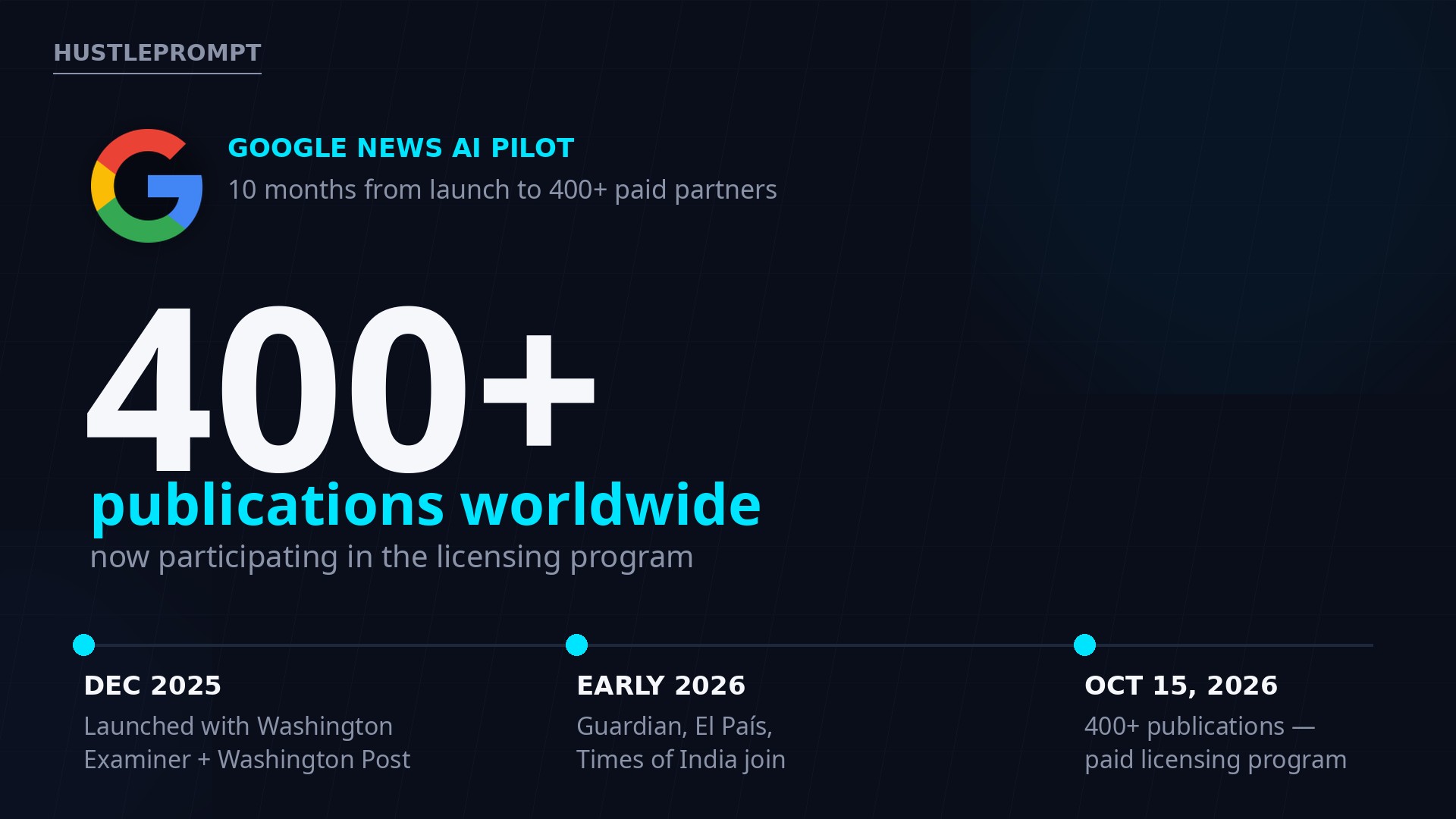
Google is now PAYING publishers for AI content. Not fighting them in court, not scraping them in the shadows — cutting them checks. On October 15, 2026, Google confirmed its News AI pilot now includes more than 400 publications worldwide, and that it is a licensing program: Google pays news outlets for their content to develop new AI features. If you run a content site, the era of “AI takes your content for free” just got a lot more complicated — in a good way.
This is the headline publishers have been waiting for. Google paying publishers for AI content at this scale is the first sign that original reporting is becoming a licensed input to AI, not just training fodder. Here is what changed, who gets paid, and how you can position your own site for a cut.
What Google Just Announced
Google published the update on its official Keyword blog on October 15, 2026. The headline facts:
| Fact | Detail |
|---|---|
| Program | News AI pilot — a licensing program |
| Launched | December 2025, with The Washington Examiner and The Washington Post |
| Scale today | “More than 400 publications worldwide are now participating” |
| Deal type | Google pays for “the delivery and use of enhanced content” |
| Built with it | Article overviews on Google News pages; customizable audio briefings |
| Terms | Not disclosed |
The key line, in Google’s own words: “Through this licensing program, we pay participating news publications for the delivery and use of enhanced content to develop new AI features.” That is procurement, not scraping — Google is buying the input.
The licensed content powers two features so far:
- In-depth article overviews on Google News publisher pages — AI context shown before a reader clicks through.
- Customizable audio briefings — AI-narrated news tuned to listener interests.
Both ship “with clear attribution and direct links,” so the publisher’s brand and the click travel with the AI experience. Early partners also included The Guardian, El País, and the Times of India, per Nieman Lab’s reporting.
The 8 New Partners — and Why the Mix Matters
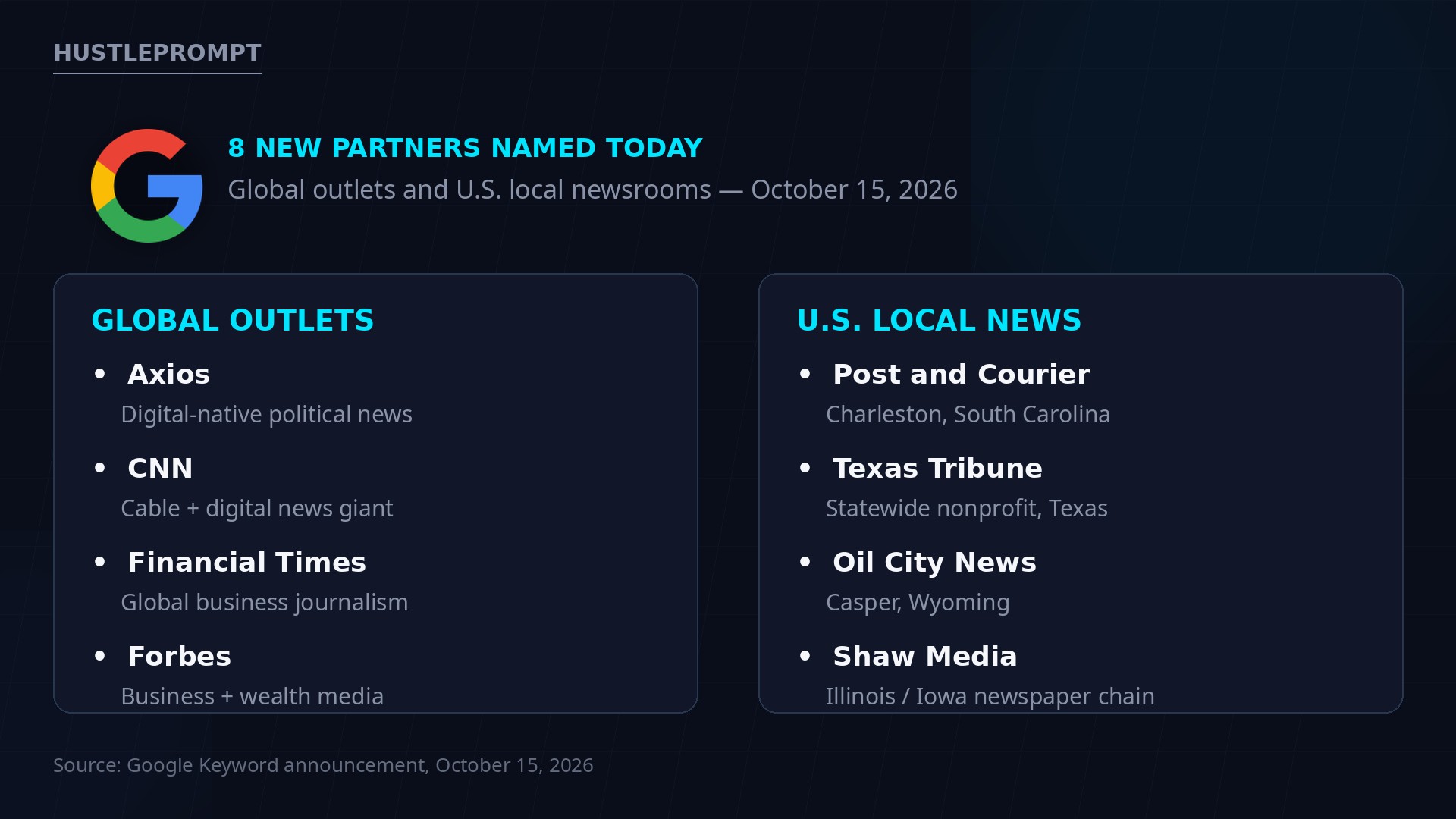
Today’s announcement named eight new partners. The split is the story: Google is pairing global giants with small U.S. local outlets.
| Outlet | Type | Why It Matters |
|---|---|---|
| Axios | Global digital | Smart-brevity format fits AI briefings |
| CNN | Global cable + digital | Deep archive of reported news |
| Financial Times | Global business | Paywalled premium journalism, now licensed |
| Forbes | Business + wealth | High-volume contributor model |
| Post and Courier | Local — Charleston, SC | Regional reporting AI can’t replicate |
| Texas Tribune | Local — Texas nonprofit | Statehouse coverage with real sources |
| Oil City News | Local — Casper, WY | Hyperlocal news, tiny newsroom |
| Shaw Media | Local — IL/IA chain | Community papers across two states |
The pattern is unmistakable: original, on-the-ground reporting. Google is licensing content only a newsroom with reporters can produce — not commodity rewrites. That is the single biggest signal for creators in this announcement.
How the Licensing Deal Actually Works
Strip away the press language and the flow is simple:
HOW THE MONEY FLOWS
1. PUBLISH
Newsroom produces original, enhanced content.
2. LICENSE
Google pays for delivery and use of that content.
3. BUILD
Google develops AI features: article overviews, audio briefings.
4. ATTRIBUTE
Features ship with clear attribution and direct links to the publisher.
One crucial nuance, per Nieman Lab: this is not pay-per-click or pay-per-use. Publishers are paid to provide content for experimental AI features — a licensing fee for the input, closer to syndication than to ad-revenue share.
What Google Pays For — and What It Doesn’t
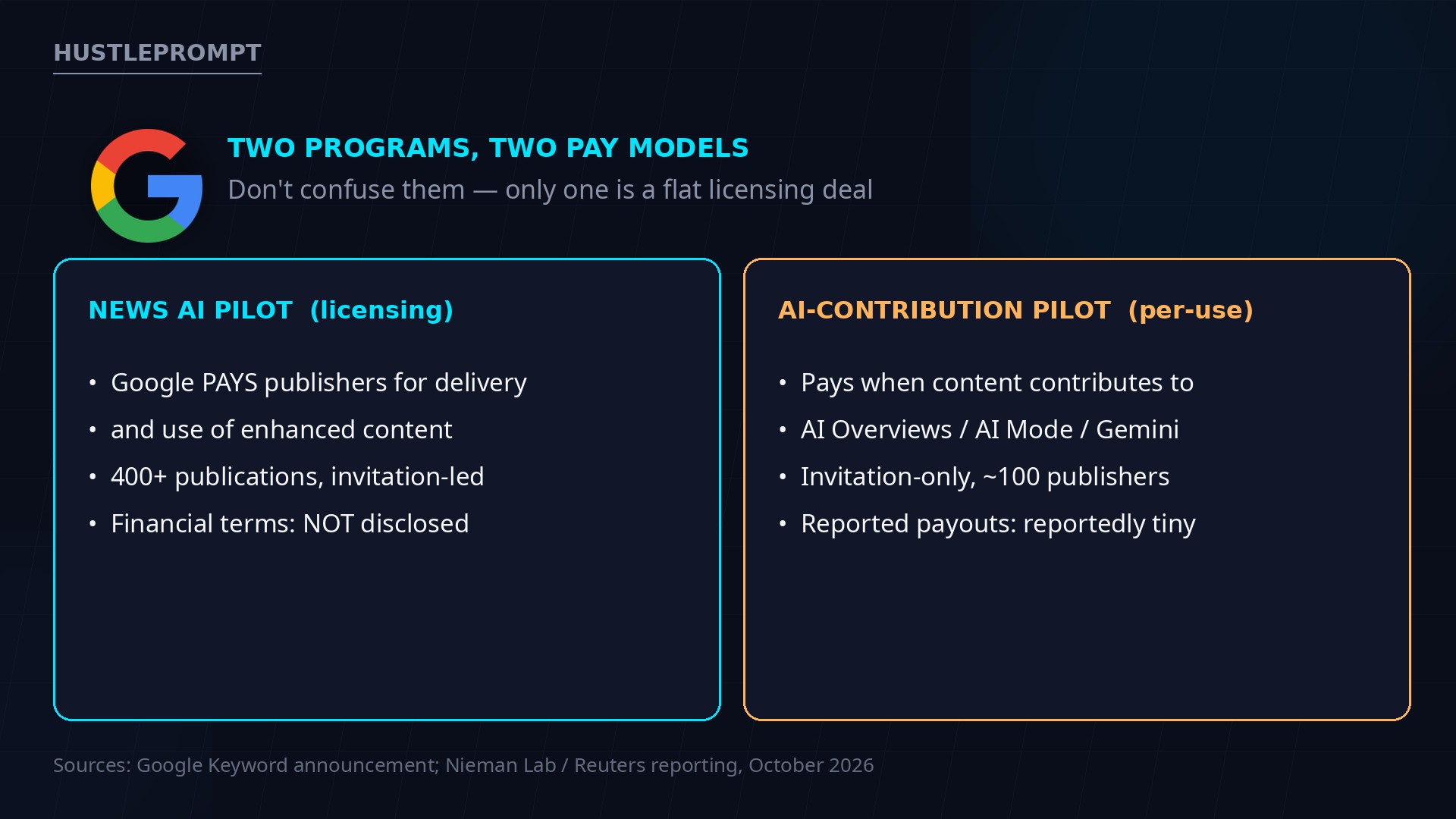
Do not confuse the News AI pilot with Google’s other publisher-payment experiment. Two programs, two completely different pay models:
| Factor | News AI Pilot (Licensing) | AI-Contribution Pilot (Per-Use) |
|---|---|---|
| Trigger | Delivering “enhanced content” to Google | Content contributing to AI Overviews, AI Mode, or Gemini |
| Publishers | 400+ worldwide | ~100, invitation-only |
| Payout | Terms not disclosed | Reportedly tiny — a fraction of a percent of ad revenue |
| Launched | December 2025 | 2026 (reported) |
Two honesty notes. First: Google has not disclosed the financial terms — Reuters’ coverage notes the same, so anyone quoting a per-article price is guessing. Second: the per-use pilot’s reported payouts are small enough that analysts treat them as symbolic. The licensing program is where the real money conversation is.
Same Day: Google Is Also Boosting Publisher Links in AI Search
The licensing news did not arrive alone. The same day, Google’s Nick Fox announced changes making publisher links more prominent inside AI Overviews and AI Mode:
- More inline links embedded directly in responses, appearing higher and more often.
- A top-of-response section highlighting the 1–2 links you need for a task or exact info.
- News carousels going global for timely topics, featuring readers’ Preferred Sources.
- Clickable publisher and creator names in video results, linking to Search profiles.
The message is clear: Google is building a two-track relationship with publishers — pay them for content, then send them traffic. The winning strategy on both tracks is the same: become a source worth citing.
How to Get Your Cut: 5 Concrete Steps
You won’t get a licensing check tomorrow. But the direction is set, and early positioning is how small publishers win these shifts.
1. Publish original reporting, not rewrites
Every partner produces content a model can’t generate: interviews, on-the-ground reporting, proprietary data. Pick a niche you can actually cover and report things that exist nowhere else online.
2. Go local — the arbitrage is real
Three of the eight new partners are tiny local operations. No national model attends a Casper city council meeting. A well-run local or niche-vertical news site is exactly the profile Google is licensing.
3. Structure your content for licensing
Google pays for “enhanced content”: clean structure, clear authorship, original media, consistent publishing. Licensed content is content that is easy to ingest.
4. Get into Google News and Preferred Sources
Both new AI features surface publisher content through Google News — and the new global news carousels explicitly highlight preferred sources.
5. Build the relationships before you need them
Both payment programs are invitation-led; there is no application form. Publish consistently for 12–18 months, build traffic and a brand, and make yourself impossible to overlook.
Frequently Asked Questions
Is Google really paying publishers for AI content now?
Yes. Google confirmed on October 15, 2026, that its News AI pilot is a licensing program paying 400+ publications for the delivery and use of their content to develop AI features.
How much does Google pay each publisher?
Terms have not been disclosed — not by Google, and not in Reuters’ coverage. Treat any specific dollar figure as speculation.
How can my site apply to the News AI pilot?
It can’t — not yet. The program is invitation-led with no public application. Build an original-reporting publication in a defensible niche, get into Google News, and become the kind of outlet Google invites.
What is the difference between Google’s two publisher-payment programs?
The News AI pilot pays a licensing fee for providing enhanced content (400+ participants, terms undisclosed). The separate AI-contribution pilot pays when your content contributes to AI Overviews, AI Mode, or Gemini (~100 publishers, invitation-only, reportedly small payouts).
Can a small blog or local news site actually get paid?
The partner list says yes: Oil City News in Casper, Wyoming, and the Texas Tribune are in. Small, original, and local beats big, generic, and rewritten.
Sources
- Google’s official Keyword announcement on the News AI pilot program
- Search Engine Roundtable’s coverage of Google’s AI Overviews and AI Mode link updates
- 9to5Google’s breakdown of the new AI search link features
- Digital Applied’s analysis of the AI-contribution pilot’s reported payouts
KEEP READING