
Microsoft just told its own employees it has beaten OpenAI at its own game — using a quarter of the computing power. On October 15, 2026, Microsoft AI announced MAI-Base-2, a mixture-of-experts foundation model with 2.8 trillion total parameters and only 80 billion active per token, and claims it outperforms every open-weight model it tested.
The announcement, published in Microsoft AI’s official Lab Notes post “Frontier Pre-training at Microsoft AI”, is the company’s clearest signal yet that it no longer wants to rent its future from OpenAI. Microsoft AI CEO Mustafa Suleyman went further in a Thursday staff town hall, saying the new model is stronger than the one currently powering OpenAI’s GPT-5.6 Sol — and that it was built with one-quarter of OpenAI’s compute.
What Microsoft actually announced
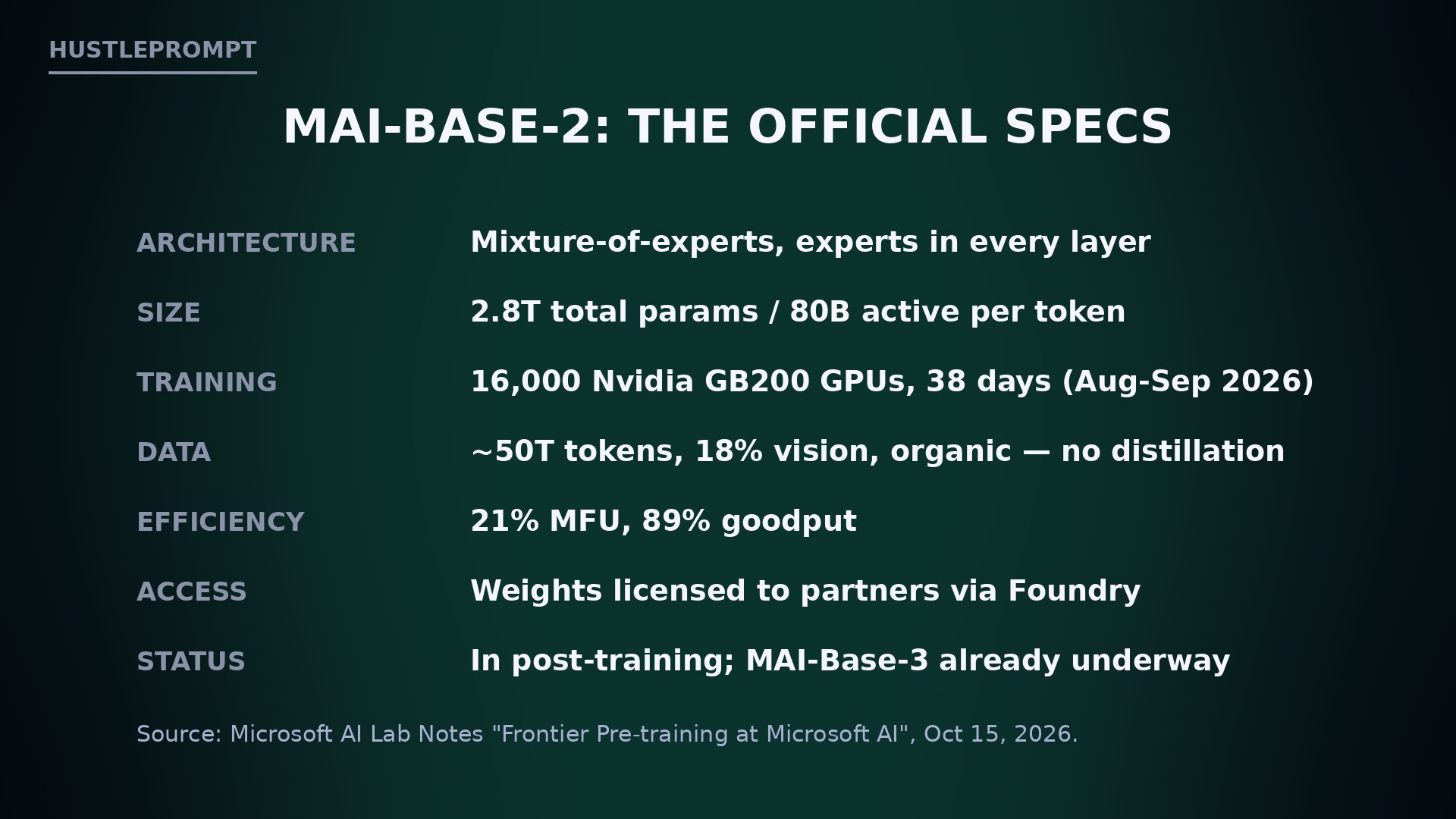
MAI-Base-2 is a base model — the raw result of pre-training, before instruction tuning and safety training. It is currently in post-training, and Microsoft says preparations for MAI-Base-3 are already underway. Here are the official specs:
| Spec | MAI-Base-2 |
|---|---|
| Architecture | Mixture-of-experts, experts in every layer |
| Parameters | 2.8 trillion total / 80 billion active per token |
| Training hardware | 16,000 Nvidia GB200 GPUs, 38 days (Aug–Sep 2026) |
| Training data | ~50 trillion tokens; 18% vision-language; organic data, no distillation |
| Knowledge cutoff | March 2026 |
| Utilization | 21% MFU (model FLOPs utilization), 89% goodput |
| Planned access | Weights licensed to trusted partners via Foundry |
| Status | In post-training; no release date or pricing announced |
The efficiency numbers — and why they matter
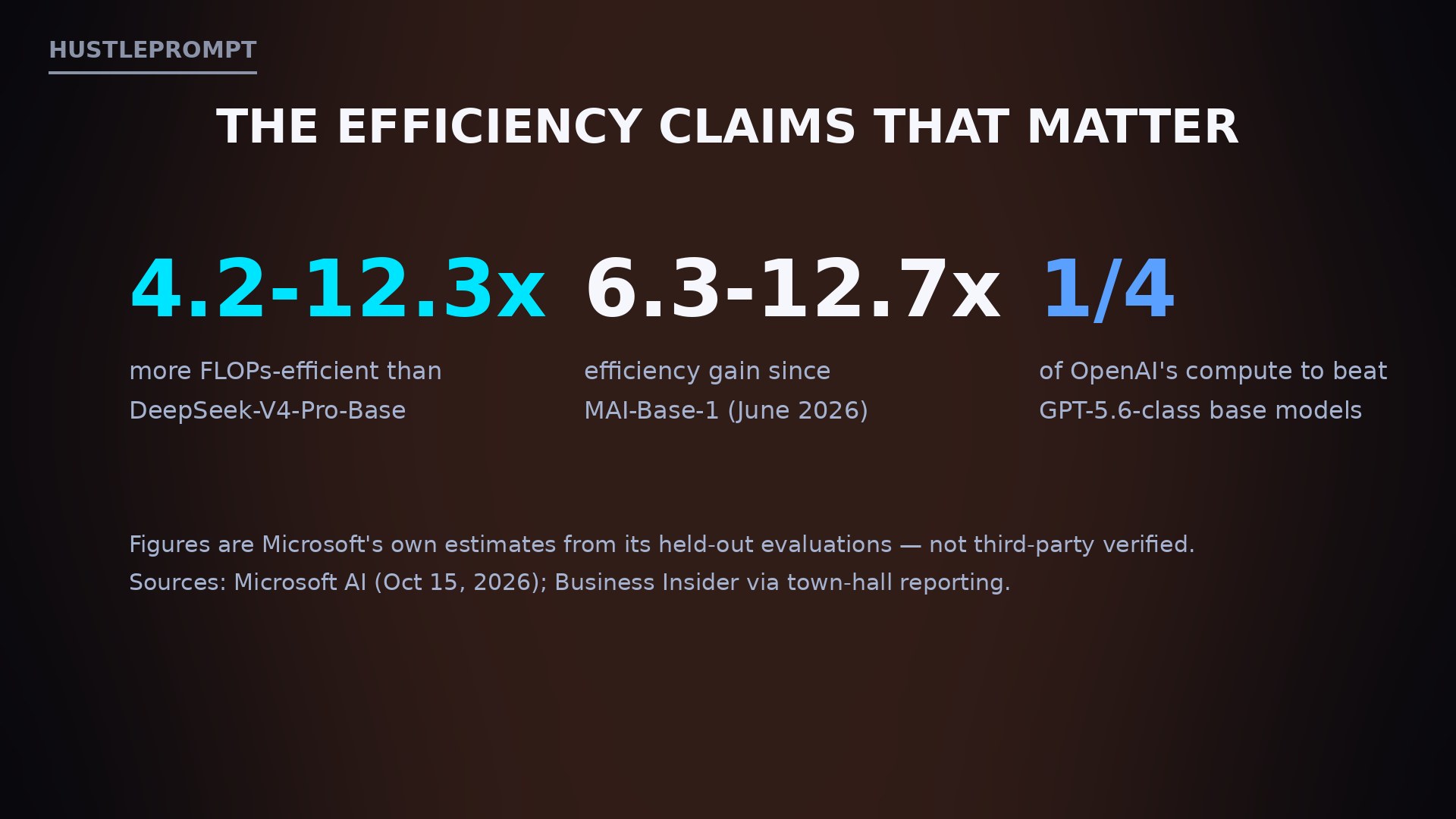
The headline isn’t the size. It’s the compute efficiency. Microsoft says MAI-Base-2 is 4.2 to 12.3 times more pre-training FLOPs-efficient than DeepSeek-V4-Pro-Base, the strongest open base model, and 6.3 to 12.7 times more efficient than its own MAI-Base-1 from June 2026. Microsoft says it poured the savings into training a bigger model.
How the claims stack up:
| Claim | Number | Source |
|---|---|---|
| FLOPs-efficiency vs DeepSeek-V4-Pro-Base | 4.2–12.3x | Microsoft AI (own evals) |
| Efficiency gain since MAI-Base-1 | 6.3–12.7x | Microsoft AI (own evals) |
| Compute vs OpenAI’s GPT-5.6-class model | 1/4 | Suleyman town hall (Business Insider) |
| Compute vs DeepSeek training | 12x less | Suleyman town hall (Business Insider) |
Suleyman’s town-hall message, as reported by Business Insider: “We now have a stronger pre-trained base model than the model that currently powers GPT 5.6 Sol. And in fact, we used one-quarter of the compute that OpenAI used to train their model.”
Important context: these are Microsoft’s own estimates from its own held-out evaluations (bits-per-byte, tokenizer-agnostic). No third party has independently replicated the performance or efficiency claims.
Why Microsoft is quietly breaking up with OpenAI
Microsoft has invested billions in OpenAI and its stake is likely worth more than $100 billion. Yet it is now publicly comparing its own model favorably against OpenAI’s flagship — using technical information it holds confidentially as OpenAI’s partner.
The strategy is written into the announcement: owning the pipeline end-to-end means “strong data provenance,” no distillation from other models, and the ability to license model weights to trusted enterprise partners through Foundry. That is a direct pitch to enterprises that want frontier intelligence without depending on OpenAI — or on OpenAI’s pricing.
For anyone building an AI business, the takeaway is structural: cheaper training compute means cheaper inference, and Microsoft is positioning Foundry as the low-cost, legally-clean intelligence source for enterprises.
How to profit from the efficiency race
Compute efficiency is a margin story. Every 2x efficiency gain roughly halves the cost of serving a token — and margins are where AI businesses live or die. Five concrete plays:
- Sell the efficiency arbitrage. Build your product to swap models as cheaper intelligence lands. When Foundry licensing opens, you can undercut competitors locked into expensive per-token contracts.
- Position for Foundry licensing. Microsoft explicitly wants trusted partners for its weights. Enterprise integrators who can deploy and tune MAI models for regulated industries will be first in line for deals.
- Offer GPU-cost optimization. Microsoft published real techniques — dropless MoE, Muon optimizer, source scaling, activation gradient clipping. A consultancy that brings these to mid-size labs can cut real training bills.
- Sell “clean data” services. Microsoft’s moat claim is organic, provenance-tracked data with no distillation. Data curation and decontamination services are about to get very billable.
- Go multi-model now. The Microsoft–OpenAI wedge means single-vendor architectures are fragile. Abstraction layers that route between models by cost and quality are a product people will pay for.
The MAI-Base-2 profit playbook: 4 steps
1. Study
Read Microsoft’s published efficiency techniques — they’re free and detailed.
2. Cut costs
Apply MoE co-design and data-source scaling to shrink your own GPU bills.
3. Position
Build multi-model architectures ready for Foundry licensing when it opens.
4. Sell
Offer the arbitrage to enterprises: same intelligence, lower token COGS.
What MAI-Base-2 can’t do (yet)
Keep the hype in check. This is a base model in post-training, not a chatbot you can try today. There is no release date, no pricing, and no public weights. The comparison to OpenAI’s models was a private internal test, not an independent benchmark. And all efficiency figures are Microsoft’s own — impressive if true, but unverified.
Frequently asked questions
What is Microsoft MAI-Base-2?
MAI-Base-2 is Microsoft AI’s new mixture-of-experts foundation model with 80 billion active and 2.8 trillion total parameters. It completed pre-training in September 2026 and was announced on October 15, 2026.
When can I use MAI-Base-2?
Not yet. It is undergoing post-training, and Microsoft has not announced a release date. Access will come through weight licensing to trusted partners via Foundry, not as a public API on day one.
Is MAI-Base-2 better than GPT-5.6?
Microsoft AI CEO Mustafa Suleyman told employees it outperforms the model powering GPT-5.6 Sol on internal tests using one-quarter of OpenAI’s compute. That comparison has not been independently verified.
Is MAI-Base-2 open source?
No. Microsoft plans to license the weights to trusted partners through Foundry. That is more open than a pure API but far from an open-weights release.
How did Microsoft train it so efficiently?
Three pillars: scaling science (source scaling for repeated data), model-infrastructure co-design (MoE in every layer, Muon optimizer, dropless MoE), and scaled data pipelines with native vision training from the start.
What does this mean for AI business costs?
Training efficiency flows downstream into inference costs. If Microsoft’s 4–12x efficiency claims hold, Foundry-licensed models could materially lower per-token costs for enterprises — which is exactly the arbitrage builders should watch.
Keep Reading