
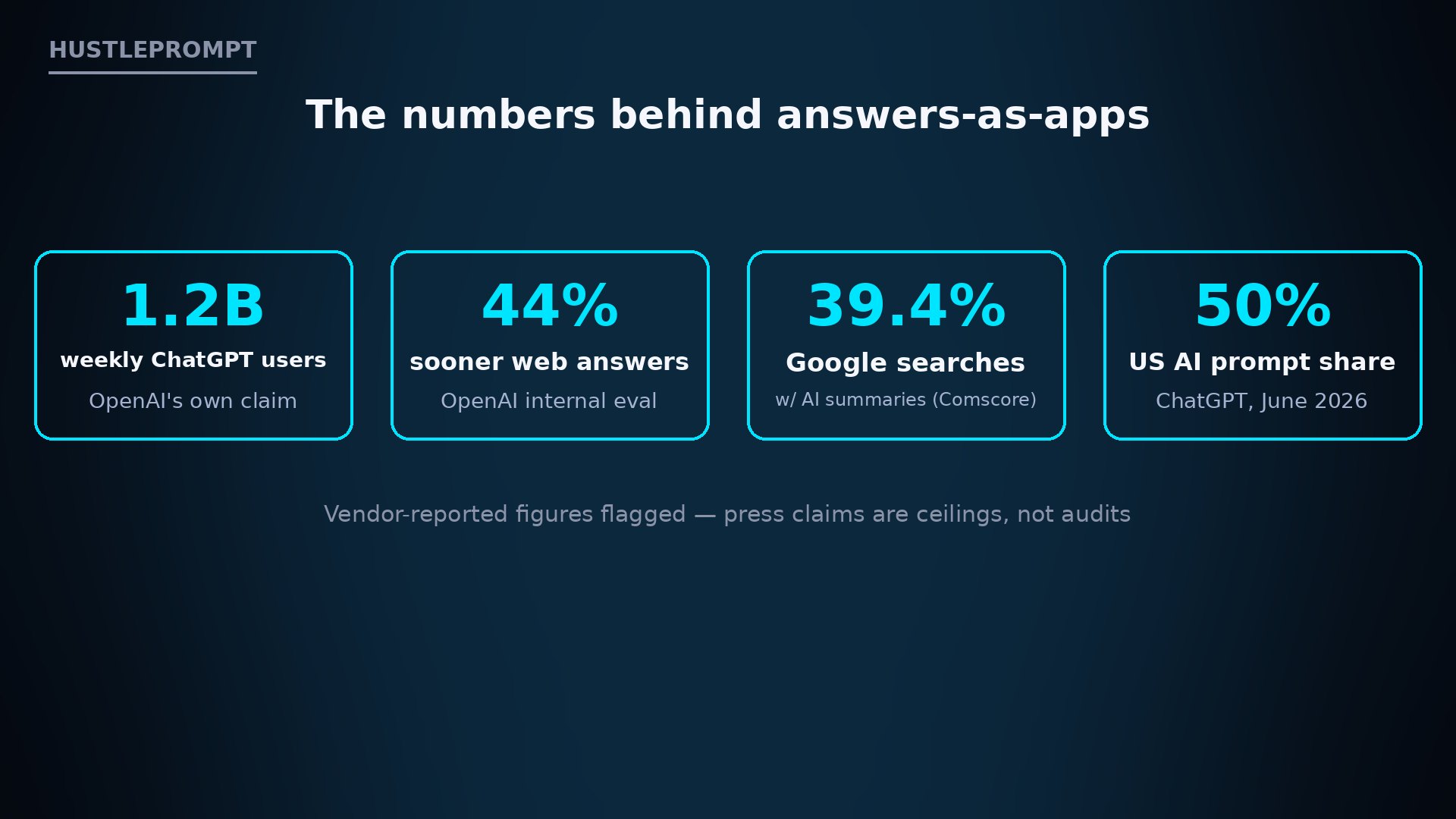
The chat bubble had a good run — a decade of rounded rectangles and typing dots. On October 7, 2026, OpenAI quietly ended the era: ChatGPT’s answers now arrive as working interfaces for what OpenAI says are more than 1.2 billion weekly users (unaudited company figure). Ask about a Sunday roast and you get a timeline beside the recipe. Ask about retirement and you get a calculator you can operate, right inside the chat.
OpenAI calls it “Intelligent UI” — and it means the answer is becoming the app.
What OpenAI actually launched on October 7
OpenAI’s announcement, “GPT-6 and Intelligent UI for everyone,” lets ChatGPT compose responses from text, visuals, and interactive elements — graphics, tappable buttons, forms, charts, diagrams — with the mix chosen per question. Plain text still appears when it fits best; otherwise:
- Comparisons render side by side, not in paragraphs.
- Explanations become interactive diagrams — a TechCrunch demo showed the model diagramming airplane-wing lift.
- Plans get visual structure: recipe timing beside the steps, road-trip stops on a map.
- Tools get built on request: a savings calculator, a bill splitter, a small game.
Under the hood: a library of native, streamable components plus a compiler that renders the interface progressively as the model generates it. GPT-6 judges its own interfaces for clarity and usefulness — while OpenAI admits “there’s still work ahead” on design judgment. And GPT-6 can begin answering while it keeps thinking: OpenAI says GPT-6 Instant starts web-search answers 44% sooner than GPT-5.6 Instant (an internal time-to-first-token evaluation).
The rollout, as OpenAI reported it (OpenAI, MacRumors):
- October 7: Plus, Pro, Business, Enterprise get GPT-6 Sol with Intelligent UI
- October 8: Free and Go tiers follow with GPT-6 Luna
- Exceptions: the Pro reasoning option (GPT-6 Astra) does not get it; Chat tab only — Work and Codex unchanged
It is not just OpenAI — everyone is building this
| Player | Move | When | Source |
|---|---|---|---|
| Generative UI research — custom interfaces for Gemini and Search | Nov 2025 | Blockster | |
| Anthropic | Claude Dashboards + Motion — live dashboards on company data, handoff to Adobe | ~Oct 9, 2026 | The Neuron |
| OpenAI | Intelligent UI for all ChatGPT tiers | Oct 7, 2026 | OpenAI |
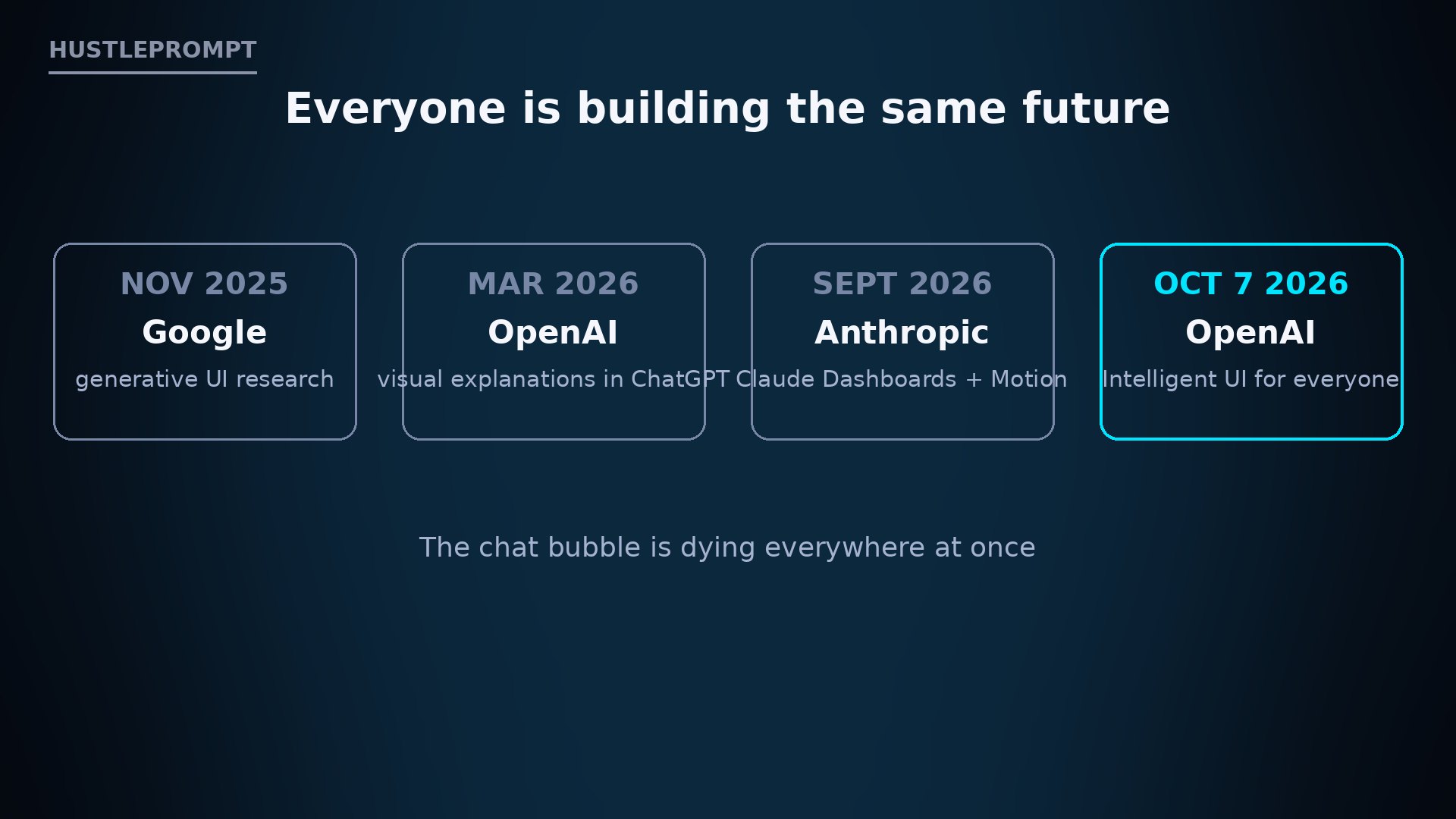
The Neuron’s summary: “Everybody suddenly wants to own the last mile between ‘AI answered me’ and ‘I can actually use this.'” Structural — not a single launch.
Why the chat bubble was always going to die
Retention economics. An interactive answer keeps the user inside ChatGPT; a wall of text sends them elsewhere. Every generated interface is one more reason not to leave — and one more surface for the Sponsored Agent ads OpenAI is already testing (ContentGrip).
A share war. Comscore’s Q2 2026 report shows ChatGPT’s US prompt share fell from 70% to 50% in H1 2026, while Gemini rose 17%→30% and Claude 2%→11%. When answers commoditize, experience is the moat.
Agentic commerce needs buttons. Answers are starting to sell directly: OpenAI + Stripe’s Agentic Commerce Protocol powers ChatGPT Instant Checkout; Google has its Agent Payments Protocol (AP2). Transactions need interfaces — pickers, payment buttons, order summaries. The answer and the checkout are converging.
The old answer vs. the new answer
1. You ask
“Compare two lenders” or “plan my roast”
2. GPT-6 picks the format
Side-by-side table, diagram, calculator, map — or plain text when that fits
3. The interface compiles live
Streamable components render progressively as the model writes
4. You act inside the answer
Tap, adjust, calculate, buy — no second app needed
OpenAI’s endgame: “software will adapt to people.”
What this does to websites (and SEO)
If the assistant generates the interface on demand, the website’s role shrinks from destination to data source. Dentsu’s 2026 search predictions: “Search without websites may become a reality in 2026” — transactions completing inside chat interfaces, with sites surviving as authoritative sources for feeds and assets. Analyst Malcolm Figures predicts 10% of search results may be entirely AI-generated by end of 2026.
The survival question, as AI Idealis framed it: if an AI assistant can generate simple interfaces on demand, what makes a standalone tool worth visiting? Four things interfaces can’t replace:
- Unique data: prices, inventory, bookings, files — the inputs the interface is built from.
- Transactions that finish on your rails, even if they start in chat.
- Trust and identity: reviews, community, credentials.
- Machine-readability: Crystal Carter (Wix) told Search Engine Land “the future of AI search is optimizing for the AI agents.” If your product data isn’t machine-readable in real time, agents skip you.
How to Profit From Answers-as-Apps
When every answer becomes an app, the money moves to whoever feeds the apps with data and whoever builds on top of them:
1. “Answer-ready” content retainers
Most business sites are unreadable to the answer layer: prices in images, specs in PDFs, no structured data. Sell answer-compatible rebuilds — schema, comparison tables, real-time feeds, citation-ready FAQs — at $1,500–$4,000 setup plus $500–$1,500/month.
2. Agentic-commerce feed setup for stores
ChatGPT Instant Checkout and Google’s AP2 reward machine-readable catalogs; most Shopify and WooCommerce stores aren’t ready. A one-time $750–$2,500 per store package: feed audit, structured product data, checkout-path testing inside the assistants.
3. Interactive lead magnets as a service
The calculators businesses hosted on their sites are being regenerated inside every chat. Sell the premium version: branded embeddable widgets with data capture and CRM integration. $500–$2,000 per widget, plus monthly hosting.
4. Get cited inside the interface
Interactive answers still need sources — and a brand cited inside a working calculator beats a blue link. Publish the original data assistants build from: benchmarks, pricing studies, teardowns. The GEO gold rush, extended: the citation is now the storefront.
| Play | Pricing to aim for | Why it works now |
|---|---|---|
| Answer-ready retainer | $1.5k–$4k setup + $500–$1.5k/mo | Agents skip unreadable sites; compliance is the gate |
| Agentic-commerce feed setup | $750–$2,500 per store | Instant Checkout surfaces readable catalogs first |
| Interactive lead magnets | $500–$2,000 per widget | Chat widgets can’t capture leads or carry branding |
| Original data for citations | Traffic + affiliate upside | Interfaces need sources; unique data can’t be generated |
What to do now
- Try it this week. GPT-6 Luna is on the free tier — ask for a bill splitter, a comparison, an interactive explanation. Note where the model fumbles.
- Audit one site for answer-readiness. Could an AI rebuild its key pages as interactive tools from your content? If not, your data is invisible to the answer layer.
- Sell one pilot, not a platform. Offer one local business the feed-setup or answer-ready package on a 30-day trial. One receipt beats a pitch deck.
- Learn prompt-to-UI steering. Early testers report that Custom Instructions and explicitly naming the layout reliably steer the format — a billable micro-skill.
- Build for the agent layer. Structured pricing, real-time availability, product feeds — the 2027 interfaces are built from this, not homepage copy.
Where this is heading: three predictions
1. Pure-text chatbots become a legacy mode. By mid-2027, the default answer from every major assistant is a hybrid interface. The chat bubble becomes the fallback — like the command line under the GUI.
2. Sponsored interactive answers become the ad unit. OpenAI is already testing Sponsored Agent ads inside ChatGPT. Expect “sponsored calculators” with their own CPM economics — and new ad-tech built around answer inventory.
3. “Answer compatibility” becomes a service category. Audits, schema, feed optimization, agent-readable pricing — the 2027 equivalent of SEO in 2005. Early movers set the pricing.
Watch
Keep Reading
- The GEO Gold Rush: Getting Cited in ChatGPT Beats SEO
- Enterprises Are Buying AI Agents, Not AI Tools
- The AI Orchestrator: Why Freelancers Now Earn 34% More
FAQ
What is ChatGPT’s Intelligent UI?
A GPT-6 capability, announced October 7, 2026: ChatGPT answers with interactive interfaces — charts, diagrams, buttons, forms, calculators, maps — instead of only text. The model chooses the format per question.
Is it available on the free plan?
Yes. Paid tiers got it October 7 (GPT-6 Sol); Free and Go followed October 8 (GPT-6 Luna). The Pro reasoning option (GPT-6 Astra) does not support it; Chat tab only.
Are chatbots really dying?
The bubble isn’t disappearing — it’s becoming the fallback. Answers turn into working interfaces; plain text stays for simple questions. Command line under the GUI, not extinction.
Will this kill my website’s traffic?
It changes what your site is for. Transactions increasingly complete inside chat interfaces; websites become authoritative data sources. Sites with unique, machine-readable data — prices, inventory, original research — become more valuable, because the interfaces are built from them.
How can a freelancer profit?
Make client sites “answer-ready” ($1,500–$4,000 setup + retainers); set up agentic-commerce feeds ($750–$2,500 per store); sell branded interactive lead magnets ($500–$2,000 each); publish original data that gets cited inside AI-generated interfaces.
What are the limits right now?
OpenAI admits design judgment still needs work, the full system isn’t a public API, and early users report it doesn’t activate on all effort levels. A ChatGPT capability, not a developer platform — yet.