
Freelancers who use AI earn 34% more per hour. Freelancers selling simple AI-generated output just watched rates fall 13% in a year. Same dataset. That contradiction is the story of work in 2026.
AI is not killing freelancing. It is splitting it in two. One tier is being commoditized at machine speed. The other — people who connect AI tools to real expertise and own the outcome — commands a growing premium. Upwork’s researchers named it: the AI Orchestrator.
The split, in one dataset
The evidence: Upwork’s Future Workforce Index 2026 — a survey of 2,400 U.S. skilled knowledge workers plus marketplace transaction data. Now 38% of skilled U.S. knowledge workers freelance (up from 28%), and 58% of full-time employees are considering it (up from 36%).
Complex AI work: earnings up 45% year-over-year. AI-augmented professional services: volume up 72%, earnings up 22%. But simple generative production saw 90% more contract starts with 13% lower per-contract rates. More demand, less money per job — that is commoditization.
Source: Upwork Future Workforce Index 2026 (survey + marketplace data)
What an “AI Orchestrator” actually is
An AI Orchestrator connects AI tools to domain expertise, applies judgment, and turns AI execution into business outcomes. Not someone who prompts ChatGPT — someone who takes a messy business problem, picks the right tools, builds the workflow, verifies outputs, and answers to a decision-maker.
As Jennifer Brett of the Upwork Research Institute puts it: “As AI agents continue to proliferate, the advantage for talent will come from becoming an AI Orchestrator, someone that can direct, integrate, and be accountable for agents across complex workflows.”
The keyword is accountable. Anyone can generate output now. Almost nobody wants to sign their name under it. The orchestrator stands behind the machine’s work — and that is exactly what clients pay the premium for.
- Generic AI writing
- Unedited AI drafts
- Basic data entry
- Prompt-and-paste output
- AI-augmented services
- AI workflow design + QA
- Agent implementation
- Judgment + accountability
Why this is happening now
First, tool abundance: when everyone can generate a blog post in seconds, the output becomes worthless. Only the judgment about what to generate — and whether it is any good — keeps its value.
Second, the implementation gap. Fiverr’s 2026 Business Trends Index — millions of searches, November 2025 to April 2026 — shows companies racing to hire freelancers who bridge the gap between experimenting with AI and running on it. “Freelancers are bridging the gap between businesses that experiment with AI and those that are meaningfully adopting it,” said Elliott Johnson, founder of EKB Labs and an AI consultant on Fiverr.
Source: Fiverr Business Trends Index, June 2026. Full report.
Source: Fiverr Business Trends Index 2026 — fiverr.com/news
Third, agents changed the leverage math. Stanford economist Nick Bloom’s read: AI’s value concentrates in complex work where people layer expertise, judgment, and business context on top of AI. Direct agents across a workflow and the person with the judgment to direct them becomes the bottleneck — and bottlenecks get paid.
The solo studio is now real
Stack Overflow’s 2026 Developer Survey — 30,903 responses, 169 countries — found “company of one” developers jumped from 4% to 10% in one year: AI lets single workers handle tasks outside their expertise. Only 22% are happy in their job.
The economics are striking. FirstPageSage’s October 2026 data: solo operators run 1.3 agents at $29 per seat monthly, ChatGPT Agent at 38.4% share among businesses under 20 people. Enterprises: 4.6 agents at $82 per seat.
Source: FirstPageSage, Top AI Agents by Market Share — October 2026
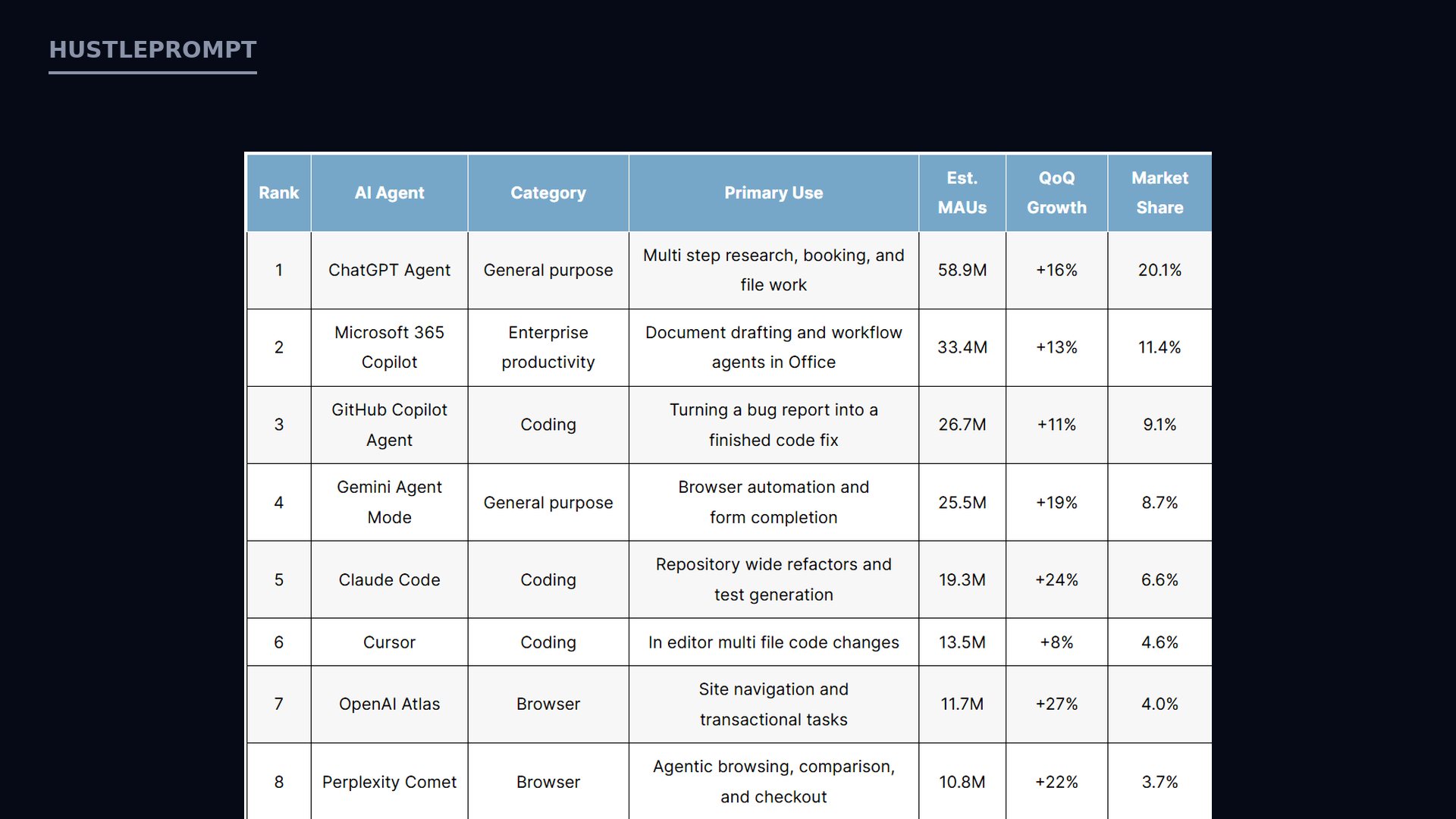
Source: FirstPageSage, Top AI Agents by Market Share, Oct 2026

Source: Stack Overflow Developer Survey 2026 — survey.stackoverflow.co
Five money plays for the Orchestrator era
Five ways to position on the premium side. The data proves the demand — you set the rates.
1. Ride the +938% wave: Claude Code implementation for small businesses
Businesses want agents built, not tools explained. Pick one repeatable pain and solve it with Claude Code.
- Learn it on a personal project, then sell a two-week “agent pilot”: one live workflow plus a handover doc.
- Pitch with the Fiverr demand data — it proves the market so you don’t have to.
2. AI-augment the profession you already have
AI-augmented professional services: +72% volume, +22% earnings — the reverse of the commoditized tier.
- List your three most-sold services; attach an AI layer to each: research, drafting, QA.
- Rewrite every offer around the outcome instead of the hours.
3. Productize AI worker setups
Voice agents (+49%), n8n (+125%), AI video pipelines (+265%): businesses want them installed, not taught.
- Build one end-to-end template for a single niche; sell it as a fixed-scope install.
- Document every build so each new client costs less to serve.
4. Run the company-of-one studio
One expert, a couple of agents, no payroll. At $29 per seat, infrastructure is trivial — judgment is the constraint.
- Pick a narrow niche you know; standardize two or three agent-assisted workflows.
- Sell outcomes and retainers, never hours — hours compete with the −13% tier.
5. Sell the verification layer
AI UGC video ads are up 265% — and human video editing is up 36% alongside. Every AI output stream creates a market for verification. Make accountability the product.
- Offer “AI output audit and polish” packages; specialize in one content type’s failure modes.
- You sign off, they sleep well — the orchestrator premium in its purest form.
What to do this week
- Pick your stack. Choose one agent above — ChatGPT Agent or Claude Code for most solo operators — and commit for 30 days.
- Document one workflow. Write a client task step by step; rebuild it with the agent executing, you deciding.
- Rewrite one offer. Hours to outcomes: “an AI follow-up system that answers every lead in 5 minutes.”
- Publish one proof. Post a before-and-after where your buyers hang out.
- Schedule an orchestration hour. One hour a week on a new agent capability.
Where this is heading
The premium gap widens first. Complex AI work +45% year-over-year; simple output rates −13%. Expect the spread to keep growing through 2027.
“AI Orchestrator” becomes a job title — a searchable marketplace category within a year. Claim the label now; the positioning is free.
The solo studio becomes the default small agency. At $29 per seat, one expert delivers what used to need a team. The company-of-one share climbs past 10%.
Accountability becomes the billable unit. The scarce resource is someone who stands behind the machine’s work. Freelancers selling verified outcomes inherit the premium tier.
Watch
FAQ
Is freelancing dead because of AI?
No — it is growing and splitting. Skilled freelancers rose 28%→38% of U.S. knowledge workers in a year; 58% of employees consider the jump. Undifferentiated output is dying. Judgment-heavy work thrives.
What exactly is an AI Orchestrator?
A professional who connects AI tools to domain expertise, applies judgment, and turns AI execution into business outcomes — while staying accountable. Conductor, not instrumentalist: you direct the agents and sign off on what they produce.
Which skills are actually safe?
Where judgment is the bottleneck: diagnosis, workflow design, verification, accountability, domain expertise + AI fluency. Complex AI work: +45%. Simple production: −13%.
Do I need to learn to code?
Not necessarily — big demand is no-code: n8n (+125%), voice agents (+49%), video pipelines (+265%). But the +938% Claude Code surge is the hottest signal — if you code, ride it.
How do I start with no audience?
Go where buyers search. Fiverr shows what businesses type in: Claude Code specialists, n8n automation, voice agents. Productize one fixed-scope offer around a surging term.
Is the 34% premium real, or just survivorship bias?
It is measured: a 2,400-person survey plus marketplace transaction data, with AI jobs classified by an LLM pipeline. Freelancers doing AI work earn 34% more per hour — same platform, same period.