
Overnight, three model IDs appeared in OpenAI’s developer API that no one had ever seen: aurora-red-alpha, aurora-green-alpha, and aurora-blue-alpha. By morning they were gone — pulled as if they had never existed. The aurora models leak has researchers asking one question: is GPT-Image-3 about to drop?
This is a real sighting with independent corroboration — and a total information vacuum from OpenAI. Everything beyond the raw observations is speculation, labeled as such. Here is what happened on October 18, 2026.
What actually happened
AI researcher Lisan al Gaib (posting as @scaling01 on X) flagged three unfamiliar model IDs in OpenAI’s developer API. TestingCatalog and other AI watchers amplified the find within hours — then the IDs were removed. The confirmed facts:
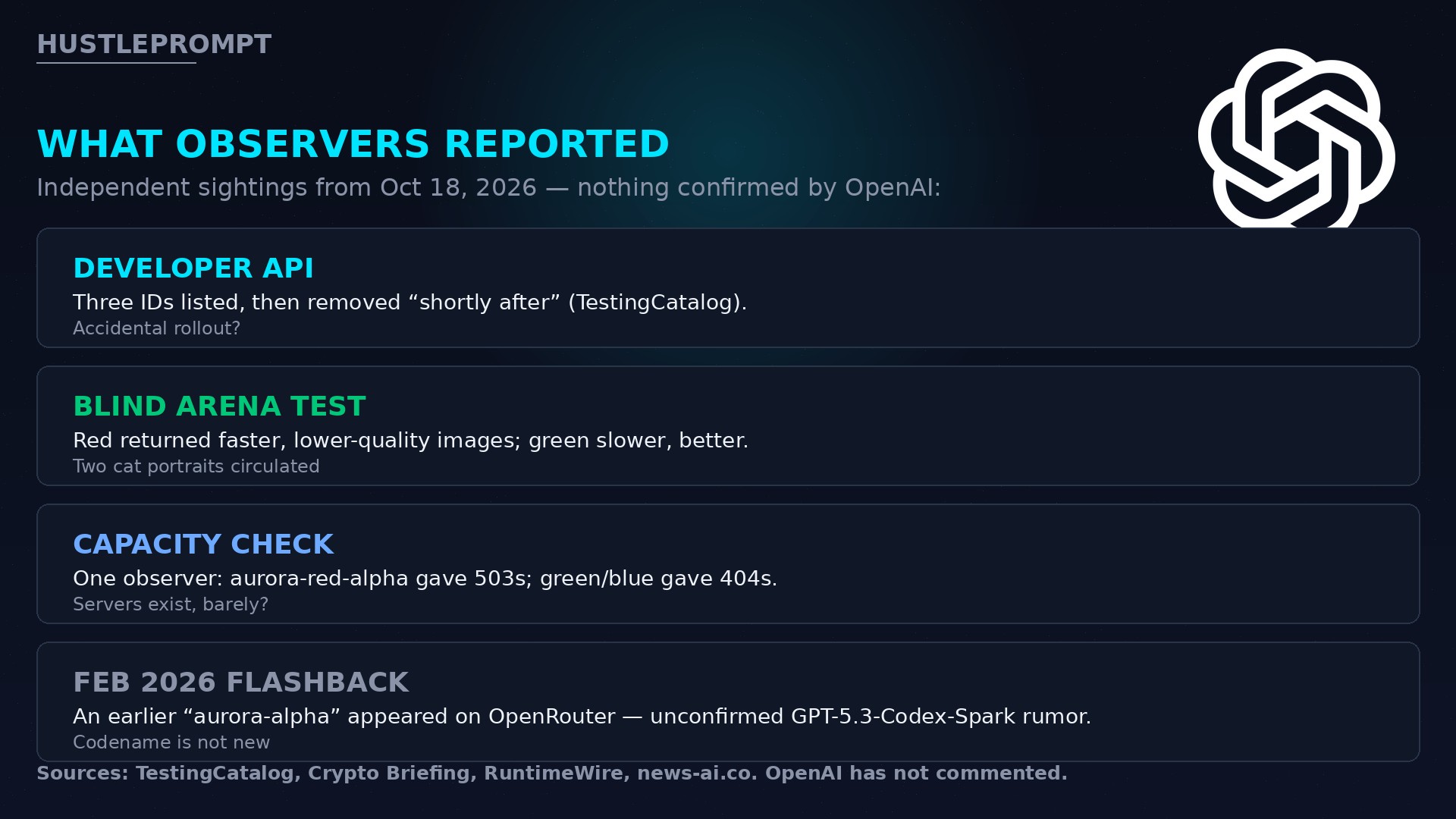
- Three new model IDs were listed in OpenAI’s API on Oct 18, 2026, then removed — consistent with an accidental rollout, per TestingCatalog’s coverage.
- OpenAI has said nothing. No announcement, changelog, documentation, or pricing — nothing on OpenAI’s news page.
- The codename is not new. An earlier “aurora-alpha” surfaced on OpenRouter in February 2026 — RuntimeWire’s breakdown notes the unconfirmed speculation tying it to a GPT-5.3-Codex-Spark variant.
What observers actually saw
The strongest corroboration came from blind arena tests — the same three names appeared in image-generation matchups within hours. news-ai.co’s roundup describes two circulating cat portraits, with observers comparing speed and quality across variants.
Evidence snapshot
TestingCatalog reported the IDs were “removed shortly after” appearing — the hallmark of an accidental rollout.
The arena tests showed a clean speed-vs-quality split: red ran faster with rougher output, green slower with more polish — textbook pre-launch variant testing.
Is this GPT-Image-3? Honest answer: unconfirmed
Independent observers — including Lumina Bench and TestingCatalog — speculate these models may be GPT-Image-3. The logic: the arena comparisons were image tests, and OpenAI’s current image model is due for a successor. But OpenAI has announced nothing, and no one has confirmed the connection.
- The three variants look like A/B testing. A fast/rough variant, a slow/polished variant, and an untested control is textbook pre-launch experimentation.
- Nothing is priced or named. Until OpenAI publishes a system card or changelog, “GPT-Image-3” is an educated guess — not a fact.
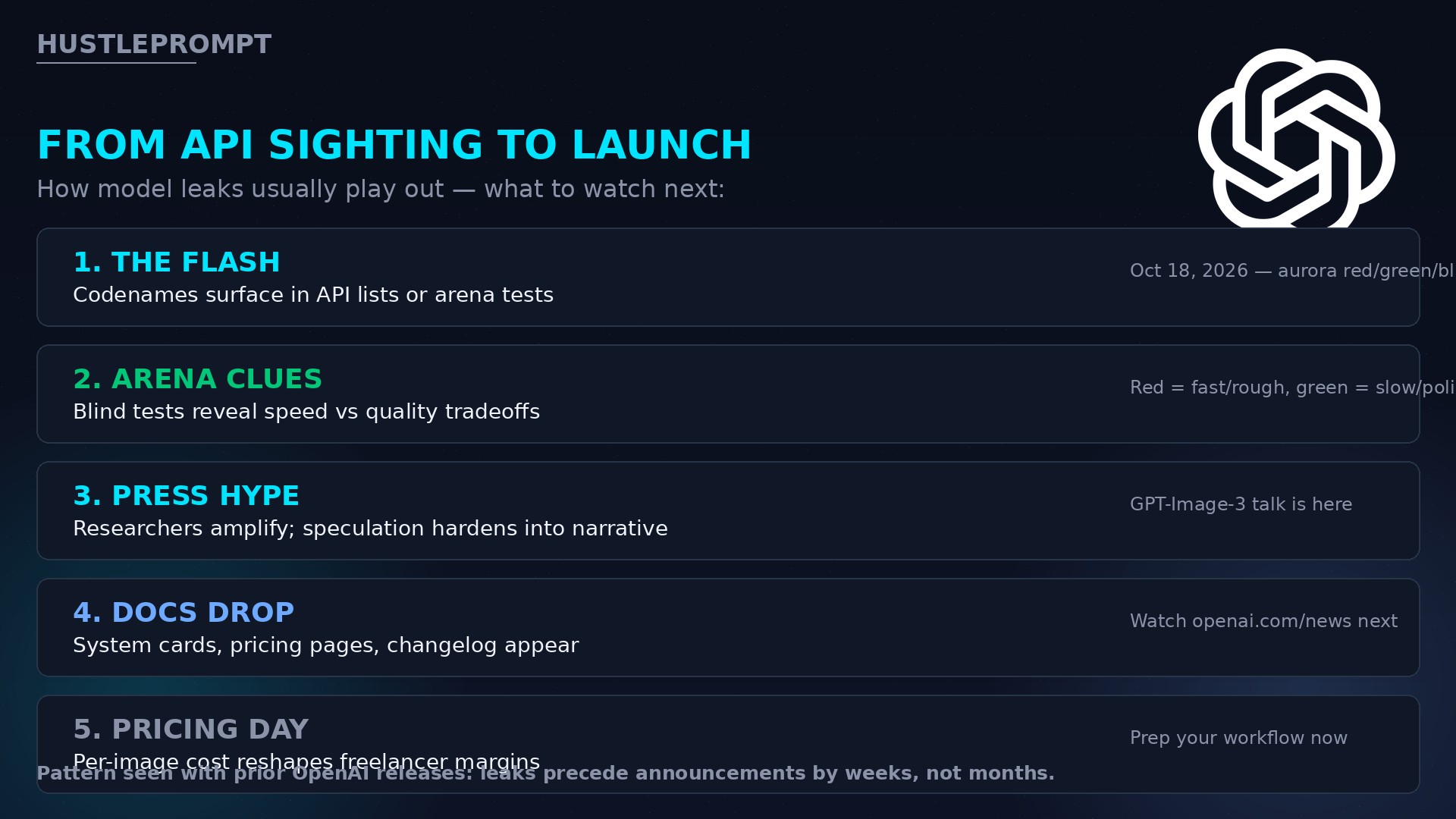
From API sighting to launch: what to watch next
From API sighting to launch: how model leaks usually play out
The aurora codenames are at step one. Watch what comes next:
How to position yourself before a new image model drops
Every new image model resets costs, quality bars, and client expectations overnight. First movers capture the premium. Five moves to make this week:
- Watch the two early signals. Check the LMArena leaderboards and OpenAI’s developer changelog each morning — arena codenames precede announcements by weeks.
- Prep your pipeline on GPT-Image-1 today. Build mockups, ad creatives, and thumbnail workflows on the current model now. When the new model lands, you swap the engine — not rebuild the business.
- Reprice with a cost buffer. New models launch at new price points. Quote retainers with a “model-upgrade clause” so a price change does not eat your margin.
- Draft a “day-one demo” offer. The first 48 hours after launch is when clients pay most for a walkthrough. Prepare a short explainer and before/after samples now; customize on launch day.
- Track the official trail, not the hype. Confirmations hit OpenAI’s news page and the API changelog first — not rumor threads. Build offers on confirmed pricing, not codenames.
Current baseline: what “aurora” has to beat
While the speculation plays out, OpenAI’s official channel shows what today’s models can do — watch below.
Frequently asked questions
What are the aurora model IDs?
Three unannounced OpenAI model IDs — aurora-red-alpha, aurora-green-alpha, and aurora-blue-alpha — briefly appeared in the API on October 18, 2026, then were removed. OpenAI has not commented.
Is this GPT-Image-3?
That is the leading speculation — raised by Lumina Bench and TestingCatalog — but it is unconfirmed. The guess rests on the models behaving like image generators in blind arena tests.
What did the arena tests show?
Two cat portraits circulated from blind tests. Observers said aurora-red-alpha returned images faster but at lower quality; aurora-green-alpha was slower with better results. aurora-blue-alpha produced no public results.
What was the February 2026 “aurora-alpha”?
An earlier codename that appeared on OpenRouter in February 2026, with unconfirmed speculation linking it to a GPT-5.3-Codex-Spark variant. OpenAI never acknowledged it.
How should creators prepare?
Build workflows on the current model now, reprice packages with a cost buffer, draft a day-one demo offer, and watch official sources (openai.com/news, the API changelog) rather than rumor threads.
When will we know more?
Past OpenAI leaks have turned into announcements within weeks. Watch for system cards, pricing pages, or a news post — those are the signals that matter.
Keep Reading
- Midjourney Review 2026: Still the Best AI Image Generator?
How today’s leading image model stacks up — the bar “aurora” has to beat. - Sell AI Headshots: Build a Profitable Service
Turn a new image model into a service business on day one. - ChatGPT Visual Ads Are Coming: How to Profit From Them
Better image generation + ad inventory = a new income channel for creators.