
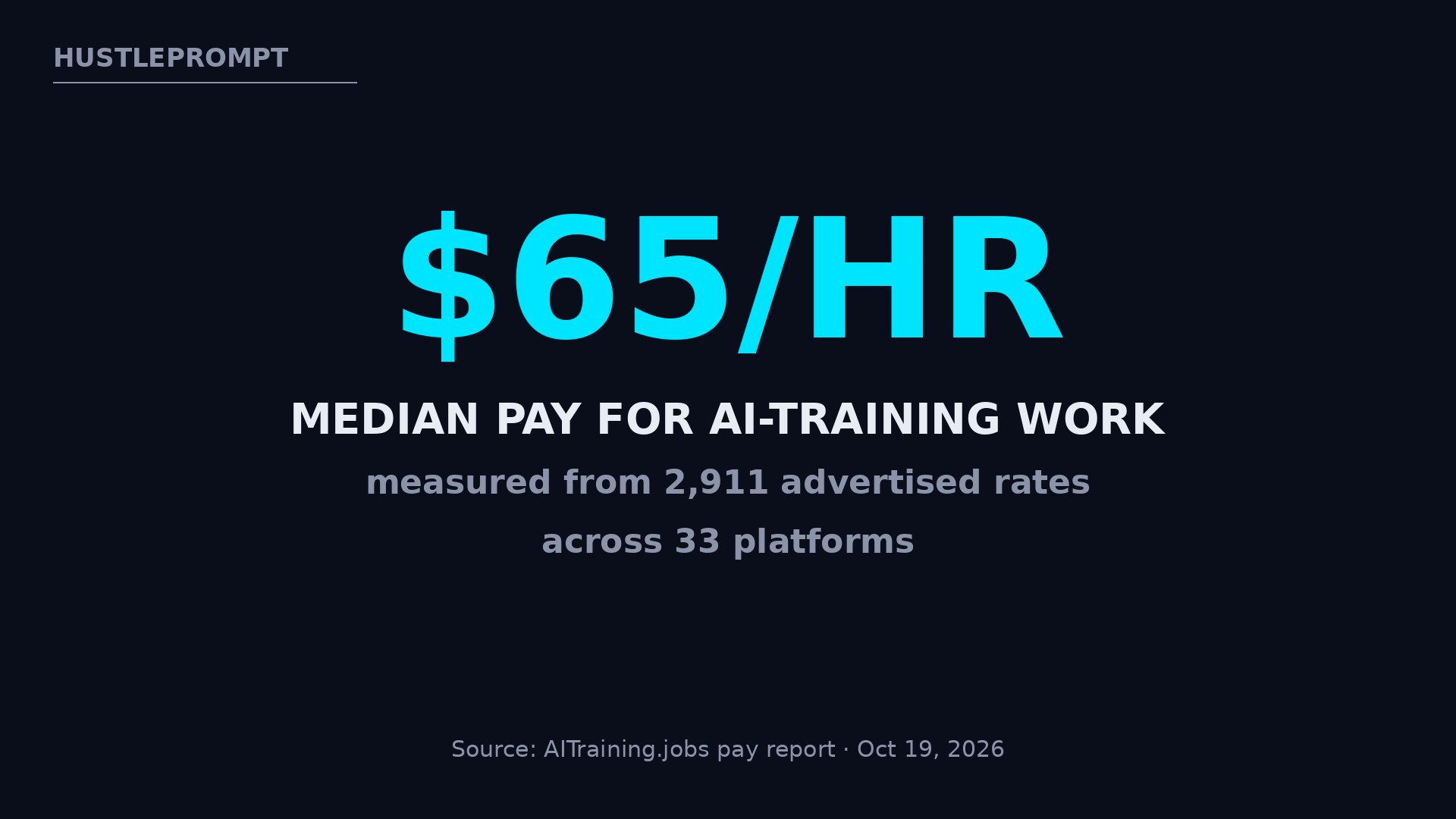
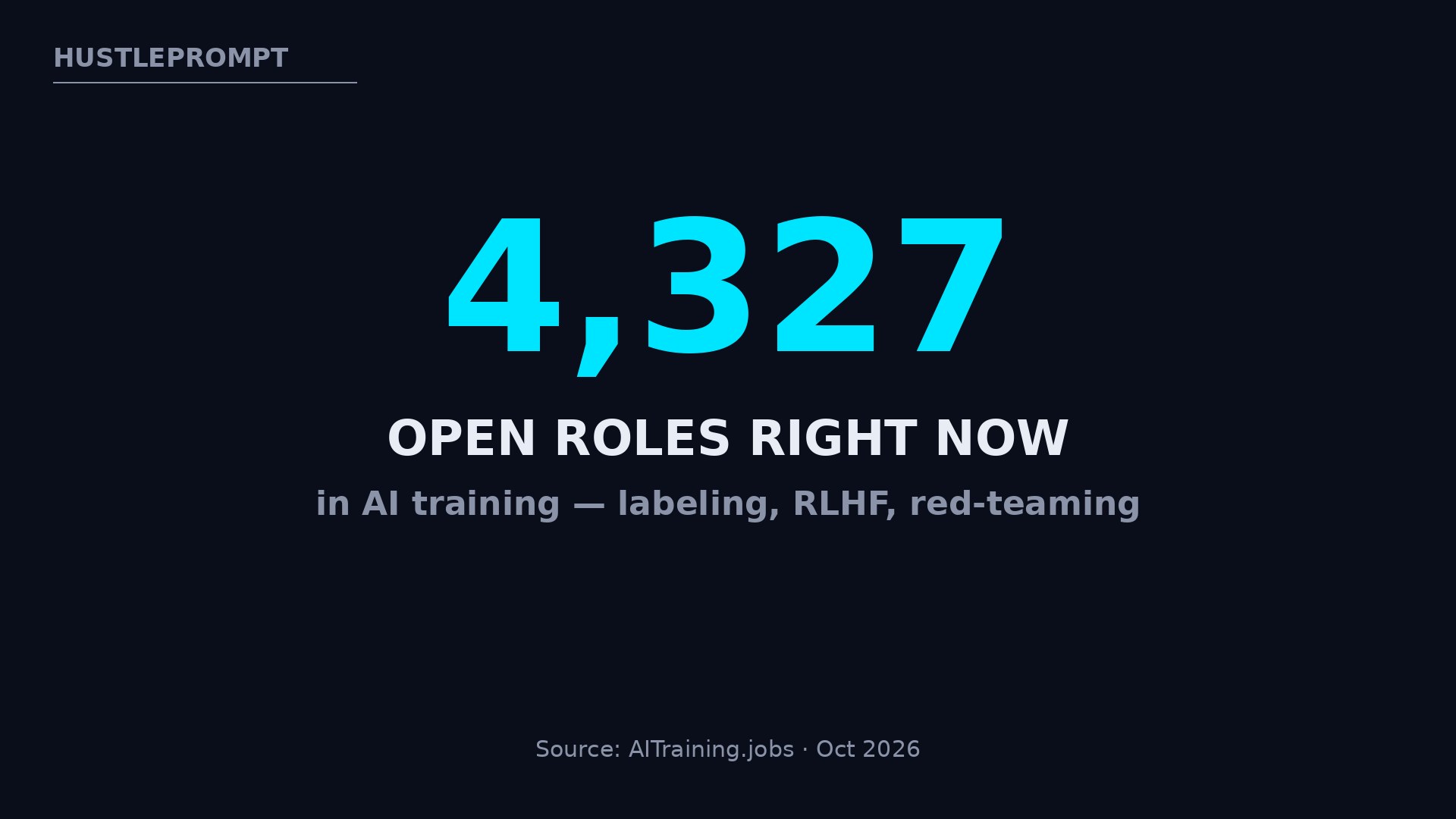
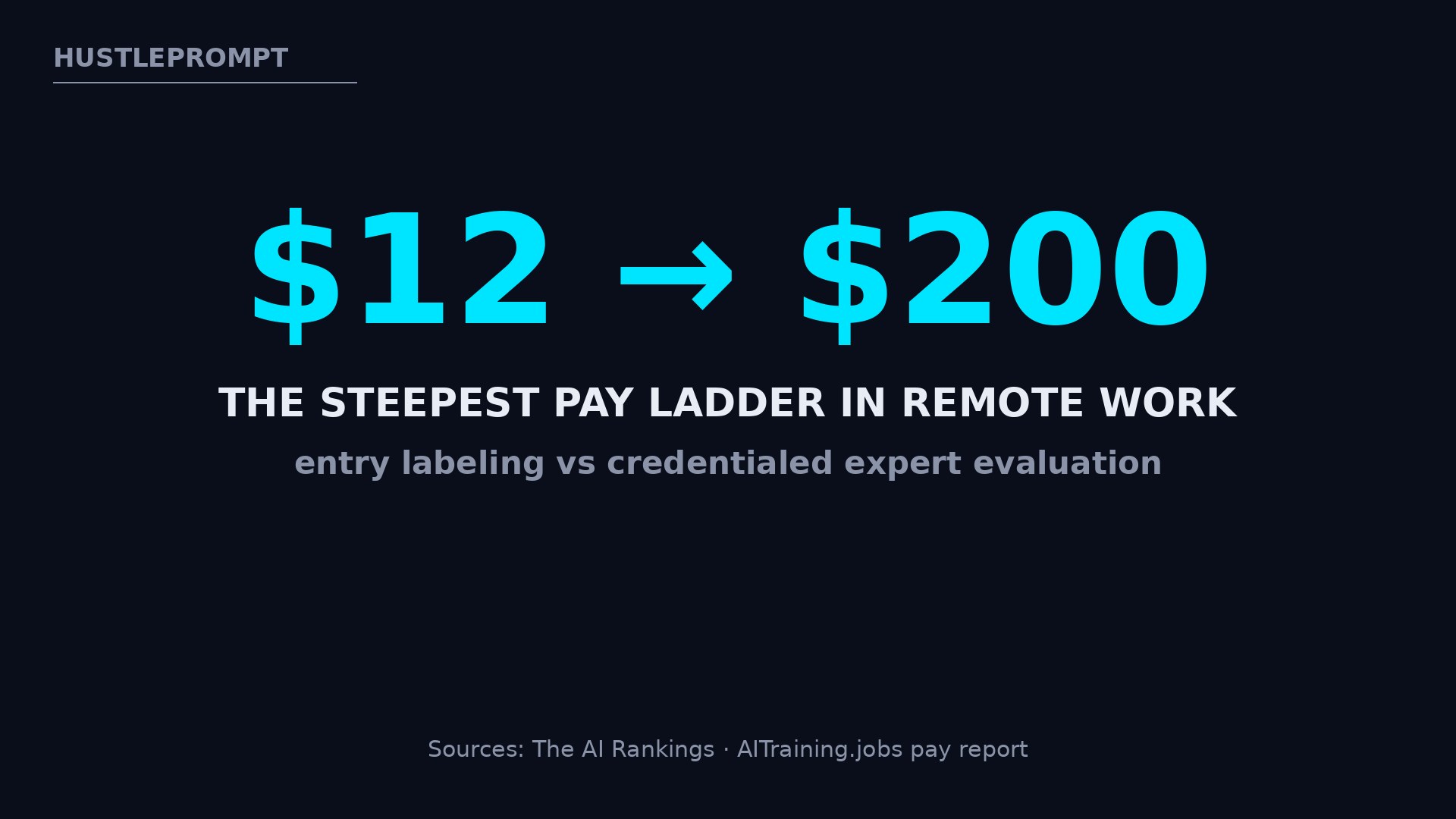
Every time ChatGPT gives you a brilliant answer, a human being taught it to say that — and the median worker doing that teaching earns $65 an hour. According to AITraining.jobs’ pay report, updated October 19, 2026, there are 4,327 AI-training roles open right now, with advertised rates spanning a jaw-dropping range from $12 to $200 an hour. The invisible workforce behind AI isn’t a metaphor. It’s a labor market — and it’s booming.
The Numbers Behind the Boom
The AITraining.jobs pay report measured 2,911 advertised rates across 33 platforms. The headline findings:
- Typical pay runs $35–$130/hr, with a median of $65/hr
- RLHF evaluation pays a median of $60/hr; coding and software evaluation $65/hr
- Agentic tasks and RL environments: $50/hr
- Data annotation and labeling: $30/hr
- Red-teaming (adversarial testing): $75/hr
Other sources confirm the range. The AI Rankings’ guide documents pay tiers from $12 to $200/hr, while ZipRecruiter’s US average for full-time “AI Trainer” sits at $64,984 a year (about $31/hr) and Glassdoor at $81,197 (about $39/hr) — full-time floors, far below what skilled evaluators earn project by project.
Then there’s the human face. GenZ NewZ reported on October 13, citing The Times, the story of “Amelia,” a 24-year-old Oxford graduate now labeling data in London. A GlobeNewswire release the day before backed up the ladder: DataAnnotationJobs.org’s top-3 places to work for annotators — Pipeline Simple, HireCade, and Rejoy Health — pay entry workers around $12/hr, senior specialists $50–$70/hr, and Rejoy Health AI Trainers $75–$100/hr.
Why Demand Is Exploding Right Now
Why would labs pay humans when AI keeps getting better? Four forces are converging:
1. Agentic AI needs trajectory grading
Grading a chatbot means picking the better of two answers. Grading an AI agent — software that chains tool calls to complete tasks — means scoring every step: right tools, right order, right parameters. That’s the $50/hr agentic-task tier, and it’s growing because agents are the industry’s main bet right now.
2. RLAIF hasn’t replaced humans
Reinforcement learning from AI feedback was meant to automate humans away. It scaled cheap grading, but synthetic feedback drifts without human ground truth. Humans now handle the highest-leverage work — audits, edge cases, red-teaming — while machines handle volume.
3. Every new model resets the clock
Post-training data goes stale with each capability jump: reasoning models need reasoning evals, coding models need real code review. Every frontier release triggers a fresh hiring wave, keeping openings in the thousands.
4. Frontier reasoning needs credentialed judgment
The cheapest data is nearly infinite; the binding constraint is expert judgment. Zen van Riel’s October 2026 breakdown shows pay climbing with credentials: a PhD physicist grading physics reasoning earns multiples of a generalist ranker. That scarcity pushes the top tier to $200/hr.
The Pay Ladder: From $12 Labeling to $200 Expert Eval
Here’s the full ladder, compiled from the sources above. Notice the pattern: pay scales with judgment, not speed.
Sources: AITraining.jobs pay report (Oct 19, 2026) — 2,911 advertised rates across 33 platforms; The AI Rankings AI-training-jobs guide ($12–$200/hr tiers); DataAnnotationJobs.org top-3 ranking (GlobeNewswire, Oct 12, 2026).
THE ANNOTATION PAY LADDER
Pay scales with judgment, not speed. Every step up is a skill you can acquire.
Tag text, draw boxes, categorize. No degree needed.
Judge which AI answer is better and explain why.
Score multi-step agent runs: right tools, right order.
Break the model on purpose: jailbreaks, safety probes.
PhD/MD/law-level judgment on frontier tasks.
The Money Angle: 5 Ways to Profit From This Trend
Here is the part most coverage misses: this isn’t one job, it’s a ladder — and every rung is climbable from a laptop. Real pay math, based on the medians above.
1. Start with entry annotation gigs ($12–$30/hr)
Entry labeling starts around $12/hr; annotation’s median is $30/hr. At 15 hours a week, that’s roughly $450/week — starter income, zero credentials. Learn the tooling and build a quality record here; platforms promote their best workers upward.
2. Graduate to RLHF evaluation ($60/hr median)
Preference ranking pays roughly double annotation — median $60/hr. Screening tests reward one skill: clear, structured writing. At 10 hours a week, that’s about $2,400/month of side income from answering “which response is better and why.”
3. Weaponize your credentials ($100–$200/hr)
The top is reserved for domain experts: lawyers grading legal reasoning, engineers reviewing code, clinicians evaluating medical answers. The Rejoy Health tier pays $75–$100/hr; top expert tiers reach $200/hr because credentials can’t be faked. Five hours a week at $120/hr is about $2,400/month.
4. Stack platforms to beat feast-or-famine
The sector’s real weakness, flagged by The AI Rankings: feast-or-famine cycles on any single platform. The fix is portfolio thinking — hold accounts on 4–5 platforms across labeling, RLHF, agentic tasks, and red-teaming, so you’re never idle when one project ends.
5. Sell the skill, not just the hours
The meta-play: everything you learn grading AI makes you better at prompting and evaluating AI for clients. Evaluators routinely graduate into AI consulting — the same judgment, repackaged at consulting rates. The ladder doesn’t end at $200/hr; it ends wherever you take the expertise next.
What to Do This Week: Your Action Plan
- Apply to 3 annotation platforms today. Screening takes days to weeks; the pipeline starts now. Entry pay is ~$12/hr; the annotation median is $30/hr.
- Take one screening test seriously. Most rejections come from rushed qualification rounds. Structured, evidence-backed answers are what RLHF platforms buy at $60/hr.
- Audit your credentials. A degree, license, or deep hobby (chess, medicine, law, coding) is a multiplier, not a footnote. Expert-eval tracks pay $75–$200/hr.
- Watch the video below. It tours five active annotation platforms and what each asks of workers.
- Stack, don’t settle. Keep 4–5 platform applications warm so the feast-or-famine cycle never hits your wallet.
See the Platforms in Action
Five active annotation platforms, what they offer, and how workers get in:
Where This Is Heading: 3 Predictions
1. The middle hollows out, the ends thrive
RLAIF keeps eating the middle. But the $12/hr floor and the $200/hr expert tier are both safe: labeling stays cheap, and frontier judgment can’t be synthesized. Expect the median to hold while the middle compresses.
2. Credential verification becomes the moat
As AI-written applications flood screening tests, platforms weight verifiable credentials more heavily. Degrees, licenses, and portfolios become the scarcest — and best-paid — asset in the market.
3. Agentic evals become the growth engine
Every company shipping AI agents needs trajectory grading at scale. The $50/hr agentic tier is the report’s youngest category and the one tied most directly to the industry’s biggest bet.
Frequently Asked Questions
How much can you actually make doing AI data annotation?
Advertised medians (AITraining.jobs, Oct 19, 2026): labeling $30/hr, RLHF eval $60/hr, coding eval $65/hr, red-teaming $75/hr. Market range: $12–$200/hr, typical $35–$130/hr.
Do you need a degree to do AI training work?
No — entry labeling starts around $12/hr. But credentials multiply pay: senior roles $50–$70/hr, expert eval $75–$200/hr. A degree isn’t required; it’s leverage.
Is AI data annotation work stable?
Feast-or-famine on any single platform, as The AI Rankings notes. Demand is huge — 4,327 open roles — but projects end. Hold accounts on several platforms so idle weeks on one are covered by others.
What’s the difference between annotation and RLHF evaluation?
Annotation is structured labeling — boxes, tags, categories (~$30/hr median). RLHF evaluation is judgment — comparing responses, ranking them, explaining why (~$60/hr median). Pay climbs with judgment.
Can AI itself replace data annotators?
Partially — that’s the RLAIF trend. But synthetic feedback drifts without human ground truth, so humans moved up the value chain: audits, edge cases, red-teaming. The middle automates; the judgment ends grow.
Where do beginners apply for AI training jobs?
Annotation platforms for the entry tier (~$12/hr), RLHF and agent-grading platforms for the middle ($40–$80/hr), specialist programs for expert work ($75–$200/hr). The video above tours five active platforms; DataAnnotationJobs.org’s top-3 list is another vetted starting point.
Keep Reading
- Sell Prompt Engineering: AI Systems Clients Pay For
Turn the judgment you build grading AI into a consulting offer clients buy. - The 10 Best AI Models of 2026, Ranked for Making Money
Know the models you’re training — ranked by money-making potential. - Sell AI Headshots: Build a Profitable Service
Package a skill, sell it at 10x the hourly rate.