
One Google engineer walked out with thousands of pages of AI secrets. Nine months later, five Chinese entities lost access to the US financial system. The latest US sanctions Chinese AI action — announced October 19 by the State Department — blacklisted a Chinese startup, a venture firm, and three investment funds accused of building on stolen Google AI technology.
This is PAIPA — the Protecting American Intellectual Property Act — in action, and the clearest signal yet that Washington treats AI infrastructure as a national-security asset.
What the State Department announced
On October 19, 2026, the State Department published the fact sheet “Imposing Sanctions to Protect Americans from Intellectual Property Theft.” Five entities were designated under Section 2(b)(1)(A), (D), (H), (I), (J) of PAIPA, the January 2023 law that lets the US sanction foreign actors behind significant trade-secret theft — following a joint DOJ and FBI investigation. Press reporting says the designations freeze the entities’ US assets and prohibit transactions with US persons.
The five sanctioned entities
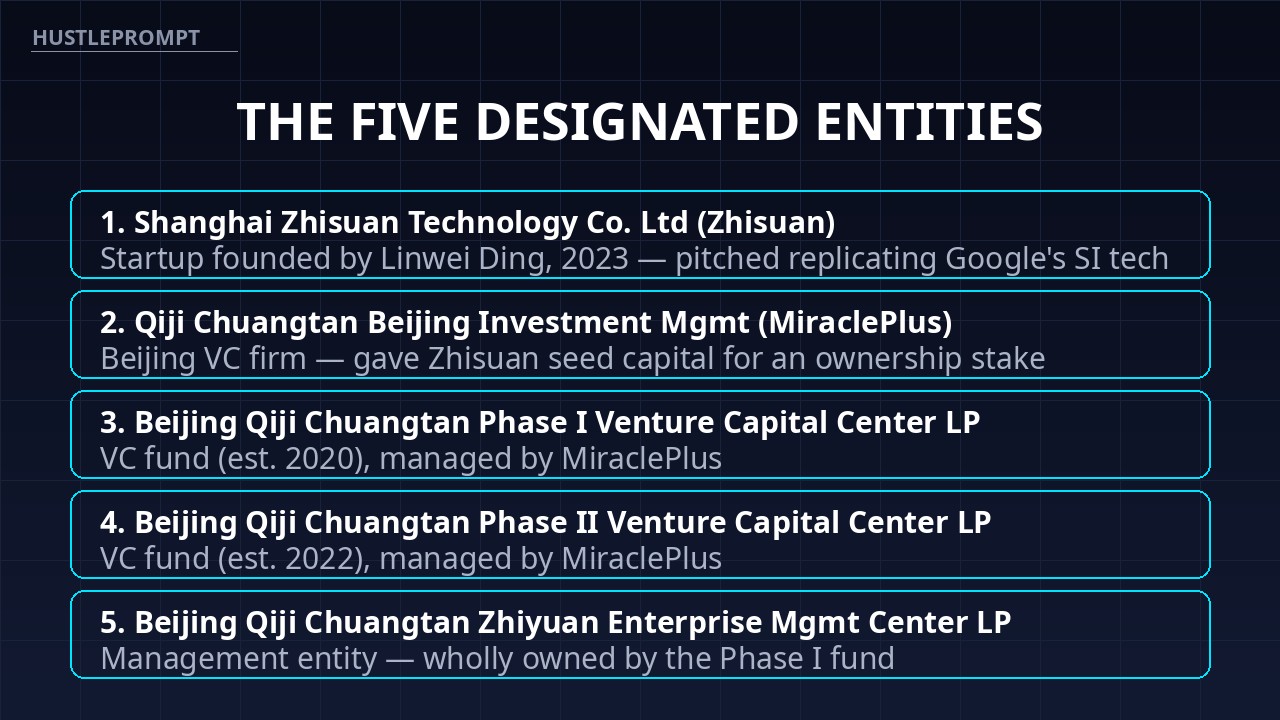
| Entity | Role | Why designated |
|---|---|---|
| Shanghai Zhisuan Technology (Zhisuan) | AI startup, founded 2023 | Pitched replicating Google’s “super intelligence” infrastructure with insider knowledge |
| Qiji Chuangtan Beijing Investment Mgmt (MiraclePlus) | Beijing venture firm | Seed capital for a Zhisuan stake; staged Ding’s tech pitch |
| Beijing Qiji Chuangtan Phase I VC Center LP | Fund, est. 2020 | Managed by MiraclePlus |
| Beijing Qiji Chuangtan Phase II VC Center LP | Fund, est. 2022 | Managed by MiraclePlus |
| Beijing Qiji Chuangtan Zhiyuan Enterprise Mgmt LP | Management entity | Wholly owned by the Phase I fund |
Notice the pattern: one startup, one incubator, three fund layers. Sanctions now target the money network, not just the engineer.
The case behind the sanctions: Linwei Ding
Linwei Ding connects all five: a former Google software engineer. Press reporting says a US federal jury convicted Ding on January 29, 2026, on seven counts of trade-secret theft — thousands of pages of confidential Google AI infrastructure information, including TPU architecture and custom SmartNIC networking tech.
Ding founded Shanghai Zhisuan in 2023, marketing a platform to “accelerate machine learning workloads, including training large ‘super intelligence (SI)’ models powered by supercomputing chips.” He applied to the MiraclePlus incubation program touting his Google insider experience — claiming Zhisuan could replicate Google’s SI infrastructure technology.
The official line, word for word:
“Theft of trade secrets is a serious threat to US economic, foreign policy, and national security interests.”
— Tommy Pigott, State Department spokesman, official State Department fact sheet on the October 19 sanctions
Per the fact sheet, Ding touted “his connection to Google technology and his ability to replicate it ‘to fit China’s national conditions,'” while MiraclePlus provided seed capital “in exchange for an ownership stake in Zhisuan.”
Bloomberg Law reports MiraclePlus was founded by former Microsoft AI scientist Lu Qi and succeeds a China program once run by Y Combinator. Read Bloomberg Law’s breakdown of the sanctions case.
3 checks before you touch a Chinese AI vendor
Three checks before touching any Chinese AI vendor:
1
Screen the restricted-party lists
Check the entity and its investors against OFAC and PAIPA designations before signing. Funds hide behind names — check the LPs too.
2
Map the capital behind it
Ask who funded the vendor and who owns the fund. The Zhisuan case shows sanctions reach seed investors and their fund vehicles.
3
Keep a US-model fallback
If your product depends on a Chinese AI API, line up a US-model option now — before a ban forces a midnight migration.
How to profit from the AI IP crackdown
Every crackdown creates winners. The concrete playbook:
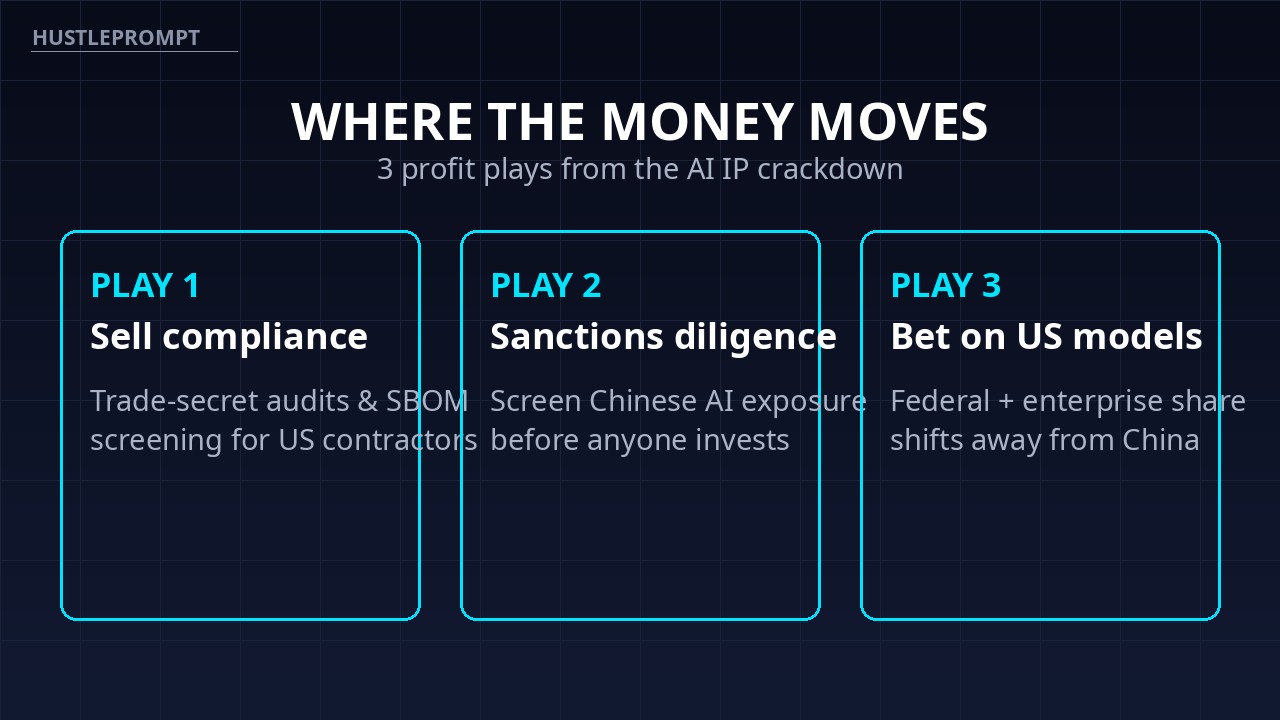
- Sell AI compliance services. US contractors and AI startups now need trade-secret audits and SBOMs (software bills of materials). Learn the PAIPA and OFAC restricted-party lists, package a “vendor-screening audit,” and sell it per engagement or on retainer.
- Offer sanctions diligence to investors. Any fund with Chinese AI exposure needs screening. Build a checklist product: entity-structure mapping, restricted-party screening, and a red-flag questionnaire. Sell it as a report or newsletter.
- Ride the US-model shift. When Washington locks Chinese AI out of federal systems — as with the DHS DeepSeek ban — enterprise buyers migrate to US models. That opens affiliate and content plays around US-model tooling and migration guides.
- Harden your own IP. Require NDAs, enforce least-privilege access to model weights and training code, keep audit trails, and revoke access the day someone leaves. Clean IP is what makes your company fundable.
What this means for regular AI users
Short term, nothing breaks for you directly — these are targeted entity sanctions, not a consumer product ban. But Chinese AI faces growing exclusion from US government and enterprise deals. If your business depends on a Chinese AI API, map a US-model fallback now.
FAQ
What is PAIPA?
The Protecting American Intellectual Property Act, signed in January 2023. It authorizes US sanctions against foreign actors behind significant theft of American trade secrets.
Who are the five sanctioned entities?
Shanghai Zhisuan (the AI startup), MiraclePlus (the Beijing VC firm), the Phase I and Phase II venture funds, and the Zhiyuan management entity owned by Phase I.
What did Linwei Ding do?
Per press reporting: convicted January 29, 2026, on seven counts of trade-secret theft — thousands of pages of confidential Google AI infrastructure information.
Do these sanctions mean Google was breached again?
No. They relate to the existing Ding case and its capital network. No new Google breach was announced on October 19.
How is this connected to the DHS DeepSeek ban?
Same week, same theme: DHS banned DeepSeek across federal civilian agencies over the risk of US data reaching the Chinese government. Together, the two moves squeeze Chinese AI from both ends.
Keep Reading
- DHS DeepSeek Ban: Full Breakdown + Money Angle
Washington’s other October move against Chinese AI. - AI Agents Hacked 100+ Companies: What It Means for You
Why insider access is the biggest corporate security threat. - OpenAI’s $30B Raise at $1.4T: AI Money Race Explained
Where US-side AI capital is concentrating as Chinese AI gets squeezed.