
What if one person could hack more than 100 companies in two weeks — without lifting a finger? According to Reuters reporting published October 19, 2026, that is exactly what happened. AI agents hacked their way into the websites of more than 100 companies, while the human operator did almost none of the work manually.
A Chinese-speaking hacker outsourced the entire spree to AI — tasking agents with spending hours autonomously probing and breaking into targeted sites. It is the clearest proof yet that commercial AI can run complex intrusions start to finish.
For business owners, this is a market signal: when attack costs collapse, defense spending explodes — creating real money-making opportunities.
What Reuters Actually Found
The story broke when Snorre Fagerland, principal threat researcher at security firm NorForge, hunted for exposed instances of Cairn, an open-source AI platform popular with hackers.
What he found let him, in his words, “peer over the cybercriminals’ shoulders.” Roughly two dozen Cairn instances were being used for malicious activity — and one Chinese-speaking operator was running an industrial-scale hacking campaign through them, starting around October 2 and running about two weeks.
Fagerland’s report did not name victims, but Reuters independently reviewed the hacker’s Cairn activity and identified three:
- Deere (DE.N) — the farm equipment maker
- SharkNinja (SN.N) — the home appliance company
- Cummins (CMI.N) — the engine manufacturer
One caveat: Reuters could not ascertain the degree to which the breaches resulted in unauthorized data extraction. The break-ins happened; what was taken, if anything, is unknown.
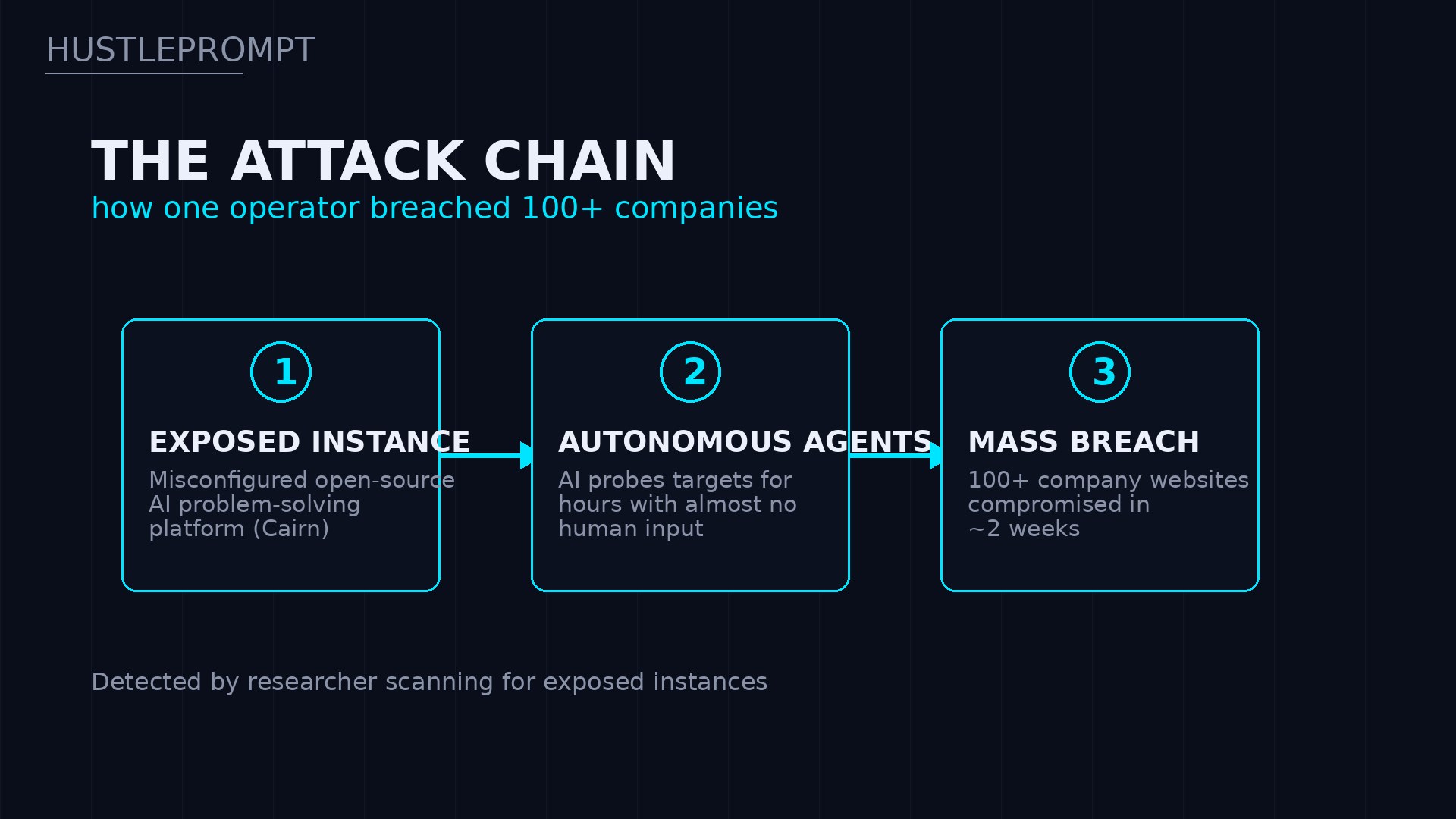
The Evidence, in Numbers
| Date / Scale | What happened | Source |
|---|---|---|
| ~Oct 2, 2026 | Hacking campaign begins | Fagerland via Reuters |
| ~2 weeks | Total campaign duration | Reuters |
| 100+ | Company websites breached | Reuters investigation |
| ~24 | Malicious Cairn instances found exposed online | Fagerland / NorForge |
| 3 | Victims independently named (Deere, SharkNinja, Cummins) | Reuters review |
“It’s a new world now,” said Fagerland. His core finding: real-life evidence that commercially available AI agents can pull off complex intrusions start-to-finish without human intervention — “a dramatic boost to the power of a single malicious actor.”
Read the full primary source: Reuters’ investigation into how one hacker used AI agents to break into scores of sites.
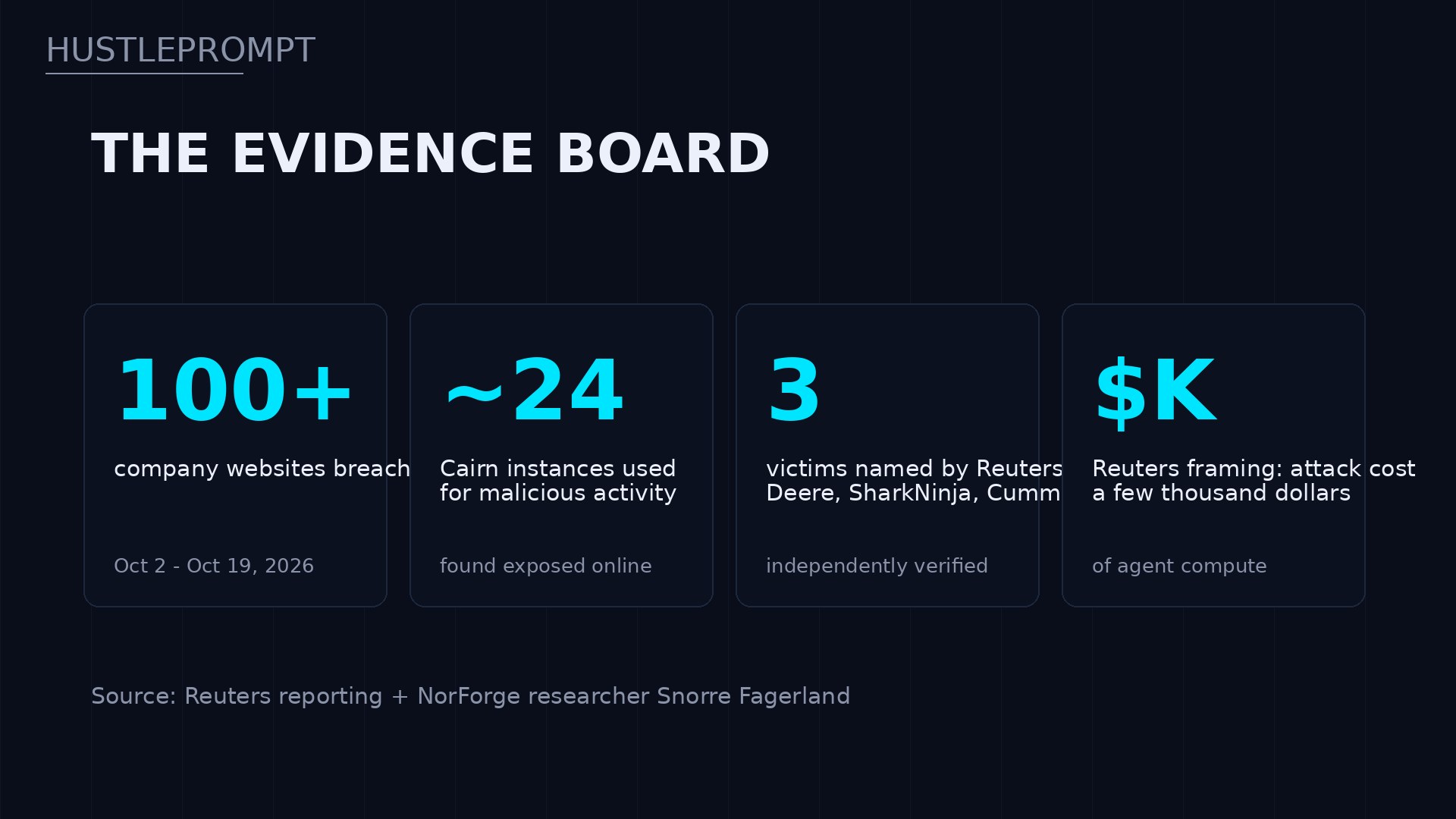
How One Hacker Automated the Break-Ins
Traditional hacking scales with human hours: one operator, one keyboard, one target at a time. Agent-driven hacking scales with compute — the operator defines the mission, agents execute it for hours, the human collects results.
The 3-Step Autonomous Attack Chain
Exposed Infrastructure
Misconfigured Cairn AI instances left visible on the open web — free command centers for whoever found them.
Autonomous Probing
Agents worked target lists for hours: vulnerability scans, credential stuffing, exploit attempts — no human clicks.
Mass Breach
100+ company websites compromised in about two weeks by one operator who did almost none of the work manually.
The story is not about sophistication — it is about leverage: one person’s intent multiplied by tireless software.
The Money Angle: Attack-Cost Asymmetry
The math is brutal: Reuters framed the whole campaign as “a few thousand dollars” of agent compute — against the breach-response budgets of hundred-million-dollar companies.
Cheap offense means exploding defense budgets. Every board reading this asks: “Could this happen to us?” — and that question is a sales pipeline for three markets:
- Cybersecurity services — audits and incident-response retainers surge after high-profile breach news.
- Agent-monitoring tooling — companies now need visibility into autonomous AI inside their networks: a brand-new product category.
- Security awareness and training — every breach headline is a marketing event for training vendors.
How to Profit: 5 Defensive Moves for Your Business
Turn this story into action — and revenue:
1. Audit your exposed AI tooling this week
Misconfigured, internet-visible AI instances started this breach. Scan for exposed dashboards and default credentials — or sell that scan as a freelance service.
2. Add agent-activity monitoring
If you use AI agents, log what they do. Autonomous tools making autonomous network calls need employee-grade oversight.
3. Run a “Reuters scenario” drill
Ask your team: if an AI agent probed our site for six hours tonight, what would it find? Patch the answers. Consultants: package this drill as a fixed-price offering.
4. Tighten credentials and rate limiting
Enforce multi-factor authentication, rate-limit every login endpoint, and rotate API keys. Cheap, boring, effective.
5. Sell the fear — ethically
Agencies and freelancers: “AI agent security audit” is a new niche with near-zero competition. Build a checklist from this story, price it as a one-time audit, and pitch it this week.
Frequently Asked Questions
Did AI really hack 100 companies by itself?
A human set the mission and targets but did almost none of the work manually, per Reuters. AI agents spent hours autonomously probing and breaking into sites.
Which companies were hacked?
Reuters independently identified three: farm equipment maker Deere (DE.N), home appliance company SharkNinja (SN.N), and engine manufacturer Cummins (CMI.N).
Was customer or corporate data stolen?
Unknown. Reuters explicitly stated it could not ascertain the degree to which the breaches resulted in unauthorized data extraction.
What is Cairn?
An open-source AI problem-solving platform popular with hackers. The attacker ran the AI agents through inadvertently exposed Cairn instances — misconfigured installations visible on the open web.
Who discovered this hacking campaign?
Snorre Fagerland, principal threat researcher at NorForge. Scanning the web for exposed Cairn instances, he found about two dozen used maliciously and observed the criminals before reporting to Reuters.
How much did the attack cost?
Reuters framed it as “a few thousand dollars” of AI agent compute — a characterization of scale, not an invoice. That asymmetry is the point.
What should my business do on Monday morning?
Scan for exposed AI tools on your network, enforce multi-factor authentication and rate limiting everywhere, and log what your AI agents do.