
Two senior job postings. Hundreds of applications. Salaries up to £190,000 a year. That happened this month at the UK’s Financial Conduct Authority. Meanwhile, the door into tech is quietly slamming shut behind new graduates: entry-level hiring at the biggest technology companies has collapsed roughly 65% since 2019. AI isn’t killing jobs. It’s killing the career ladder.
Companies still desperately need senior engineers. They are just refusing to hire the junior ones those seniors used to be. And that gap — between the experience companies demand and the experience they no longer provide — is creating the decade’s biggest pay premium: the AI-supervision premium.
The ladder is broken: the numbers
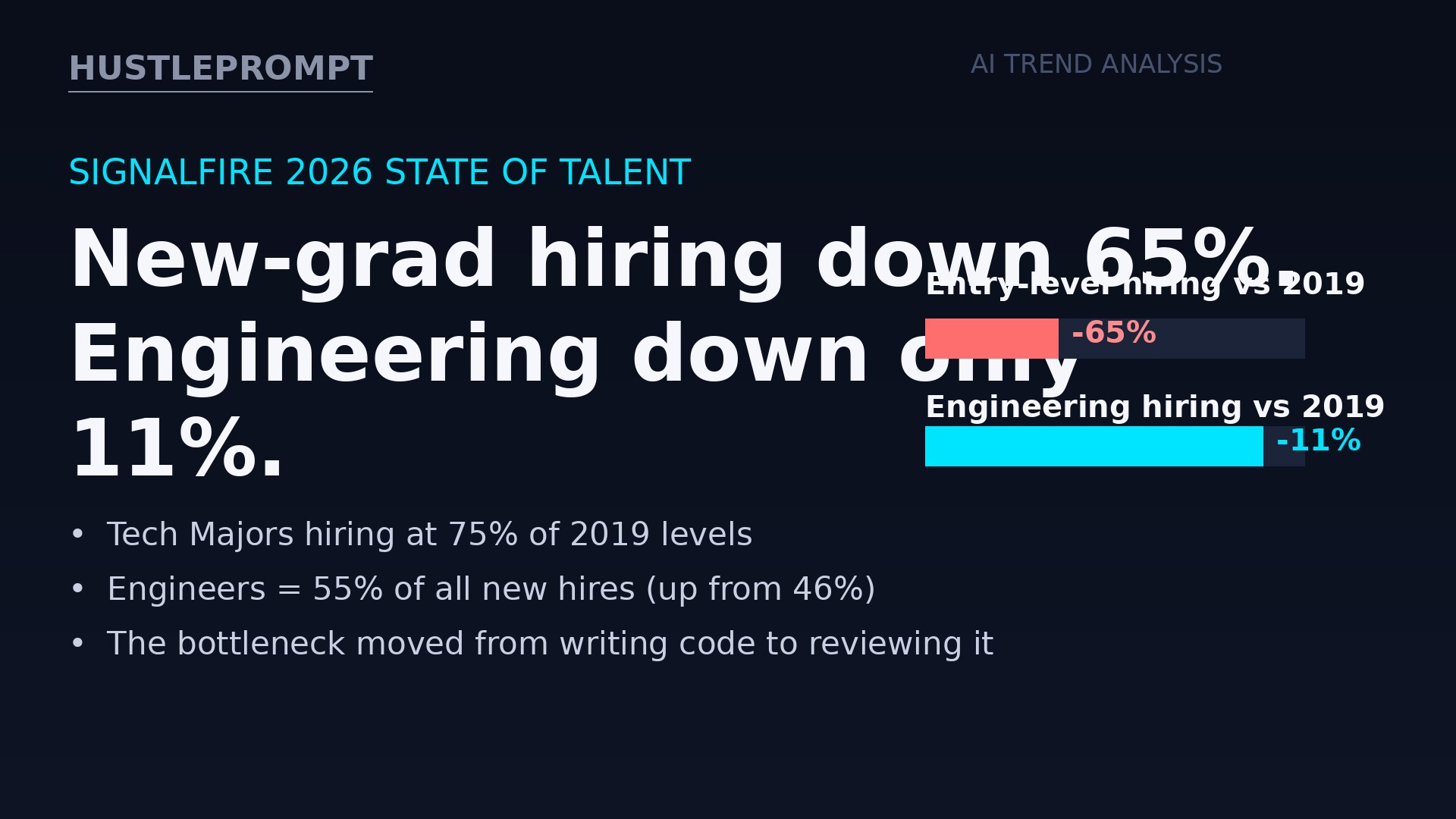
Venture firm SignalFire’s 2026 State of Talent Report tracks hiring across the largest tech companies, and its verdict is blunt: the industry is “shattering the traditional career ladder.” The mechanism is one devastating sentence: “the operational bottleneck has moved from writing code to reviewing it.” Juniors slow teams down because the scarce skill is no longer producing code — AI does that — it’s judging the code.
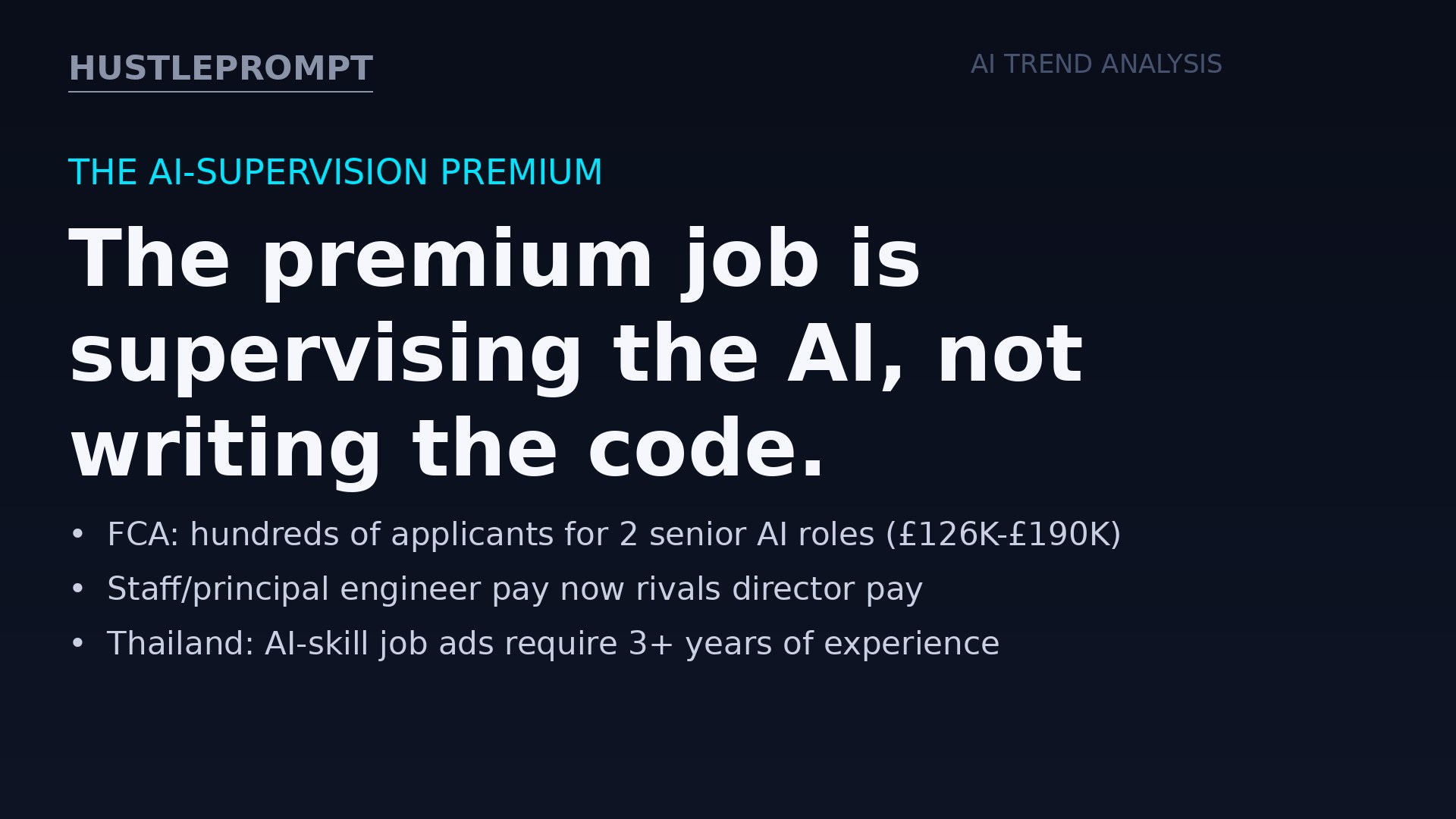
And the pay is following the judgment. The report finds top staff and principal engineer packages at the largest tech companies now rival or beat director pay, reversing two decades of management premium. A new role has emerged: the “Super IC,” an individual contributor operating at a scope once reserved for managers. Engineers now make up 55% of all new hires at the tech majors, up from 46% in 2019 — a senior-heavy core with the junior scaffolding stripped out.
Seniors wanted; juniors optional
The clearest real-world illustration landed this month: the Financial Conduct Authority received hundreds of applications for just two senior AI roles paying £126,000–£190,000. Chief AI officer Jessica Rusu: “We have two senior leadership roles in the market now and we have had hundreds of really high-quality applications.” And: “AI is moving faster than any regulatory framework was designed.”
The same day, Siemens’ chief people officer Judith Wiese warned that cutting entry-level jobs could destroy the skills companies need next. With roughly 30,000 software engineers on staff, Siemens faces every firm’s choice: use AI productivity gains to employ fewer people, or expand output with the same workforce. Wiese’s warning goes straight to the ladder problem:
“The crucial question is always: What do I need to have done, checked and seen myself to avoid being misled by AI?” — Judith Wiese, Siemens chief people and sustainability officer
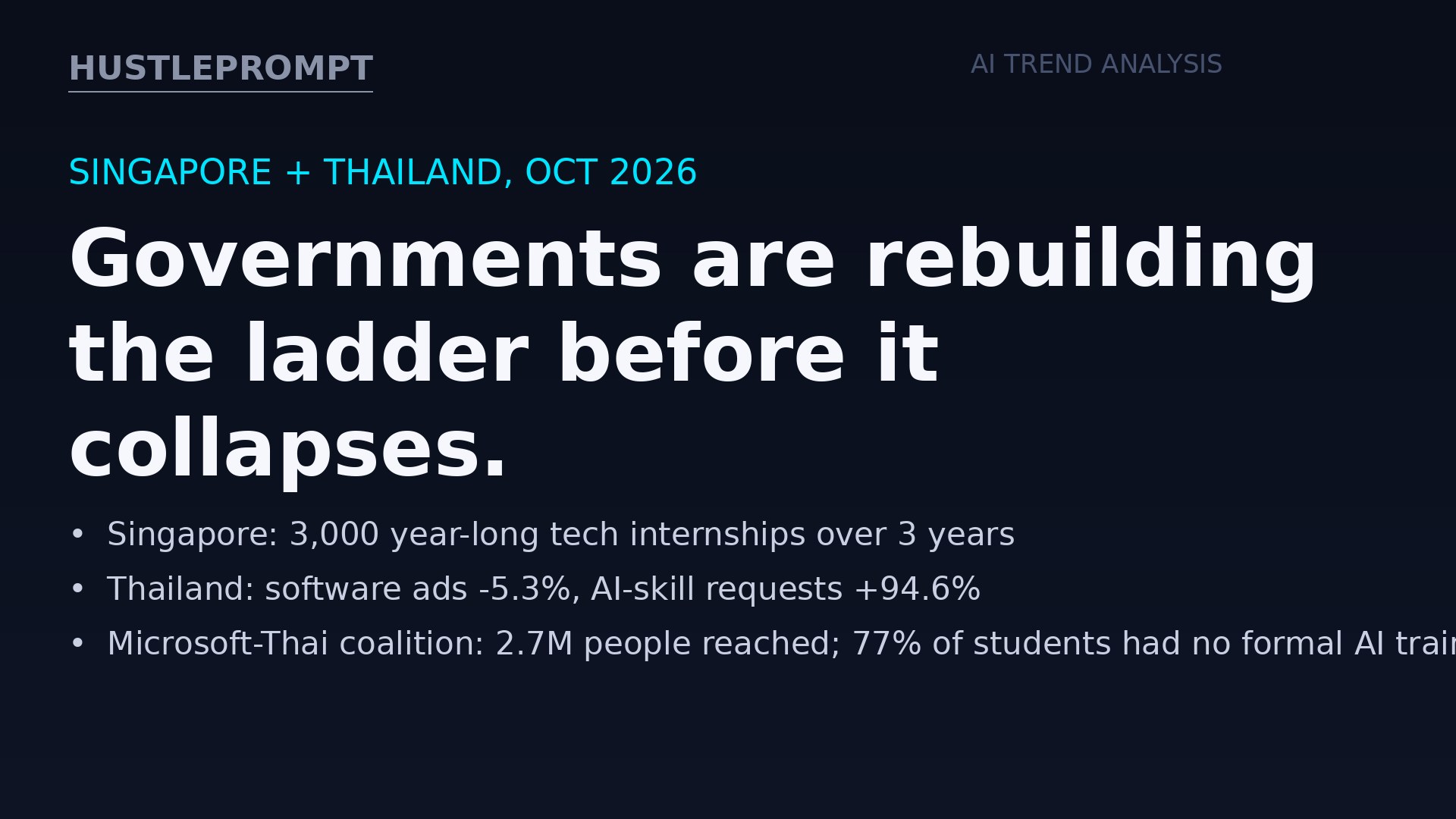
Her rule is the whole thesis in one line: junior developers need to write code themselves to judge code produced by AI. Skip the doing, and you lose the ability to spot when the machine is wrong. Thailand’s data proves the hiring bar is already rising: the Thailand Development Research Institute found software engineering job ads fell 5.3% while ads requesting AI skills rose 94.6% — and those AI-skill postings were more likely to demand at least three years of experience. Employers want someone who can supervise AI output immediately. As the institute warned: “fewer starting positions mean fewer opportunities to develop the experienced workers companies will later need.”
Anatomy of a broken ladder
Super ICs, staff engineers, AI supervisors. Pay rivaling directors. Everyone is hiring them.
Reviewing, auditing, verifying and securing AI output. This is the rung you must build yourself now.
Boilerplate, tests, docs — now done by AI. Down 65–76% since 2019. No longer the on-ramp.
Companies won’t give you the old junior rung anymore. But they pay senior money for the supervision layer — reviewing AI output, catching the expensive mistakes, signing off.
Governments are already trying to rebuild the rungs
When governments start acting like career counselors, the ladder problem is real. On October 19, Singapore announced ~3,000 year-long tech internships over three years under Bridge2Tech within TIP Alliance+: 10–12 month placements, up to S$1,000 per month per intern for employers, up to 90% funding for AI, cloud and cybersecurity certifications, and 200+ employers (DBS, Google, HSBC, Singtel) pledging skills-based hiring.
Days earlier, Microsoft and the Thai government announced a national employment coalition — the first of 19 countries to implement Microsoft’s “Elevate AI and Jobs” model. Microsoft’s programs have reached 2.7 million Thai people, and 77% of students surveyed had received no formal AI training. Honest gap: the announcement gave no numerical job-placement target. Training is funded; hiring isn’t guaranteed.
How to profit: claim the AI-supervision premium
The thesis is simple: companies pay senior salaries to anyone who can supervise AI output — without checking how you learned it. The arithmetic (illustrative; rates vary by market):
1. Solo AI code auditor
Audit AI-generated codebases for startups shipping fast with coding agents. Math: 15 hours/week × $150/hour = $2,250/week, roughly $9,000/month part-time — already above many junior salaries. One monthly audit retainer replaces an entire entry-level income.
2. Packaged audit products
A fixed-price “AI Codebase Health Audit” at $2,500 — security scan, logic review, dependency check, written report — done in two days. Four per month = $10,000/month, with no hourly ceiling. The AI angle (auditing agent-written code) is the differentiator.
3. Senior-as-a-service retainers
Small teams need a senior to approve pull requests but can’t hire one. Retainer math: $5,000/month per startup × 5 clients = $25,000/month, each client getting senior-level review of AI output for a fraction of a hire. SignalFire’s “Super IC” — minus the employer.
How juniors become “AI-native seniors”
- Do the work before you delegate it. Wiese’s rule is your training: write code by hand first, then compare with the AI’s version.
- Build a public review portfolio. Audit open-source repos, document the bugs and security flaws in AI-written code, publish findings. 200+ employers in Singapore’s program have pledged to hire on demonstrated skill.
- Specialize in the expensive mistakes. Security review, compliance-aware review, financial-systems validation — the FCA story shows where desperate demand lives.
- Sell supervision, not code. Nobody pays a premium for typing. They pay for the person who signs off and catches the one line that would have broken everything.
Watch: why nobody will become a senior engineer again (unless they adapt)
Frequently asked questions
Is AI killing jobs or just changing them?
Both, but the damage is concentrated on the entry ramp, not the profession. Engineering hiring is down only 11% while new-grad hiring collapsed ~65% (SignalFire 2026). The jobs exist; the path into them doesn’t.
Why would companies cut the juniors they need as future seniors?
Short-term math: a senior with coding agents does the work of a small team, and the bottleneck moved from writing code to reviewing it, where juniors slow teams down. Long-term it’s self-defeating — Siemens’ Judith Wiese and Thailand’s TDRI both warn that fewer starting positions today means fewer experienced workers tomorrow. And it’s accelerating: the IMF’s October 2026 Asia outlook found recruitment demand in AI-exposed occupations fell nearly 10% relative to less-exposed ones since ChatGPT’s launch.
What exactly is the AI-supervision premium?
The pay gap between producing AI output and being trusted to verify it. Hundreds of applicants for two FCA senior AI roles at £126K–£190K; SignalFire finds staff/principal pay now rivals director pay; the IMF finds up to a 15% UK wage premium for roles requiring multiple new skills.
What should a junior learn right now?
The supervision stack: code review, security auditing, testing strategy, and the judgment to know when AI output is wrong. Do the work yourself first — Wiese’s rule — then build a public portfolio of audits.
Can freelancers earn senior-level money without a senior title?
The math says yes: a solo AI code auditor at 15 hours/week and $150/hour earns roughly $9,000/month part-time. Companies pay for verified judgment, not years on a résumé — and the window to position yourself in the supervision layer won’t stay cheap forever.
Are governments doing anything about the broken ladder?
Yes — Singapore’s 3,000 year-long internships and 90% training funding, plus the Microsoft-Thailand coalition (2.7 million people reached). Honest gap: Thailand’s coalition announced no job-placement target. Training is funded; hiring is not guaranteed.