
A Flint coding model with 40 billion parameters that runs on your laptop — not in someone else’s cloud. Recursive shipped Flint on October 21: an open-weight mixture-of-experts (MoE) model built for fast agentic coding on local hardware, with only about 2.5 billion parameters active per token. The weights are free under Apache 2.0, and Recursive reports 125+ tokens per second on an M4 Pro MacBook Pro.
For freelancers, that is a business model: zero per-token API bills, client code that never leaves the machine, and a sellable “private AI” service. Here is what Flint is, the numbers, and how to profit.
What Flint actually is
Flint is a decoder-only MoE Transformer designed for coding agents — AI that investigates codebases, fixes bugs, implements features, and writes tests across multiple steps. It takes text in and out, supports reasoning and multi-turn tool use, and speaks OpenAI-compatible tool calls, so it plugs into existing agent harnesses.
The trick: a mixture-of-experts model activates only a few specialist sub-networks per token — most of Flint’s 40 billion parameters sit idle while roughly 2.5 billion do the work. Strangest of all, Recursive says a small team plus its “Eureka Machine” research system built Flint from scratch in under four months.
The official specs, straight from the model card
All figures below are from Recursive’s own model card (RecursiveSI/flint) — vendor-reported, not independently tested.
| Spec | Flint |
|---|---|
| Total parameters | 39.8B (“40B-A2.5B” rounded designation) |
| Active per token | ~2.5B (active body alone ~2.2B, excluding input embeddings) |
| Architecture | 49 layers: 2 dense + 47 MoE; 256 routed experts, 6 selected per token, plus 1 shared expert |
| Context window | 262,144 tokens documented (blog cites up to 512K; 256K recommended) |
| License | Apache 2.0 — free commercial use, no revenue gate |
| Knowledge cutoff | June 2026 |
Stat highlights (all vendor-reported by Recursive)
- 125+ tokens/sec on an M4 Pro MacBook Pro; 150+ tokens/sec on a 64GB NVIDIA RTX Spark — “up to 2x faster than comparable models.”
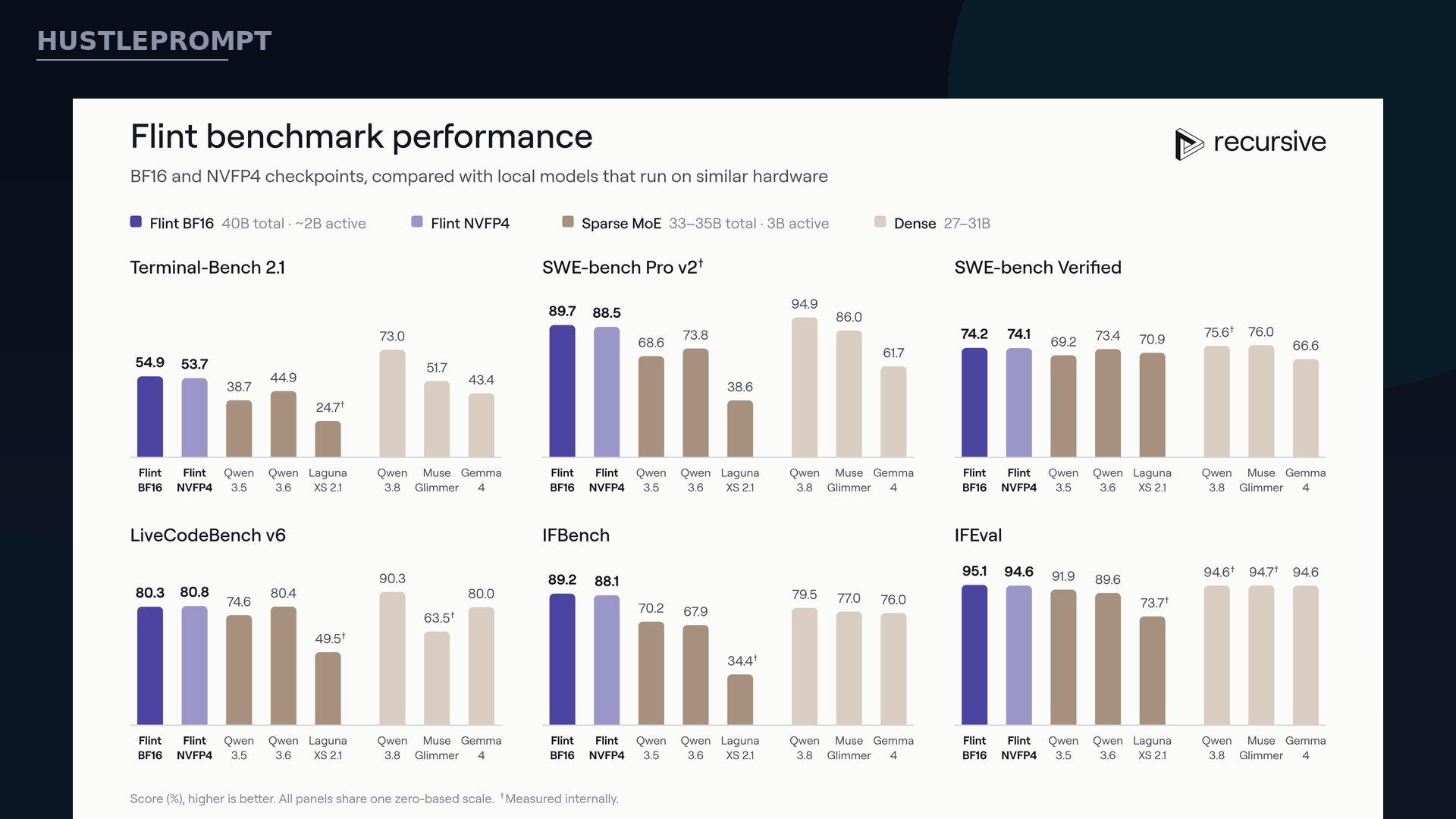
- 74.2% SWE-bench Verified, 89.7% SWE-bench Pro v2, 54.9% Terminal-Bench 2.1, 95.1% IFEval.
- Needs 48GB Apple Silicon (M4 Pro, M5 Pro, M5 Max) or a 48GB NVIDIA GPU; 4-bit weights run in ~23GB.
- Day-0 support in vLLM, Ollama, llama.cpp, LM Studio (+ Unsloth, SGLang) — plus Recursive’s own “rec” engine with a Metal megakernel for M4/M5 Macs.
Sources: RecursiveSI/flint model card · vLLM day-0 support announcement
The speed story, in plain numbers
Speed is Flint’s pitch. At 125 tokens/sec, a typical snippet lands in seconds; Recursive’s comparison puts rival local models at 58–69 tokens/sec on the same machine — roughly half the pace.
vLLM added day-0 support, reporting ~500 tokens/sec on a single GB200 at 100K context (vLLM blog). Two checkpoints ship: BF16 (~80GB) and NVFP4 (within 0.7 points of full precision).
How it works: a local agent that reads your repo
Flint is not a paste-code chatbot. It does agentic coding: you hand it a goal, and it loops through tools — searching code, reading files, running tests — for multiple turns until done.
From download to local coding agent in 4 steps
How freelancers turn Flint into money
Every API coding agent bills per token, forever. Flint bills nothing per token — the cost is hardware you own. That flips the economics:
- Kill your own API bill first. Route a month of heavy agent use to a local Flint setup. The savings are the first profit.
- Sell “private on-device code AI” setups. Law firms, clinics, and fintechs can’t paste code into cloud APIs — offer a preconfigured workstation wired to their repos. Privacy is the pitch; zero marginal cost is your margin.
- Productize agentic workflows — “test-suite writer,” “dependency audit bot” — sold as fixed-price deliverables. Local inference costs nothing per run, so fixed pricing is pure margin.
Local vs cloud: the honest comparison
| Flint (local) | Cloud API coding assistants | |
|---|---|---|
| Marginal cost | $0 per token after hardware | Billed per token, every run |
| Privacy | Code stays on your machine, works offline | Code travels to provider servers |
| Model quality | Strong locally; needs more guidance than closed models | Generally stronger, less hand-holding |
| Hardware | 48GB Apple Silicon or 48GB NVIDIA GPU | Browser-based, no hardware needed |

The honest limits
Recursive is candid: Flint needs more guidance than big closed assistants — split work into small subtasks. Its Terminal-Bench 2.1 (54.9%) trails dense Qwen 3.8 (73.0%) on Recursive’s own chart, all vendor-reported. And the hardware bar is real: no 48GB machine, no free lunch.
Frequently asked questions
Is Flint free for commercial use?
Yes — Apache 2.0: free commercial use and modification, no revenue gate (official model card).
What hardware runs Flint?
A 48GB Apple Silicon Mac (M4 Pro/M5 Pro/M5 Max) or a 48GB NVIDIA GPU; 4-bit weights run in ~23GB.
How fast is it?
125+ tokens/sec on an M4 Pro MacBook Pro, 150+ on a 64GB RTX Spark per Recursive; ~500/sec on a GB200 per vLLM.
What are its benchmark scores?
Vendor-reported: 89.7% SWE-bench Pro v2, 74.2% SWE-bench Verified, 95.1% IFEval, 54.9% Terminal-Bench 2.1.
Which tools support Flint?
Day-0 support in Ollama, llama.cpp, LM Studio, and vLLM (plus Unsloth, SGLang), and Recursive’s own “rec” engine for M4/M5 Macs.
Keep Reading