
OpenAI just turned a startup’s $7.6 billion idea into a commodity. On October 22, 2026, the OpenAI Decisions API left beta and went generally available — a dedicated endpoint answering classify, route, and score questions in 100–180 milliseconds at $0.10 per million input tokens, with zero output fees. Product lead Nikunj Handa told TechCrunch his team watched rival TypeSafe’s Jev take off and realized “we have like a million use cases for this.” If you build AI agents, this changes your cost math today.
Per the official OpenAI announcement (October 22, 8:51pm), the API is “officially out of beta and ready to add near real-time decisions to your production workflows.” It runs on GPT-6 Luna — reconfigured, not rebuilt: OpenAI adapted its small model to skip text generation and return only typed answers.
What OpenAI actually launched
The Decisions API sits between your app and a full language model. Your agent sends a question with a fixed set of allowed answers; the API returns one typed result — no paragraphs, no JSON parsing, no output tokens. New since the October 6 beta:
- Native GPT-Live integration — voice apps can now react as people speak
- Prompt caching — reuse context at $0.01 per million cached tokens
- Up to 400 questions per request — double the beta limit, so one call can batch twice the decisions
It also takes native JSON inputs (structured app data, no reformatting) and images in individual question instructions — compare several images against one reference, like quality control on product photos.
Evidence 1: the pricing table
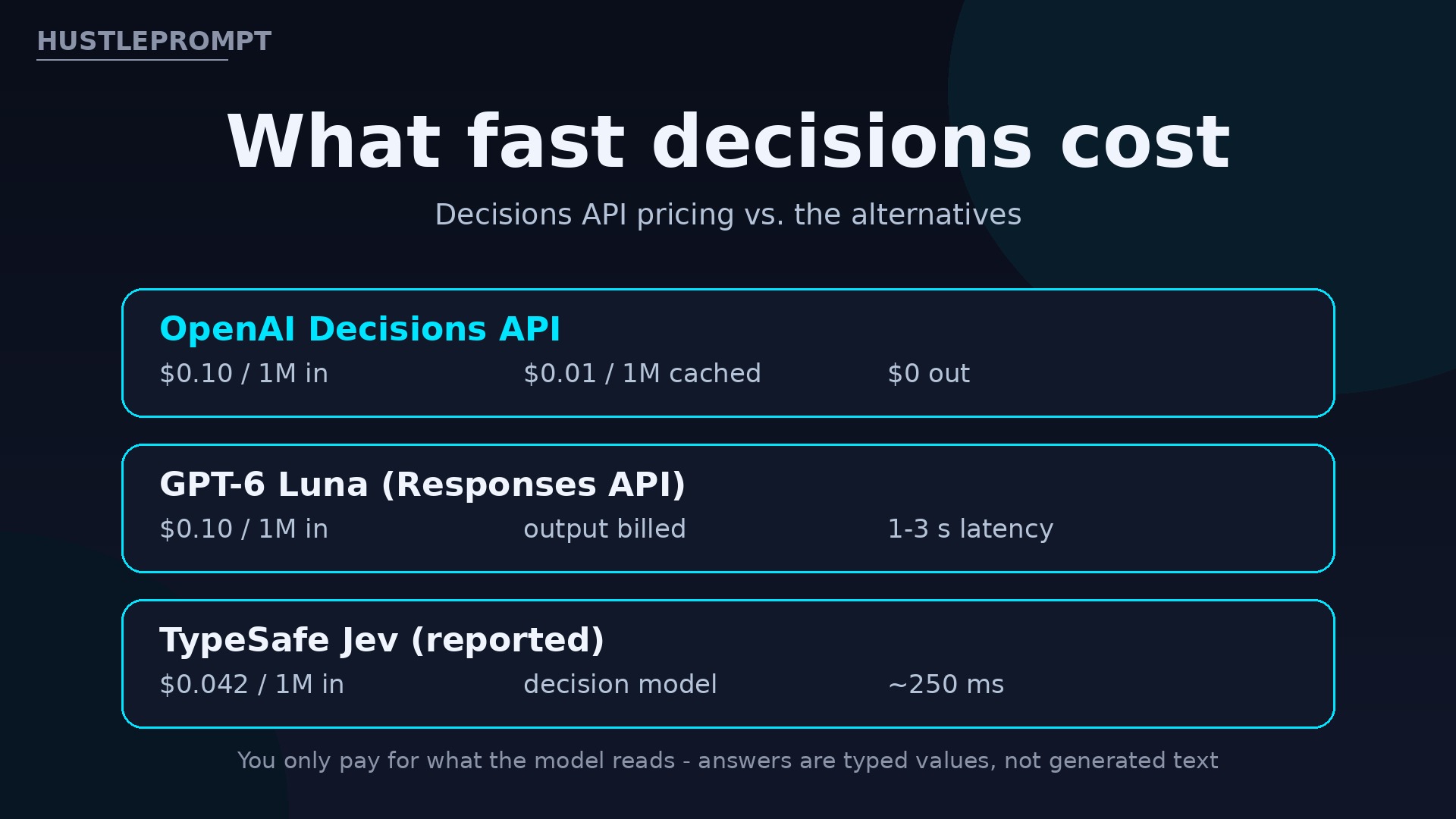
This is where the money moves. You pay only for input tokens; the typed answers themselves are free:
| Service | Input price | Output | Speed |
|---|---|---|---|
| Decisions API (GA) | $0.10 / 1M tokens | $0 — no output fees | 100–180 ms |
| GPT-6 Luna via Responses API | $0.10 / 1M tokens | billed per token | 1–3 seconds |
| TypeSafe Jev (reported) | $0.042 / 1M tokens | no output fees | ~250 ms |
At high volume the gap widens: a Responses-API call bills output tokens on every request, while Decisions kills that line item. Yes, Jev’s $0.042/M input rate is 2.4x cheaper — but OpenAI is betting distribution beats price: one endpoint, your existing API key, your existing billing.
Evidence 2: what early customers actually got
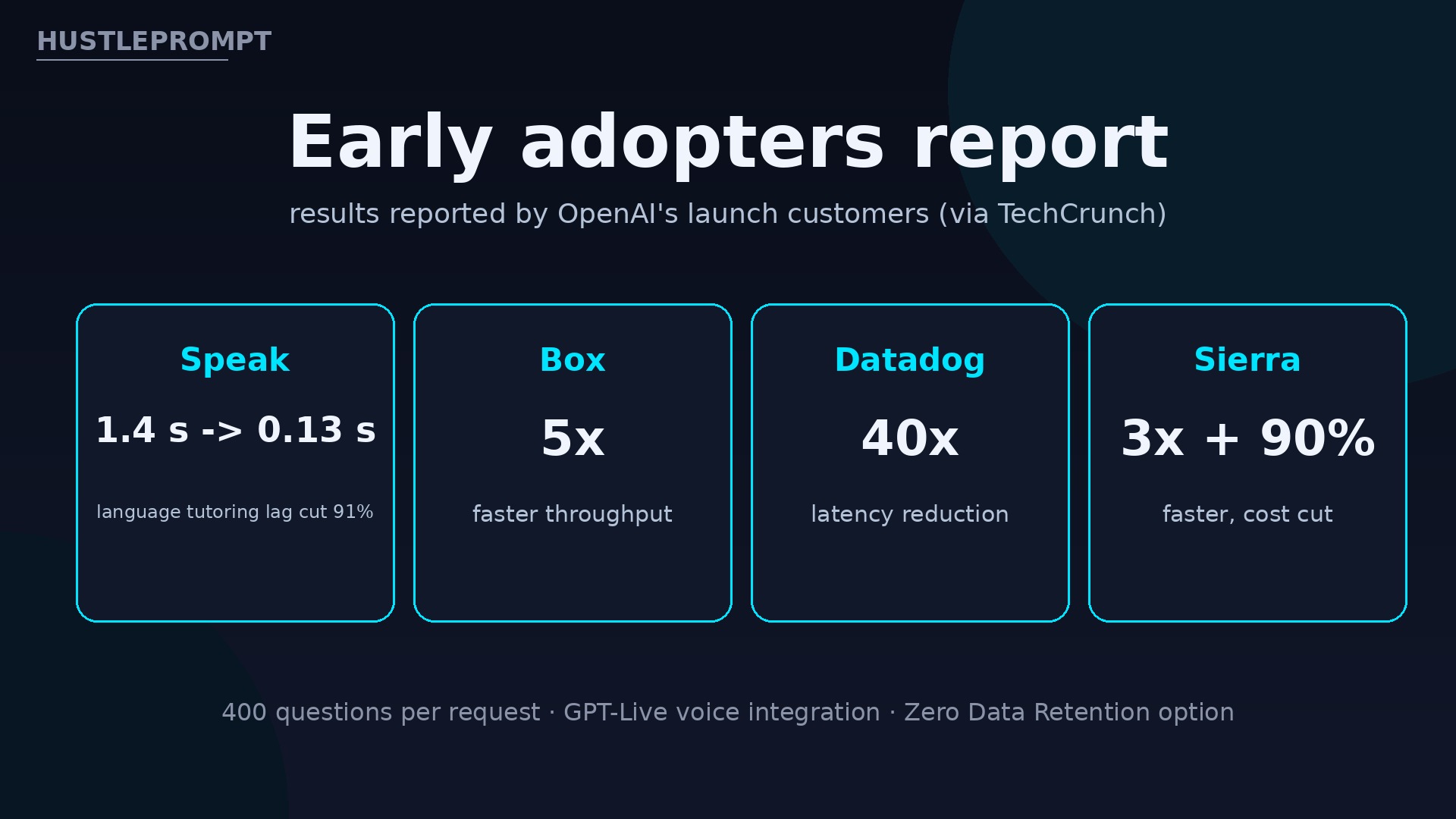
OpenAI tested the API with real customers before opening it up:
- Speak (AI language tutoring): lag between actions fell from 1.4 seconds to 0.13 seconds — a 91% cut
- Box: 5x throughput gain after swapping LLM calls for Decisions
- Datadog: reported 40x latency reduction
- Sierra: 3x speed with 90% cost savings versus standard Responses API calls
OpenAI is also dogfooding it to sharpen its own Dots voice assistant, and Handa’s forward target is a 60-millisecond call — “an API call for every single frame in a video.” One caveat from independent analysis: rivals like Jev rank higher on public benchmarks, so test on your own tasks before migrating anything that matters.
The three answer types, explained
How it works
The endpoint is POST /v1/decisions, and gpt-6-luna is the only model for now. Each request: 1. write the question in plain language, 2. list the allowed answers (your options, rubric, or yes/no condition), 3. pass the context — text, images, or JSON. The response is a typed value plus probabilities, no chatty preamble to strip.
Eligible customers get Zero Data Retention and HIPAA-eligible use — important if you route health- or finance-adjacent data. Regional processing in the US and Europe keeps latency low worldwide.
See the official walkthrough from OpenAI below:
How to profit from this
Every “smart routing” step just got cheaper to run. The plays:
- Cut your own agent costs. Find every workflow that calls a full LLM just to classify, route, or score, and swap those calls for Decisions — Sierra-style savings can reach 90% of that line item.
- Sell triage pipelines. Support-ticket triage, lead scoring, content moderation: charge $500–$2,000/month per client for a pipeline whose API cost is pennies (10,000 tickets ≈ $1 at list price).
- Productize the batch. 400 questions per request scores an entire CRM overnight. Package “CRM lead-scoring audits” as a one-time $997 deliverable.
- Ride the voice wave. The GPT-Live integration enables voice apps that react as people speak — the backbone of voice receptionists, a proven $1,000–$3,000/month local-business retainer.
Frequently asked questions
What is the Decisions API?
A POST /v1/decisions endpoint returning typed decisions — a probability, a choice, or a rubric score — instead of text. Built on GPT-6 Luna; GA since October 22, 2026.
What does it cost?
$0.10 per million input tokens, $0.01 per million cached, zero output fees. Cache writes are billed.
How fast is it?
100–180 milliseconds per decision per OpenAI — up to 10x faster than the Responses API. Speak cut lag from 1.4 to 0.13 seconds.
Which models work with it?
Only gpt-6-luna for now.
How does it compare to TypeSafe’s Jev?
Jev’s $0.042/M rate is cheaper and it benchmarks higher; OpenAI’s edge is distribution plus GPT-Live voice integration and zero data retention.
Should I switch from structured outputs?
If you classify with JSON mode on a full model, you were paying output tokens and waiting seconds per label. Decisions removes both for bounded-answer calls.
Keep Reading
- OpenAI Lands on Google Cloud: GPT-6 Now on All 3 Clouds
Astra, Sol, and Luna are going everywhere. - Always-On AI Agents Are Here: Work While You Sleep
The proactive-agent race fast decisions will power. - Walmart Lets AI Agents Shop for You: Agent Profiles
Commerce is going agentic.
Sources: OpenAI — Decisions API generally available (Oct 22); TechCrunch reporting via Technopolis; AI Weekly — Jev vs. Decisions context.