
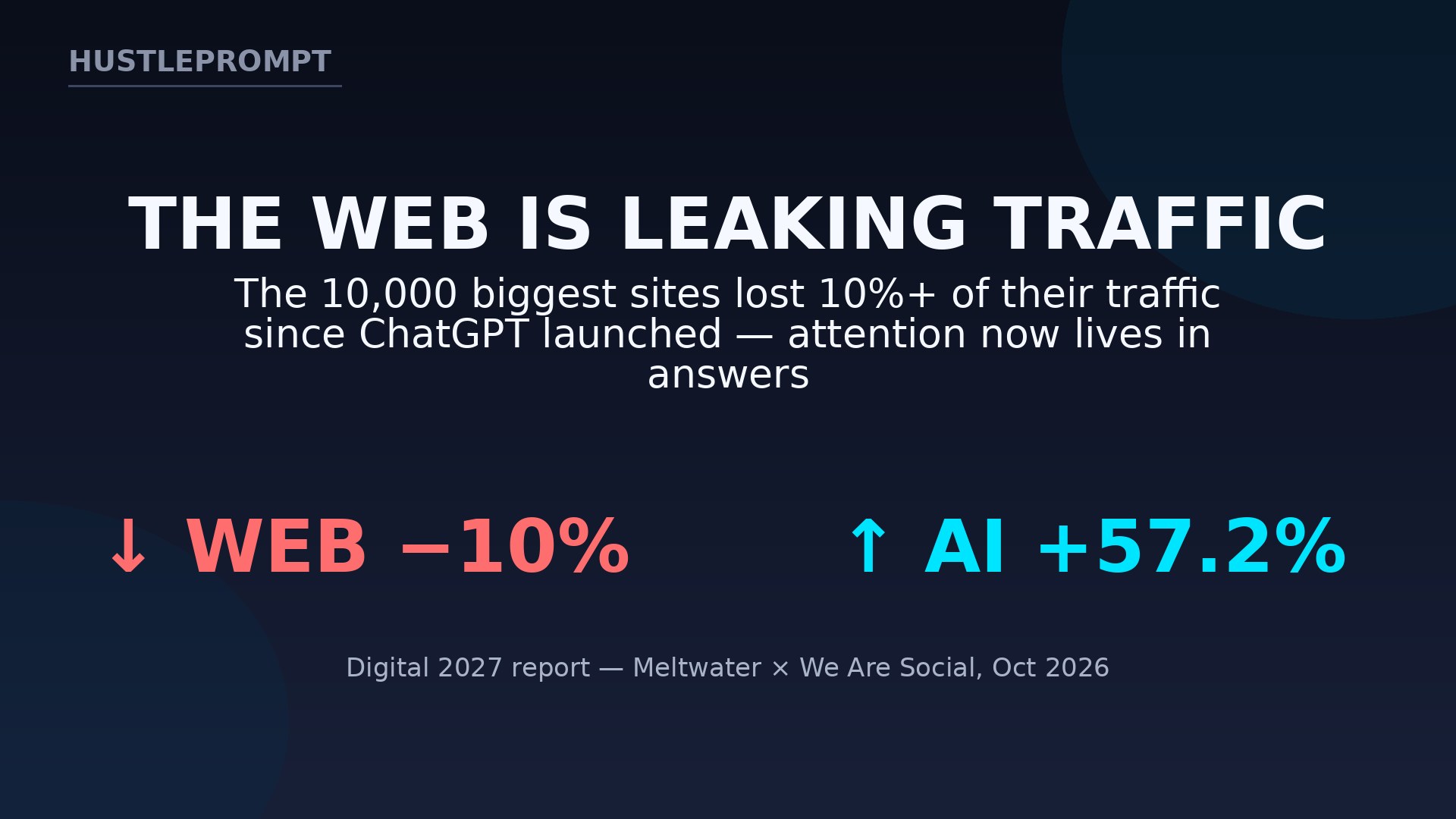
3.24 billion people use generative AI every month — 38.9% of all humanity — while the world’s biggest websites have lost more than 10% of their traffic since ChatGPT launched. Combine those facts and you get the biggest shift in online marketing since Google replaced the Yellow Pages: the click is dying, and the citation is replacing it.
The Digital 2027 report, released October 21, 2026 by Meltwater and We Are Social, documents a global migration of attention away from websites and toward AI answers. Businesses no longer compete just to rank — they compete to be the source AI quotes. For freelancers, this is a gold rush with a starting line.
Where the attention went: the numbers behind the migration
Adoption grew 57.2% in a year, adding 1.2 billion monthly users in 12 months. ChatGPT leads with roughly twice the monthly users of its nearest rival, while Google’s Gemini surges — its mobile app quadrupled users in a year, and its web base is now over 60% the size of ChatGPT’s.
Meanwhile, the old web is shrinking. Across the world’s 10,000 largest web domains, total monthly traffic has fallen by more than 10% since ChatGPT launched, and time spent on the open web dropped 11.2% over the past 24 months, per ecommerce news coverage. The typical user now spends 19 hours 18 minutes per week on social and video — up 3.8% year over year — with YouTube capturing the largest share of global social media time and TikTok leading per-user time at 1 hour 55 minutes a day (BusinessMirror).
Why this matters: search isn’t dead — it’s splitting in two
Note the nuance: online adults are still 74% more likely to visit a search engine than to use an AI platform when researching brands. Search isn’t dead; it’s splitting into the click journey (Google results, website visits) and the answer journey (AI Overviews, ChatGPT answers, AI Mode summaries).
The trend line is what matters. 60.4% of people globally now use AI to find information, and 46.9% of 16-to-24-year-olds use Instagram or Facebook as their primary brand-research source. Discovery happens in answers; only the curious click through. When ChatGPT names your business in its response, you win the customer before they ever open a tab.
What the AI actually cites: follow the citations, not the hype
An October 2026 SE Ranking study (an SEO vendor’s research — industry data, not neutral science) measured exactly where AI answers pull their sources from:
AI models cite content that is specific, structured, and experience-based — video demonstrations, expert threads, first-person reviews. That’s where to build presence.
And the plumbing of commerce is going machine-readable. Since October 12, Google Ads can automatically pull offers from your website into ads, and Google AI Mode can alert users when your prices, stock, or opening hours change (Netmatters digital debrief). If your prices, stock, and hours aren’t in a structured feed the machines can read, you’re invisible to the alert layer.
The AI Citation Economy: how the game is actually played now
Call it the AI citation economy: the market where visibility is won by becoming the source AI models quote. SEO isn’t gone, but it’s joined by GEO (generative engine optimization) and AEO (answer engine optimization) — making your content the one AI answers cite.
The loop works in four stages:
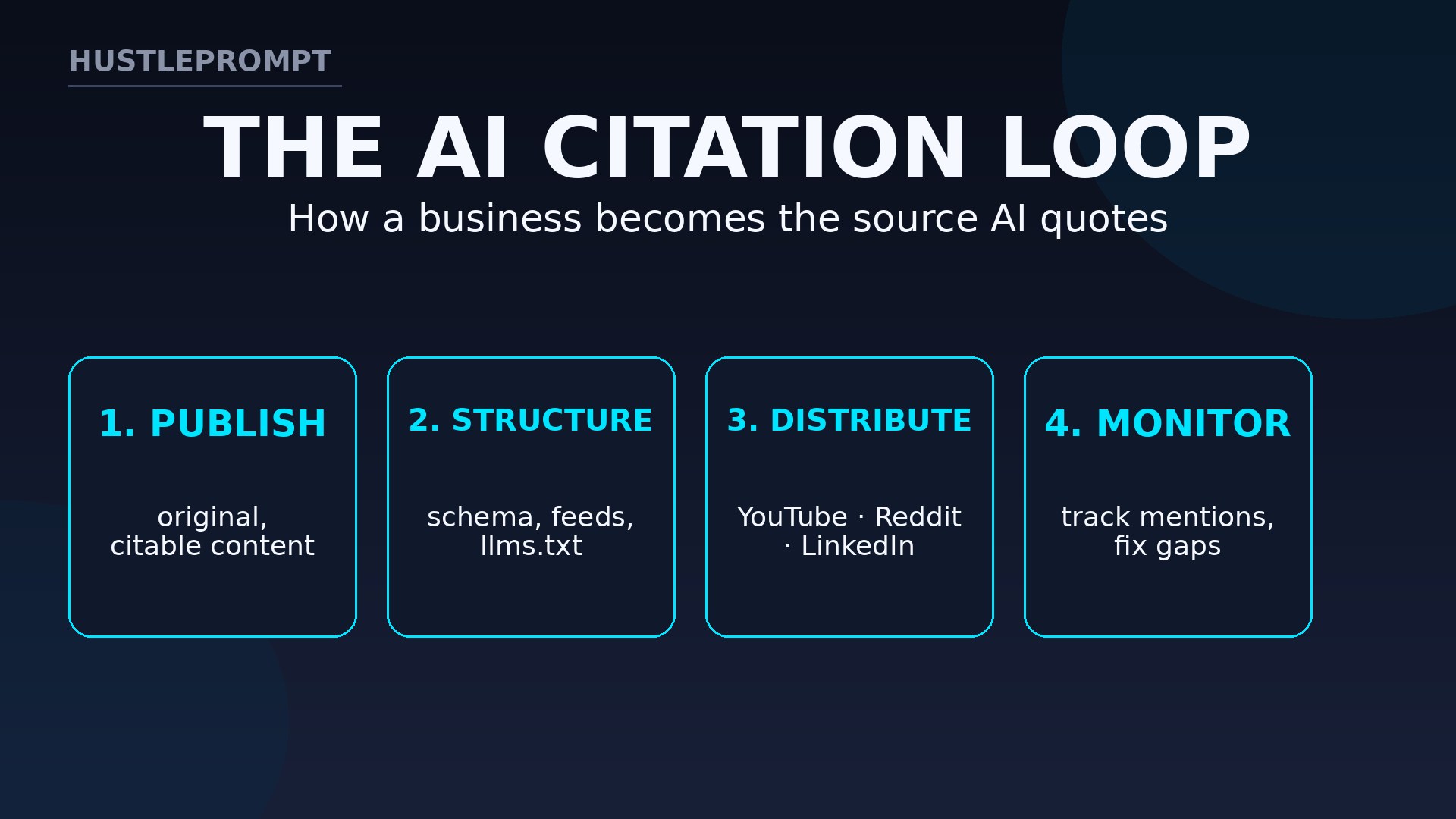
Backlinks matter less than quotability: short, factual, well-structured statements a model can lift verbatim. Social platforms aren’t just “distribution” — they’re your citation infrastructure.
The money angle: sell AI Citation Audits to invisible businesses
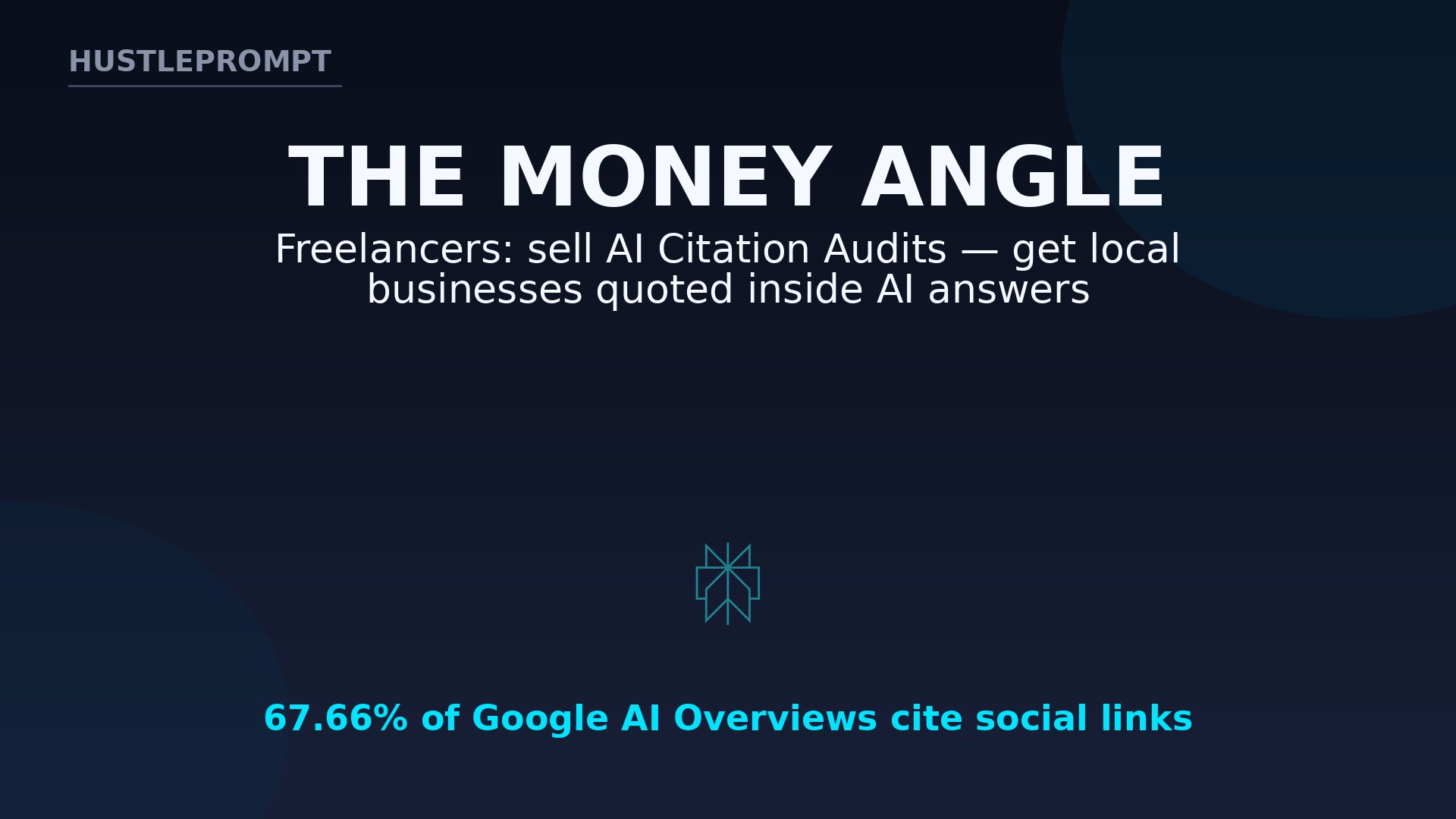
Every local business right now has the same problem: customers ask AI about them, and AI answers with someone else’s information — or nothing at all. Sell the fix: an AI Citation Audit showing a business exactly how it appears inside AI answers, who gets cited instead, and the roadmap to become the quoted source. My suggested pricing (my estimate, not market data): $995 for the audit, plus a $495/month retainer.
What goes inside the audit
- AI visibility test: ask ChatGPT, Gemini, Perplexity, and Google AI Mode the top 10 questions customers ask. Screenshot what each says.
- Citation gap analysis: which competitors get quoted instead — and on which platforms.
- Machine-readability score: FAQ schema, product/price feeds, Google Business Profile, llms.txt. Most businesses have none of these.
- Fix roadmap: prioritized actions with owners and timelines — which becomes your retainer work.
Run this playbook this week
- Pick one niche. Dentists, roofers, wedding photographers, SaaS tools — anywhere customers ask “who’s the best X near me?”
- Run 3 free sample audits for local businesses to build before/after proof. Ask the AI tools, screenshot, fix one thing, re-test.
- Build your citation infrastructure: a YouTube channel answering niche questions, active Reddit/LinkedIn presence, and a website with FAQ schema.
- Package it: audit at $995, retainer at $495/month (my pricing estimate). One client pays for the whole setup.
- Scale with proof: every “before: AI never mentioned you / after: AI quotes you” screenshot is a case study that sells the next client.
Where this is heading: 4 predictions
- AI answers become the primary product-research layer. The “consideration set” will be built by AI, not by ten blue links.
- “Citation SEO” becomes a budget line item. GEO/AEO services — audits, schema, citation monitoring — will sit next to SEO and PPC within 18 months.
- Structured feeds become mandatory. When AI Mode alerts customers about your price changes, your product/stock/hours feed is your storefront. No machine-readable data, no presence in the answer layer.
- The platforms AI cites become the most valuable owned channels. YouTube, Reddit, and LinkedIn aren’t just social media — they’re the raw material of AI answers.
Watch how ranking inside AI search actually works, going into 2027:
Watch: “AEO & GEO Explained: How to Rank in AI Search in 2027” by AI Anytime — answer-engine and generative-engine optimization explained.
Frequently asked questions
Is SEO dead now that AI answers questions directly?
No — it’s splitting. Classic SEO still matters for high-intent queries, and online adults remain 74% more likely to visit a search engine than an AI platform when researching brands. The new second game is getting cited inside AI answers, where a growing share of discovery happens.
What is GEO and how is it different from SEO?
GEO (generative engine optimization) means making your content the source AI models quote, rather than ranking a page for a click. SEO optimizes for the results page; GEO optimizes for the answer — through quotable facts, structured data, and presence on the platforms AI cites.
What is an llms.txt file?
A proposed standard (like robots.txt) summarizing a site’s key information in machine-friendly form for AI crawlers. With FAQ schema and product feeds, it helps AI systems parse and cite your business accurately.
Which platforms do AI answers cite most?
Per SE Ranking’s October 2026 study: social links appear in 67.66% of Google AI Overviews (YouTube leads), 32.39% of AI Mode answers, and 8.4% of ChatGPT answers (Reddit and LinkedIn lead). Presence there is the highest-leverage move for getting cited.
How can a small business get cited by AI?
Publish specific, factual, experience-based content; add FAQ and product schema plus machine-readable price/stock feeds; keep a Google Business Profile updated; post the same expertise on YouTube, Reddit, and LinkedIn. Then ask the AI tools about your business and fix what they get wrong.
How much can freelancers charge for AI citation audits?
No established rate exists yet — it’s a new category. As a starting estimate: $995 for a one-time audit plus a $495/month retainer for implementation and monitoring. Anchor pricing to the cost of being invisible when customers ask AI about your client’s category.