
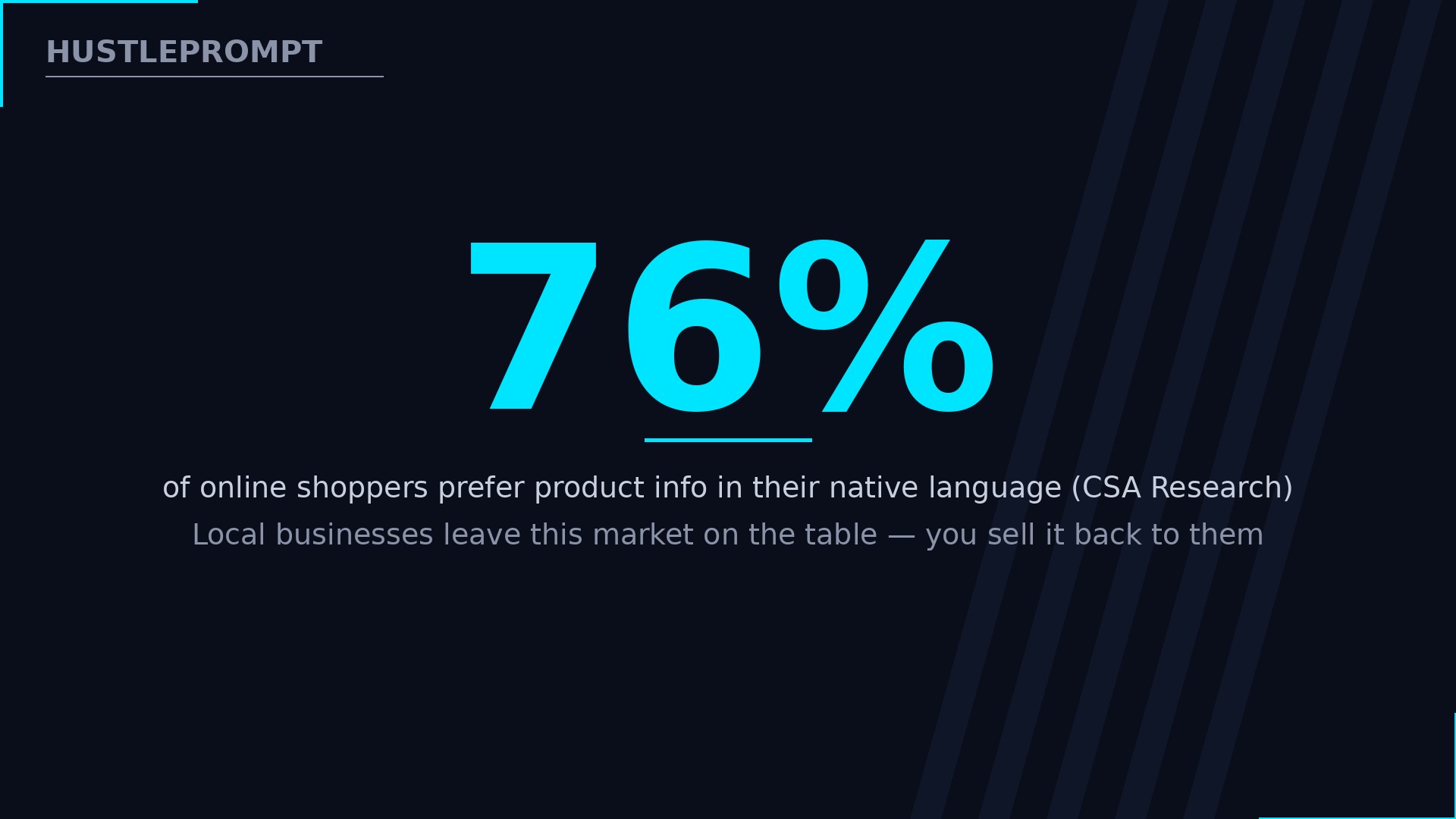
AI website localization turns a plain English site into a Spanish-speaking customer magnet — and 76% of online shoppers prefer product information in their native language. Forty percent will never buy from a website that is not in their language, according to CSA Research’s study of 8,709 consumers in 29 countries.
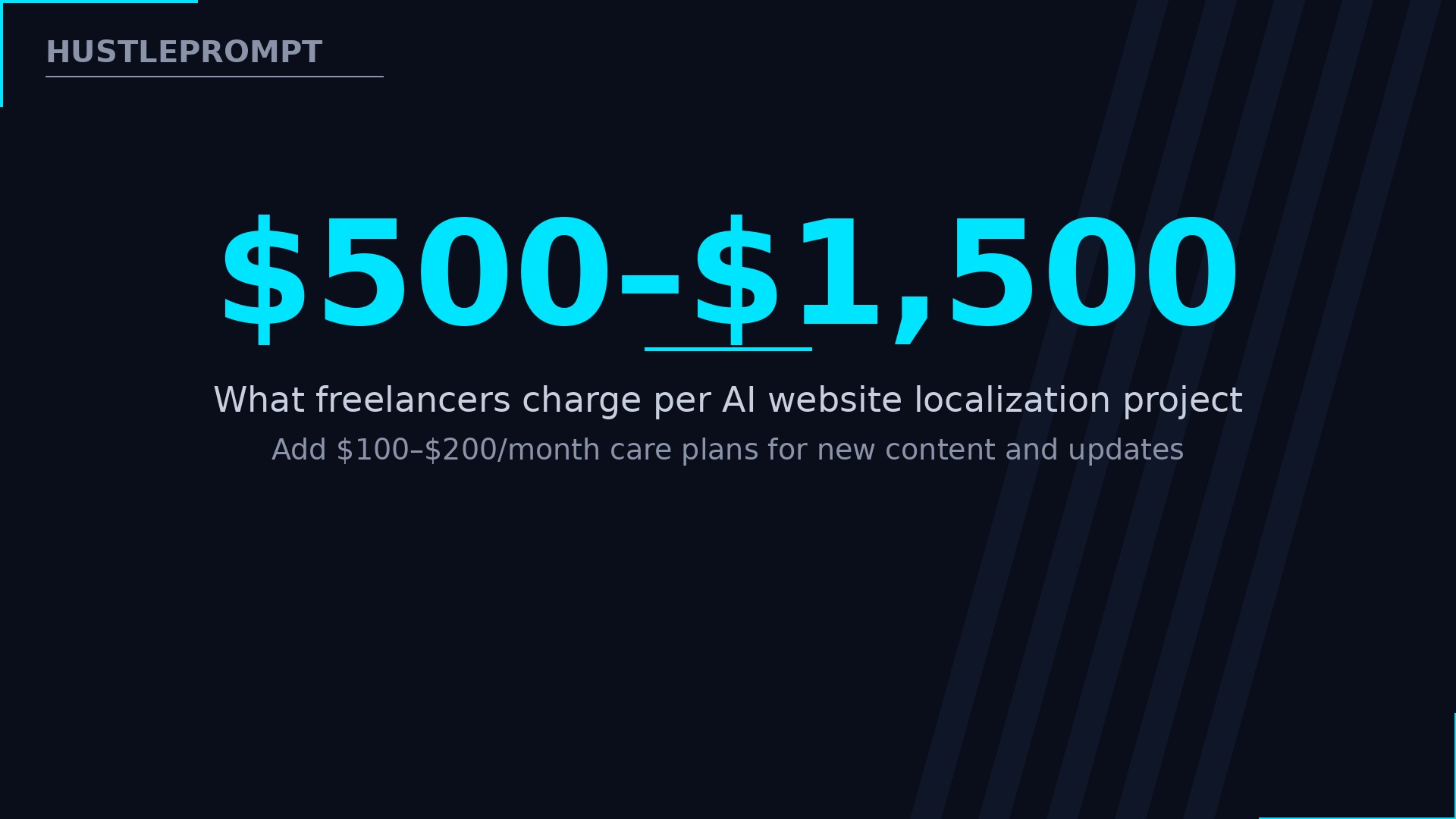
Here is the freelance angle: AI does the first-pass translation in minutes, and you do the human QA that machines cannot — tone, slang, the checkout flow. Small businesses pay $500–$1,500 per project because every new customer pays for the localization many times over.
Video: How to translate a WordPress website | Step-by-step tutorial 2026 — Official Weglot step-by-step tutorial showing how to translate a WordPress site in minutes — the exact first-pass workflow freelancers in this article run before adding their paid human QA layer. (Weglot)
The market case: two stats your prospects can’t ignore
Walk into any local business in Texas, Florida, California, or New York and ask this: “How many Spanish-speaking customers walk past your website every month?” Then show them the data. CSA Research found that 76% of online shoppers prefer buying products with information in their native language — and 40% will not buy at all from sites outside their language.
In the United States, nearly 45 million people speak Spanish at home — your first market, already served in person by most small businesses but ignored online.
Translation works fast, too. Weglot’s published case study of review platform REVIEWS.io reports German traffic up 120% and conversion up 20% after translation (Weglot, 2026). You are not selling words — you are selling a bigger store.
Your AI localization tool stack
Three tools cover 95% of small-business projects. You pay for one or two subscriptions and reuse them across every client — the AI does the heavy lifting, you do the judgment:
| Tool | What it does | 2026 price (billed annually) | Best for |
|---|---|---|---|
| Weglot | Translates the whole site, adds language switcher, dedicated URLs, hreflang tags | Starter $17/mo (10,000 words, 1 language); Business $32/mo (50,000 words, 3 languages) | WordPress, Shopify, Wix — under-10-minute setup |
| DeepL Pro | Top AI translation quality for European languages | Individual $8.74/user/mo (300,000 chars/mo) | First-pass quality and glossaries |
| ConveyThis | Weglot alternative with a free tier and import tools | Entry plans from ~$12/mo (30,000 words) | Budget clients, small brochure sites |
| Your bilingual QA partner | Native reviewer who polishes AI output page by page | $20–$50/hour, project rate | The quality edge machines cannot copy |
Prices are the vendors’ own 2026 listings — confirm at checkout, as plans and regions change. Weglot bills in euros (USD figures are its estimates; see the official 2026 overview); DeepL figures via Eesel’s pricing roundup.
Weglot leads the stack because it auto-generates translated URLs and hreflang tags — the Spanish site can rank on Google, which a raw machine-translation widget never gives you.
The 7-step AI localization workflow
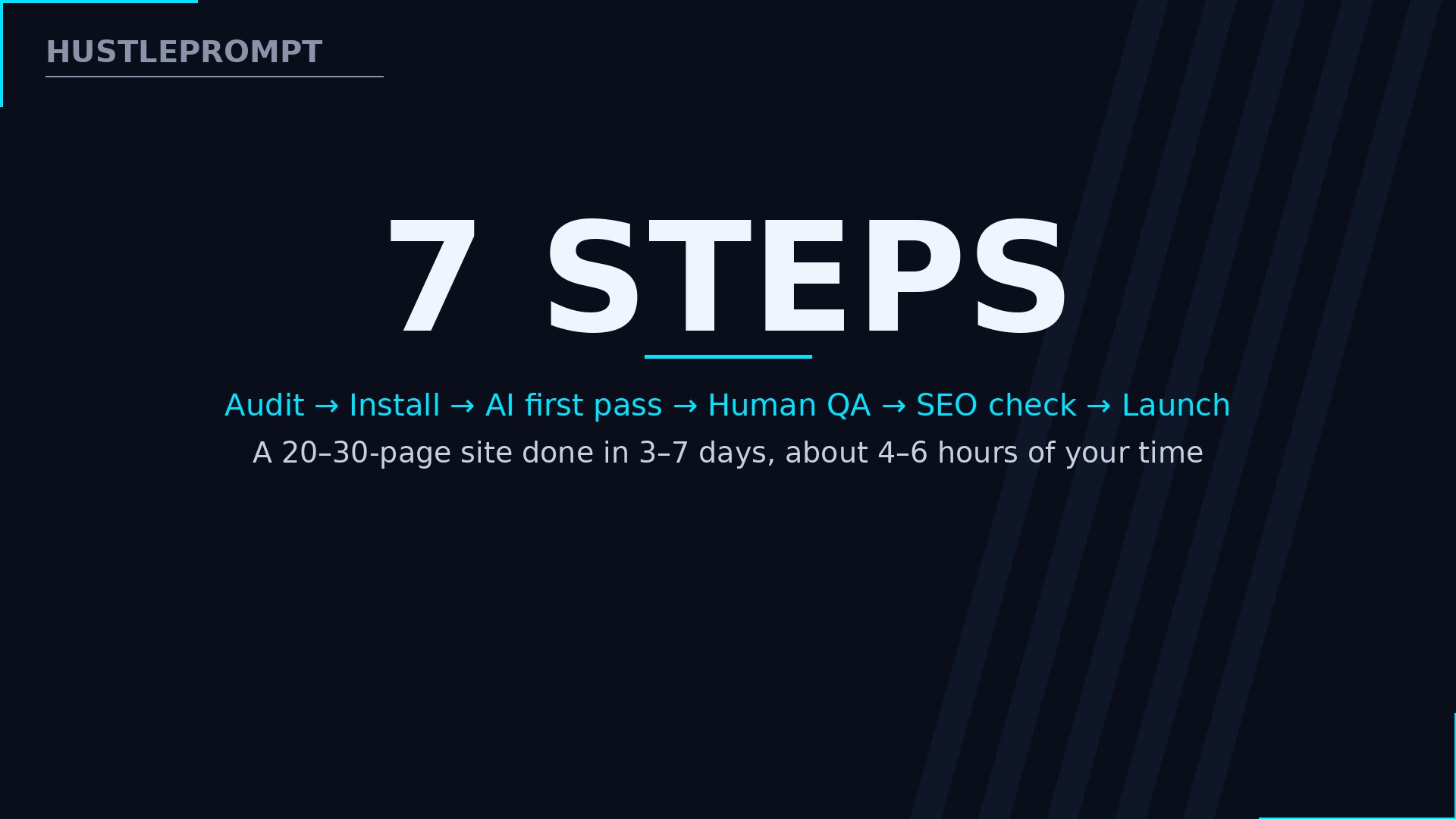
A 20–30-page small-business site takes 3–7 working days from first call to handover:
- Audit (30 min): crawl the site with a word-count tool. Confirm page count, dynamic content (menus, forms, popups), and which language goes first — almost always Spanish for US clients.
- Install and connect (15 min): add Weglot via the WordPress plugin or JavaScript snippet, enter the API key, pick English → Spanish, start the free trial.
- AI first pass (hours): let the engine translate everything. Weglot picks between DeepL, Google, and Microsoft per language pair — always the strongest engine.
- Private review mode: hide the translated version from the public while you work. Your QA reviewer edits tone, idioms, and local phrasing in the Visual Editor.
- Fix the untranslatables: currency and date formats, units, phone conventions, images containing text. This is where human QA earns the fee.
- Multilingual SEO check: verify dedicated URLs (example.com/es/), hreflang tags, and translated meta titles so the new pages can rank.
- Launch and handover: flip the switch and hand the client a one-page care sheet — how new content gets translated automatically — then schedule the upsell call.
Repeatability is the business model. Turn this into a checklist, and project three becomes a template — roughly 4–6 hours of your time per client while the software does the rest.
Pricing: what to charge per project
English↔Spanish runs about $0.10–$0.15/word as a 2026 market range. But you do not sell per word — you sell a finished multilingual website:
- Starter — $500: brochure site up to 15 pages, one language, AI translation + your QA pass. The door-opener.
- Standard — $900: 15–40 pages, one language, full QA, multilingual SEO check, launch handover. The volume product.
- Premium — $1,500: everything in Standard plus two languages, form localization, and a 60-day fix window.
- Care plan — $100–$200/month: new content translated and QA’d automatically, quarterly glossary updates. Recurring revenue.
Arithmetic illustration, not a promise: two Standard projects a month is $1,800 against roughly $20–$40 in tool subscriptions, since one Weglot account serves multiple clients. The margin comes from judgment, not hours.
Outreach: landing your first three clients
Small businesses do not search for “localization.” Sell the customer they are losing:
- Target by zip code: Google Maps “plumber,” “dentist,” “law firm,” “HVAC” in high-Hispanic-population areas.
- The 60-second audit: open their site, confirm there is no Spanish version, screenshot the homepage.
- Send the one-pager: the screenshot, the CSA stat (76% prefer native-language info), your price. Under 100 words.
- Follow up once: one polite bump after 4–5 business days. Most yeses come here.
The script: “I checked your site and saw it’s English-only. 76% of online shoppers prefer buying in their language — around here that’s a lot of customers. I localize sites with AI plus human review for $900, live in under a week. Want the one-page plan?”
Quality control: the human QA edge
Raw AI translation is good — CSA found 65% of consumers accept even poor-quality native-language content. But businesses pay YOU for the final 10% that builds trust:
- Tone and register: AI writes formal Spanish where a taco shop needs warm, casual Spanish. Your reviewer fixes it.
- Local idioms: “carro” vs “coche” — the US Hispanic market has its own vocabulary.
- False friends: marketing copy is where machines embarrass clients; your reviewer catches them.
- Forms and checkout: test the whole funnel in Spanish. A mistranslated address field kills the sale.
If you are not fluent, hire a native reviewer from day one ($20–$50/hour). The QA line is a cost line in your quote — and it is the reason clients cannot just buy Weglot themselves.
Upsells that grow the account
The first translation is the sale; everything after is margin:
- Second language — $400–$700: Portuguese, French, or Mandarin depending on the local market.
- Multilingual SEO package — $500: translated keyword research, meta rewrites, and a second-language Google Business Profile.
- Ongoing updates — $100–$200/month: new pages flow through AI translation plus your QA automatically.
- Ad landing pages — $250/page: Spanish versions of their Google Ads pages, where lifts are easiest to measure.
FAQ
Do I need to speak Spanish (or another language) myself?
No — but you need a native reviewer for the QA step ($20–$50/hour). Many localization sellers never speak the target language; their skill is the workflow, the tools, and the SEO.
How is localization different from translation?
Translation swaps words. Localization adapts everything: formats, units, images with text, forms, tone, and SEO structure. That is why you charge per project, not per word.
Which website platforms does this work with?
Weglot and ConveyThis integrate with WordPress, Shopify, Wix, Squarespace, and Webflow — and with any site via a JavaScript snippet. No developer needed.
How long does a project actually take?
A 20–30-page site runs 3–7 working days: one day for install and AI pass, the rest for QA, SEO checks, and revisions. Your hands-on time is roughly 4–6 hours once you have the checklist down.
Will the translated pages rank on Google?
Yes: dedicated URLs (example.com/es/), hreflang tags, and translated meta titles — all automatic in Weglot. Free translation widgets cannot be indexed, which is your selling point.
Can AI handle legal disclaimers or medical pages?
Machine translation plus your review works for marketing and service pages. For regulated content (legal, medical, financial disclosures), insist on a certified human translator for those pages, priced as an add-on. Never gamble with liability text.
What should I charge as a beginner?
Start with the ladder above: $500 starter, $900 standard, $1,500 premium, $100–$200/month care plans. Those ranges reflect 2026 freelance market conditions — your local market and portfolio decide where you land inside them.