
Moonshot AI just put near-frontier coding AI within 0.7 percentage points of Anthropic’s most expensive model — then cut the API price by a third and promised to give the whole thing away free on November 4. Kimi K3.1 Pro, launched today, is the most aggressive open-model move of 2026, and it changes the math for anyone selling AI-powered services.
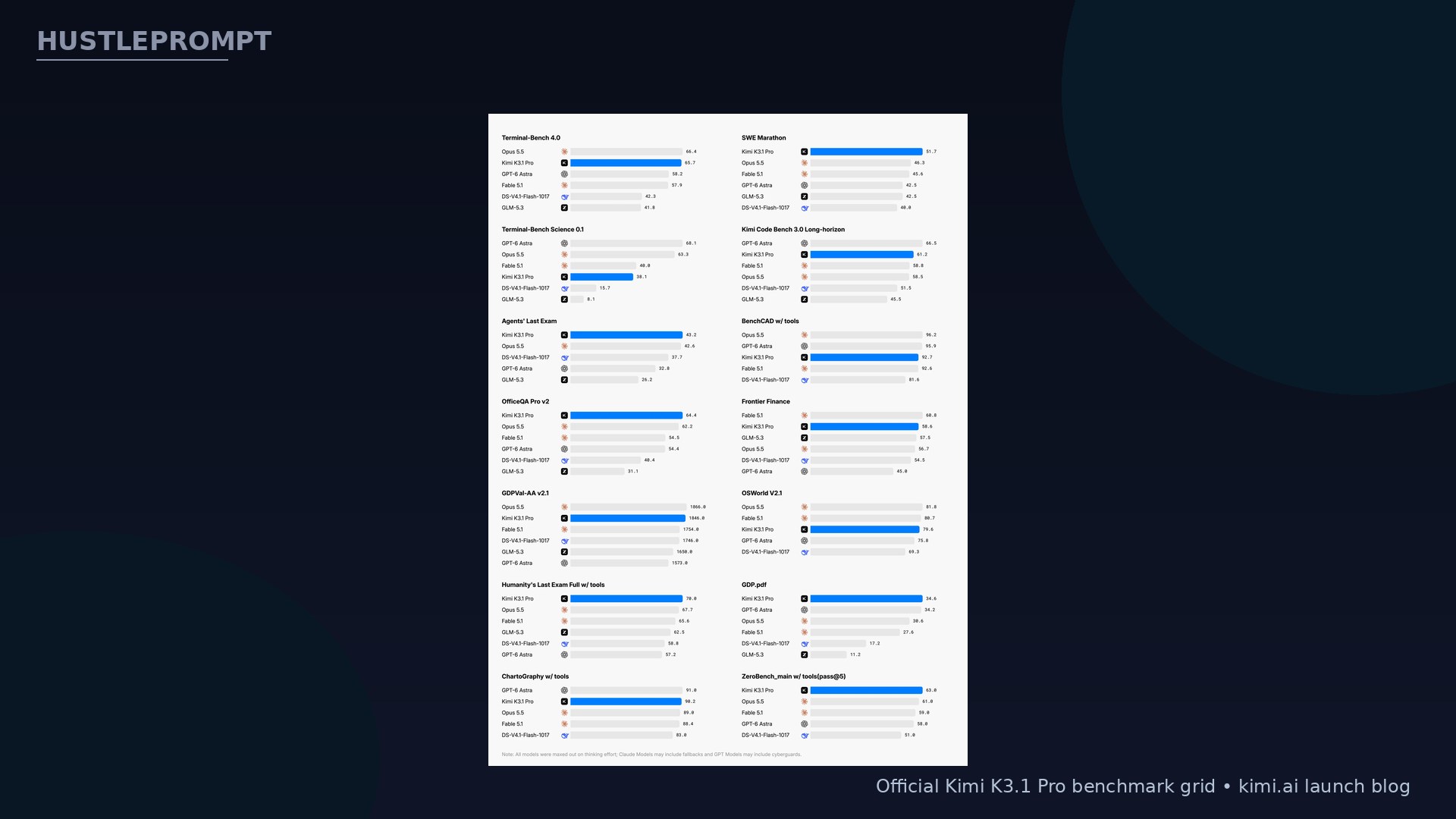
Here is the short version: you get 65.7% on Terminal-Bench 4.0 — a test of real coding agents working in real terminals — against 66.4% for Claude Opus 5.5 and 58.2% for GPT-6 Astra. The API costs $2 per million input tokens and $10 per million output. And the full open weights land by November 4, meaning you can run it on your own hardware at zero per-token cost.
What Moonshot launched today
Kimi K3.1 Pro is the first model in Moonshot’s new K3.1 series, described in the official Kimi K3.1 Pro tech blog as the company’s “most capable 3T-class open-weight model to date,” with a 1-million-token context window. It is a post-trained version of Kimi K3 with, in Moonshot’s words, “substantially larger post-training compute” — joint reinforcement learning across “hundreds of downstream domains” rather than a new base model.
Two versions shipped today:
- Kimi K3.1 Pro — the full model, thinking mode always on, reasoning effort configurable (low / high / max, default max).
- Kimi K3.1 Pro Highspeed — identical capabilities at 2–3× the speed, for more responsive interactions.
Both are live now on Kimi.ai, the Kimi mobile apps, Kimi Work (desktop, v3.1.0+), Kimi Code (select via the /model command), and the Kimi API as kimi-k3.1-pro and kimi-k3.1-pro-highspeed. The full model weights will be released by November 4, 2026.
The benchmarks: within striking distance of the frontier
All numbers below are from Moonshot’s official launch data — the company flags that these are its own evaluations, not yet independently audited. K3.1 Pro was run inside Anthropic’s Claude Code harness; rival scores come from their published reports or official leaderboards.
| Benchmark | Kimi K3.1 Pro | Claude Opus 5.5 | GPT-6 Astra |
|---|---|---|---|
| Terminal-Bench 4.0 (coding agents) | 65.7% | 66.4% | 58.2% |
| Kimi Code Bench 3.0 Long-horizon | 61.2% | — | — |
| BenchCAD w/ tools (3D/CAD code) | 92.7% | 96.2% | 95.9% |
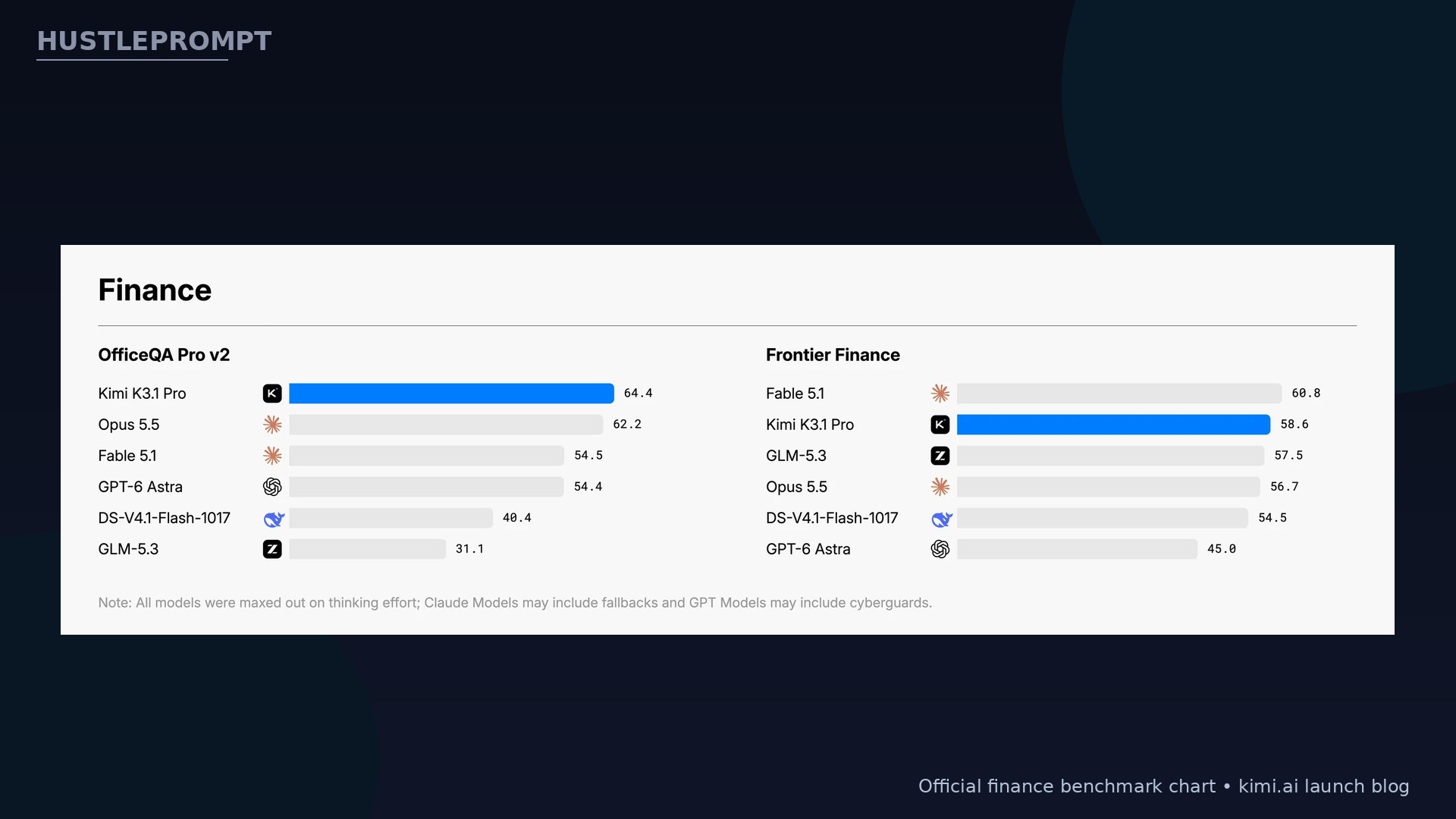
| OfficeQA Pro v2 (finance docs) | 64.4 (SOTA) | 62.2 | 54.4 |
| Frontier Finance (invest workflows) | 58.6 | 56.7 | 45.0 |
The independent check that matters: Artificial Analysis puts K3.1 Pro at 55 on its Intelligence Index — fourth overall, behind only Claude Opus 5.5 (58), Claude Sonnet 5.5 (56) and Muse Wonder Full (56). K3 scored 44. If the weights ship on schedule, K3.1 Pro becomes the highest-scoring open-weight model on that index, cutting the open-vs-closed gap from 12 points to 3.
The price cut that changes the math
Moonshot’s listed API pricing (via its official price list, as reported by The Decoder and benchmark trackers) puts Kimi K3.1 Pro at $2 per million input tokens and $10 per million output tokens, with cached input at $0.20 — a 33% cut from K3’s $3/$15/$0.30. The Highspeed variant lists at $4/$20 with $0.20 cached input.
| Model | Input / M tokens | Output / M tokens | Cached input / M |
|---|---|---|---|
| Kimi K3.1 Pro | $2.00 | $10.00 | $0.20 |
| Kimi K3.1 Pro Highspeed | $4.00 | $20.00 | $0.20 |
| Kimi K3 (previous) | $3.00 | $15.00 | $0.30 |
| Claude Opus 5.5 | $4.00 | $20.00 | — |
Translation: near-Opus coding performance at half the input and output price of Opus 5.5 — and output is where coding agents burn tokens. Artificial Analysis estimates the cost per Intelligence Index task at about $1.98, roughly flat vs K3, because the model generates 14% more output tokens but each costs 33% less.
Key numbers, straight from the launch
Moonshot launch blog
Moonshot Kimi Hallu Bench Hard
Moonshot internal finance bench
Moonshot safety eval
Two of these deserve a closer look. First, the hallucination drop: on Moonshot’s hardest factual-accuracy stress test, the share of responses containing at least one factual error fell to 42.4% of the predecessor’s rate — this is why the model is suddenly credible for financial research, not just coding demos.
Second, the cyber section. Moonshot says it deliberately removed cyber-related data from both mid-training and RL before the open-weight release. On its xdev-bench-hard (reproducing recently disclosed bugs in the Linux kernel, Node.js, Exim and others), the released model scores 81.0% versus 90.5% for the unfiltered checkpoint. Moonshot’s stated principle: not to release open weights “that would extend the absolute frontier of cyber capability” — while still leaving enough capability for defensive security work.
How to profit from Kimi K3.1 Pro
The playbook is simple: sell near-frontier AI work at frontier quality while paying half the token cost — then go to zero cost when the weights land on November 4.
- Coding agent services. Terminal-Bench 4.0 (65.7% vs 66.4%) is a test of agents doing real multi-step engineering work. Freelancers can sell debugging, migration, and full-project builds through Kimi Code or the API at 33–50% lower inference cost than before, keeping the margin.
- Financial research products. OfficeQA Pro v2 at 64.4 (state of the art) and Frontier Finance at 58.6 mean fiscal document analysis, DCF models and cross-document verification are in scope. Moonshot’s own examples include a fully linked NVDA DCF/LBO model and an investment-committee deck.
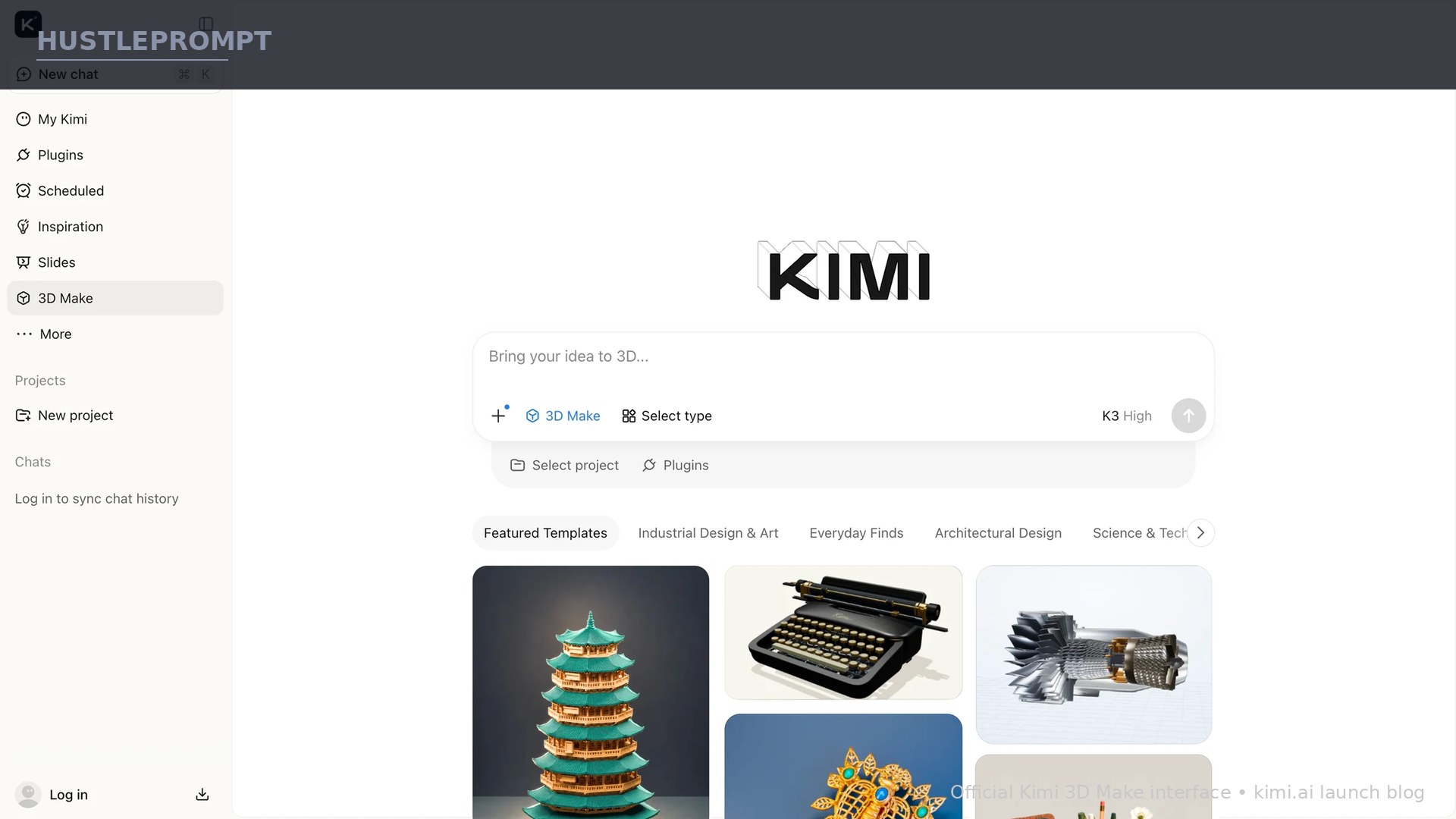
- 3D asset services. BenchCAD at 92.7% plus the new 3D Make feature (live on kimi.ai and the Kimi app: text-to-3D, preview, export for 3D printing or video) opens product mockups, game assets and configurators for clients.
- Self-host on November 4. When the open weights drop, teams can run the model on their own infrastructure — zero per-token cost, full data control, and no vendor lock-in. This is the endgame for agencies with steady workloads.
The K3.1 Pro Money Playbook
Cache-heavy workloads get an extra boost: cached input costs just $0.20/M with automatic prefix caching.
The honest catches
- Moonshot’s numbers are self-reported. The Terminal-Bench scores ran in the Claude Code harness; independent verification lands once the weights are out and labs can test them directly.
- The weights are a promise, not a download. “By November 4” is a commitment, not a file. Until then, you are on Moonshot’s hosted API.
- Weak on science terminal tasks. On Terminal-Bench Science 0.1, K3.1 Pro trails the frontier badly — this is a coding/finance/3D specialist, not a generalist.
- API quirks. Thinking mode is always on (requests with it off are rejected), temperature and top_p are fixed at 1.0/0.95 (omit them), vision needs base64 or ms:// IDs — no public image URLs — and web search is “being updated,” so do not build production workflows on it yet. API access unlocks after a top-up of at least $1.
- K2 models are retiring. New sign-ups lose K2 access October 31; the series shuts down by end of December. Budget any K2-dependent workflows now.
How to get started today
- Go to Moonshot’s official Kimi K3.1 Pro quickstart and get an API key.
- Top up at least $1 — this unlocks the model and sets your tier and rate limits (concurrency, RPM, TPM, TPD) by cumulative top-up.
- Use model IDs
kimi-k3.1-proorkimi-k3.1-pro-highspeed. Setreasoning_efforttomaxfor the benchmarked results (default), orlow/highfor cheaper/faster runs.max_completion_tokensdefaults to 131,072 and can go up to 1,048,576. - For teams: Kimi Enterprise admins must switch K3.1 Pro on — it is off by default. API customers can request Zero Data Retention.
Kimi K3.1 Pro FAQ
When was Kimi K3.1 Pro released?
Moonshot AI launched Kimi K3.1 Pro on October 23, 2026, alongside a faster Kimi K3.1 Pro Highspeed variant (2–3× speed). It is live now on Kimi.ai, Kimi Work, Kimi Code and the Kimi API.
How much does Kimi K3.1 Pro cost?
On Moonshot’s API price list: $2 per million input tokens, $10 per million output tokens, with cached input at $0.20 — a 33% cut from K3. Highspeed costs $4/$20. API access unlocks after a top-up of at least $1.
When do the Kimi K3.1 Pro open weights release?
Moonshot says the full model weights will be released by November 4, 2026. After that, anyone can download, self-host and fine-tune the model.
Is Kimi K3.1 Pro better than Claude Opus 5.5?
Close but not quite. On Terminal-Bench 4.0, K3.1 Pro scores 65.7% versus 66.4% for Opus 5.5 — and it beats GPT-6 Astra (58.2%) decisively. On the independent Artificial Analysis Intelligence Index it ranks 4th with 55 points, behind only Opus 5.5, Sonnet 5.5 and Muse Wonder Full.
What can you build with Kimi K3.1 Pro?
Long-horizon coding agents (Unity, Unreal, Godot, full-project builds), financial modeling and research (it leads OfficeQA Pro v2), 3D creation via BenchCAD-level CAD scripting and the new 3D Make feature, plus auditable research with a hallucination rate cut from 23.4% to 8.3% on Moonshot’s hardest test.
Is Kimi K3.1 Pro safe to use commercially?
Moonshot removed cyber-related training data so the open release won’t extend the frontier of offensive hacking, and the API offers Zero Data Retention for customers. Enterprise access is admin-controlled and off by default. As always with Chinese-hosted models, check your own compliance requirements before production use.