
What if every paragraph you ship from Claude carried a secret signature only machines can read? It does now. Claude text watermarking is live: Anthropic weaves an imperceptible mark into generated words — invisible to readers, detectable with Anthropic’s key.
An emergent.sh report on October 23 spotlighted the system, citing 95%+ detection for texts over 200 tokens. The facts come from Anthropic itself: announced August 2026, documented on its official support page (updated October 21). If you create or sell content, here’s what changed — and how to profit.
What Anthropic Actually Announced
On August 11, 2026, Anthropic confirmed that future Claude models would generate text containing a watermark — “a way of determining the likelihood that Claude was involved in writing the text.” Three days later it published “How Claude’s text watermarking works,” a plain-language explainer.
The trigger: Article 50 of the EU AI Act, applying since August 2, 2026, requires generative-AI providers to mark outputs machine-readably. Anthropic signed the EU’s transparency Code of Practice in July — and, unable to scope marking by region, applied it globally. No opt-out.
How the Watermark Works
A text watermark is a statistical pattern hidden in word choices. Claude constantly picks between equally good words — “overcast” vs. “grey” — and the system tilts those low-stakes choices per a secret key. Readers see nothing; a keyed detector can check the pattern.
Per Anthropic’s official documentation:
- Imperceptible: no change to meaning, quality, or readability.
- Nothing added: no hidden characters, metadata, or visible labels.
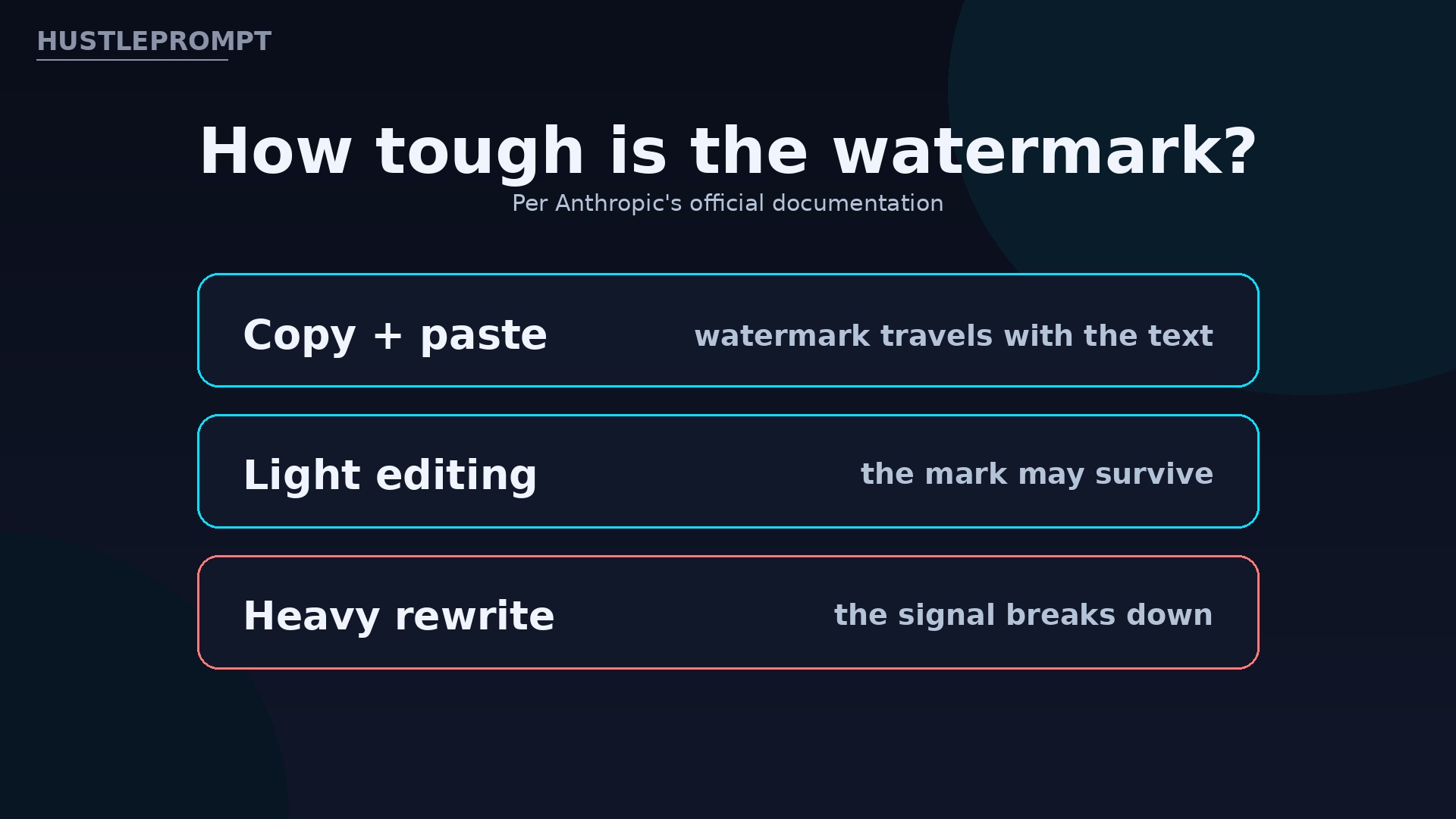
- It travels: the mark lives in the words, so it moves with copy-pasted text and may persist through some editing.
- Model-level: applied by the model itself — present on every Claude surface.
Files are handled separately: Claude-generated PNGs, JPGs, and SVGs carry signed provenance metadata under C2PA, the content-authenticity standard.
Which Claude Models Are Marked
| Model | Text watermark | C2PA on files |
|---|---|---|
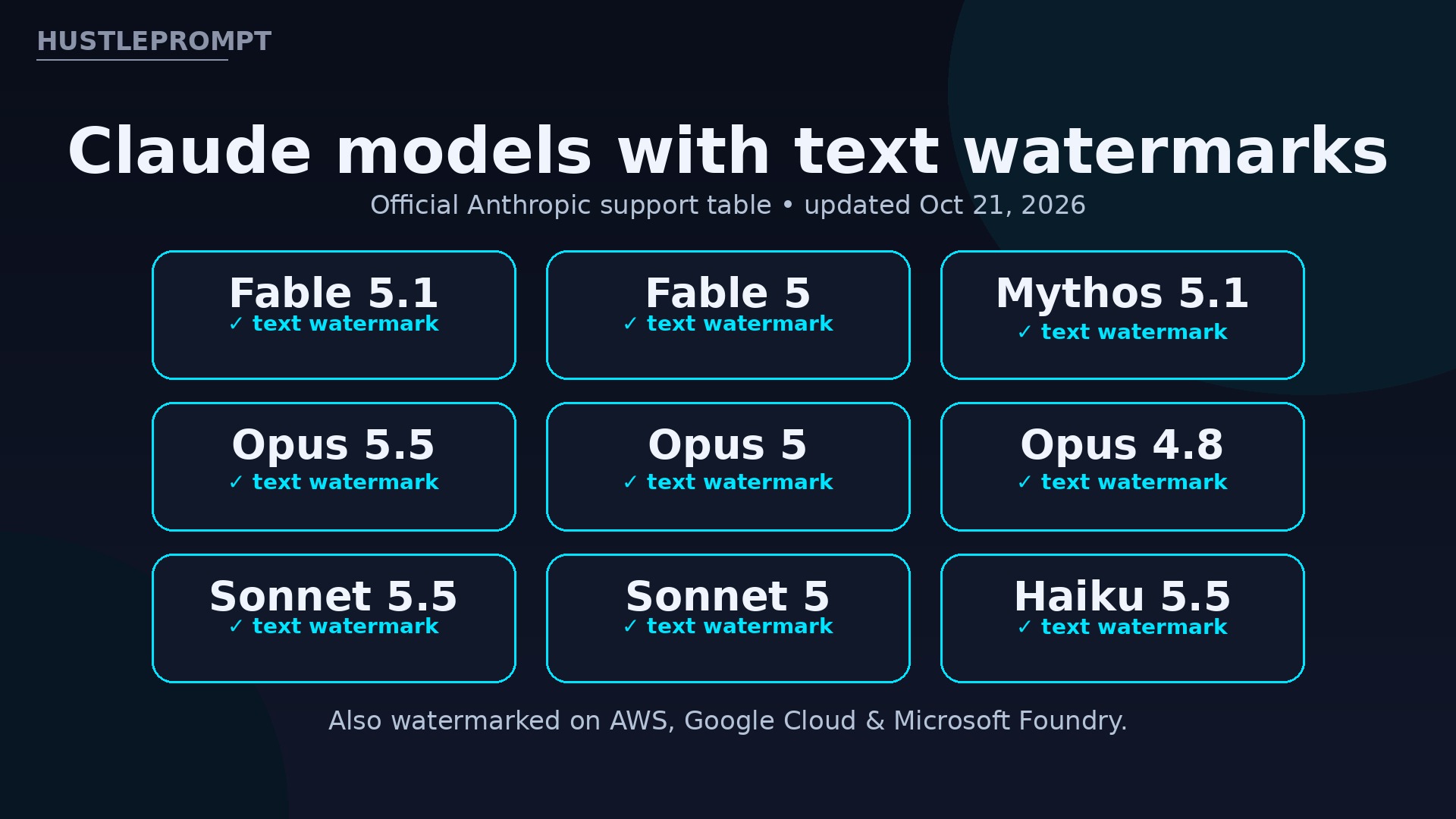
| Fable 5.1 / Fable 5 | Yes | Yes |
| Mythos 5.1 | Yes | Yes |
| Opus 5.5 / Opus 5 / Opus 4.8 | Yes | Yes |
| Sonnet 5.5 / Sonnet 5 | Yes | Yes |
| Haiku 5.5 | Yes | Yes |
Source: Anthropic support (updated Oct 21, 2026). Marking also applies via AWS, Google Cloud, and Microsoft Foundry — the Bedrock rollout completes October 23.
Nine models carry live text watermarks, with older models being retrofitted.
What the Mark Can and Can’t Prove
A watermark is a provenance signal, not a lie detector. Anthropic is explicit: detection means the content may have been generated or processed by Claude — nothing more specific.
| The watermark can | The watermark can’t |
|---|---|
| Suggest Claude likely generated or processed the text | Prove who wrote it, or that a human didn’t |
| Travel with copy-pasted text | Survive a heavy rewrite or translation |
| Work across app, API, Code, and cloud partners | Be checked by the public — detection is in private preview |
| Mark files with signed C2PA credentials | Identify the user, organization, or chat |
Based on Anthropic’s official documentation (support.claude.com).
Two limits matter for creators. Short or constrained text — code, factual answers, light proofreading — gives the model fewer free word choices, weakening the signal. And absence proves nothing: older models are still being retrofitted, and rival AI text carries no Claude mark.
How to Profit: Sell Trust in the Watermark Era
Every agency, publisher, and educator using Claude has a provenance question now — and most don’t know it. Five steps:
- Learn the detection landscape. Text watermark (private-preview API for eligible orgs) vs. C2PA file credentials (public via the free Claude Content Checker) vs. generic “AI detector” scores (statistical guesses). Clients conflate all three.
- Offer AI-use audits: map where AI touches a client’s pipeline and what must be disclosed. Compliance-adjacent work bills well.
- Bundle C2PA checks: the free Content Checker verifies file credentials today — a natural add-on for creative services.
- Write disclosure policies: a one-page “how we use AI” policy is a trust asset. Template it, customize per client.
- Be the honest broker: “We use Claude openly — here’s our watermark-aware workflow.”
FROM PROMPT TO PROOF
1 · You prompt Claude
Any surface: app, API, Code, or a cloud partner.
2 · Words get picked
Low-stakes choices tilt per a secret key. Text reads perfectly normal.
3 · Pattern travels
Copy, paste, publish — the signal rides along in the words.
4 · Detector scores it
With Anthropic’s key: “likely Claude” — or not.
The mark is the pattern of choices, not hidden characters. Source: Anthropic support.
FAQ
Does the watermark change what Claude writes?
No — it’s imperceptible, with no change to meaning, quality, or readability. Only low-stakes word choices tilt, never the substance.
Can clients detect that I used Claude?
Only with Anthropic’s detection tooling, currently in private preview. No public text checker exists; file credentials are checkable via the free Claude Content Checker.
Can I remove the watermark?
Light editing likely won’t remove it — the pattern spans many word choices. A full rewrite replaces those choices, but then the text is meaningfully yours anyway. Nothing to strip: no hidden characters, no metadata.
Which Claude models are watermarked?
Nine: Fable 5.1, Fable 5, Mythos 5.1, Opus 5.5, Opus 5, Opus 4.8, Sonnet 5.5, Sonnet 5, Haiku 5.5 — across app, API, Code, and cloud partners.
How can I prove my content is human-written?
You can’t prove a negative — absence of a mark proves nothing. Use process evidence instead: drafts, revision history, and a clear AI-use disclosure policy. That’s also a service you can sell.
Keep Reading
Official sources: Anthropic support — “How Claude marks AI-generated content” (updated Oct 21, 2026). News peg: emergent.sh — “Anthropic Claude Models Now Include AI Text Watermarks” (Oct 23, 2026).