
Every finance team buying AI asks the same question: what are we actually getting for this money? On October 28, 2026, Anthropic answered with proof, not promises. Claude Enterprise now includes three generally available tools showing what teams do with Claude, what it costs, and whether employees think it is worth it.
The timing is no accident: Anthropic is heading toward a public listing, and buyers must justify AI spending. According to Anthropic’s official announcement, smart reports, in-app surveys, and pooled group budgets are now generally available for Claude Enterprise, turning return on investment into a report an admin can open.
Evidence, from Anthropic’s official announcement: all three tools are generally available for Claude Enterprise; smart reports analyze transcript samples, grouping work into workstreams with spend, deliverables, and friction.
Surveys capture the team’s view of value and time saved; pooled budgets give each team one shared monthly budget, with alerts at 50%, 75%, 95%, and 100%.
What actually launched
These are three views of the same question: is this AI spend earning its keep?
| Tool | What it does | Who it helps most |
|---|---|---|
| Smart reports | Transcript samples grouped into workstreams, with spend, deliverables, friction | Admins planning investment |
| In-app surveys | Employees report value, time saved, and what would slow down without Claude | Leaders needing proof of value |
| Pooled group budgets | One shared monthly budget per team, individual limits as guardrail, alerts at 50%, 75%, 95%, 100% | Finance and admins controlling spend |
Availability varies by configuration, including HIPAA and customer-managed encryption key setups. Check the Help Center first.
Smart reports: the work, priced
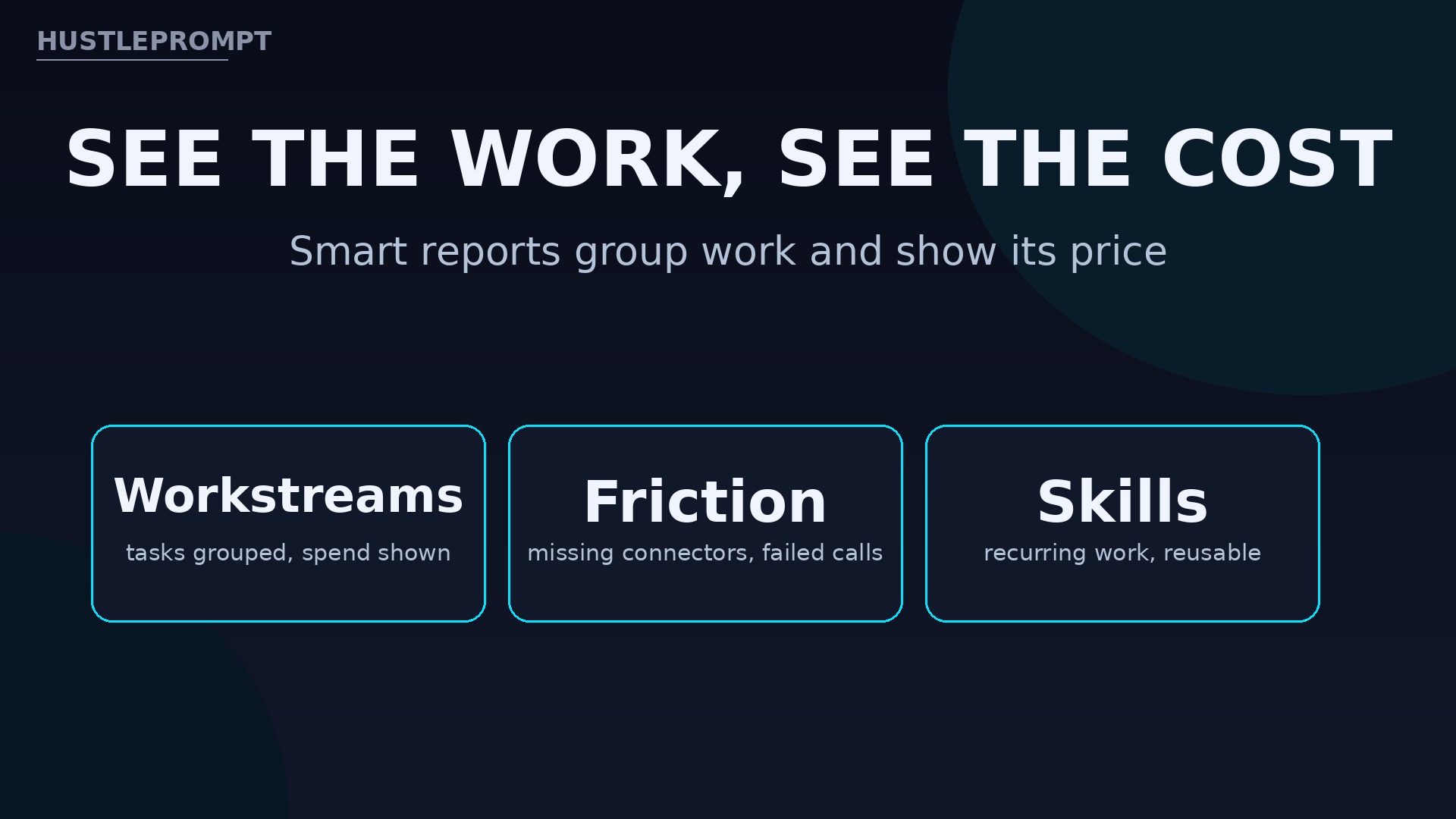
A smart report starts with three choices: a team, a date range, and products to include. Claude analyzes a transcript sample, grouping work into workstreams with spend, deliverables, and friction such as a missing connector or failed tool call.
The most useful part is the recommendations list: recurring workflows to turn into skills and rules for a code repository. Findings can be shared as an artifact, and admins can save custom usage and cost questions as templates.
Anthropic draws one clear line: smart reports inform investment planning, but are not for evaluating individual performance or employment decisions.
The ROI loop, in three steps
Together, the three tools form a loop enterprises have been missing: measure, ask, control.
1. Measure with smart reports. What work happened, what it cost, where it stalled, by workstream.
2. Ask with in-app surveys. What was valuable, what saved time, what a teammate should copy.
3. Control with pooled budgets. One shared monthly pool per team, individual limits as guardrails, alerts before money runs out.
Repeat monthly. Turn recurring workflows the reports surface into reusable skills, then measure again.
In-app surveys: the employee’s side of the story
Numbers alone never convince a skeptical CFO, so Anthropic added the human side. In-app surveys appear as a short card after a reply in the tool employees already work in. Default questions focus on value: the most valuable recent work, how it changed time spent, which use a teammate should copy, and what would break first without access.
Admins can customize questions, choose recipients and timing, and export responses. Anthropic states surveys are the customer’s data, accessed only as necessary to operate the service, and deleted on the retention schedule where a single period applies.
Pooled budgets: spend where the work happens
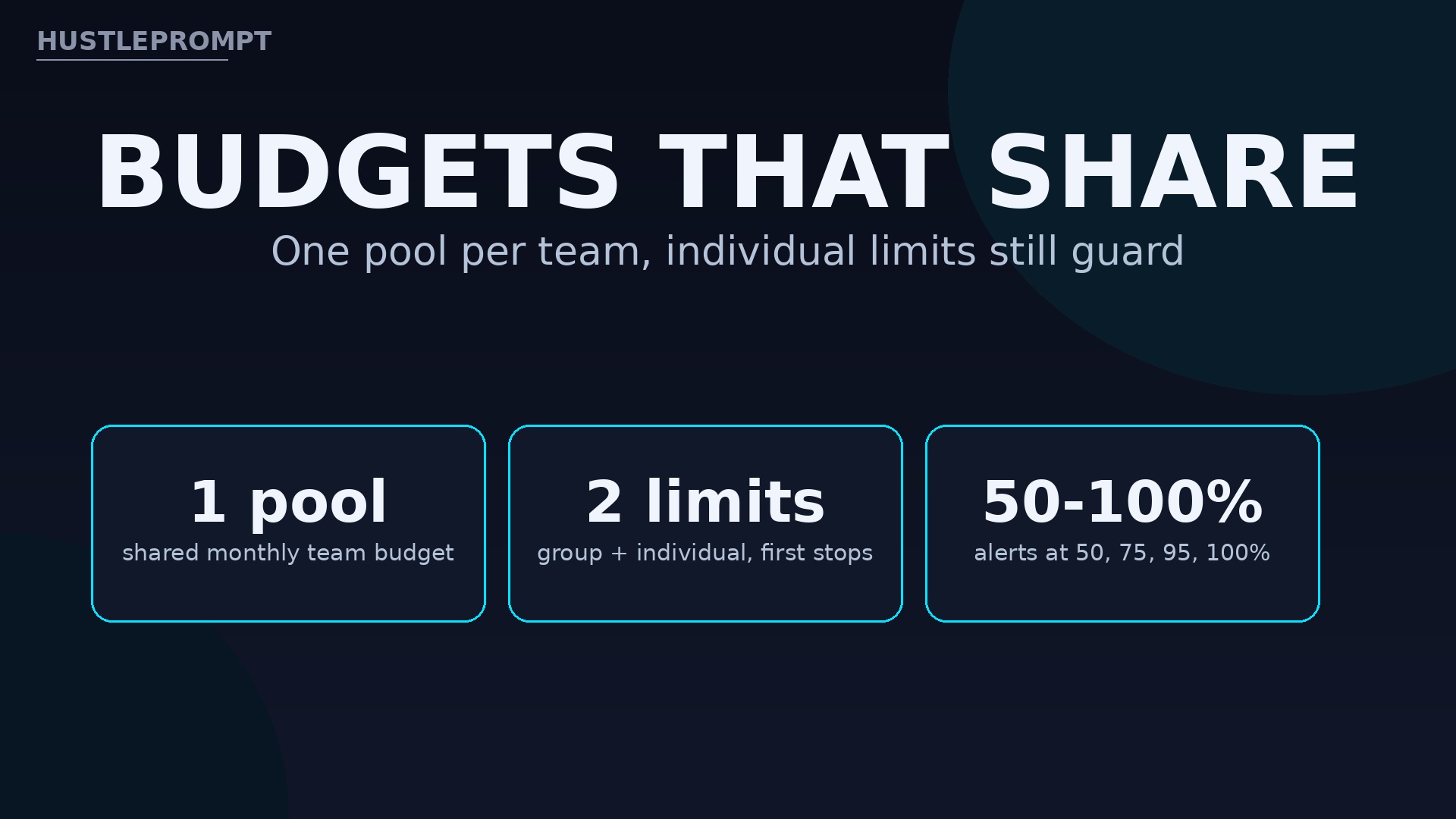
Individual limits create a familiar problem: heavy users hit the ceiling early while light users leave budget unspent. Pooled budgets fix that with one shared monthly budget, while member limits guard against unusually high individual use.
Every request counts against both limits, and a member stops at whichever runs out first. When someone hits a limit, they can request more inside Claude. Setup suggests an amount from recent usage, and billing admins get alerts at 50%, 75%, 95%, and 100%.
How to profit from Claude Enterprise ROI tools
The product is not Claude itself, but the proof layer around it.
- Sell an AI ROI audit. One-month engagement: run smart reports, survey the team, deliver spend by workstream plus friction fixes.
- Turn reports into skills, for a fee. Every report surfaces workflows worth converting into reusable skills. Package conversion at a fixed price per workflow.
- Offer budget design as a service. Set up pooled budgets, alert thresholds, and approval flows for teams wanting control without babysitting limits.
- Run the survey-to-training loop. Use survey answers about what teammates should copy to build training: the top five Claude workflows, taught by users.
- Write the business case for renewal. The company with a report showing deliverables, time saved, and cost per workstream wins the budget.
What these tools do not do
- Judge employees: Anthropic says smart reports are not for performance evaluation or employment decisions.
- Prove company-wide ROI alone: reports cover Claude usage, not full project outcomes.
- Work identically everywhere: availability varies for HIPAA and customer-managed encryption key setups.
Frequently asked questions
What are Claude Enterprise smart reports?
Reports analyzing transcript samples, grouped into workstreams, showing spend, deliverables, friction, and recommendations.
How far back can a smart report look?
Admins choose a team, a date range, and products to include. Launch coverage describes reports covering up to 28 days.
What do Claude in-app surveys ask?
Default questions cover the most valuable recent work, time saved, which use a teammate should copy, and what would break first without access. Admins can customize and export responses.
How do pooled group budgets work?
Each team gets one shared monthly budget, with individual limits as guardrails. Every request counts against both; use stops at whichever runs out first. Members can request more inside Claude.
When do budget alerts arrive?
Billing admins receive email alerts at 50%, 75%, 95%, and 100% of a group’s budget.
Are smart reports used to evaluate employees?
No. Anthropic states they inform investment planning, but are not for evaluating individual performance or employment decisions.