
Samsung just posted the biggest quarterly profit in its history, and its shares fell anyway. The Samsung Q3 profit story is the AI economy in 2026 in one frame: memory chips printing money, phones losing money, investors asking what comes next.
Samsung Electronics reported third-quarter 2026 results on October 29, 2026, for the quarter ended September 30: operating profit of 107.44 trillion won, about $80.04 billion, on revenue of 195.25 trillion won.
Evidence, as reported: Operating profit of 107.44 trillion won, up 783.11% from a year earlier and up 20.06% from the second quarter, according to Reuters’ report on Samsung’s record third-quarter profit and Seoul Economic Daily’s coverage of the results.
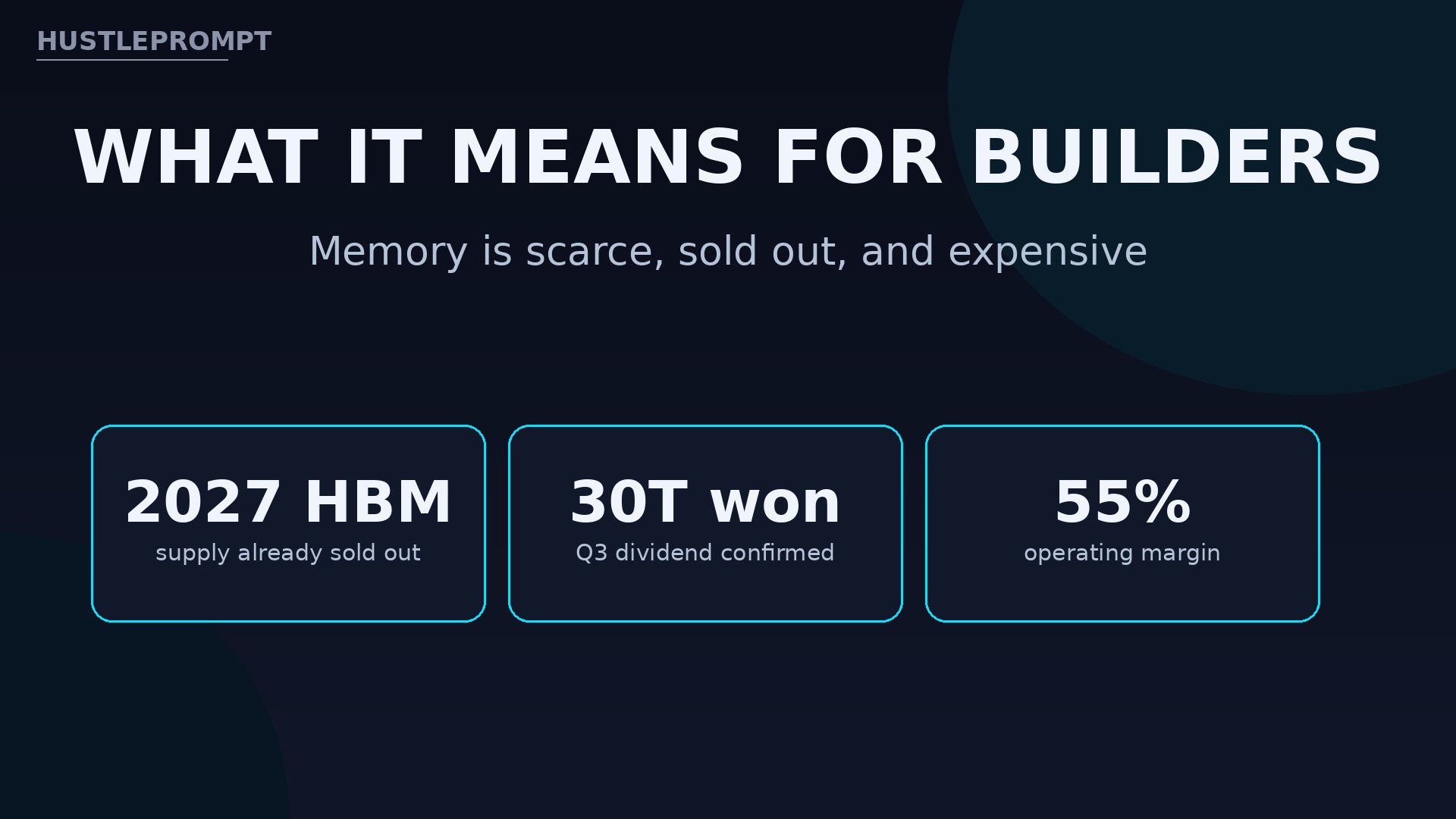
Revenue rose 126.88% year over year to 195.25 trillion won. The operating margin hit 55.0%, up from 52.2% in the prior quarter. It was Samsung’s fourth straight quarter of record revenue and profit.
What Samsung actually reported
| Metric, Q3 2026 | Figure | Change |
|---|---|---|
| Revenue | 195.25 trillion won | +126.88% year over year, +13.85% quarter over quarter |
| Operating profit | 107.44 trillion won | +783.11% year over year, +20.06% quarter over quarter |
| Operating margin | 55.0% | Up 2.8 percentage points from Q2 |
| Net profit | About 75.1 trillion won | Up about 5% from Q2 |
| Prior-year operating profit | 12.2 trillion won | The base for the near-ninefold jump |
Samsung is now the first technology company to pass 100 trillion won in quarterly operating profit, versus 12.2 trillion won a year earlier.
Chips made the quarter
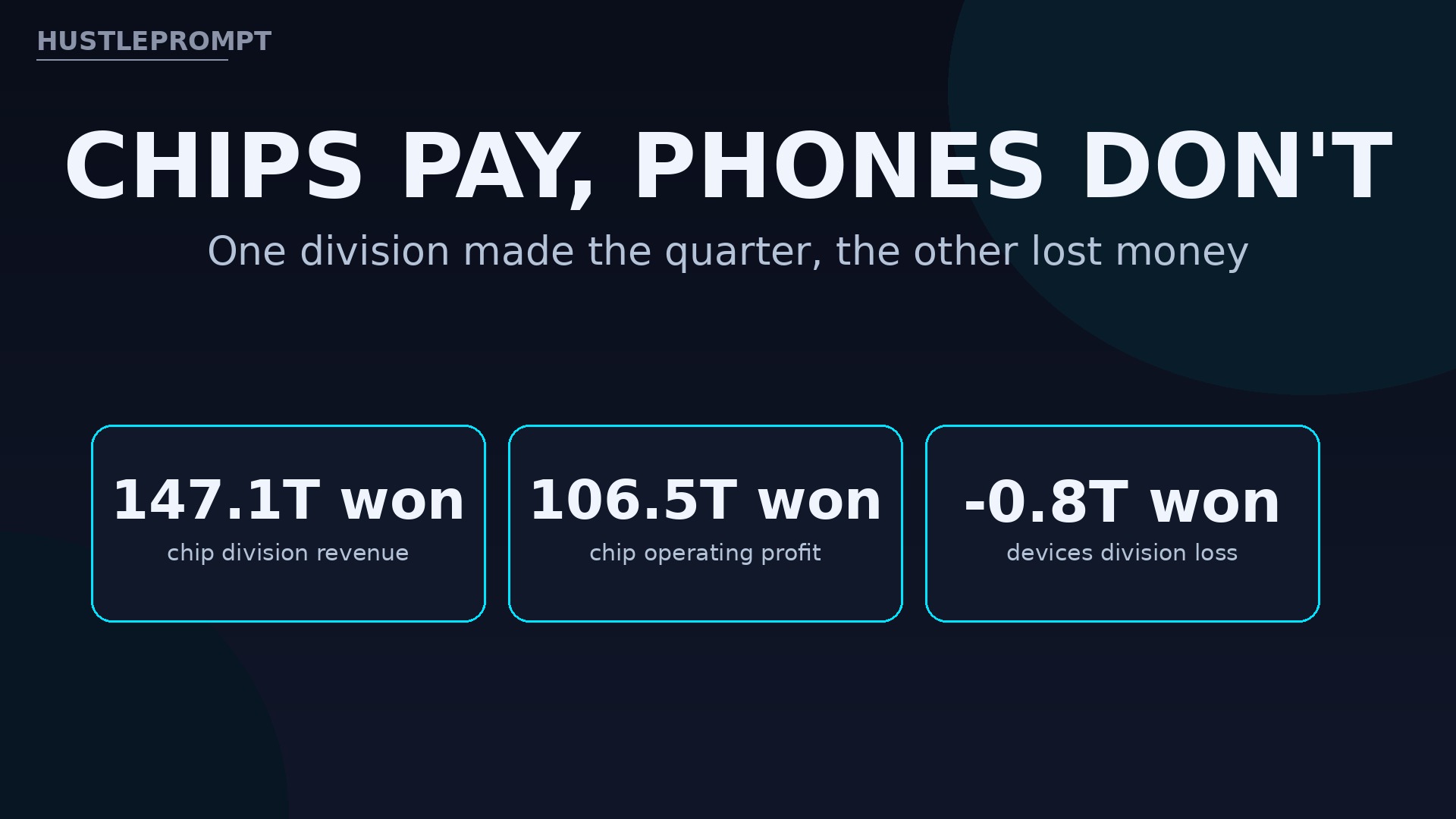
The Device Solutions division, which runs semiconductors, made 147.1 trillion won in revenue and 106.5 trillion won in profit: about 99% of Samsung’s total, and the first chip profit above 100 trillion won.
Memory did the heavy lifting: revenue of 140.7 trillion won, up 427% year over year, the second straight quarter above 400% after a 471% jump in Q2.
Two forces combined: higher prices and premium products. DRAM prices rose 20% from the prior quarter, and NAND prices rose by high-teens percentages. High-bandwidth memory (HBM), the specialized memory stacked beside AI accelerators, was the star: HBM4 sales more than tripled and reached 60% of total HBM revenue.
Jaejune Kim, Samsung’s memory sales chief, said HBM share had already caught up with Samsung’s overall DRAM share, ahead of its second-half target. Then came the line every hardware buyer should note: 2027 HBM supply is already sold out at an agreed price, and customers keep asking for more.
Phones lost money, again
The Device Experience division, covering phones, TVs, and appliances, went the other way: 52.1 trillion won in revenue and a 0.8 trillion won loss, its second straight quarterly deficit.
Chips: 147.1 trillion won in revenue, 106.5 trillion won in profit. Devices: 52.1 trillion won in revenue, a 0.8 trillion won loss. Phones alone: 37.7 trillion won in revenue, a 0.6 trillion won loss. Display earned 1.1 trillion won and Harman 0.6 trillion won.
Read that table as one company paying itself: the chip division sells memory at record prices, and the phone division buys it at record prices.
How a memory supercycle works
1. AI data centers order more memory for training and inference.
2. Supply cannot keep up. Samsung says the shortage deepens next year.
3. Prices surge. DRAM rose 20% in one quarter; memory revenue jumped 427% year over year.
4. Device makers pay the bill as the memory inside their products gets pricier.
Why the shares fell anyway
Samsung shares fell 5.17% to 229,500 won in Seoul morning trading, after rising as much as 2.89% early in the session. Coverage points to one main reason: Samsung deferred shareholder-return details to January.
The company did confirm a 30 trillion won dividend, or 4,601 won per share, within a 90 to 110 trillion won return plan announced earlier this year, with up to 75 trillion won still to be executed. Investors wanted the specifics now, not in January.
Two smaller drags also appeared. Net profit missed one consensus estimate of roughly 84 trillion won, and weaker exchange rates cut about 10 trillion won from operating profit versus the second quarter. Full-year capital expenditure is set at 84.4 trillion won, mostly for semiconductors. Rival SK hynix, which reported the day before, earned a chip margin of 79.7% versus Samsung’s 72%, according to Aju Press.
How to profit from Samsung’s $80 billion quarter
This is not investment advice, just a read on where the money is moving.
- Sell AI infrastructure services, not hardware. With 2027 HBM sold out, capacity is the bottleneck, and GPU setup and cost monitoring are billable now.
- Price memory exposure into every quote. Lock component prices in writing; a 20% quarterly DRAM move can erase a margin.
- Offer a memory-cost audit. Show clients how much of their hardware bill is memory, and what cheaper options would cost.
- Build on rented compute while chips are scarce. Renting, with clear per-job costs, keeps a small AI service profitable.
- Watch SK hynix alongside Samsung. The margin gap between the two tells you where pricing power sits each quarter.
Frequently asked questions
How much profit did Samsung make in Q3 2026?
Operating profit of 107.44 trillion won, about $80.04 billion, on revenue of 195.25 trillion won.
What drove Samsung’s record quarter?
AI memory chips: the semiconductor division earned 106.5 trillion won, about 99% of total profit.
Why did Samsung shares fall on record earnings?
Mainly the deferred shareholder-return details, plus a net-profit miss versus one estimate and currency headwinds.
Is Samsung’s 2027 HBM supply really sold out?
Yes, per Samsung’s memory sales chief on the earnings call: 2027 HBM volume is sold out at an agreed price, with more requests arriving.
Why did Samsung’s phone business lose money?
Rising memory costs: devices lost 0.8 trillion won, phones 0.6 trillion won.
How big was Samsung’s dividend?
30 trillion won, or 4,601 won per share, within a 90 to 110 trillion won return plan.