
A power station that has powered Britain for more than fifty years could soon power its AI economy. The Drax AI data centre plan, announced November 3, targets more than 1 gigawatt (GW) of data centre capacity — but the headline £20 billion figure is an estimate, not money already committed.
Drax Group, Brookfield, and Radiant, Brookfield’s UK-headquartered AI infrastructure platform, signed an agreement to jointly develop, deliver, and operate the project on the Drax Power Station estate in North Yorkshire. Capital comes through the Brookfield-Qai joint venture announced in 2025.
What Drax, Brookfield, and Radiant actually announced
Drax confirmed on November 3, 2026 that the partners will target a GW-scale data centre at Drax Power Station. The first phase targets up to 100 megawatts (MW) of compute capacity, with commercial operations from the first quarter of 2028.
Brookfield estimates that total potential investment, including semiconductor chips, could exceed £20 billion, with an initial £2.5 billion as part of Phase 1. That distinction matters: the £20 billion is Brookfield’s estimate of what the full build could reach, not a funding commitment announced today.
Drax CEO Will Gardiner said the project “can help secure the long-term future of the site and protect hundreds of jobs.” Radiant CEO Mahdi Yahya said it would give “British researchers, startups and enterprises access to frontier compute at home.”
The three phases, in one table
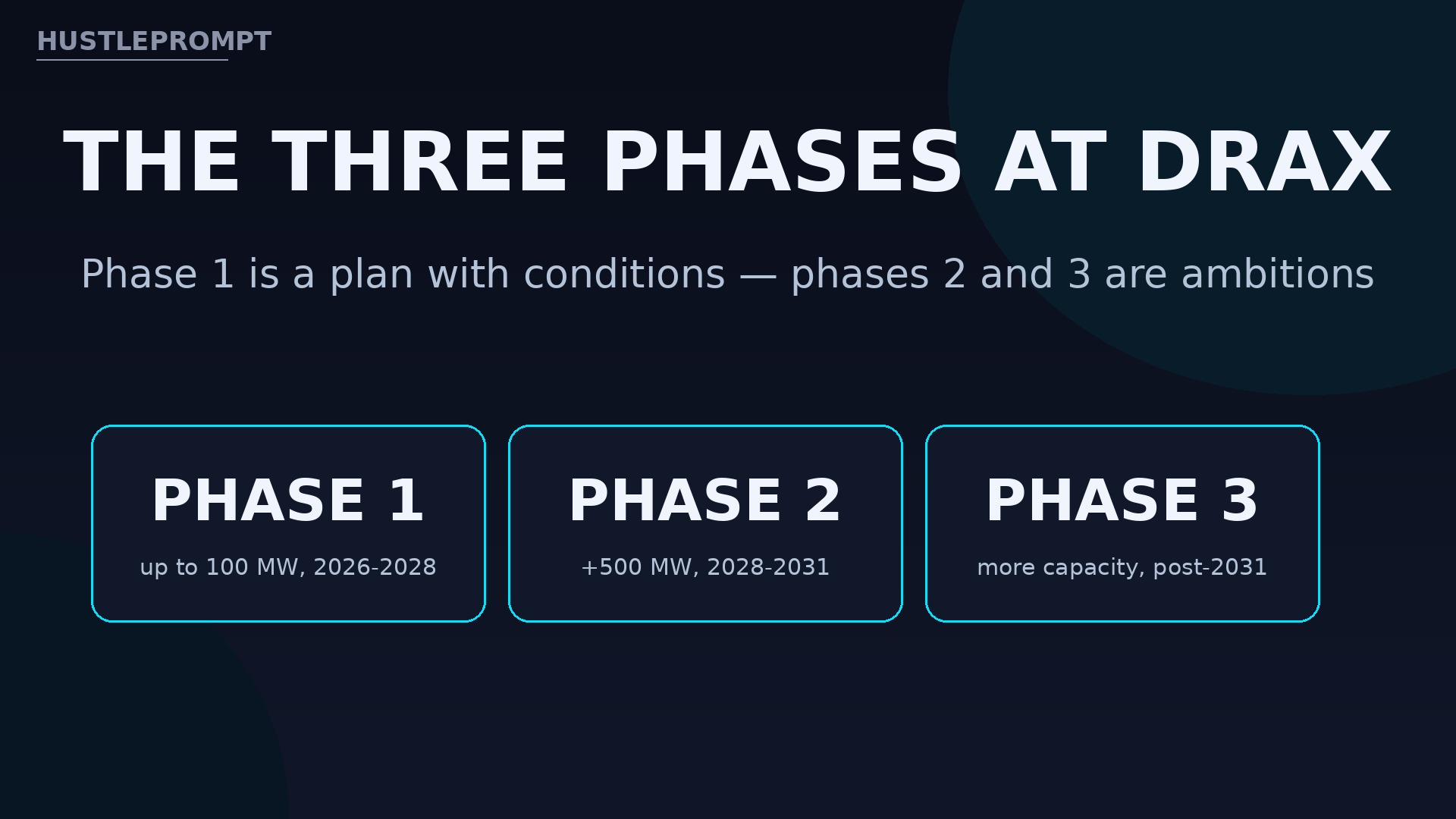
| Phase | Capacity | Timing and status |
|---|---|---|
| Phase 1 | Up to 100 MW | 2026–2028; commercial operations targeted from Q1 2028 |
| Phase 2 | Additional 500 MW ambition | 2028–2031; behind-the-meter power under a long-term agreement, subject to consents |
| Phase 3 | Additional capacity ambition | After 2031; same behind-the-meter approach as Phase 2 |
| Total | More than 1 GW targeted | Across all three phases, if built in full |
Source: Drax Group’s stock-exchange announcement on the GW-scale data centre partnership.
4 GW grid access, 2.6 GW generation
1,000+ acre estate, existing cooling
Radiant designs, builds, operates
Anchor tenants sought first
Radiant leads design and commercialisation; Drax leads land, power integration, and planning.
Why this site can move faster than most
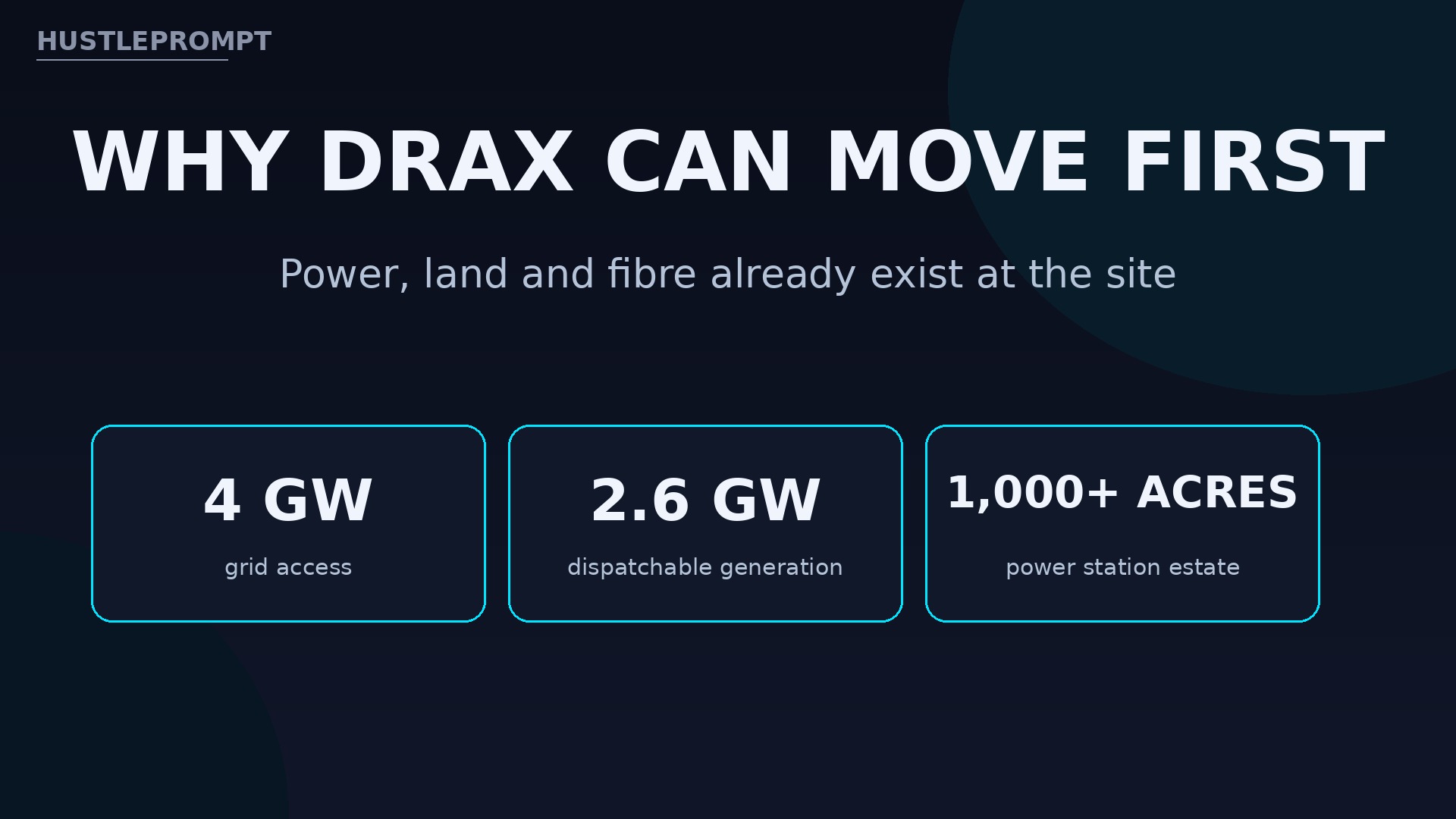
The pitch is simple: the power is already there. The estate covers more than 1,000 acres, sits next to one of the UK’s largest substations, and has about 4 GW of grid access plus 2.6 GW of generation and cooling systems.
Phase 1 will import power directly from the grid through existing connections, managed by Drax. Phase 2 is expected to use Drax’s own generation to supply power directly to the data centre, around the clock, under a long-term agreement.
That Phase 2 model connects to a November 2025 contract-for-difference agreement: about 6 terawatt-hours of biomass generation per year between April 2027 and March 2031, about 30% of baseload output, with a mechanism to request up to 500 MW for a data centre, subject to government agreement.
What is NOT settled yet
Phase 1 still needs planning approval, regulatory and network approvals, an acceptable tenant, negotiated commercial agreements, and a final investment decision from each partner. No tenant has been named. A planning application is being prepared, and public consultation is expected in November 2026.
Read the announcement as a roadmap with a first milestone, not a finished data centre. The 100 MW phase has a date. Later phases are labelled ambitions.
How to profit from the Drax AI data centre plan
- Sell AI infrastructure readiness, not hype. UK startups and scale-ups will need help estimating compute, power, and cost for GPU workloads. A one-page readiness audit — workload, budget, latency, data residency — is sellable today, before any tenant is named.
- Watch the anchor-tenant signal. Radiant is seeking anchor commitments before construction. The first named tenant will show which workloads this site serves first.
- Target the Yorkshire supply chain. Rashid said the project will create “many direct and indirect jobs around the broader Yorkshire area.” Local firms in construction, electrical, cooling, and facilities should track the planning application now.
- Do not price in the £20 billion. That figure includes chips and the full build. Pitch work against Phase 1’s £2.5 billion and 100 MW, and label later phases as ambitions.
- Learn the behind-the-meter model. Phase 2’s direct, around-the-clock power deal is a template other large sites will copy. Consultants who can explain it to energy buyers and AI teams will be in demand beyond Yorkshire.
The bottleneck in AI is no longer just chips. It is power, planning, and permission. Drax is selling all three at once — and firms that prepare for Phase 1 will be first in line when tenants appear.
Frequently asked questions
What did Drax, Brookfield, and Radiant announce?
They signed an agreement to jointly develop, deliver, and operate an AI data centre on the Drax Power Station estate in North Yorkshire, targeting more than 1 GW of capacity across three phases.
How much is being invested?
Brookfield estimates total potential investment, including semiconductor chips, could exceed £20 billion, with an initial £2.5 billion as part of Phase 1. The £20 billion is an estimate, not committed funding announced today.
When will the first data centre open?
Phase 1 targets up to 100 MW of compute capacity, with commercial operations from the first quarter of 2028, subject to approvals, a tenant, commercial agreements, and final investment decisions.
Has a tenant been named?
No. Radiant is seeking anchor customer commitments before construction starts, and Phase 1 requires an acceptable tenant among its conditions.
What happens in Phase 2?
Phase 2 aims to add 500 MW between 2028 and 2031, expected to use Drax generation directly, around the clock, under a long-term power purchase agreement, subject to consents.