
What if one well-researched PDF could win you a paying client every single week? That is exactly what AI neighborhood guides offer freelancers right now.
Buyers do not choose a house first. They choose a neighborhood. According to the National Association of Realtors (NAR) 2025 Profile of Home Buyers and Sellers, 59% of buyers ranked quality of the neighborhood as a top factor in their decision. That same report found 88% of buyers worked with a real estate agent.
Agents know this. Yet most have no polished guide to hand a relocating buyer. That gap is your service: research a neighborhood with AI, turn it into a branded guide, and sell it to agents as a lead magnet.
Why Agents Pay for Neighborhood Guides
A lead magnet is a free resource an agent offers in exchange for a prospect’s contact details. A neighborhood guide is one of the best kinds, because it answers the exact questions relocating buyers already ask.
Think about it from the agent’s side. A buyer moving from another state cannot drive around the area. They search online at night and compare school zones. A guide answering those questions builds trust before the first phone call.
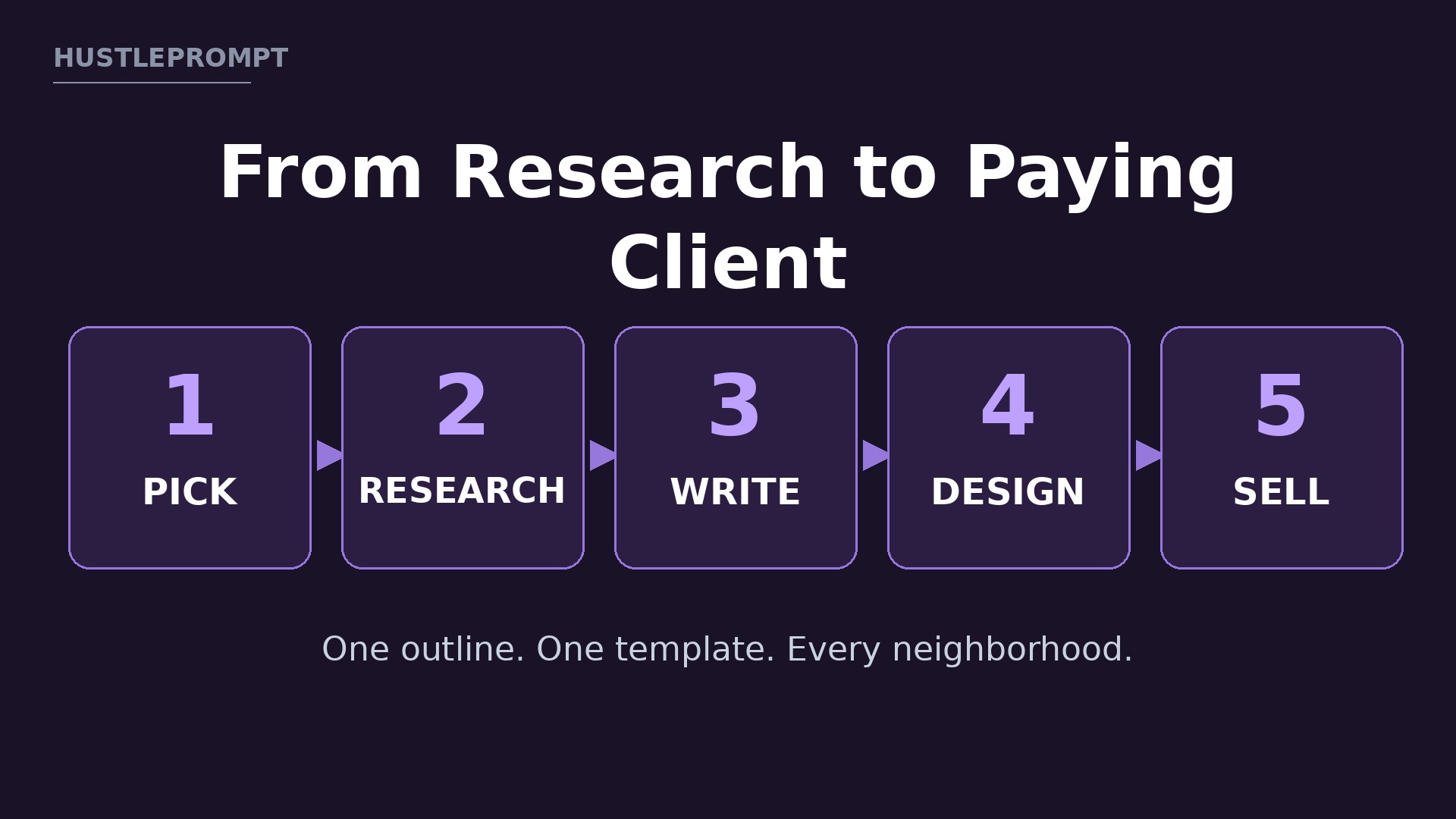
Your 6-Step Neighborhood Guide Workflow
Pick one neighborhood and one niche.
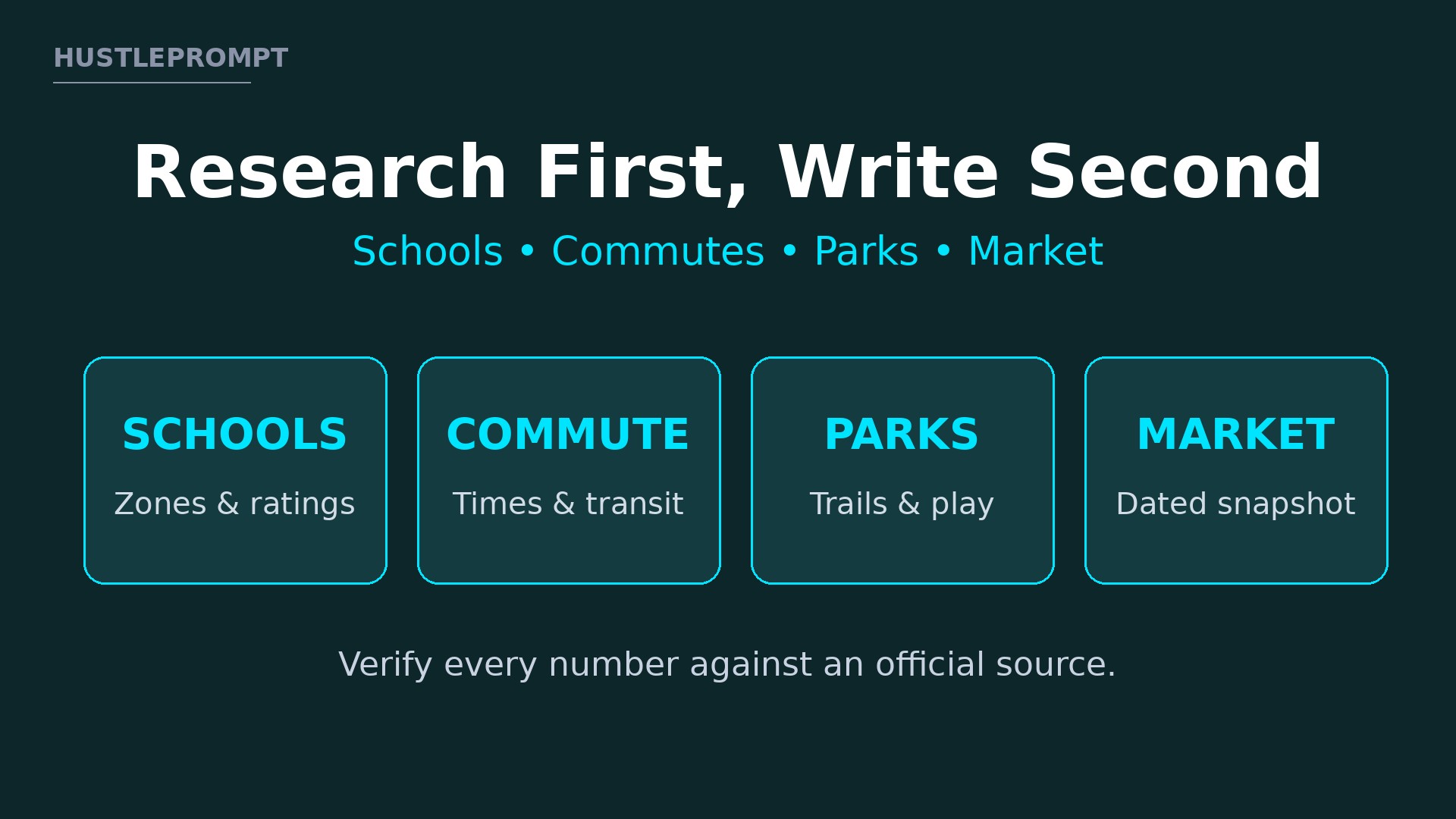
Gather schools, commutes, parks, and market data.
Draft from a fixed outline for consistency.
Lay it out in Canva with the agent’s branding.
Fact-check every number before delivery.
Pitch with a sample, then offer updates as a retainer.
Same six steps every time — your second guide is much faster.
Step 1: Pick a Neighborhood and a Niche
Do not try to cover a whole city. Pick one neighborhood with a clear identity, such as a suburb with strong schools or a walkable downtown district. A narrow focus sharpens your research and your pitch.
Then pick a buyer niche. Good options include:
- Relocating families who care about schools and parks
- First-time buyers who need plain-English cost explanations
- Remote workers who care about internet quality and coworking spots
- Downsizers who want walkability, healthcare access, and low-maintenance living
Your niche shapes the sections you emphasize, the tone you use, and the agents you pitch. An agent serving relocating families will pay for a family-focused guide, not a generic city overview.
Step 2: Research the Neighborhood With AI
Start with a research prompt that forces structure. Ask your AI tool to organize findings under fixed headings: schools, commute, parks, dining, safety context, and market snapshot. Then verify each claim.
Useful research sources include:
- School district websites and state education department pages for school zones and ratings
- Google Maps for commute times, transit stops, and walking distances
- City and county websites for parks, libraries, and upcoming developments
- Local MLS market reports or brokerage market updates for pricing trends
Never copy a statistic from an AI answer without checking it. Treat AI as a research assistant, not a source of truth.
Step 3: Write the Guide From a Fixed Outline
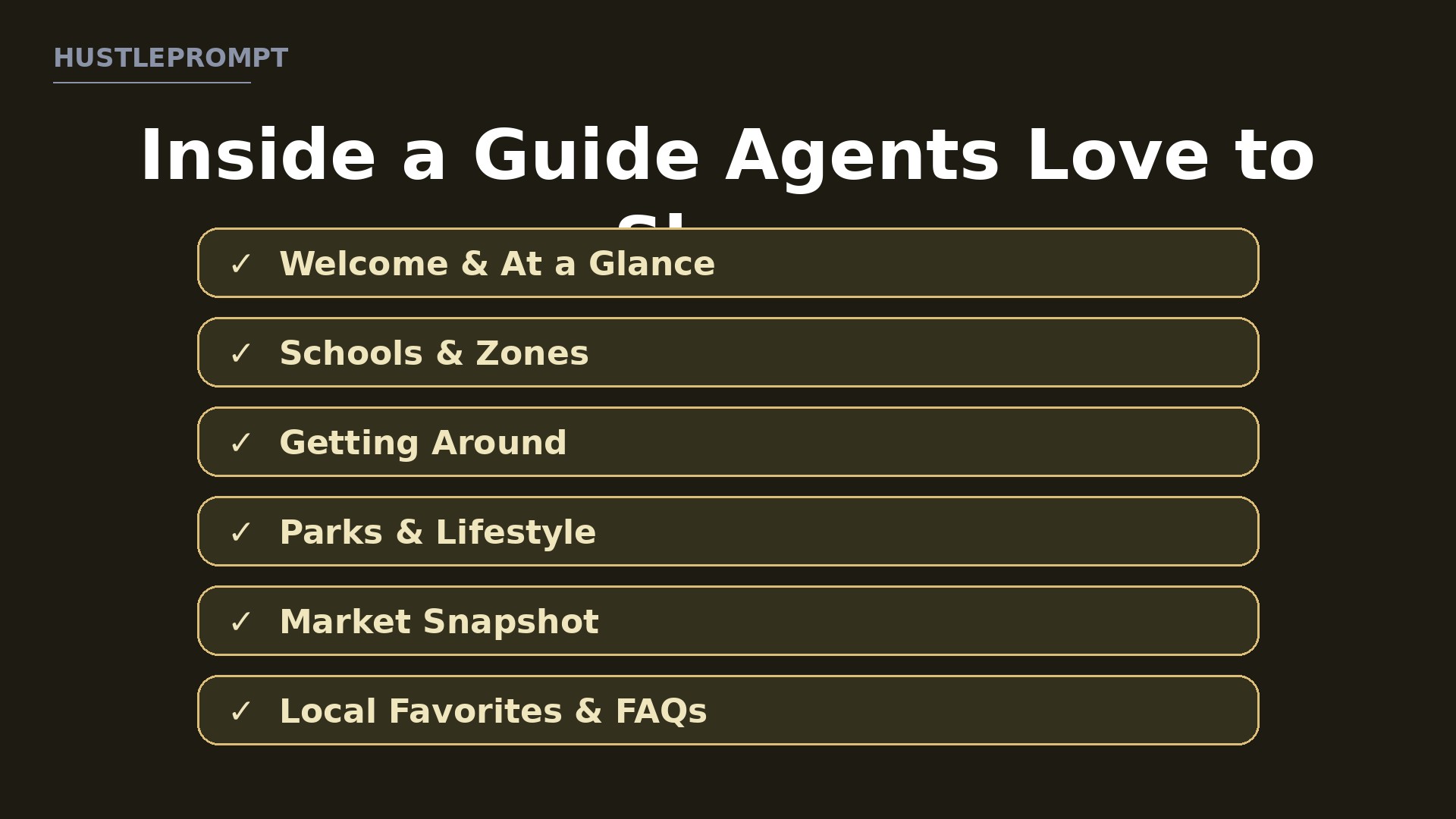
A consistent outline keeps your work fast and your product recognizable. Reuse this sample outline for every neighborhood:
- Welcome: a one-paragraph snapshot of the neighborhood’s character
- At a Glance: location, home types, and who the area suits best
- Schools: zones, notable schools, and what parents ask about most
- Getting Around: commute times, transit, and walkability notes
- Parks and Lifestyle: trails, playgrounds, sports, and weekend life
- Market Snapshot: recent pricing context with a dated source
- Local Favorites: coffee, dining, and hidden gems
- FAQs: the five questions every buyer asks about this area
- Next Step: the agent’s contact details and call to action
Write in short paragraphs and plain language. Buyers skim on their phones, so favor lists and subheadings over long blocks of text.
Step 4: Design a Guide Agents Are Proud to Share
Design matters as much as content. An agent will only share a guide that looks professional, because it carries their name. Use a clean Canva template: one cover page, consistent headings, white space, and the agent’s headshot and contact details on the cover and final page.
Step 5: Write the Market Snapshot Carefully
The market snapshot is the section agents value most, and where accuracy matters most. Never invent prices. Use a dated, sourced figure, such as a brokerage market report, and label the date clearly.
Here is a sample market snapshot section for a fictional suburb, Maplewood:
Maplewood Market Snapshot — Fall 2026. Recent brokerage market updates show Maplewood homes selling in a mid-range band typical for family suburbs, with well-presented homes moving faster than fixer-uppers. Demand is strongest for three- and four-bedroom homes near the top-rated elementary zone. Ask your agent for this month’s exact figures before making an offer.
Notice what this sample does: it describes the pattern without inventing a median price. If you include a specific number, cite the report, publisher, and month.
Step 6: Price It and Sell It to Agents
Offer three packages so agents can start small and upgrade. Prices below are illustrative starting points, gross before tool costs and taxes — not income promises. Set your own rates for your market.
- Single Guide: one neighborhood guide, PDF delivery, agent branding included
- Guide + Updates: the guide plus a quarterly market refresh so it never goes stale
- Neighborhood Bundle: three to five guides covering the agent’s whole farm area
Start by offering one free sample to a local agent. Pick an agent who already creates content, because they understand the value of a lead magnet instantly.
Sample Agent Outreach Message
Hi Sarah, I create neighborhood guides that agents use as lead magnets for relocating buyers. I put together a short Maplewood sample — schools, commutes, parks, and a market snapshot — branded with your details. May I send it over? If you like it, I can build the full guide for your farm area this week.
Keep outreach short, specific, and sample-led. Agents ignore generic pitches but open messages showing real work for their own area. Follow up once after three days, then move on.
Tools and Costs: What You Actually Need
You can start with free tools and add paid ones as orders grow. The table below shows list prices for the core stack, checked in November 2026. Confirm live prices before you buy.
| Tool | Plan | Price | Use in this service |
|---|---|---|---|
| ChatGPT | Plus | $20/month | Research drafts, outlines, FAQ drafting |
| Canva | Pro | $15/month or $120/year | Guide layout, agent branding, PDF export |
| Google Maps | Free | Commute times, distances, transit checks |
Sources: OpenAI ChatGPT pricing and Canva pricing — verify live prices before subscribing.
Why This Service Works Right Now
NAR’s 2025 Profile reports that 59% of buyers ranked neighborhood quality as a top factor, ahead of proximity to friends and family (47%) and convenience to a job (31%). The median buyer searched for 10 weeks — weeks of questions your guide can answer.
Watch: What Buyers Look for in a Neighborhood
This official guide from Berkshire Hathaway HomeServices covers the seven features buyers weigh when judging a neighborhood. Study its structure, then mirror those buyer questions in your own guides.
Frequently Asked Questions
Do I need a real estate license to sell neighborhood guides?
No. You sell research, writing, and design — not representation. Avoid personal buying advice, and let the agent handle licensed activity.
How long does one guide take to produce?
Your first guide may take a full day. Once your outline and template are set, most guides take three to five hours, with verification taking about a third of that time.
What if the agent wants changes?
Include one revision round in your base price and charge for further rounds. Expect light edits — usually the agent’s own phrasing on the cover and call to action.
How do I keep guides accurate over time?
Offer a quarterly refresh as a paid update. Re-check school zones, market figures, and new developments, then re-issue the PDF with a new date.
Can I sell the same guide to multiple agents?
Only if you agree that upfront. Most agents pay for exclusivity in their area, so sell each guide to one agent per neighborhood unless you offer a shared version at a lower price.
What should a sample FAQ entry look like?
Keep answers short and sourced. Example: “Are there good schools nearby? Maplewood is served by two elementary schools in the Riverside district — your agent can confirm the exact zone for any address.”
Keep Reading
Explore more ways to build income with AI: browse the free AI tools and the free courses on HustlePrompt.
Start this week: pick one neighborhood, research it properly, and build a sample guide. One strong sample can land your first paying client.