
The $20 price tag is not going away. The deal behind it is. OpenAI, Anthropic, and Google are all keeping their headline monthly prices while quietly changing what that money actually buys — and for anyone who sells AI work, that difference is now the business.
Starting in December, OpenAI will measure ChatGPT and Codex usage in tokens and draw both from one shared allowance. Its always-on agent product, dots, still runs on open-ended “extended limits” with no published price — but that arrangement has a reported end date of March 31, 2027. Anthropic’s IPO filing explains why the labs cannot keep giving work away: its compute bill grew far faster than its revenue in a single quarter.
This is the end of the flat-rate era for agent work, not the end of cheap AI. The freelancers who win will be the ones who price work the way the labs now price it: by the outcome, with the meter in plain sight.
What Is Actually Trending
A token is the unit a model reads and writes — roughly a word fragment, not a message. A flat plan hides that unit. A token allowance exposes it. When OpenAI says usage “will be measured in tokens,” it is saying that a long reasoning session and a short question will no longer cost the user the same amount of allowance, even if they cost the same $20 a month.
The change was not announced with a blog post and a price list. It appeared in OpenAI’s Help Center article “Understanding ChatGPT and Codex usage limits,” updated October 31, 2026. That article says Plus, Pro, and Business plans will share one allowance across ChatGPT and Codex from December, that “more advanced models and complex tasks generally use more of your allowance,” and that Instant chat — the fast default — “will not draw from your usage.” At the limit, users wait for a reset, upgrade, or buy credits.
What the article does not say matters just as much. It gives no exact December date and no token size for any plan. OpenAI says it expects “most users won’t need to wait for their usage to reset more often than they do now.” That is a forecast, not a guarantee, and it cannot be checked until the meter is live.
The Evidence: The Meter Arrives From Three Directions
First, OpenAI’s own current estimates show how uneven token burn already is. On ChatGPT Plus, in a five-hour Work and Codex window, OpenAI estimates roughly 5 to 45 messages with its flagship GPT-6 Astra, 15 to 150 with GPT-6 Sol, and 350 to 3,000 with the lighter GPT-6 Luna. Those are today’s Work and Codex figures, not December figures — but they show why a shared pool changes behavior: one flagship session can cost as much allowance as dozens of light ones.
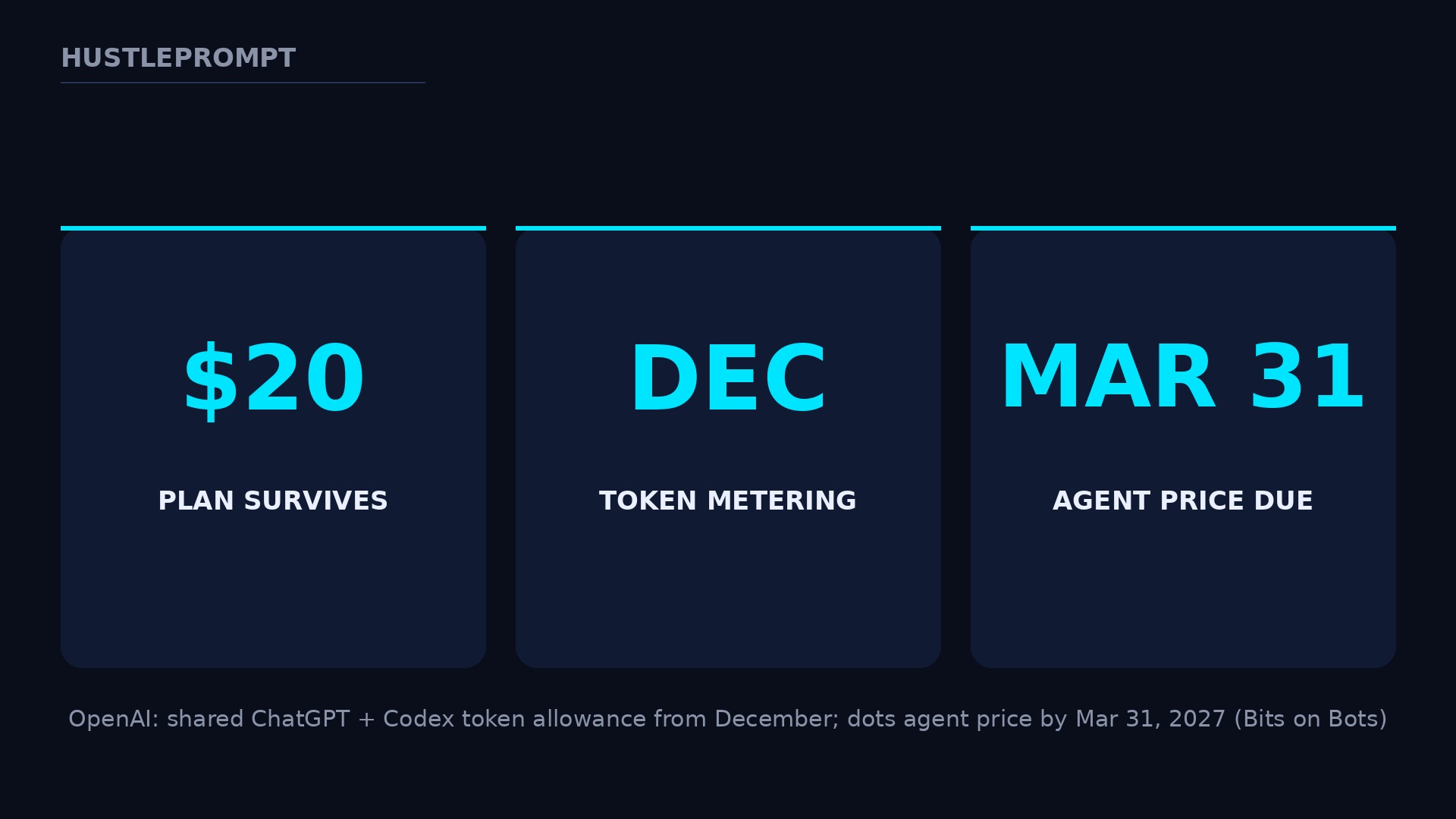
Sources: Bits on Bots, “The flat AI plan wasn’t built for agents that never log off” (Nov 4, 2026) · Automater, “ChatGPT and Codex Move to One Shared Token Allowance in December” · CellCog, “ChatGPT and Codex Will Share One Usage Limit in December” · Medium, “Is AI Getting Cheaper? Yes and No (2026 Data)”.
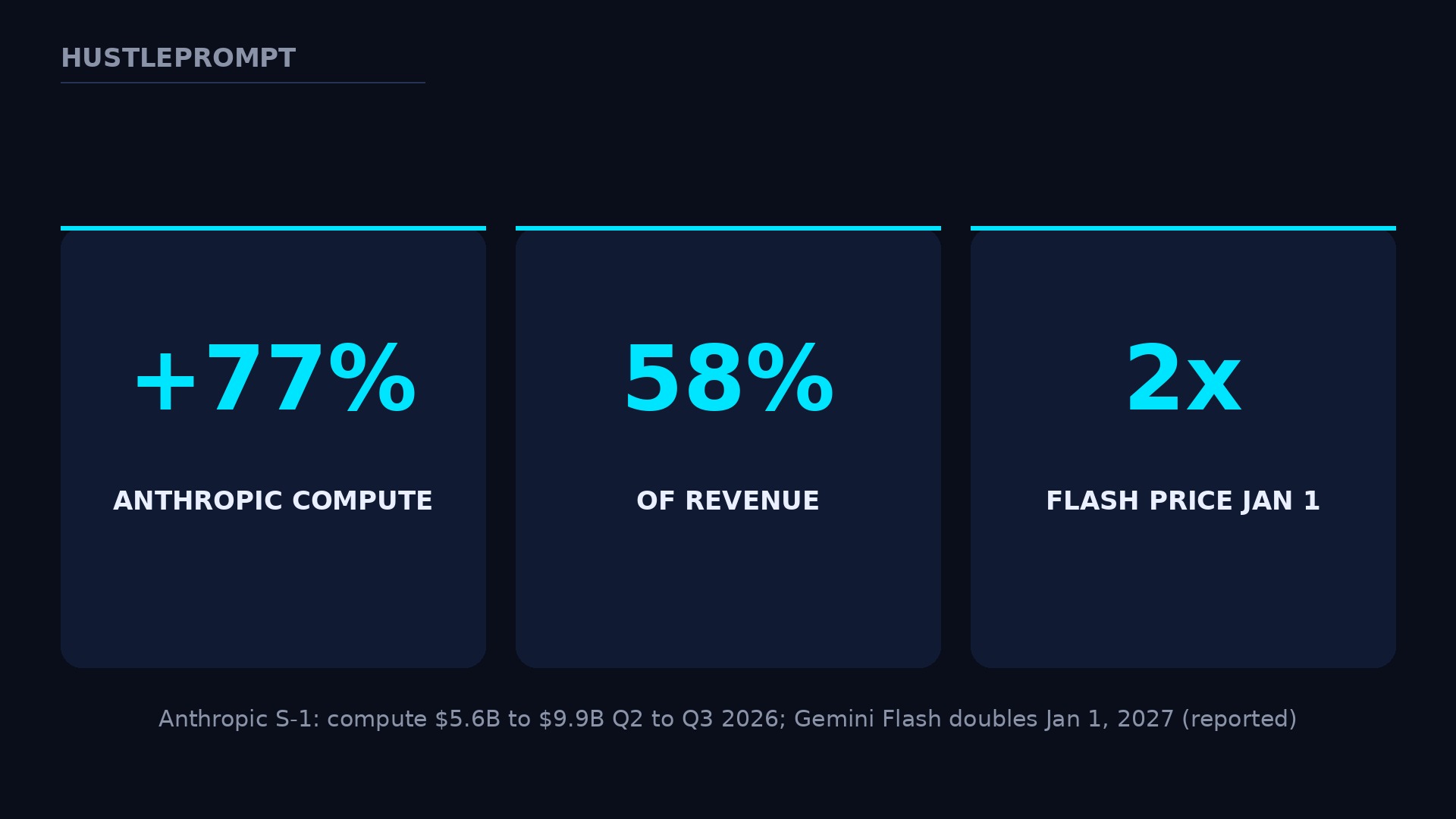
Second, Anthropic’s amended IPO filing puts a cost behind the meter. From the second quarter of 2026 to the third, its compute and infrastructure cost rose 77%, from $5.6 billion to $9.9 billion, while revenue rose 47%. Compute went from 48% of revenue to 58%. The filing also notes that changing usage limits has already brought legal claims. A lab whose compute bill eats nearly three-fifths of revenue cannot subsidize unlimited agent work forever, no matter what the sticker price says.
Third, Google is already numbering its agent-adjacent work. Its Flow video tool lists 1,000 credits a month on the $19.99 Pro plan and 25,000 on the $199.99 Ultra 20x plan. Credits are not tokens, but they are the same idea: a visible budget for heavy work, separate from the monthly headline. The direction across all three labs is identical — the subscription stays, the open-ended allowance goes.
Why This Breaks the Old Freelance Math
Most freelance AI pricing was built on a hidden assumption: the model is basically free at the margin. If you charged $500 for a deliverable, your tool cost was your $20 subscription, and the rest was your time. Under token metering, that assumption fails in two ways.
First, your costs become variable. A client who asks for “one more revision” on a flagship model can burn more allowance than the original job. If you quoted a flat fee, you absorb that burn. If you quoted per outcome without a usage cap, you argue about it later. Either way, the meter shows up in your margin before it shows up in your invoice.
Second, your clients’ costs become visible. When a client sees their own ChatGPT allowance draining because an agent ran overnight, “AI is cheap” stops being a sales argument. The conversation shifts from “how fast can you do it” to “how much work, on which model, at what cost.” That is an uncomfortable conversation for sellers who never measured their own usage — and a wide-open one for sellers who did.
The deeper cause is structural, not greedy. Agents do not log off. A person sends a few dozen messages a day; an agent monitoring a codebase, inbox, or store can run thousands of model calls overnight. A monthly plan priced for a person who sleeps cannot pay for a worker who does not. The labs are not raising the $20 price because they want to. They are metering the work because the work no longer fits the price.
Price the Meter: Measure, Route, Cap, Charge
Clients will pay for agent work once they can see what it costs. Make the meter part of the deliverable.
Log real burn
Record tokens, model, and task for one real week. Your December allowance is unknowable; your November burn is not.
Match model to task
Light models for routine work, flagship models only where quality changes the outcome. OpenAI’s own ranges show a 70-fold gap.
Put a ceiling in writing
Every quote states a usage budget and what happens at the cap: pause, approve, or pay for credits.
Bill the outcome, show the meter
Price the result, itemize the usage. Transparency is what makes a metered price feel fair instead of sneaky.
How to Profit From This Trend
Stop absorbing metered costs and start selling metered clarity. The offer is a service that tells a client what their agent work actually costs, rebuilds it so the cheap model does the routine work, and watches the meter as prices change. December is the pitch: every ChatGPT Plus, Pro, and Business user is about to get a usage screen they have never had to read.
Prices below are my estimates based on comparable freelance automation and consulting service rates, not market data:
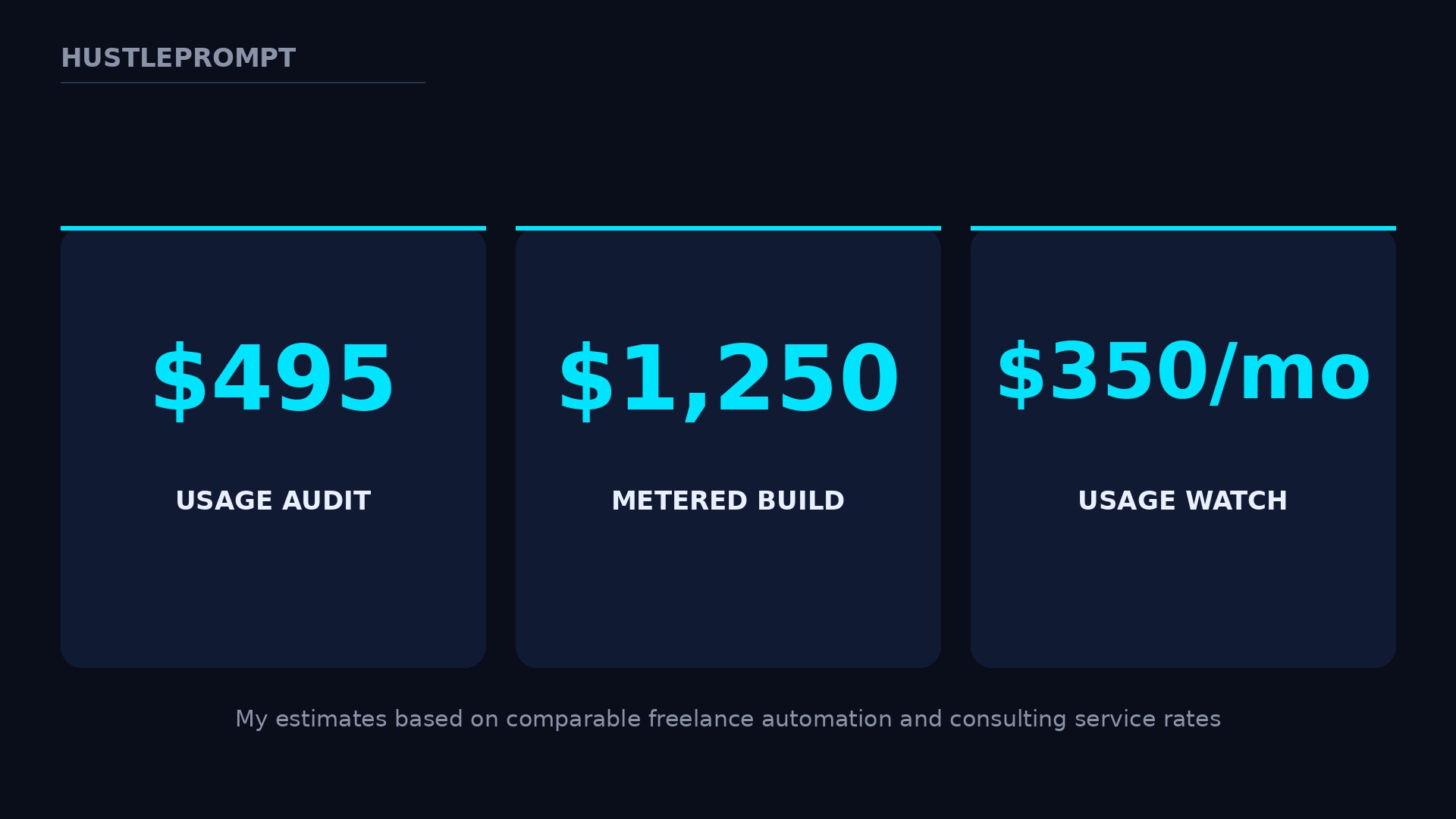
Lead with the client’s own bill, not the lab’s announcement. Ask a prospect to open Settings, then Usage, and read the number with them. Most have never done it. The audit sells itself the moment the meter becomes visible — which is exactly what December does for you.
What to Do This Week
- Measure one workflow end to end. Pick your most-used agent job, log the model, the task, and the rough token burn for a week. That log is your first product.
- Move one routine step to a lighter model. Test whether the cheaper model changes the output. If it does not, you just found margin.
- Rewrite one quote with a usage cap. State the budget, the cap, and the price of going past it. Clients respect a ceiling more than a surprise.
- Set a December check-in. When the shared allowance goes live, screenshot your own usage screen and send it to past clients with one line: “This is what changed, and this is what I would do about it.”
Watch: a third-party explainer on the December shared limit, built from OpenAI’s Help Center pages. Watch on YouTube.
Where This Is Heading
Outcome pricing replaces seat pricing. When usage is metered, the natural next step is charging for completed work rather than access. Expect more “per resolution,” “per build,” and “per verified outcome” offers — from labs and freelancers alike — and fewer “unlimited” promises that nobody can keep.
The $20 tier becomes the waiting room. The headline price survives because it is a marketing anchor, but heavy agent work will live on higher tiers, credits, or API billing. Freelancers who build only for the $20 tier will find their best clients priced out of their own workflows.
Cost per outcome becomes a sales skill. The sellers who can say “this job costs $4.20 in model time on this model, $31 on that one, and here is why I chose the first” will beat sellers who can only say “AI is fast.” In a metered world, the receipt is part of the pitch.
Frequently Asked Questions
Is OpenAI raising the price of ChatGPT?
No — the $20 Plus price is not reported as changing. What changes in December is the allowance behind it: ChatGPT and Codex draw from one shared, token-measured pool on Plus, Pro, and Business plans, with Instant chat exempt.
What is a token, in plain terms?
A token is the unit a model reads and writes — roughly a fragment of a word. Longer, more complex work uses more tokens, so a flagship reasoning session drains an allowance far faster than a short chat.
When does the December change start, exactly?
OpenAI has only said “starting in December.” No exact date and no per-plan token sizes have been published, so watch the Help Center article and your Settings, then Usage, screen.
What are OpenAI dots, and why do they matter here?
Dots are OpenAI’s always-on agents, launched September 29, 2026, with their own cloud computer and open-ended extended limits. Bits on Bots reports those limits end by March 31, 2027, when a monthly allowance or price is due — that deadline is reported, not an OpenAI price list.
Why is Anthropic’s filing relevant to my subscription?
Because it shows the cost pressure behind the meter: Anthropic’s compute bill rose 77% in one quarter, from $5.6 billion to $9.9 billion, reaching 58% of revenue. Labs cannot subsidize unlimited agent work at that cost structure.
How do I protect my freelance margins from metering?
Measure your burn, route routine work to lighter models, put a usage cap in every quote, and itemize usage in your invoice. The meter is only a threat if it is invisible to you and your client.