
The best AI agent in the world just took a test built from real professional work — and failed 88% of it. That number, 12%, is the most important AI figure of November, because it measures what agents actually do when nobody is holding their hand.
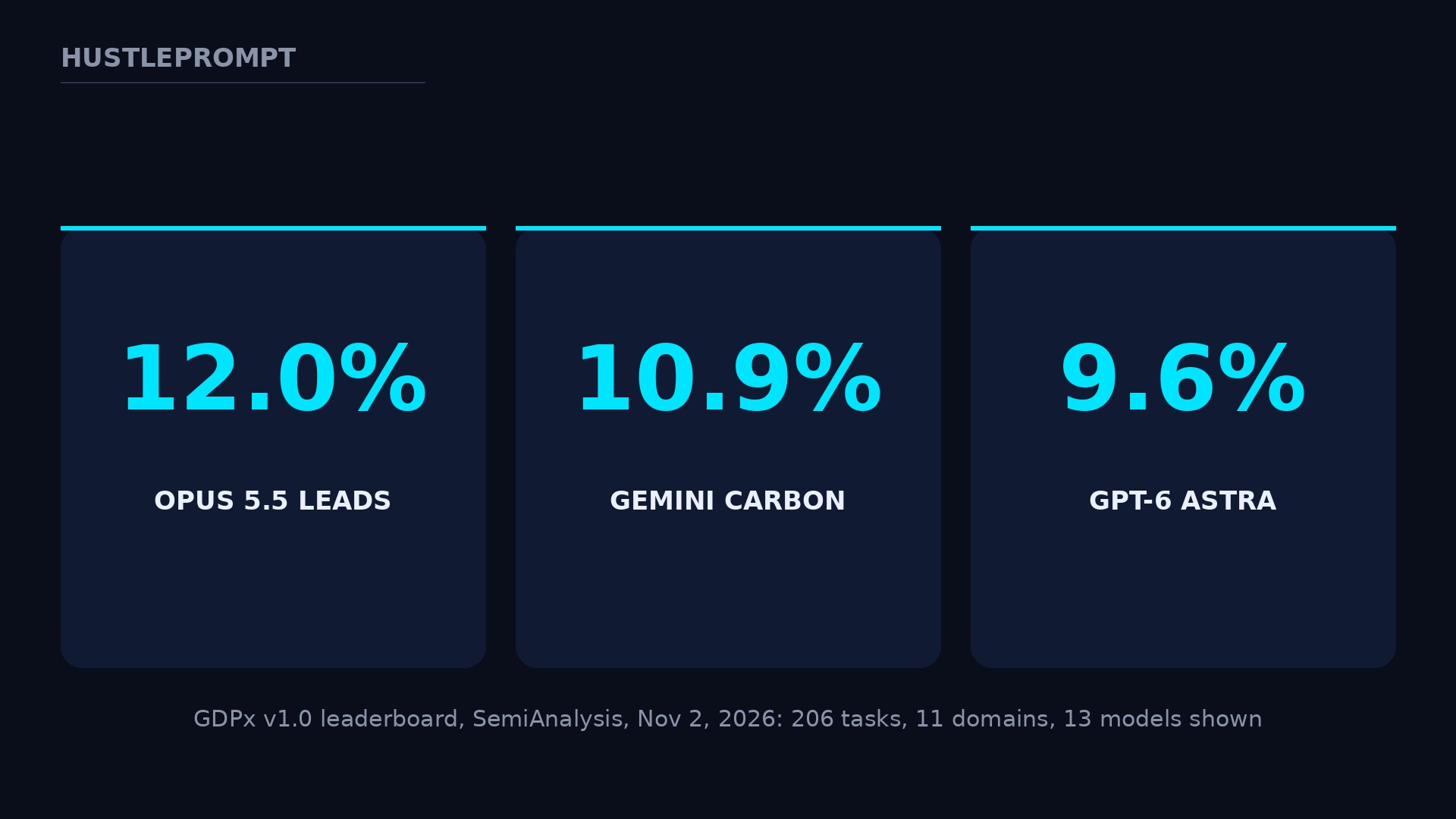
On November 2, 2026, research firm SemiAnalysis published GDPx, a benchmark of 206 long, messy tasks drawn from eleven fields it picked for their economic value. The top model, Anthropic’s Claude Opus 5.5, scored 12.0%. Google’s Gemini 4 Carbon scored 10.9%. OpenAI’s GPT-6 Astra scored 9.6%.
This is not another leaderboard for chatbots answering quiz questions. It is a reality check on the agent economy — and a price list for the humans who will clean up after it.
What Is Actually Trending
A benchmark is a standardized test: the same tasks, the same scoring, for every model. Most famous benchmarks are short. GDPx is deliberately long. Tasks run for up to eight hours in a realistic working environment, built with 14 specialized data partners, and scored mostly pass or fail — a plausible draft that fails its acceptance test does not pass.
The eleven domains are chip design, cybersecurity, biology, finance, legal work, quantitative trading, recursive self-improvement, hardware design, materials science, alignment, and software engineering. SemiAnalysis says it chose them because that is where frontier models should earn their highest returns — and deliberately left out government, real estate, and insurance.
The timing matters. Agents are being sold as replacements for junior staff, and priced as if they already were. GDPx arrives just as that sales pitch meets its first independent-style measurement of full jobs rather than demo tasks.
The Evidence: 12% at the Top, Zero in Finance and Legal
The leaderboard is spiky in a useful way. No model is best at everything. Opus 5.5 wins quantitative trading, hardware design, and chip design. Carbon leads biology and narrowly leads software engineering. Astra wins recursive self-improvement and materials science.
Sources: SemiAnalysis, “GDPx: Measuring Frontier Model Capabilities” (Nov 2, 2026) · GDPx leaderboard (SemiAnalysis) · Dealroom, “SemiAnalysis launches GDPx” (Nov 2, 2026) · Tech Times, “GDPx Benchmark: Best Frontier AI Scores 12%” (Nov 3, 2026).
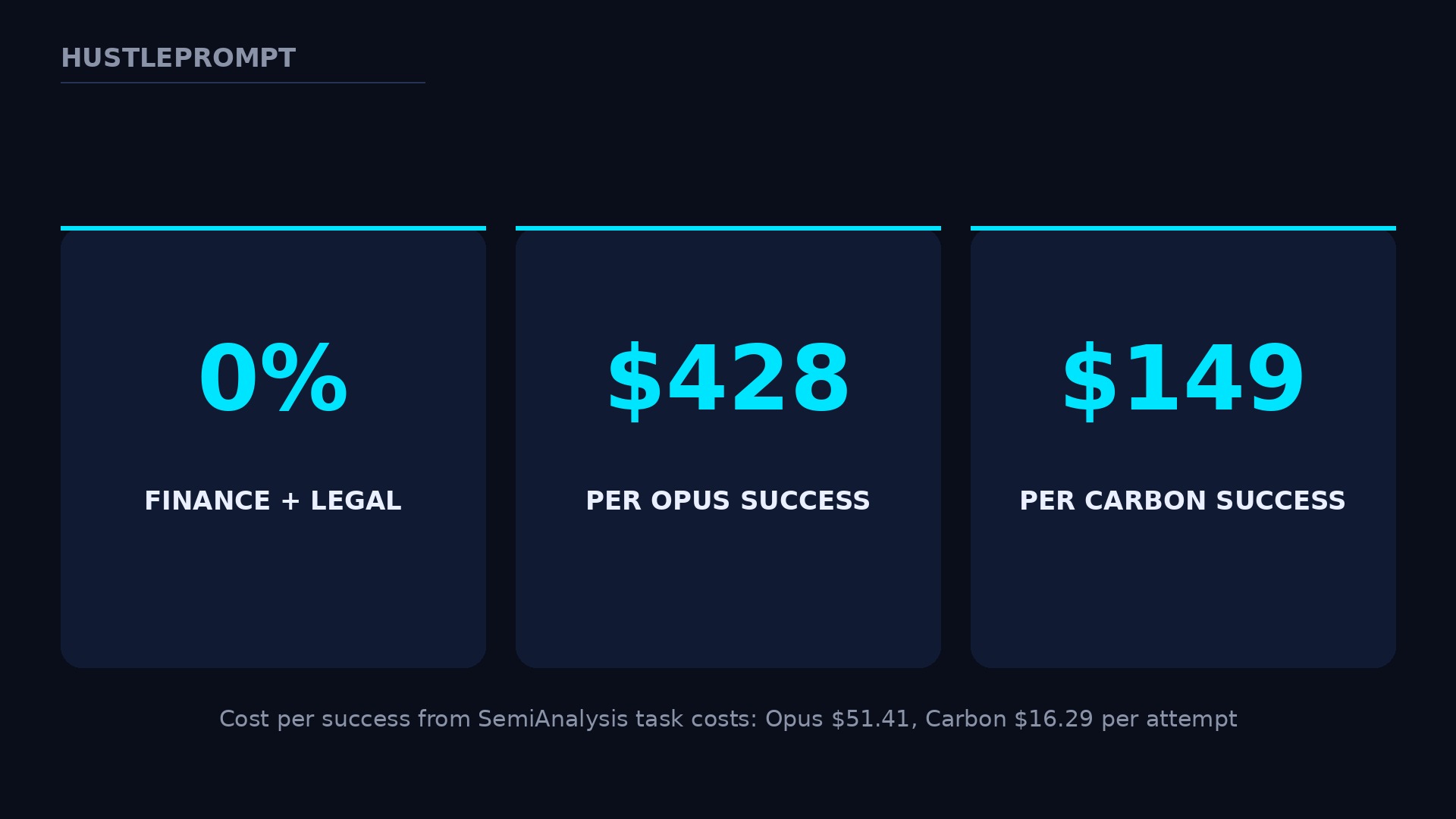
The second shock is the zero. Under pass-or-fail grading, every model scored 0% on finance and legal tasks. SemiAnalysis publishes partial-credit scores for those domains instead of a wall of zeros — but the underlying position is blunt: no model produced a complete, approvable finance transaction or legal deliverable.
One finance example shows why. The finance tasks reconstruct a private-equity deal spread across roughly 4,000 anonymized files, and the agent must find the right documents itself, exactly as a junior associate would. That is not a knowledge test. It is a stamina, organization, and judgment test — and every model failed it.
Why 12% Is Not the Whole Story
Three caveats change how you should read the number, and each one is a business signal.
First, the price of a success is high. SemiAnalysis lists Opus 5.5 at about $51.41 per task attempt. Divide by its 12% success rate and each completed task costs roughly $428. Carbon costs about $16.29 per attempt, or roughly $149 per success — about 91% of Opus’s score at about 32% of its cost. The cheap model that nearly keeps up is often the better business choice.
Second, safety filters distort the ranking. SemiAnalysis says its own safety classifiers pulled down Opus 5.5 and GPT-6 Astra in cybersecurity, biology, and alignment, where a refusal can look like a failure. Remove those three domains and the ranking flips: Astra moves from third to first, and Carbon drops from second to fifth. A buyer who only reads the headline ranking is buying the wrong model for their domain.
Third, the test is designed to be hard — and it is one lab’s test. These are SemiAnalysis’s own runs, not an independently re-run result. Wharton professor Ethan Mollick has already argued that zeros hide economically meaningful differences in partial success: a model that gets 90% of a deal file right is worth more than one that gets 10%, even if both score zero. Treat GDPx as a respected measurement, not a settled verdict.
None of that rescues the agent-replacement pitch. Even the generous reading — partial credit, filtered domains, cheaper models — leaves a market where long professional work still needs a human in the loop. The question for freelancers is not whether agents improve. It is who gets paid for the gap between 12% and done.
Sell the 88%: Slice, Supervise, Show Proof, Price the Outcome
The gap between an agent’s first draft and a deliverable a client can sign is now a priced service.
Break the job apart
Split long work into short, checkable tasks. Agents fail at 8-hour jobs; they are far stronger at 20-minute ones.
Verify every output
Check facts, files, and figures against the source. Never forward an agent’s draft as finished work.
Document the checks
A short verification log — what was checked, what was fixed — is what turns a draft into a deliverable.
Charge for the outcome
Clients pay for a signed, correct result, not for hours. The 88% failure rate is your pricing power.
How to Profit From This Trend
Stop selling “AI-powered” work and start selling verified work. The offer is a service that takes a client’s agent output — or their plan to automate a workflow — and returns something a human can actually sign, ship, or file. GDPx gives you the pitch in one line: the best agent completes about one in eight expert jobs, so every automated workflow needs a verification layer.
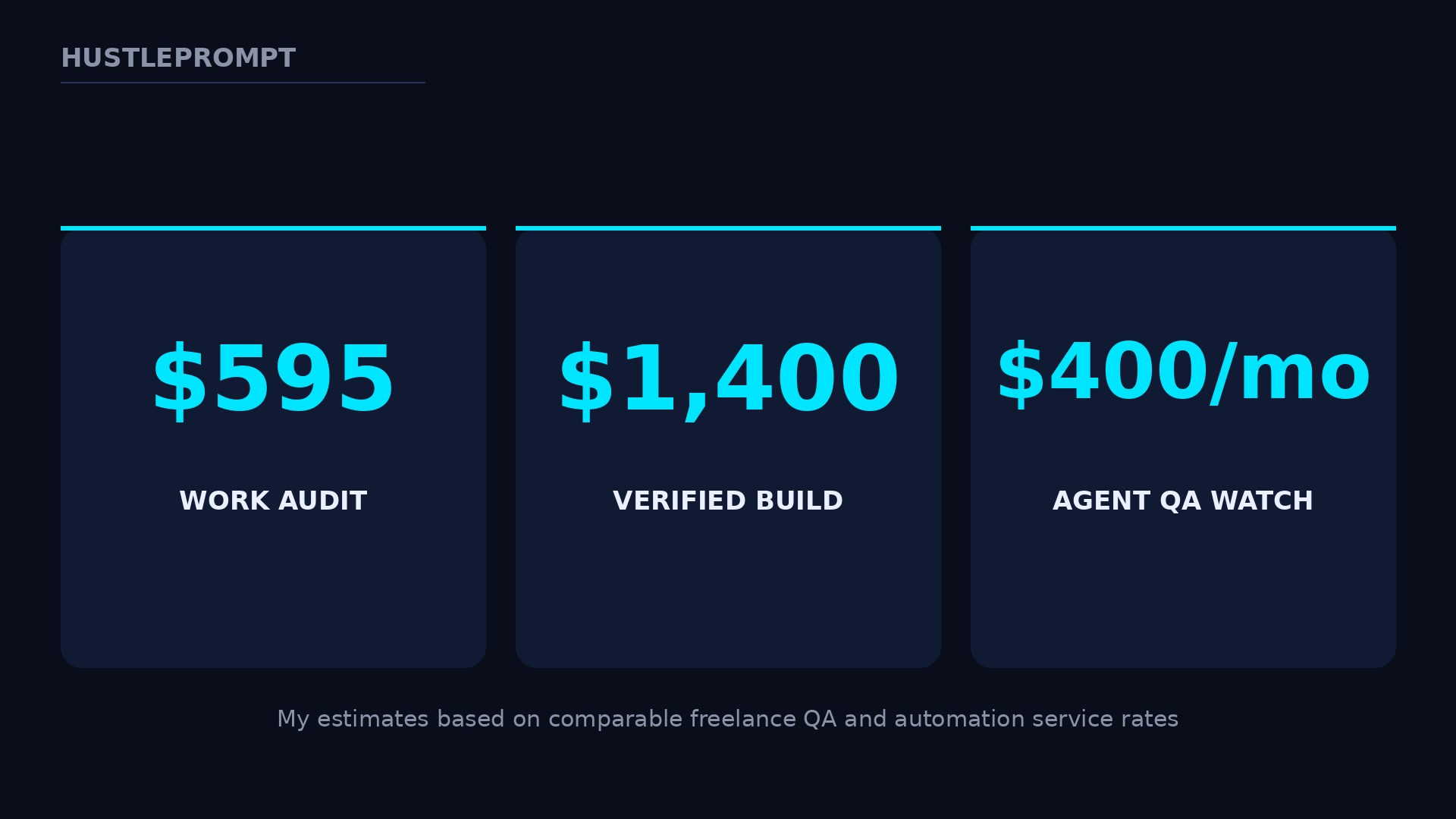
The entry product is a work audit: take one real workflow, run it through the client’s chosen agent, and score it the GDPx way — pass or fail against a written acceptance test, with the failures listed and priced. The larger sale is the verified build: the same workflow rebuilt as short, supervised agent steps with a human check at each gate.
Prices below are my estimates based on comparable freelance QA and automation service rates, not market data:
Lead with the domain split, not the headline. A law firm does not care that Opus leads chip design. It cares that every model scored zero on legal work under pass-or-fail grading — and that a human-verified legal draft is therefore still a premium product, not a commodity the client can generate for free.
What to Do This Week
- Pick one client workflow and write its acceptance test. What does “done” mean, in checkable terms? If you cannot write it, neither can the agent.
- Run the workflow through two models, not one. GDPx shows the leader changes by domain — and the cheaper model often nearly matches the leader. Test Carbon-class pricing against Opus-class quality on your own work.
- Time the correction, not just the generation. Record how long fixing the agent’s output takes. That number, not the demo speed, is your real cost.
- Price one verified deliverable this week. Offer the audit to a client already using agents, and show them the failures in their own output.
Watch: a third-party summary of the GDPx results (Model Tribune, not a SemiAnalysis video). Watch on YouTube.
Where This Is Heading
Benchmarks become buying guides. SemiAnalysis plans to refresh GDPx every three to six months. Expect procurement teams to start asking vendors for GDPx-style scores on their own workflows — and expect model cards to quote the domains where they win, not the overall number.
Cost per success replaces cost per token. At $428 versus $149 per completed task, the cheapest model per token is not always the cheapest model per result. Buyers who learn that math will stop paying premium prices for premium logos.
Verification becomes the job. As agents get better at drafts, the scarce skill moves from producing text to proving it correct. The freelancers who thrive will be the ones whose work a client can trust without re-checking — because they checked it themselves, in writing.
Frequently Asked Questions
What is GDPx?
GDPx is an agentic benchmark published by SemiAnalysis on November 2, 2026. It tests frontier AI models on 206 long tasks across 11 professional domains, built with 14 specialized data partners, with tasks running up to eight hours in realistic working environments.
Which model scored highest on GDPx?
Anthropic’s Claude Opus 5.5 leads at 12.0%, followed by Google’s Gemini 4 Carbon at 10.9% and OpenAI’s GPT-6 Astra at 9.6%. Meta’s Muse Wonder Full scored 9.0%, Grok 4.7 scored 3.9%, and Z.ai’s GLM 5.3 scored 2.7%.
Why did every model score zero on finance and legal?
Under GDPx’s intended pass-or-fail grading, no model completed a finance or legal task to the required standard — for example, the finance tasks reconstruct a private-equity deal across roughly 4,000 files. SemiAnalysis publishes partial-credit scores for those domains instead of zeros.
Does 12% mean AI can only do 12% of my job?
No. GDPx measures long, expert, multi-hour tasks under strict pass-or-fail grading. It says nothing direct about short, well-defined tasks, where agents are far stronger. The right reading is that unsupervised long work still fails most of the time.
Why does the ranking change when domains are removed?
SemiAnalysis says safety classifiers pulled down Opus 5.5 and GPT-6 Astra in cybersecurity, biology, and alignment. Excluding those three domains moves Astra from third to first and Carbon from second to fifth — so the best model depends on your domain.
How can I profit from the GDPx result?
Sell verification: audit a client’s agent workflow against a written acceptance test, rebuild it as short supervised steps with human gates, and charge for the verified outcome. GDPx is your evidence that the verification layer is not optional.