
AI traffic to US retail sites is up 130% this holiday season. On October 13, Shopify handed every AI agent on the internet the keys to a billion listings. Your shopper may never visit your website again. The agent will — and it only buys from stores it can read.
Product selection is moving upstream, from the storefront to the conversation. The storefront isn’t dying; it’s becoming data.
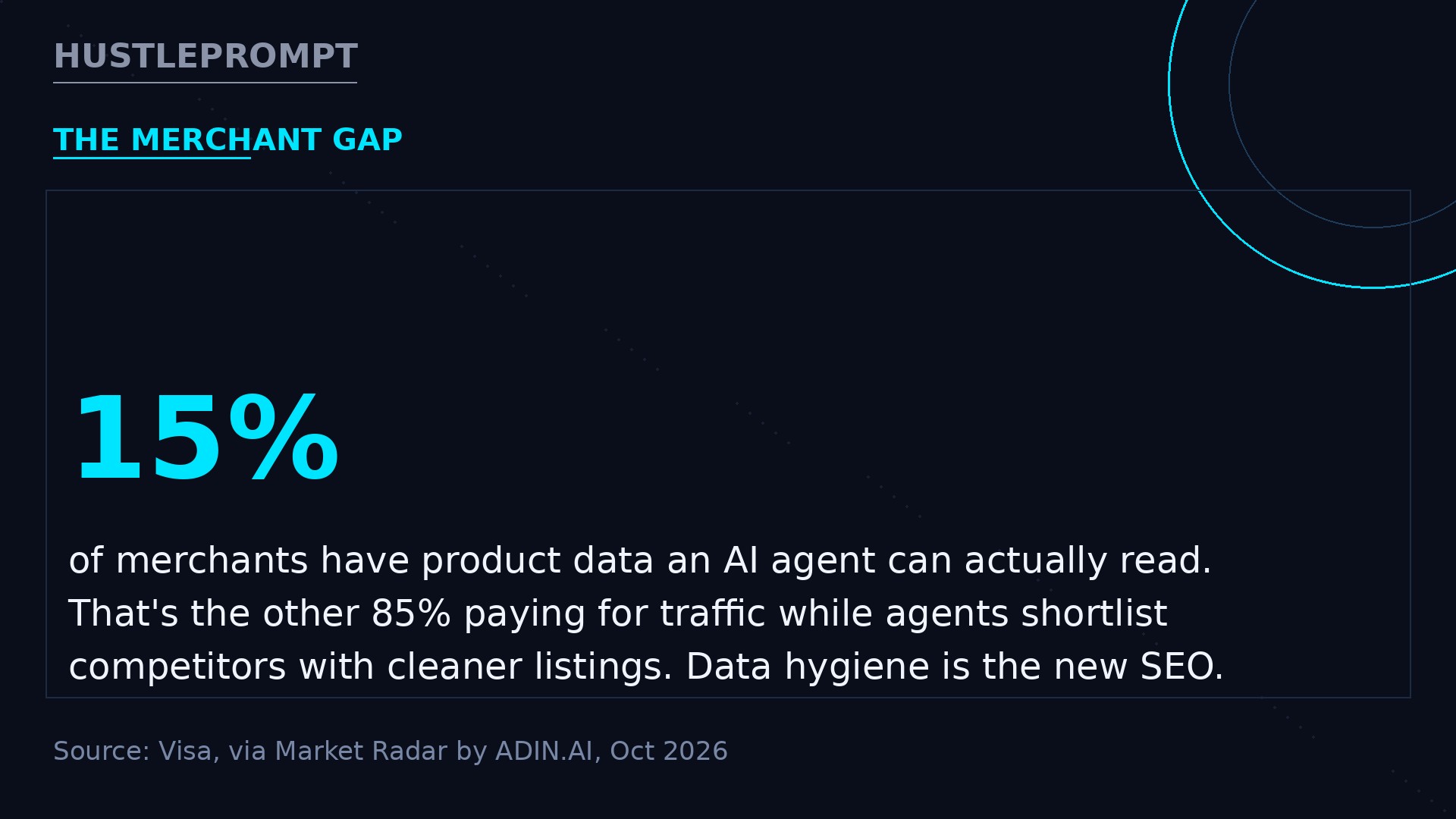
For freelancers and consultants, that question is a business. Right now, only 15% of merchants have product data an AI can actually read, per Visa data cited by Market Radar. That leaves 85% of stores invisible to the fastest-growing discovery channel in ecommerce.
The October 13 announcement that rewired commerce
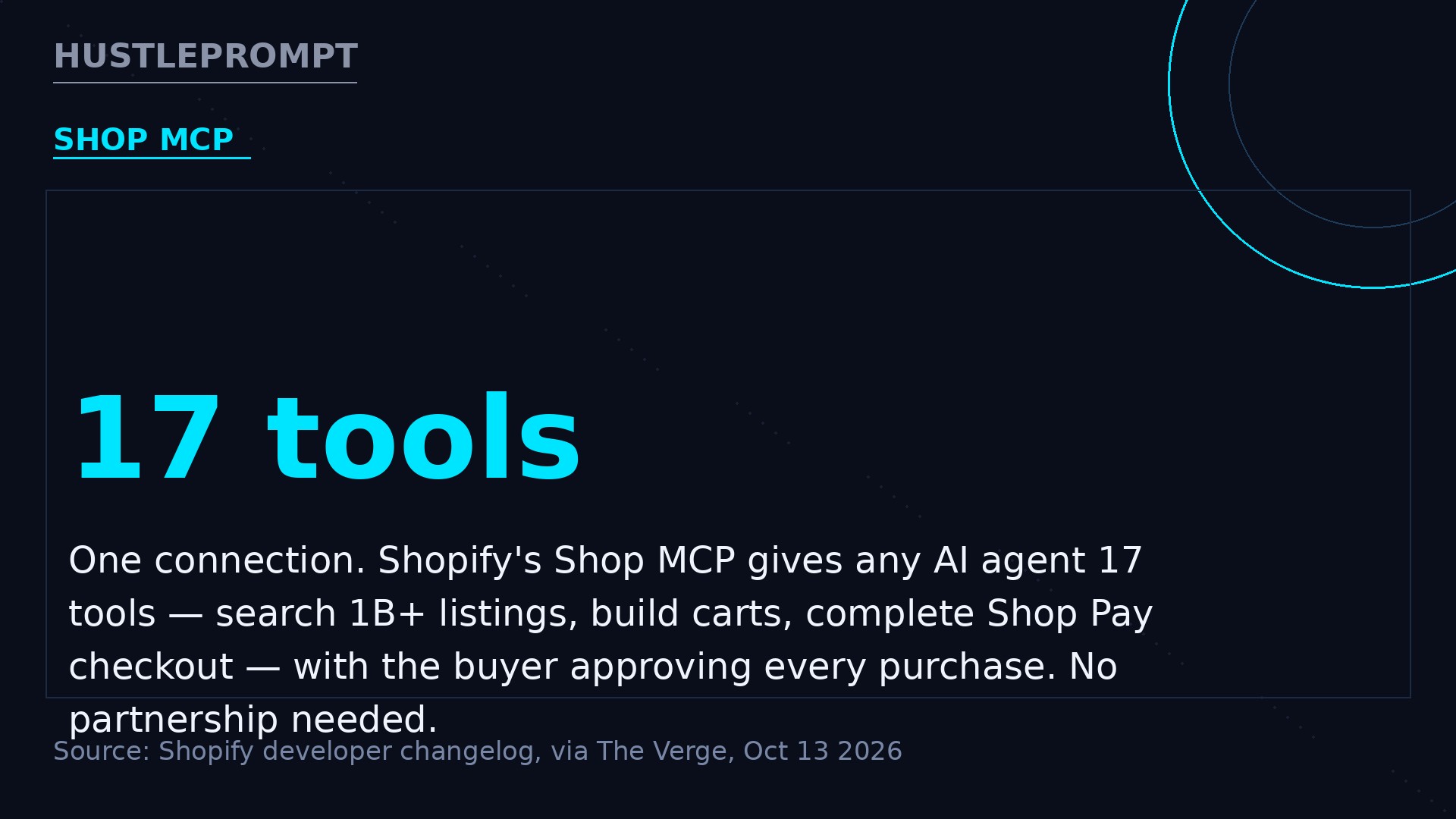
On October 13, 2026, Shopify launched Shop MCP — a hosted server giving any AI agent 17 tools (per Shopify’s developer changelog) for product search, carts, checkout, and order tracking. Catalog search needs no API key at all.
The draw is the catalog: more than 1 billion listings, on and off Shopify storefronts (The Verge). A shopper connects their own agent to their Shop account; checkout is one-click Shop Pay, and the buyer approves every purchase.
Until that Tuesday, an agent could find a product but had to send the shopper to the store’s site to pay — the detour where shoppers dropped off. The partnership requirement is gone too: in September only Meta’s Muse had access; now any MCP-compatible agent connects without a deal.
Shopify’s VP of Product Mani Fazeli: “Agentic commerce isn’t something we’re reacting to; it’s a vision we’re bringing to life at the very frontier of commerce and AI.” And the merchant homework, from Shopify’s holiday post: “an agent can only repeat the case a brand has already made.”
Sources: 8digits on the announcement · Forkast analysis with the Fazeli quote · Otto365 brief with Shopify’s holiday figures
Holiday 2026: the numbers behind the wave
October research converges on one story: shoppers already let AI pick products, and this holiday season the habit goes mainstream.
| Metric | Figure | Source |
|---|---|---|
| AI traffic to US retail sites, holiday 2026 | +130% this season, +95% on Black Friday | Adobe, Sept 2026 |
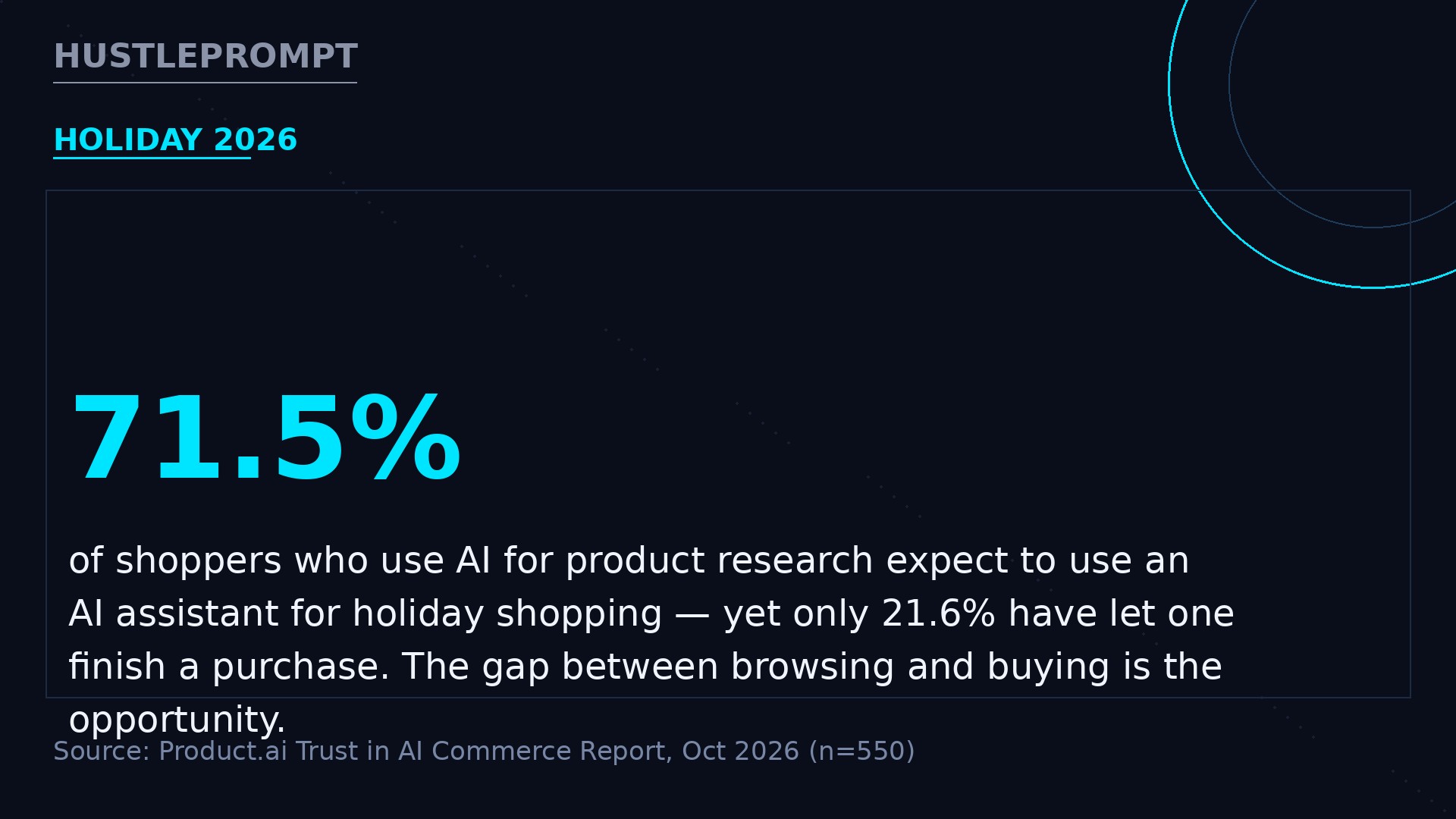
| AI shoppers planning to use an assistant for holiday shopping | 71.5% of 550 surveyed | Product.ai, Oct 2026 |
| AI shoppers who verify before buying | 89.9% (up from 85.7% in June) | Product.ai, Oct 2026 |
| AI shoppers who let an assistant complete a purchase | 21.6% (8.0% of all shoppers) | Product.ai, Oct 2026 |
| Merchants with AI-readable product data | 15% | Visa |
| E-commerce sites running their own shopper agent by Cyber Week | 1 in 3 | Salesforce |
| US consumers: would let AI check out vs. actually have | 57% say / 13% do | Omnisend / Checkout.com |
Source: Market Radar Black Friday 2026 findings · Source: Product.ai survey via PRNewswire
The say-vs-do gap is the opportunity
Intent runs ahead of behavior: 57% of US consumers say they’d let an AI agent check out, but 13% have. Skeptics call that hype. I’d call it a pipeline that leaks at verification: 89.9% of AI shoppers check recommendations first, and 37.5% won’t let an agent spend anything unasked. Accuracy is the currency — and accurate data is what merchants control.
Which assistant writes the shortlist? First Page Sage’s October 19 head-to-head — 480 questions across 8 platforms, 3,840 answers — scored Google Gemini 88.7/100, ChatGPT 87.8, Amazon Rufus 85.7. Rufus was most accurate (91.3%) but only recommends Amazon products; cross-store agents lean on whoever’s data is cleanest. Source: First Page Sage 2026 study
The agentic checkout stack: how the money moves
MCP — the Model Context Protocol — is the open standard letting an AI assistant call software tools: one connection, and the agent can use everything plugged in. Shopify’s Shop MCP is that USB port for commerce — but it isn’t the only protocol in play:
| Protocol / program | Backed by | Status (Oct 2026) |
|---|---|---|
| Shop MCP | Shopify | Live Oct 13; 17 tools; no key for search |
| ACP (Agentic Commerce Protocol) | OpenAI + Stripe | Beta; discovery live in US |
| UCP (Universal Commerce Protocol) | Google + Shopify | Live in US via AI Mode/Gemini |
| Copilot Checkout | Microsoft | Pilot; via PayPal, Shopify, Stripe |
| Perplexity Instant Buy | Perplexity + PayPal | Live in US |
Two honest limits: the live checkouts exclude subscriptions and most digital goods — this is physical retail’s wave — and risk stays with the seller. No card network has shifted liability; Stripe’s terms leave disputes with the merchant. Source: Okane Land study, Oct 14
The honest counterweight
Real infrastructure, small current volume: AI assistants drove 0.12% of revenue across ten established Shopify stores from January to August 2026. Morgan Stanley’s $190–385 billion 2030 forecast is a forecast, not a receipt.
That is the thesis: buy optimization while 85% of merchants are invisible and AI traffic compounds at 130%.
How to profit: sell the agent-readable storefront
The 15% figure describes millions of merchants who need a new discipline, weeks before peak season. Nobody has to believe a forecast to buy this: clean data lifts regular search, feeds, and conversion today.
The service package
Productize one offer: the “Agent-Ready Storefront Audit” — a scored report across titles, variant attributes, structured price/stock/shipping, schema.org markup, crawler access, guest checkout, and a saved-wallet option.
- Audit + fix (one-time): $995–$1,500 per store. Score the catalog, rewrite the top 50 listings for agent readability, add schema markup, verify crawler access.
- Holiday retainer (monthly): $395–$750/month through January. Monitor listing accuracy, update shipping cutoffs, refresh stock data, report AI-referred sessions.
The arithmetic, conservative tier: ten merchants at $995 setup = $9,950 upfront; eight take the $395 retainer = $3,160/month recurring — roughly a $20k quarter from a laptop. Agency tier: twenty stores at $1,500 setup + $750 retainer = $30,000 upfront and $15,000/month recurring.
Timing is the pitch
Black Friday is weeks away, AI traffic is up 130%, and one in three ecommerce sites will run their own shopper agent by Cyber Week. Sell the deadline, not the technology.
- Niche by vertical: parts and accessories stores are the sharpest wedge — fitment data lives in theme widgets agents can’t read. Charge a premium.
- Retainers are the business: catalogs rot. Audits open the door; subscriptions pay the rent.
- Affiliate stacking: recommend the feed apps, schema plugins, and review platforms you use, with affiliate links. The audit pays once; the stack pays monthly.
- Teach it: a $99 mini-course or paid holiday checklist converts merchants who won’t hire you.
The 7-day merchant checklist
- Fix your top 50 listings: searchable titles, spelled-out variants (size, color, capacity).
- Put price, currency, and availability in the page, with schema.org Product and Offer markup.
- Write shipping truth in structured fields — exact estimates and holiday cutoffs, not banner images.
- Let the crawlers in: check robots.txt. OpenAI’s OAI-SearchBot decides whether you appear in ChatGPT answers.
- Make checkout finishable: guest purchase, a saved wallet (Shop Pay, Link, Google Pay), no bot wall at the payment form.
- Keep dispute evidence: Visa’s Compelling Evidence 3.0 lets an agent provider’s login ID help contest fraud disputes.
- Measure the channel: tag agent-attributed orders separately. Prove the increment.
Watch: the future of checkout, explained
FAQ: AI agents shopping for your customers
What is agentic commerce?
Commerce where an AI agent does the browsing, comparing, and cart-building, with the human approving the purchase. Shopify’s October 13 Shop MCP launch made it a real channel: any agent can search 1B+ listings and check out with Shop Pay.
Can an AI agent buy from my store today?
Yes — via Shop MCP, Google’s UCP checkout (US), Copilot Checkout’s pilot, or Perplexity Instant Buy; most agents can also buy on your own site like a browser. Volumes are still small, but the infrastructure is live.
What does “agent-readable” product data mean?
Structured, machine-parseable listings: exact titles, variant attributes, live price and stock, shipping estimates, schema.org markup — plus crawler access. Only 15% of merchants have it, per Visa data.
Do I need new software to be agent-ready?
Mostly no: clean listings, schema markup, open crawlers, guest checkout with a saved wallet. Don’t buy specialist “AI commerce” software until you can measure agent discovery volume.
Who is liable if an agent buys the wrong thing?
The seller, for now. No card network has shifted liability, and Stripe’s terms leave disputes with the merchant. Keep good order evidence.
What does agent-ready optimization cost?
Freelancers are productizing it at $995–$1,500 for a one-time audit plus fixes, and $395–$750/month for holiday monitoring. The work also improves conventional SEO and conversion.
Is it too late to get ready for holiday 2026?
No. Black Friday is weeks away and 85% of merchants lack agent-readable data. A 7-day sprint on your top 50 listings covers the products agents are most likely to shortlist.
- → Anthropic Wants AI Agents to Haggle Prices for You
Agents won’t just pick products — they’ll negotiate. What that means for your margins. - → The Agent App Store Gold Rush Is Starting
The distribution wave behind this story: who owns the agent shelf owns the economics. - → Enterprises Are Buying AI Agents, Not AI Tools
Where the big budgets are going — and why services beat software in the agent era.