
The best decision-making AI model on the market right now costs ten cents per million tokens. Baseten bison-1, released on November 20, 2026, just claimed the top spot on the Artificial Analysis Decision Index — and its smaller sibling, groundhog-1, costs roughly a third of that.
A decision model does not write text. You give it a situation and a set of possible answers, and it returns a calibrated probability for each one. That is the entire job — and it is the job behind ticket triage, lead scoring, content routing, and approval pipelines.
For freelancers and small agencies, that distinction is money. A model that answers instead of chatting burns far fewer tokens, and at these prices the math gets hard to ignore.
What bison-1 and groundhog-1 are
Both models are built on Google’s Gemma 4, and both are open-weight models with their weights published on Hugging Face. bison-1 is a 31-billion-parameter dense model tuned for maximum accuracy. groundhog-1 is a 26-billion-parameter mixture-of-experts model with about 4 billion active parameters per token, built for lower latency and cost.
They share the same API as Baseten’s earlier decision models, so teams already using mammoth-1 or elephant-1 can switch by changing the model name. Both accept text and image input, and both offer a 128k-token context window — eight times the 16k window of the previous models.
The move to Gemma 4 is deliberate. Baseten’s earlier decision models, mammoth-1 and elephant-1, were built on Qwen backbones. The new pair gives teams the same class of performance on an American base model, which matters for buyers with procurement rules or clients who ask where the model comes from.
The benchmark numbers that matter
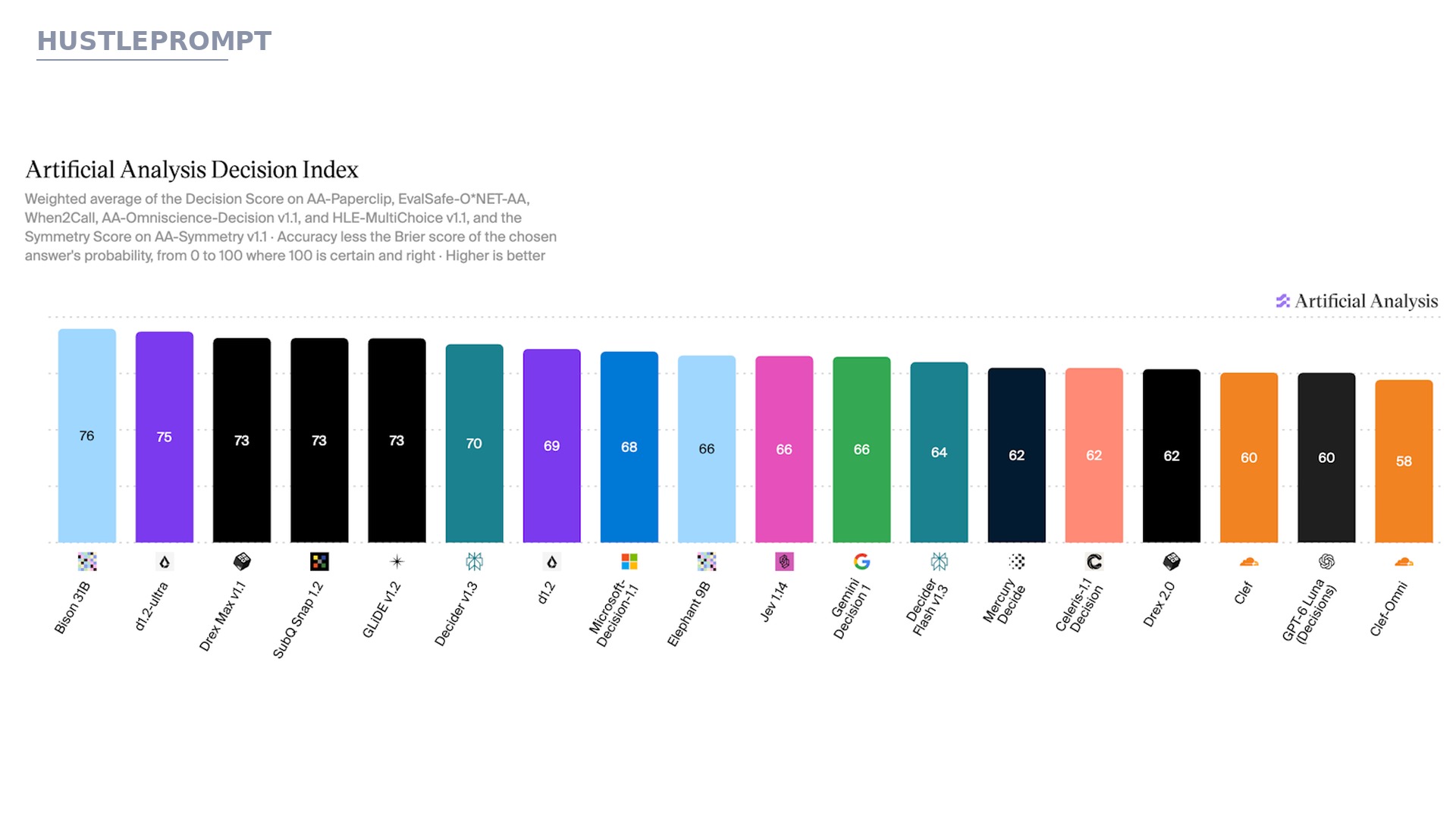
On the Artificial Analysis Decision Index v2.1, bison-1 scores 76 and ranks first of 19 decision models. Liquid AI’s d1.2-ultra follows at 75, and Baseten’s own mammoth-1 sits at 71. One point at the top of a benchmark is a narrow lead — but it is a lead over every rival, including models from Microsoft, Google, and OpenAI.
Artificial Analysis Decision Index v2.1 — top of the table
| Model | Score | Rank |
|---|---|---|
| bison-1 (Baseten) | 76 | #1 of 19 |
| d1.2-ultra (Liquid AI) | 75 | #2 |
| mammoth-1 (Baseten) | 71 | #3 |
Source: Baseten announcement, November 20, 2026, reporting the Artificial Analysis Decision Index v2.1.
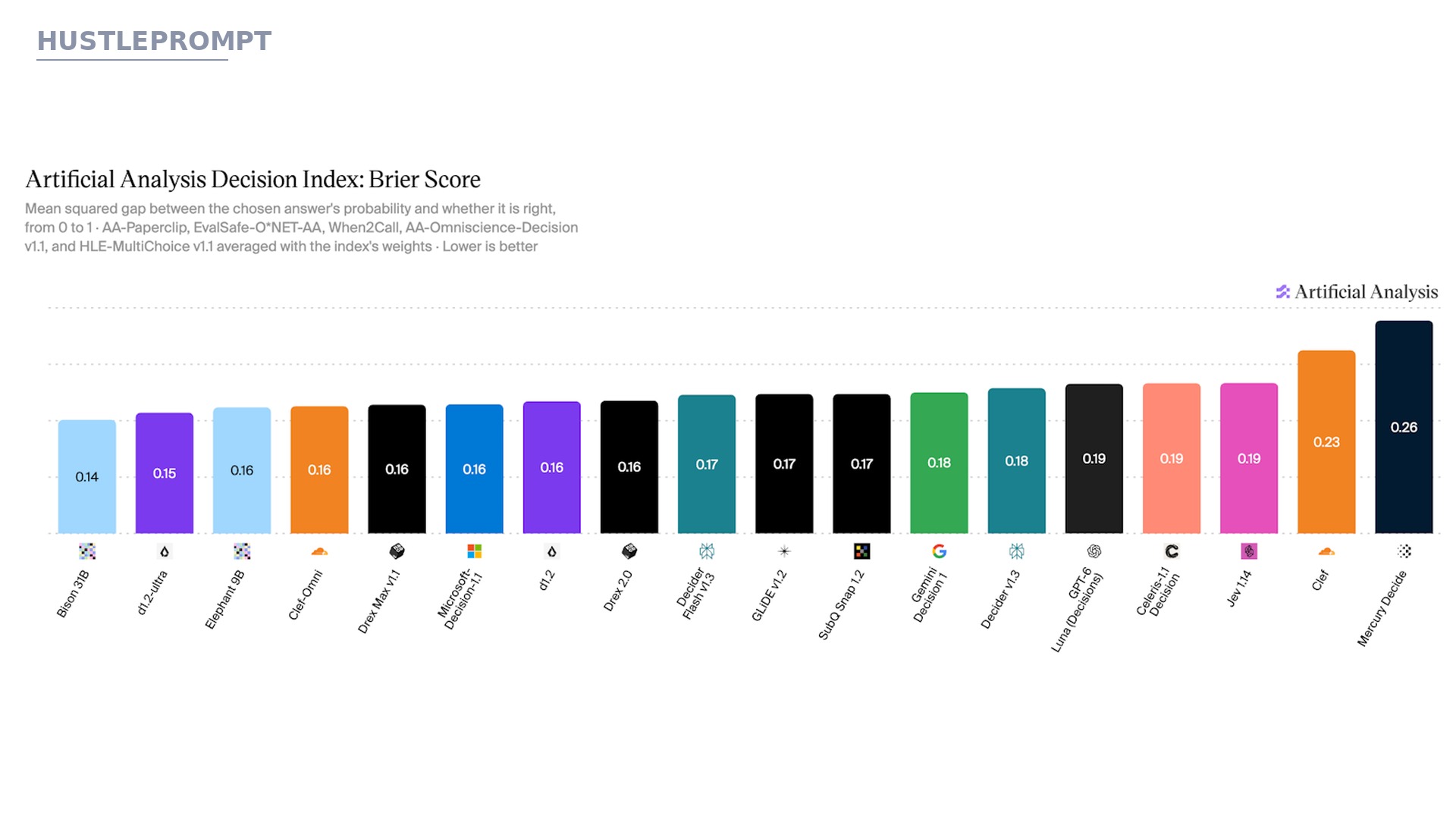
The more important number may be the second one. bison-1 also posts the best calibration on the index, with a Brier score of 0.14, ahead of d1.2-ultra at 0.15. Calibration is what turns a probability into a business rule: when the model says it is 83% sure, it should be right about 83% of the time.
Baseten credits part of that calibration to training on the Gemma base and part to scaling up “soft labels” in its training data — teaching the model to answer “83% option A, 17% option B” instead of a flat “100% option A.” For anyone building an auto-approval pipeline, that honesty is the feature.
Why calibration is the real story
Why 128k context changes the job
Long context matters because the detail that changes a decision is often buried far from the question. Baseten gives the example of an invoice that looks ready for payment — until an earlier email in the thread shows the order was canceled. Without that history, a model approves a payment it should reject.
With 128k tokens, teams can feed in full policies, full conversation histories, or full case files instead of selecting excerpts or summarizing first. That removes a whole step — and a whole source of errors — from triage and review workflows.
It also changes the cost math. A longer context window only helps if you can afford to fill it, and at $0.10 per million tokens, stuffing 100,000 tokens of history into a decision costs about a cent.
From inbox to decision in one pass
1
Input
Ticket + full history
(up to 128k tokens)
2
Decide
bison-1 or groundhog-1
scores every option
3
Probability
Calibrated score
(e.g. 92% refund)
4
Rule
Auto-approve, route,
or escalate
No text is generated at any step — the model only scores the options you define.
How to profit from a decision model
The money here is not in the model. It is in the pipeline you wrap around it. A decision model is a component, and agencies get paid for the system. Here is the shortest path from this launch to revenue:
- Pick one decision bottleneck. Support-ticket triage, refund approvals, lead scoring, or content moderation are the usual starting points.
- Define the answers up front. Yes/no, a shortlist of categories, or a 1-to-5 rubric. Decision models need bounded choices.
- Set a confidence threshold. Auto-approve above 90%, route the middle to a human, and reject or escalate below the line.
- Start with groundhog-1 for volume and switch the high-stakes calls to bison-1. Same API, one name change.
- Charge for the outcome, not the tokens. A client pays for tickets resolved per hour, not for your API bill.
The Base Labs decision model family
| Model | Parameters | Backbone | Context | Price per 1M tokens |
|---|---|---|---|---|
| bison-1 | 31B | Gemma 4 31B | 128k | $0.10 |
| groundhog-1 | 26B (MoE, ~4B active) | Gemma 4 26B-A4B | 128k | $0.035 |
| mammoth-1 | 27B | Qwen | 16k | $0.10 |
| elephant-1 | 9B | Qwen | 16k | $0.035 |
| joey-1 | 2B | Qwen3.5-2B | 16k | $0.01 |
Source: Baseten announcement, November 20, 2026. groundhog-1 is priced like elephant-1; bison-1 like mammoth-1.
What it actually costs
Decision models charge per million input tokens only. They return probabilities, not generated text, so there is no output-token bill at all. That makes the monthly math almost boring — and very cheap.
Worked example: 10,000 tickets a day at 2,000 tokens each
| Model | Tokens per day | Cost per day | Cost per month (30 days) |
|---|---|---|---|
| bison-1 ($0.10 / 1M) | 20 million | $2.00 | ~$60 |
| groundhog-1 ($0.035 / 1M) | 20 million | $0.70 | ~$21 |
Example math from Baseten’s published prices. Your token count depends on how much context you attach to each decision.
A small agency routing 10,000 support tickets a day, at roughly 2,000 tokens of context per ticket, burns 20 million tokens a day. On bison-1 that is about $2 a day. On groundhog-1 it is about $0.70. Even the flagship works out near $60 a month for a workload that would cost several times more on a chat model.
That is the pitch to sell: a client replaces a first-pass human review step with a model that costs less than a coffee a day, and you keep the margin on the system you built around it.
The honest limits
Two caveats before you rebuild your stack. First, groundhog-1 has no official Decision Index score yet. Baseten says it expects groundhog-1 to match mammoth-1, but that is an expectation, not a result — treat the cheaper model as unproven until the index says otherwise.
Second, a decision model only decides. It cannot draft the reply, write the summary, or explain itself to a customer. Every pipeline still needs a chat model or a human downstream for the words. Budget for that, and test calibration on your own data before you let any threshold auto-approve real money.
Used that way — cheap, calibrated, and fenced in by thresholds — bison-1 is the rare launch that is both the best in its class and the cheapest way to use it. For builders who sell decisions, that combination is the whole opportunity.
Frequently asked questions
What is Baseten bison-1?
bison-1 is a 31-billion-parameter open-weight decision model built on Google’s Gemma 4. It ranks #1 of 19 models on the Artificial Analysis Decision Index v2.1 with a score of 76, and it has the index’s best calibration, with a Brier score of 0.14.
How much does bison-1 cost?
bison-1 costs $0.10 per million input tokens on Baseten Model APIs. There is no output-token charge, because a decision model returns probabilities, not generated text.
What is groundhog-1, and how is it different from bison-1?
groundhog-1 is the cheaper sibling: a 26-billion-parameter mixture-of-experts model with about 4 billion active parameters, priced at $0.035 per million tokens. It shares bison-1’s 128k context and multimodal input, but it has no official Decision Index score yet — Baseten expects it to match mammoth-1.
What is a decision model?
A decision model takes a situation plus a set of possible answers and returns a calibrated probability for each one, covering yes/no, choice, and rubric questions. It does not generate text, which makes it fast and cheap for triage, routing, scoring, and approval pipelines.
Can I self-host bison-1 and groundhog-1?
Yes. Both models have open weights published on Hugging Face, and both are also live on Baseten Model APIs using the same API as Baseten’s earlier decision models.
What does a Brier score of 0.14 mean?
The Brier score measures how closely a model’s stated confidence matches how often it is right. Lower is better. bison-1’s 0.14 is the lowest — best — score on the Artificial Analysis Decision Index, ahead of d1.2-ultra at 0.15.
How do I try bison-1?
Through Baseten Model APIs. It uses the same API as the existing decision models, so if you already call mammoth-1 or elephant-1, switching is a matter of changing the model name.
Keep Reading
- Mammoth-1: Open AI Models That Decide Instead of Writing
- NVIDIA Nemotron 3.5: 5 Open Models Cut AI Agent Costs
- How to Start an AI Automation Agency (From Zero to First Client)