
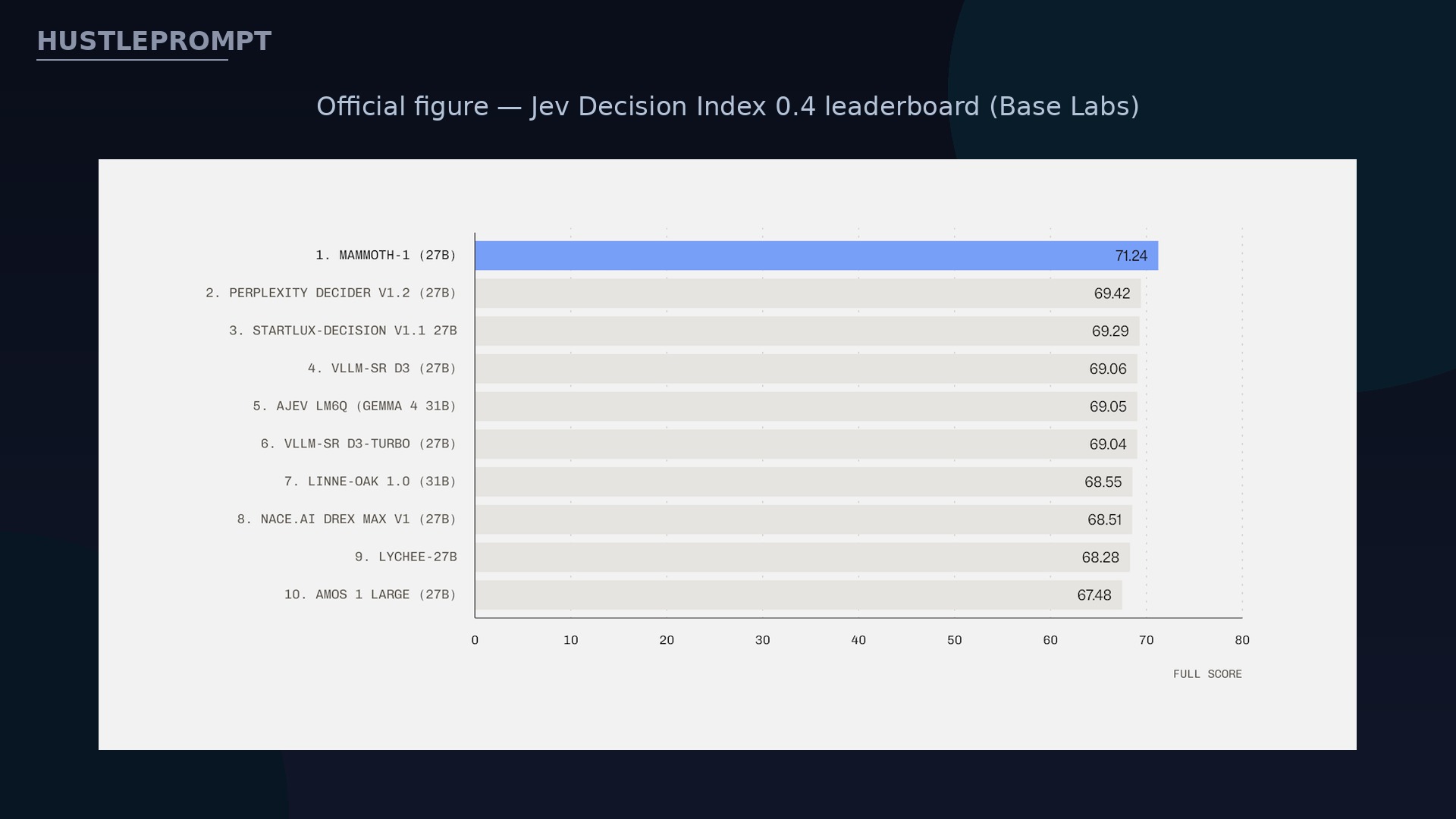
A 27-billion-parameter AI model just beat 207 rivals without writing a single word. The new mammoth-1 decision models from Base Labs don’t generate text at all — they read a situation, weigh your options, and hand back a probability for each one. Mammoth-1 now sits at #1 on the Jev Decision Index with 71.24, and both models are open-weight and free to try this week.
If you build software or sell automations, this is the cheapest “AI brain” you’ve ever rented. Here’s how to profit from it.
What Is a Decision Model, Exactly?
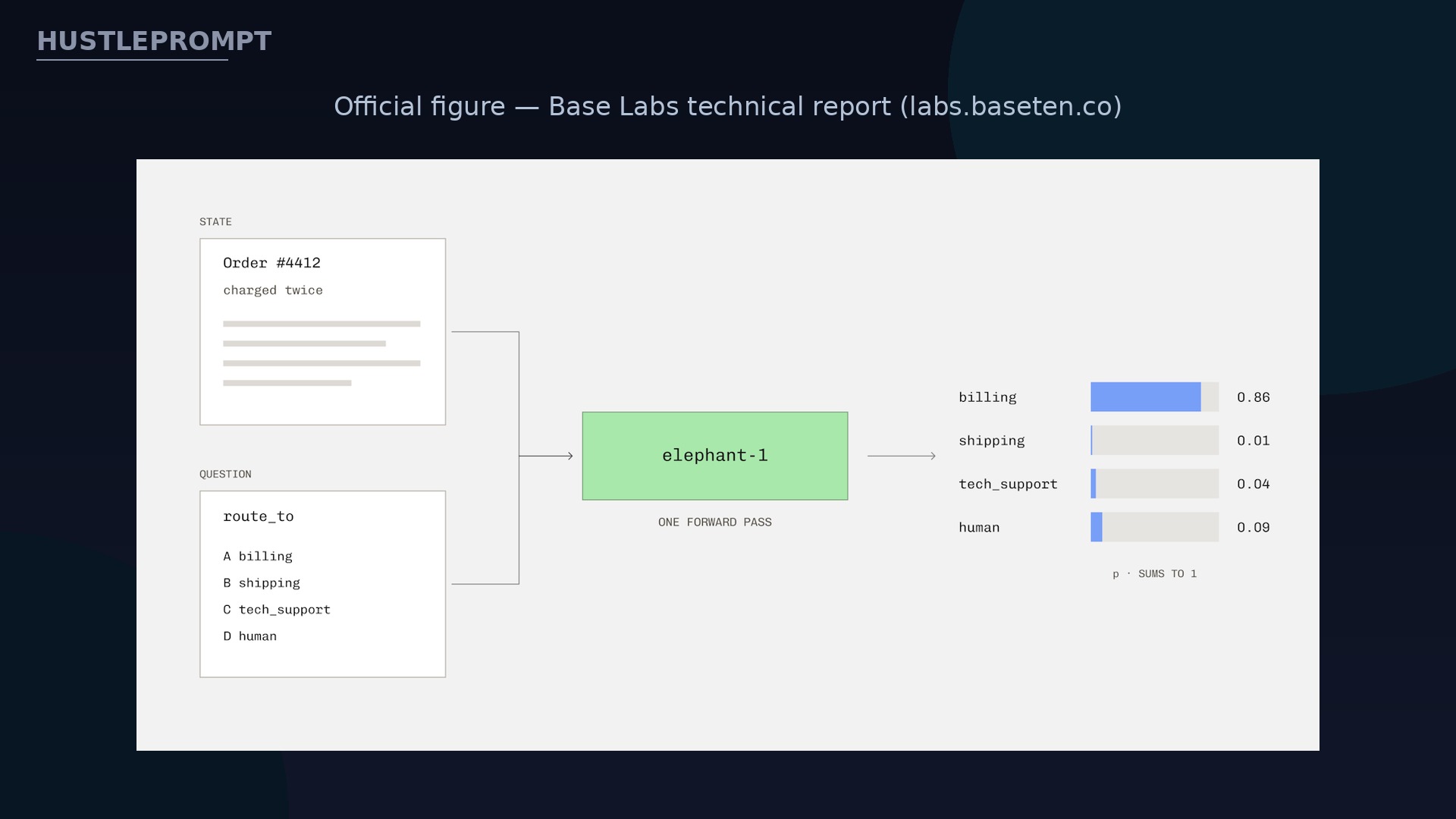
A normal chatbot takes your prompt and writes back paragraphs. A decision model skips the prose. You feed it a state — a support ticket, a lead record — plus typed questions, and it returns a probability for every possible answer in a single forward pass.
Calibrated probabilities means the numbers are honest: 86% confident means right about 86% of the time. A forward pass is one trip through the neural network — no token-by-token generation, no parsing.
Three question types:
- Choice: pick from up to 255 named options (which team owns this ticket: billing, shipping, support?).
- Yes/no: one number — the probability the answer is “true” (is this email phishing?).
- Score: rate input on a 2–10 scale (how upset is this customer, 0 = calm to 4 = furious?).
TypeSafe introduced the format in September 2026 with Jev. Base Labs post-trained open Qwen3.5 models into decision specialists that top the leaderboard.
The Numbers Behind the Launch
| Model | Size | Jev Decision Index 0.4 | Artificial Analysis Decision Index |
|---|---|---|---|
| mammoth-1 (Base Labs) | 27B | 71.24 — #1 of 208 | 65.9 (Base Labs replica) |
| elephant-1 (Base Labs) | 9B | 62.65 — tied 7th, best under 15B | 65 — tied #1 with d1-ultra |
| Perplexity Decider v1.2 | 27B | 69.42 — #2 | n/a |
Source: Base Labs — “Mammoth-1 and Elephant-1: frontier decision models” (Oct 21, 2026). AA figures for Base Labs models come from the lab’s own replica of that index.
The stats that matter for builders:
- 71.24 — mammoth-1’s score, 1.8 points clear of nearest rival Perplexity Decider v1.2.
- 6.21M — training examples in the final data mix, built over eight iterations.
- 16k — token context window on both models.
- $0 — cost of the one-week trial on Baseten’s Model APIs, zero data retention by default.
How a Decision Call Works
ANATOMY OF A DECISION CALL
1 · State
Your input as JSON: a ticket, a lead, a document.
2 · Questions
Typed questions — Choice, Yes/no, Score — several per request.
3 · One forward pass
No text generated. The prefix is processed once and reused.
4 · Probabilities
Calibrated probability per option, summing to 1.
5 · Threshold
Act above your confidence bar; escalate to a human below it.
Nothing generated means cheap, fast, thresholdable calls. Source: Base Labs technical report.
The 6.21M-Example Training Recipe
The gains came mostly from data. Base Labs grew its mix from 254k to 6.21M examples across eight iterations — and taught the models an unusual skill: saying “I don’t know.” A full million examples cover abstention: harmful-request classification, tool-call refusal, and questions where not deciding is the right call.
| Data category | Examples | Share |
|---|---|---|
| Core decision skills | 3.62M | 58.3% |
| Safety and abstention | 1.00M | 16.1% |
| Judging and expert domains | 1.00M | 16.1% |
| Public decision data | 0.59M | 9.5% |
Source: Base Labs technical report, Section 2.4.
How to Profit From the Decision-Model Wave
OpenAI just launched its own Decisions API — and the best open-weight alternative is free to try. Five steps:
- Pick one painful routing problem. Ticket triage, lead scoring, refund-fraud flags, moderation queues. One niche, one workflow.
- Prototype free this week. Free on Baseten’s Model APIs for a week and on Vercel’s AI Gateway through October 27. Build the demo before the trial ends.
- Set confidence thresholds. Auto-act above 0.9, escalate below. The calibrated probabilities are the whole point — use them.
- Productize it. Sell a hosted classification endpoint to agencies, or done-for-you triage to one vertical.
- Kill per-call costs. The weights are open on Hugging Face. Self-host elephant-1 and your marginal cost per decision drops toward zero.
Your pitch: “AI triage that knows when to ask a human.” The abstention training is the trust story.
Where to Try Mammoth-1 Today
- Baseten Model APIs — free one-week trial, zero data retention by default (Baseten blog).
- Vercel AI Gateway — free through October 27:
baseten/mammoth-1(changelog). - Hugging Face — baselabs/mammoth-1 and baselabs/elephant-1.
- OpenRouter — free
baseten/mammoth-1:freeendpoint, 16k context (OpenRouter).
FAQ
What is mammoth-1?
A 27B open-weight decision model from Base Labs (Baseten’s research lab), released October 21, 2026. It returns calibrated probabilities for questions you define instead of generating text — and ranks #1 of 208 on the Jev Decision Index at 71.24.
How is a decision model different from ChatGPT?
ChatGPT writes answers you must parse. A decision model answers structured questions with a probability per option in one pass — cheaper, faster, thresholdable.
Is mammoth-1 really free?
For now. Free for a week on Baseten’s Model APIs and through October 27 on Vercel’s AI Gateway. The weights are also open on Hugging Face for self-hosting.
What does “calibrated probabilities” mean?
The confidence numbers are honest: 80% probability means correct roughly 80% of the time. Base Labs trained for this with a loss function that punishes overconfidence.
How does this compare to OpenAI’s Decisions API?
Same idea — verdicts instead of prose — but open-weight, so you can inspect, fine-tune, and self-host. See our OpenAI Decisions API coverage in Keep Reading.
Keep Reading
Official sources: Base Labs technical report (Oct 21, 2026); Baseten blog announcement; Vercel changelog.