
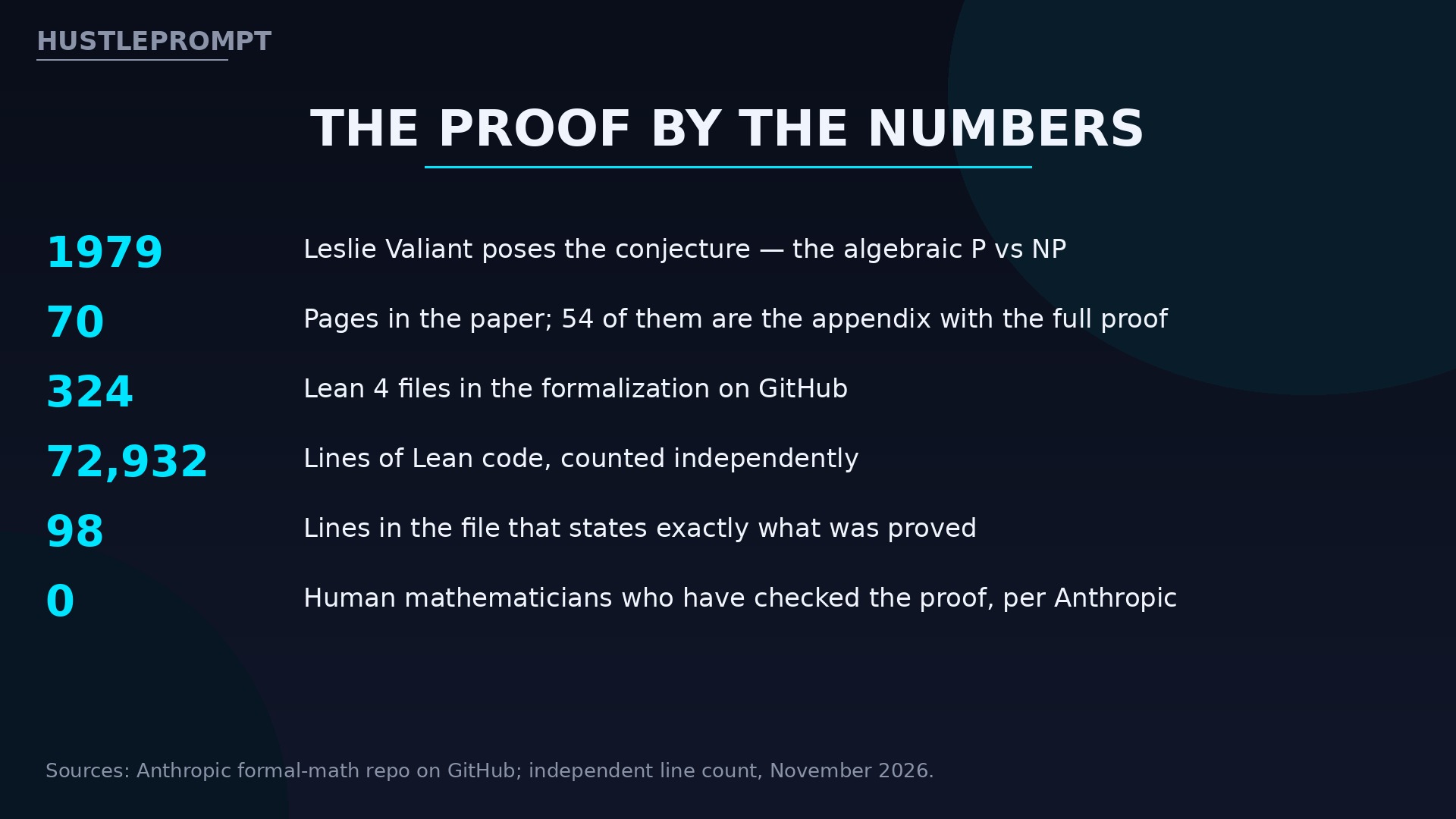
Three days after Claude claimed the Riemann hypothesis, Anthropic’s AI has claimed another one. On the night of November 23, 2026, Anthropic posted a 70-page paper credited solely to Claude claiming a proof of VP vs VNP — the algebraic P vs NP, posed by Leslie Valiant in 1979. The paper and roughly 73,000 lines of Lean 4 code are public on GitHub. The catch is on the same page: no human mathematician has checked the proof.
What Anthropic posted
Anthropic uploaded the paper, “VP ≠ VNP over every field”, and its Lean 4 formalization to the vp-vnp folder of its public formal-math repository on GitHub — with no press release. The author line lists only “Claude (Anthropic)”. An internal research Claude model found the result and wrote both the paper and the proof code.
The paper runs 70 pages, 54 of them an appendix holding the full proof. The formalization spans 324 files and 72,932 lines of Lean code, counted independently — and the file stating exactly what was proved is just 98 lines long. A second kernel, nanoda, re-validates the proofs.
What Anthropic’s own repository says
“No human mathematician has checked the proof.”
— Anthropic, formal-math repo, November 23, 2026
“Lean checks the proofs, but no machine checks that this file says what is claimed.”
— Anthropic, formal-math repo, November 23, 2026
Read the paper itself in Anthropic’s VP ≠ VNP paper on GitHub.
VP vs VNP in plain English
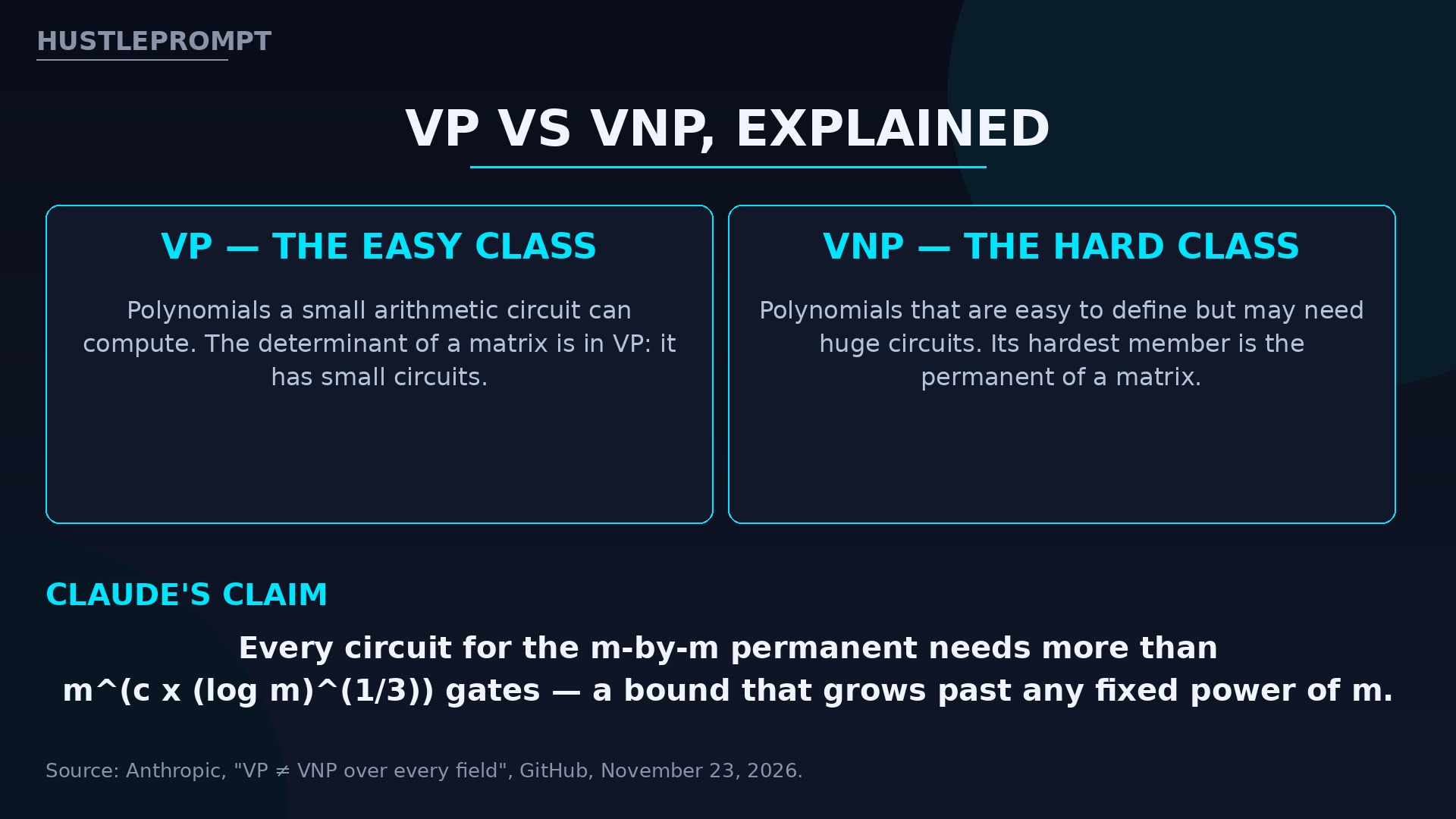
An arithmetic circuit computes a polynomial as a list of steps — each a variable, a number, or the sum or product of two earlier steps. Its size is the number of steps. In 1979, Leslie Valiant asked whether some easy-to-define polynomials need circuits that are far too big, and conjectured that the permanent is one of them.
| Class | What it means | Key example |
|---|---|---|
| VP | Polynomials that a small arithmetic circuit can compute | The determinant of a matrix |
| VNP | Polynomials easy to define but possibly needing huge circuits | The permanent of a matrix |
The permanent of a grid of numbers is its determinant with the minus signs taken out. If VP and VNP are different, the permanent can never be computed by a small circuit. That is the algebraic version of P vs NP, open for 47 years.
What the proof actually claims
The paper’s central theorem: there is a constant c greater than 0 such that, for all large enough m, every arithmetic circuit for the m-by-m permanent over the reals has more than m^(c·(log m)^(1/3)) gates. The bound applies to the permanent over any field where 1+1 is not 0, and to the Hamiltonian cycle polynomial over every field.
That is a quasipolynomial lower bound: the required gates grow past every fixed power of m, which is all Valiant’s conjecture asked for. The paper itself says the bound has room for improvement — short of the exponential bound most theorists expect.
What is verified — and what is not
Two things are already clear. First, this does not settle P vs NP, which concerns Boolean circuits, not algebraic ones. Second, OpenAI posted its own preprint, “VP and VNP are different”, on the same day. Two frontier labs claiming the same 47-year-old prize on the same day shows how fast AI-driven mathematics is moving.
Why it matters — and what it does not mean
If you follow AI capability: this is the second frontier-math claim from Claude in four days, after the Riemann hypothesis claim on November 20. An AI producing a 70-page argument and 73,000 lines of machine-checkable code on a problem that resisted humans for 47 years is a capability milestone — whether or not the proof holds up. The labs are racing in public, on GitHub, in real time.
If you are a researcher or student: the repository is public. Download the Lean code, run the checker, and read the 98-line statement. The honest work now is human verification — of the statement, and of the argument itself.
If you invest in AI: watch what happens next, not the headline. A confirmed proof would be a landmark for Anthropic and for the case that AI can do original frontier science. An error would show machine-checked steps are not a correct theorem. Either outcome moves the debate about what these systems can really do.
The caution: a Lean check confirms steps follow from each other — not that the formal statement says what the paper claims. Until specialists read the argument, the honest status is “claimed, not confirmed”.
Frequently asked questions
What is VP ≠ VNP?
Valiant’s 1979 conjecture: VP — polynomials computable by small arithmetic circuits — is strictly smaller than VNP, whose hardest member is the permanent. It is the algebraic version of P vs NP.
Did Claude solve P vs NP?
No. Anthropic is explicit that this does not settle P vs NP, which concerns Boolean circuits, not arithmetic ones. VP vs VNP is the algebraic analogue — a different question.
Has anyone verified the proof?
Partially. Lean checks that each step follows from the previous ones, and a second kernel re-validates the proofs. But no human has checked the proof, and no machine checks that the formal statement matches the informal claim — judged only by AI readers.
How can I check it myself?
The paper and the Lean 4 formalization are public in Anthropic’s formal-math repository on GitHub, in the vp-vnp folder. Download the code, run Lean, and read the 98-line statement.
What happened with the Riemann proof claim?
Three days earlier, Anthropic mathematician Levent Alpoge said he and Claude had found a proof of the Riemann hypothesis, released as about 17 million lines of Lean code. Independent checking tools have since confirmed it, according to reports. Read our coverage: Claude Claims Riemann Hypothesis Proof in $1M Math First.
What happens next?
Human verification. Specialists need to check the 98-line Lean statement against the standard definitions — then read the 70-page argument. Until then, the claim stands as posted, not proven.