
DeepSeek just told the world how big its free agent platform really is — and the number is startling. On November 5, 2026, DeepSeek disclosed usage figures for Harness, its open-source agent runtime, for the first time: 1.54 million daily active users as of November 4, burning through roughly 92 trillion tokens a day. Five weeks earlier, on September 30, it had 271,000.
That is a 5.7x jump in five weeks, with more than a million new daily users added in a single month. And Harness is free, MIT-licensed, and runs on your own machine. If you build with AI agents — or want to sell services built on them — this is the cheapest rocket ship in the market right now.
The count covers users of the official DeepSeek API. It does not include people running Harness against other providers’ models, so the real footprint is bigger than the headline number.
The Numbers: 271K to 1.54M in Five Weeks
DeepSeek disclosed the figures on November 5, and the growth curve is the story. Daily active users are a 7-day average, and the acceleration is concentrated in the last month:
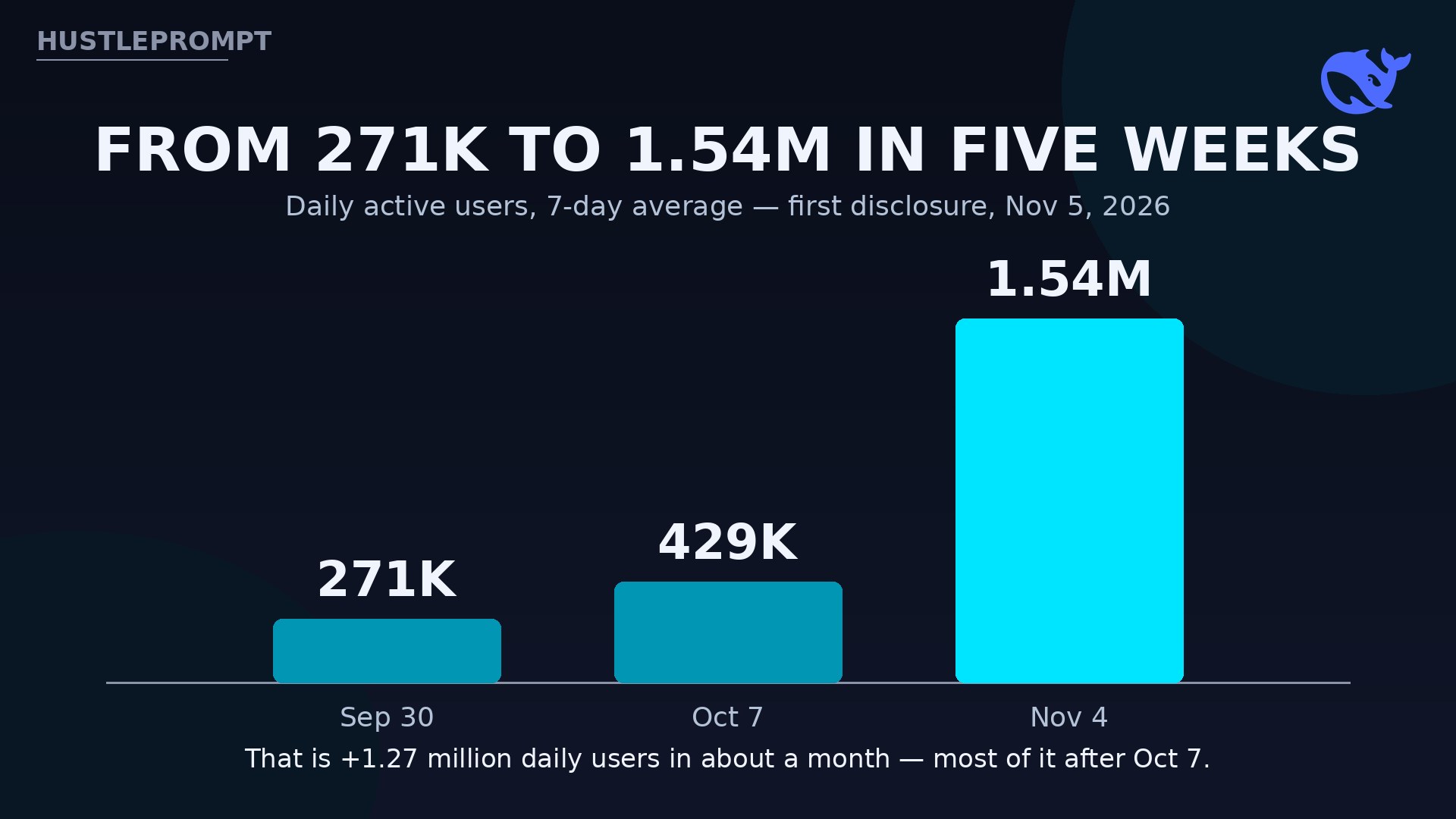
| Date | Daily active users (7-day avg) | What changed |
|---|---|---|
| Sep 30, 2026 | 271,000 | Baseline, six weeks after launch |
| Oct 7, 2026 | 429,000 | +58% in one week |
| Nov 4, 2026 | 1,540,000 | +1.27M in about a month; 5.7x the Sep 30 figure |
| Nov 4, 2026 | ~92 trillion tokens/day | Total platform consumption at current scale |
Source: Phemex News, “DeepSeek Harness Hits 1.54M DAU” (November 6, 2026), reporting DeepSeek’s November 5 disclosure. The 5.7x multiple is our own arithmetic from the disclosed figures.
Two details in the disclosure deserve attention. First, the growth is not linear — it bent sharply upward after October 7, which is when Creator Mode, the plain-English plugin builder, started spreading. Second, 92 trillion tokens a day across 1.54 million users works out to roughly 60 million tokens per user per day (our arithmetic). That is not casual chat. That is automated agent loops — code, files, and multi-step jobs running around the clock, mostly in enterprise and developer pipelines.
Evidence: What 92 Trillion Tokens Means
Token volume is the clearest signal of how seriously people use a platform. A chat app burns thousands of tokens per session. An agent loop burns millions per job. Here is the scale, side by side:
| Metric | Figure |
|---|---|
| Daily active users (Nov 4) | 1.54 million (official API users) |
| Daily token consumption | ~92 trillion tokens |
| Third-party plugins (Nov 4) | ~35,000 created or installed |
| GitHub stars at launch (Aug 13, 2026) | 60,000+ within hours; 100,000 within two days |
| Creator Mode launch video (Nov 2, Bilibili) | ~3.96 million views by the morning of Nov 6 |
Sources: DeepSeek’s disclosure via Phemex News; plugin and video figures via RaisinK; GitHub star counts via DeepSeek Harness launch coverage.
What Harness Actually Is
DeepSeek Harness — “dsh” for short — is DeepSeek’s own open-source agent runtime. It turns a language model into an agent that can edit files, run commands, search the web, and manage long tasks. It launched on August 13, 2026, open-sourced alongside the V4-Pro model, and it is built on the Cordis framework, where literally every component is a swappable plugin: the model adapter, the tool registry, the session store, the sandbox, the approval policy, the orchestration loop, and even the user interface.
That plugin architecture is the whole idea. You can swap the model — adapters exist for DeepSeek, Anthropic, OpenAI, AWS Bedrock, Azure, and Google Gemini — and you can swap the tools. Four modes ship with it:

- Standard. The full coding agent: file editing, shell, file and web search, skills, planning, goals, subagents, and workflows. The everyday default.
- Code (PTC). The model writes one TypeScript program to orchestrate many tool steps in a row — fewer round trips, cheaper long jobs.
- Minimal. A stripped-down shell and editor for benchmarking models. No extras, just the agent loop.
- Creator. Standard plus runtime inspection — and the mode that is driving the growth: describe a plugin in plain language and the AI writes it, installs it, and verifies it.
Installing it takes one command — npm install -g @deepseek-ai/dsh — or npx @deepseek-ai/dsh web for the browser UI. You need Node.js 22.19 or newer and a DeepSeek API key, or a key for whichever model you point it at. The source is on GitHub at github.com/deepseek-ai/deepseek-harness, MIT-licensed.
Creator Mode: Plugins in Plain English
The feature behind the growth spike is Creator Mode, launched November 2 with a demo video on Bilibili that passed 3.96 million views by the morning of November 6. The pitch: describe what you want in plain language, and the AI examines Harness’s development APIs, writes the plugin code, installs it, and verifies it works — no coding from you.
The official demo is specific, and it is a good test of the claim. The AI built a floating tomato clock — a Pomodoro timer widget — by writing more than 600 lines of frontend code, completing installation and execution in 5 minutes and 24 seconds. DeepSeek also published the prompt templates for seven demo cases. Other examples from the launch: a video editor with a timeline, a paper reader with highlighting and annotation, a poster design tool, an interactive 3D model generator — or reskinning the whole Harness interface as a pixel game.
Users have already built on it. As of November 4, roughly 35,000 third-party plugins had been created or installed by Harness users. DeepSeek is now preparing an official plugin marketplace, and says it plans to offer creators token incentives, technical support, and feature highlights. That is the moment a free tool becomes a way to earn: build a plugin people want, and DeepSeek will pay you in tokens to keep building.
What It Costs to Run
Harness itself costs nothing. The bill is the model underneath it, and DeepSeek’s pricing is the cheapest frontier-class inference on the market:

| Cost item | Price |
|---|---|
| Harness runtime | Free, MIT license |
| DeepSeek V4.1 Flash (default model) | $0.15 per 1M input tokens / $0.60 per 1M output tokens; 1M-token context |
| Web search / page fetch (since Nov 1) | $0.75 per 1,000 successful requests |
| Getting started | Load ~$2 of API credit to run the first examples comfortably |
Sources: DeepSeek API pricing via the OpenRouter model board; search/fetch pricing from DeepSeek’s pricing page; the $2 starter figure is a walkthrough recommendation, not a DeepSeek requirement.
The search and fetch charge matters more than it looks. Agents search constantly — every research step, every fact-check, every “look this up” is a request. At $0.75 per 1,000, a heavy agent day can add up, and it is the one cost in Harness that is not close to zero. Budget for it, or point Harness at a model whose tools you already pay for.
From Idea to Plugin in 5 Minutes
1 · DESCRIBE IT
In Creator Mode, describe the plugin you want in plain language — no code, no spec doc.
2 · AI WRITES IT
The agent reads the Harness dev APIs and writes the plugin code — 600+ lines in the tomato-clock demo.
3 · INSTALL + VERIFY
Harness installs the plugin and checks it works — 5 minutes 24 seconds in the official demo.
4 · REUSE + SHARE
Save it for future sessions. When the marketplace opens, publish it and earn token incentives.
How to Profit From Harness
A free agent runtime with 1.54 million daily users is a marketplace waiting to happen. Here is how to get paid on it:
- Build plugins for the marketplace. 35,000 plugins already exist — and DeepSeek is about to open an official store with token incentives for creators. Build the plugin small businesses ask for: a client-report generator, an invoice chaser, a social-media scheduler, a niche research tool. Plain-English Creator Mode means you can prototype without being a developer.
- Sell agent services on cheap inference. Harness plus V4.1 Flash at $0.15/$0.60 per million tokens is the lowest-cost way to run client agent work — document processing, data cleanup, research briefs, code fixes. Price per job, not per hour, and the margin is yours.
- Offer “Harness setup” as a service. One command installs it, but most small businesses will never run a command line. Install it, connect their tools, build their first three plugins, and charge a setup fee plus a monthly retainer.
- Learn the plugin API before the crowd. The 35,000-plugin head start is small — the user base grew 5.7x in five weeks. The creators who know the API when the marketplace opens will be the ones featured in it.
The pattern is familiar from every platform shift: the tool is free, the distribution is exploding, and the money goes to whoever builds the useful thing first. Harness is at the “free and exploding” stage right now.
The Honest Catch
Three warnings before you bet a business on Harness:
- It is a developer preview. DeepSeek explicitly warns that no security audit has been done and breaking changes are expected. Great for experiments; too early for production client work without guardrails.
- The metrics count official API users only. The 1.54 million figure is DeepSeek’s count of users on its own API. People running Harness against Anthropic, OpenAI, or Gemini models are not in it — the real total is higher, but nobody knows by how much.
- The marketplace is not open yet. Token incentives, technical support, and feature highlights are promised, not live. Build now, but do not count on marketplace revenue until the store actually opens.
One more thing to watch: separate reporting this week says DeepSeek plans to pretrain its next model, V5, on 160,000 Huawei Ascend chips. That is a reported plan, not a DeepSeek announcement, and it is not part of the Harness disclosure — but if it happens, it would make DeepSeek’s cost advantage even harder for Western labs to match.
Frequently Asked Questions
What is DeepSeek Harness?
A free, open-source agent runtime from DeepSeek. It turns a language model into an agent that edits files, runs commands, searches the web, and handles long tasks. Everything in it is a plugin — the model, the tools, even the interface — so you can swap parts at will. It is MIT-licensed and runs on your own machine or as a web UI.
How many people use DeepSeek Harness?
DeepSeek disclosed on November 5, 2026 that Harness had 1.54 million daily active users as of November 4, counting official API users. That is up from 271,000 on September 30 and 429,000 on October 7 — more than a million new daily users in about a month.
Is DeepSeek Harness really free?
Yes. The runtime is free and MIT-licensed. You pay only for the model underneath it — DeepSeek’s V4.1 Flash costs $0.15 per million input tokens and $0.60 per million output tokens — plus $0.75 per 1,000 web search or page-fetch requests since November 1, 2026.
What is Creator Mode in Harness?
A mode that lets you describe a plugin in plain language while the AI writes the code, installs it, and verifies it works. In the official demo, it built a floating tomato clock from 600+ lines of frontend code in 5 minutes and 24 seconds. It launched November 2, 2026, and its Bilibili video passed 3.96 million views by November 6.
How do I install DeepSeek Harness?
Run npm install -g @deepseek-ai/dsh, then start the web UI with npx @deepseek-ai/dsh web. You need Node.js 22.19 or newer and an API key — DeepSeek’s, or another provider’s if you swap the model adapter. The source is at github.com/deepseek-ai/deepseek-harness.
Can I make money building Harness plugins?
Not yet directly, but soon. About 35,000 third-party plugins have already been created or installed, and DeepSeek is preparing an official plugin marketplace with token incentives, technical support, and feature highlights for creators. Until it opens, the money is in selling agent services and setup work built on the free runtime.
Is Harness safe for production work?
Not yet, by DeepSeek’s own warning. It is a developer preview with no security audit completed and breaking changes expected. Use it for experiments and internal work, and add your own guardrails before running it on client systems.
Keep Reading
Sources: Phemex News, “DeepSeek Harness Hits 1.54M DAU” (November 6, 2026) — the 1.54M DAU, 92T tokens/day, and growth trajectory come from DeepSeek’s November 5 disclosure as reported there. DeepSeek’s official Harness page (read directly) — open beta and open source, the everything-is-a-plugin architecture, Creator Mode, and the install commands. Plugin count, Creator Mode video views, and marketplace plans via RaisinK; the tomato-clock demo details (600+ lines, 5 min 24 sec) via KuCoin/HuoXing Finance; GitHub star counts and install requirements via DeepSeek Harness setup guides. The 5.7x multiple and ~60M tokens-per-user figures are our own arithmetic from the disclosed numbers.