
Gemini 4 quantum algorithms just got dramatically cheaper — not on a benchmark, but on paper that proves itself. Google DeepMind said teams of Gemini 4 agents found new quantum circuits up to 290 times cheaper, and every result was proved correct in Lean, a formal theorem prover, before it counted.
The work, published November 23 with Google Quantum AI, targets the hardest simulations in science — fusion energy, photochemistry and drug metabolism — and DeepMind open-sourced the Lean library and verified solutions on GitHub.
The results
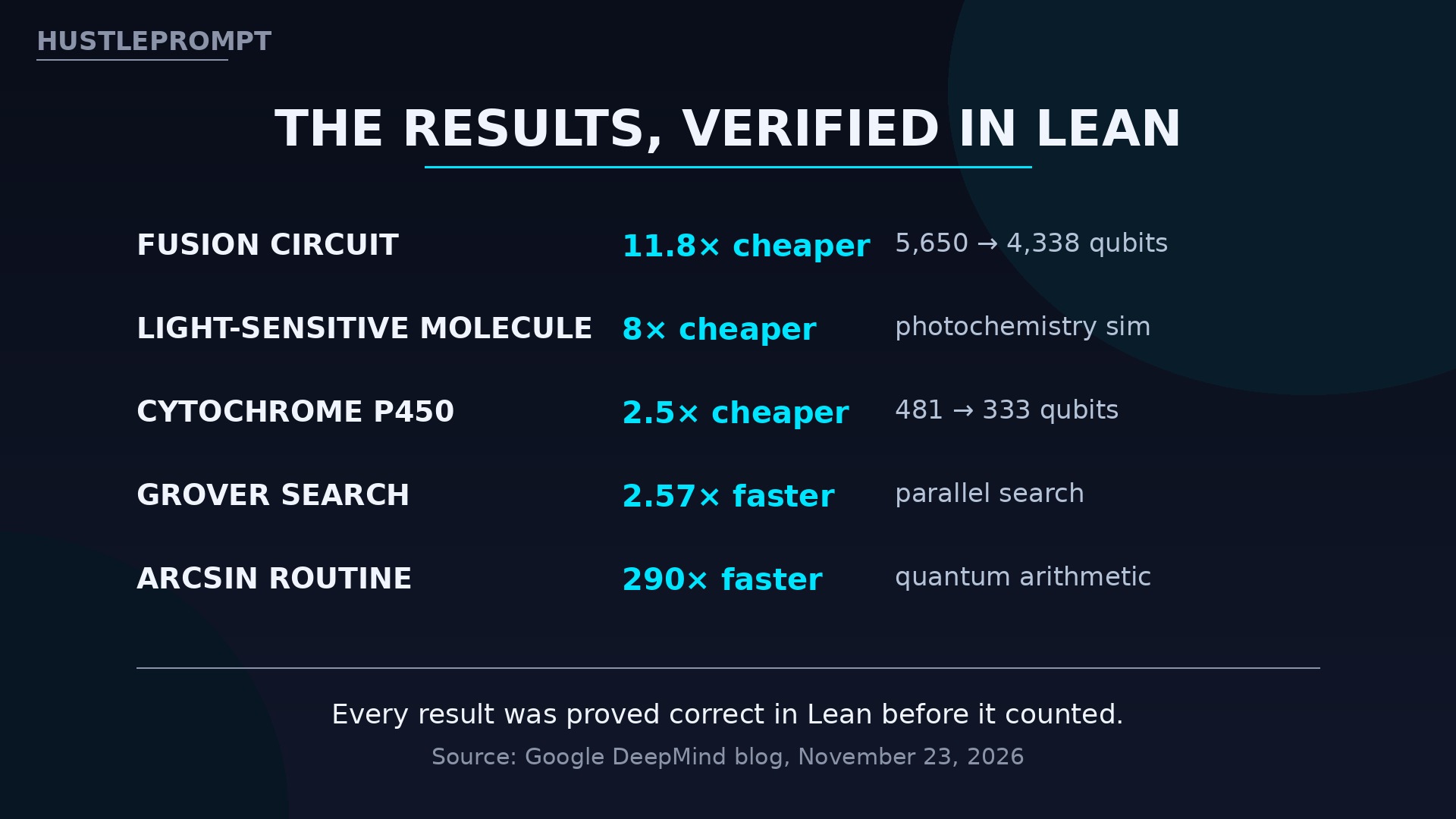
| Problem | Improvement | Detail |
|---|---|---|
| Inertial confinement fusion | 11.8× cheaper | Memory fell from 5,650 to 4,338 error-corrected qubits |
| Light-sensitive molecule | 8× cheaper | Photochemistry simulation, simpler tracking of positions and forces |
| Cytochrome P450 | 2.5× cheaper | Memory fell from 481 to 333 qubits; the enzyme breaks down most medicines |
| Grover’s search | 2.57× faster | A specific implementation of the foundational quantum search algorithm |
| arcsin routine | 290× faster | A common arithmetic building block used by many quantum algorithms |
The 290× belongs to arcsin, a routine that loads numbers into quantum states. The task-level gains are smaller but more important: fusion, chemistry and drug-metabolism simulations got 2.5× to 11.8× cheaper — the simulations that decide whether a quantum computer is useful for real science.
How agent teams did it
DeepMind did not ask one model to do the work. For each problem it tasked separate, independent teams of Gemini 4 agents with finding improvements. Each idea was verified with Lean before entering a shared notebook — and every four hours, agents from each team met at a virtual conference to trade, debate and compare ideas. As better ideas arrived, the cost gradually fell.
The method matters as much as the results. DeepMind’s own explanation is that the circuits are too big to test any other way:
What DeepMind said
Because we cannot test resource-intensive quantum circuits on classical computers or today’s small quantum processors, we have to prove that they work mathematically.
— Google DeepMind, Finding faster quantum algorithms with agents and formal verification, November 23, 2026
The paper behind the announcement — Discovering formally verified quantum programs with AI — lists 25 authors from Google DeepMind and Google Quantum AI. The team open-sourced its Lean library, problem specifications and verified solutions on GitHub.
The honest limits
DeepMind is candid about what this is not. Running these algorithms in scientific simulations would still demand more computational resources than the first error-corrected quantum computers are likely to provide. These are paper results with mathematical proofs — not simulations run on hardware.
Two more cautions. The paper is an arXiv preprint, not yet peer-reviewed, so the results await independent scrutiny. And 290× is a spacetime-volume saving on one arithmetic subroutine; the 2.5× to 11.8× gains describe real scientific workloads.
What it means for your money
If you invest in quantum: algorithm cost is the other half of the quantum timeline. Hardware gets the headlines, but a simulation that needs 4,338 qubits instead of 5,650 — or costs a tenth as much to run — pulls practical quantum closer by years.
If you build with AI agents: the method is the product. Separate teams, a shared notebook, a formal verifier as gatekeeper, and a four-hour sync rhythm is a template for reliable multi-agent work — the same “verify before you trust” pattern applies to coding agents and research agents.
If you work in drug discovery or energy: Cytochrome P450 breaks down most human medicines, and fusion simulation is one of the most expensive computations in science. Cheaper verified algorithms mean more molecules screened and more fusion designs tested per dollar — and the open-source Lean library means starting from DeepMind’s proofs, not from zero.
If you sell AI research tools: formal verification is becoming a differentiator. Buyers of AI-generated code, circuits and proofs increasingly ask for a machine-checked guarantee, not just a benchmark score.
Frequently asked questions
What did Gemini 4 actually do here?
Teams of Gemini 4 agents proposed improvements to well-known quantum algorithms — fusion, photochemistry, drug metabolism, Grover’s search and arcsin. Each was proved in Lean before it counted.
What is Lean?
Lean is a formal theorem prover: a programming language and proof assistant in which a small trusted core checks every step of a mathematical proof. DeepMind built an open-source Lean library for quantum algorithms on top of it.
Is the 290× improvement real?
It is DeepMind’s own claim, proved in Lean — a 290× spacetime-volume saving on arcsin. The paper is a preprint, so the results have not been peer-reviewed or independently replicated yet.
Can I use the code?
Yes. DeepMind open-sourced its Lean library, problem specifications and verified solutions on GitHub at google-deepmind/formal-quantum-computation.
When will these algorithms run on a real quantum computer?
Not soon. DeepMind says these algorithms would still demand more resources than the first error-corrected quantum computers are likely to provide. The gains shorten the road; they do not finish it.
Why does this matter if quantum computers are not ready?
Because algorithm cost is half the timeline to useful quantum computing. Cheaper algorithms mean the first capable machines do more science on day one — and the agent-plus-proof method compresses years of manual design.