
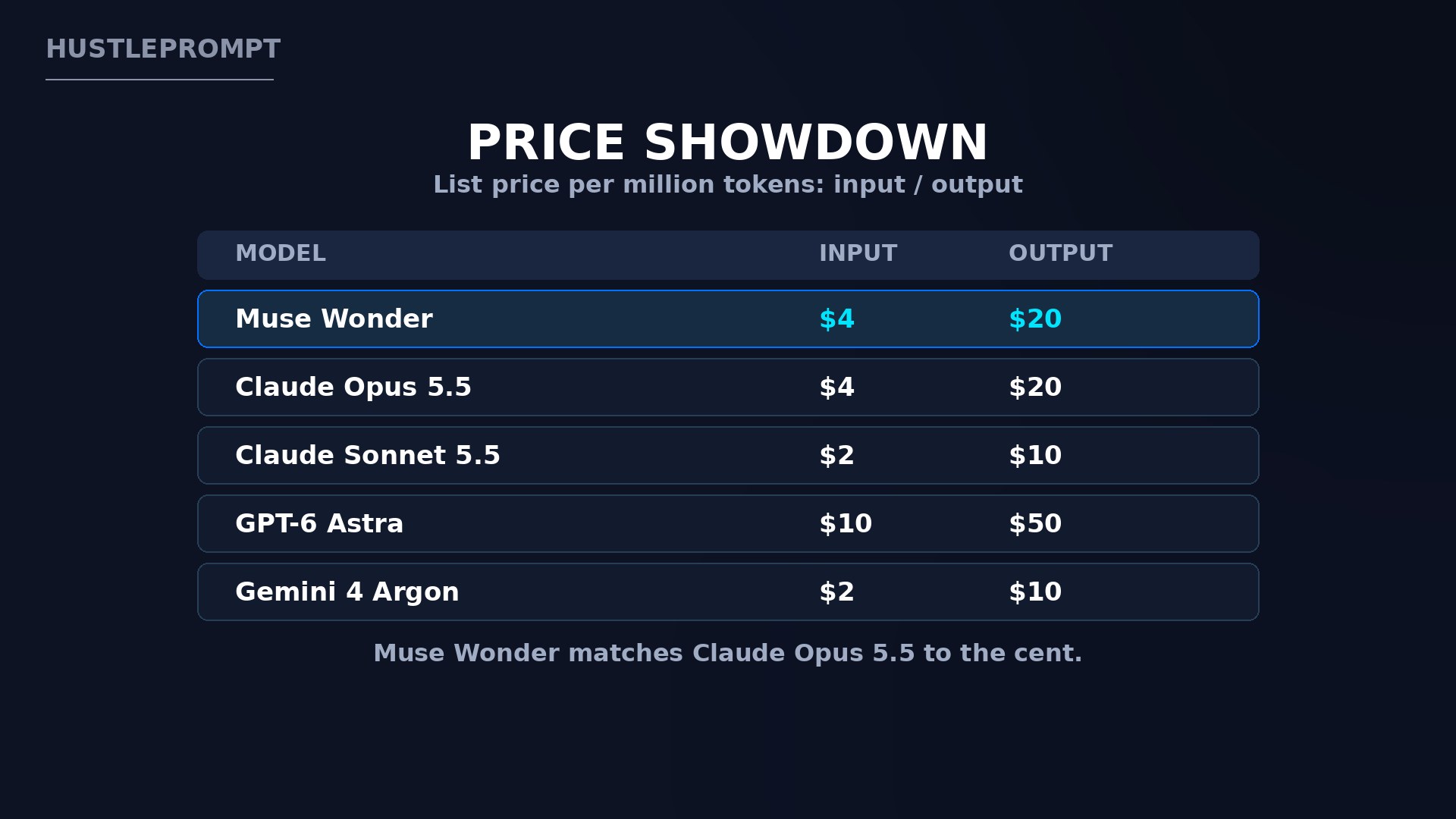
Meta just did the one thing it swore it would never do: it stopped giving away its best AI. On October 12, 2026, Meta Superintelligence Labs launched Meta Muse Wonder and Muse Wonder Full — the company’s first frontier models — priced at $4/$20 per million tokens, to the cent the same list price as Claude Opus 5.5. But identical list prices do not mean identical bills.
What Meta actually launched
Meta calls the Muse Wonder series its most capable models to date, built for personal and professional agentic tasks.
Two models, two doors in:
- Muse Wonder — on the Meta Model API (model id
muse-wonder-1.0) and inside Muse Code. - Muse Wonder Full — the stronger variant, only for Muse Code subscribers. Not on the public API at any price.
Active Memory carries what matters across conversations and retrieves details relevant to the task. Active Focus keeps working when a task gets hard — trying other approaches and checking in before consequential actions.
The model card reports a 1,048,576-token context window with text, image, video, audio, and PDF input — and no open weights. Both models are closed.
The price tag: $4 in, $20 out — matching Opus 5.5 to the cent
Cached input is $0.20 per million — a 95% discount for repeated agent loops. And Muse Wonder Full is not sold per token at all: it is bundled with Muse Code’s Power plan ($50/month) and Maximum plan ($200/month).
What the independent scores say
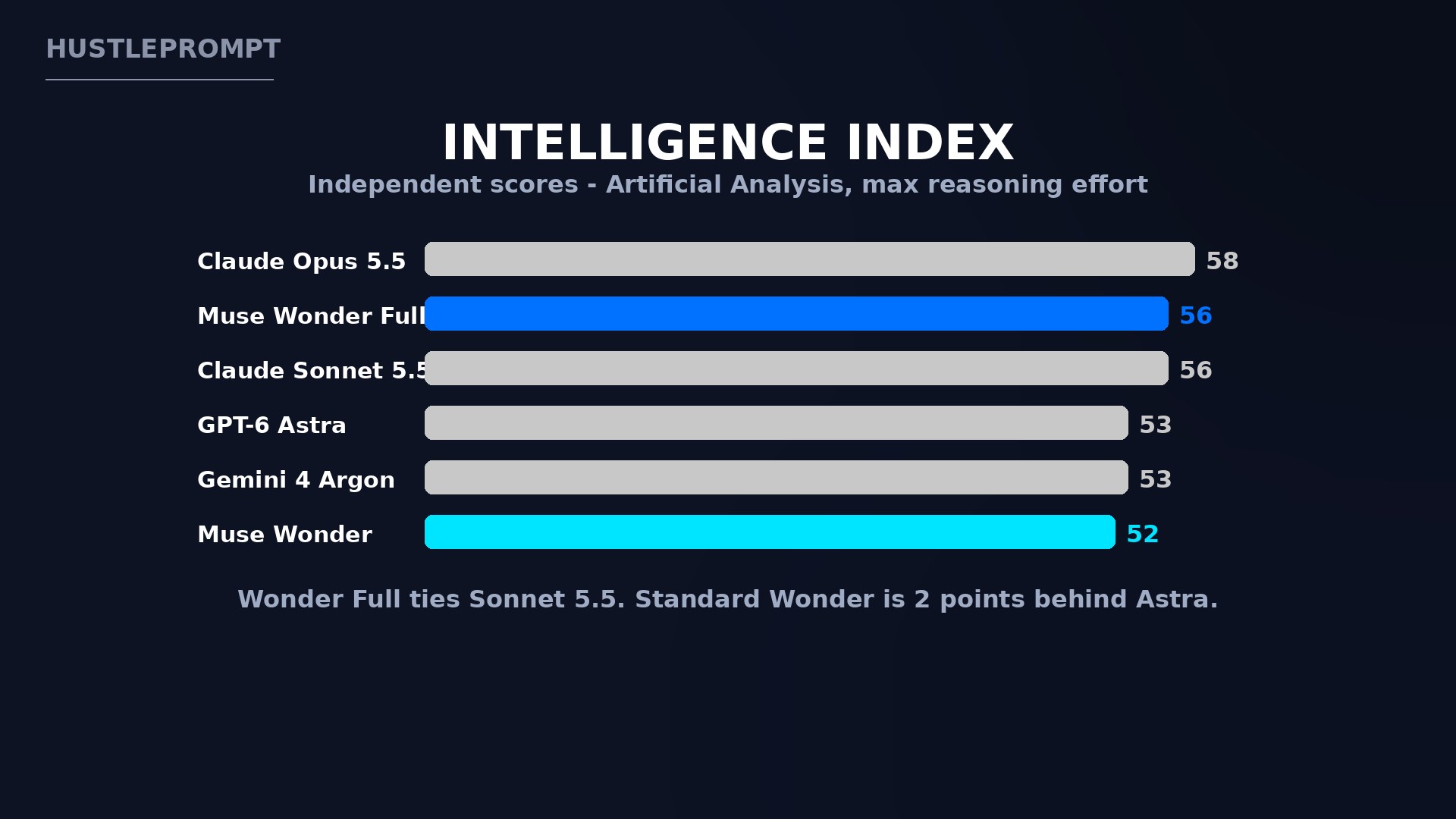
Artificial Analysis — an independent benchmarking firm — scored both models:
- Muse Wonder Full: 56 — tying Claude Sonnet 5.5, ahead of GPT-6 Astra (53) and Gemini 4 Argon (53).
- Standard Muse Wonder: 52 — two points behind Astra, four behind Wonder Full.
- Claude Opus 5.5: 58 — still leads.
Meta’s own 14-row scorecard (vendor-reported) is kinder: a Wonder model leads 7 of 14 rows, Opus 5.5 leading 6. Treat vendor rows as Meta’s claims; the index above is the independent check. One independent weak spot: on AA-Omniscience, Artificial Analysis’s factual-accuracy evaluation, Wonder scores 30 against Opus 5.5’s 46 — route fact-heavy work accordingly.
The money question: when does Wonder win?
Artificial Analysis estimates the average cost per index task — what you actually spend to finish a job:
*Independent estimates from Artificial Analysis; actual spend depends on your prompts and retry rate. (Meta’s own Spark 1.3 runs about $1.60/task — keep commodity work there.)
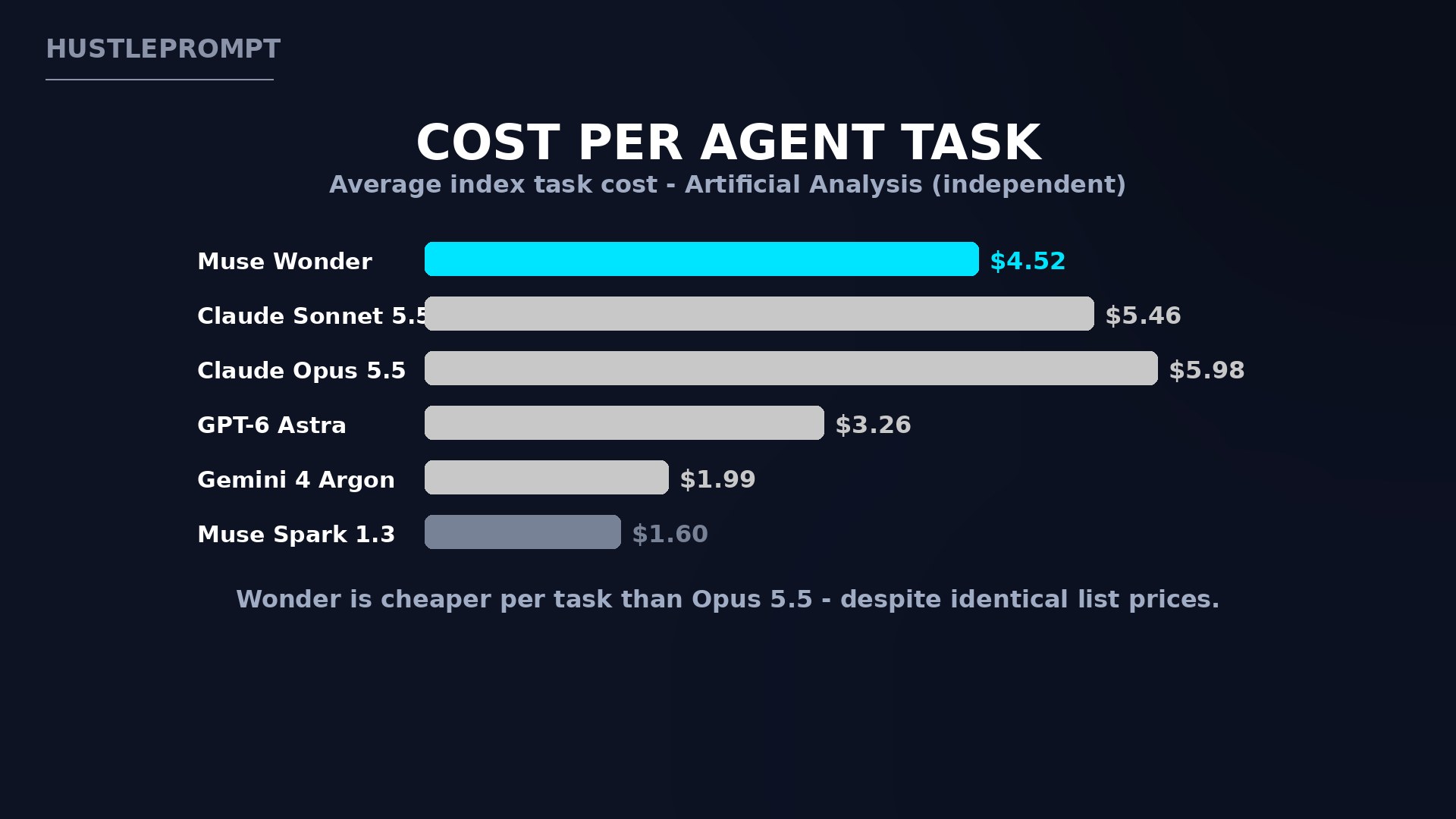
Wonder costs less per completed task than Opus 5.5 ($4.52 vs $5.98) despite identical list prices. Against Astra and Argon it loses on price but may win on long-horizon reliability. One caveat: Wonder is chatty — Artificial Analysis measured 130 million output tokens to run its full index vs a median of 85 million, so cap verbosity in your prompts and lean on the $0.20 cached-input rate.
Which model for which job: the decision flow
Route your API spend
Coding agents, research pipelines, browser automation → Muse Wonder. Active Focus is built for this, and $4.52/task beats Opus 5.5.
Summaries, drafts, classification → Spark 1.3 or Argon. Never pay frontier prices for commodity work.
Burning more than ~$50/month of Wonder tokens in coding workflows? Price the $50 Muse Code Power plan — the only path to Wonder Full.
Wonder trails Opus 5.5 on independent factual accuracy (30 vs 46) — verify outputs or route elsewhere.
How to profit from Wonder this week
- Split your traffic today. Commodity calls go to Spark 1.3 or a cheap tier; Wonder is for agent loops longer than ~10 steps, where retries on a weaker model cost more than its premium.
- Design for the cache. Reuse system prompts and long context across turns — $0.20 per million cached tokens makes repeated agent loops dramatically cheaper.
- Cap verbosity. Ask for structured, terse output (JSON, bullet caps) to cut the per-task cost on a chatty model.
Watch: Meta’s official launch video
Frequently asked questions
When did Meta launch Muse Wonder?
October 12, 2026, via Meta Superintelligence Labs.
How much does the Muse Wonder API cost?
$4 per million input tokens, $20 per million output, cached input at $0.20 — the same list price as Claude Opus 5.5.
Why can’t I buy Muse Wonder Full by the token?
It is reserved for Muse Code subscribers on the $50/month Power or $200/month Maximum plans — not sold through the public API.
What are Active Memory and Active Focus?
Active Memory carries relevant context across conversations; Active Focus keeps the model working through hard tasks — retrying, recovering from errors, and checking in before consequential actions.
Is Muse Wonder open source?
No — both Wonder models ship with closed weights, API or subscription access only.
Should I switch from Claude Opus 5.5?
For long agent runs: Wonder costs $4.52/task vs $5.98 for Opus 5.5. For fact-heavy Q&A, Opus 5.5 still leads. Run your own workload first.
Keep Reading
- Claude Fast Mode Goes GA: What Opus 5.5’s Compliance API Means for You
The model Wonder is priced against — and how its compliance API changes the math. - Claude Haiku 5.5: The Cheaper API Alternative
When the budget tier beats both Wonder and Opus on your workload. - Proof x401: The Identity Protocol for AI Agents
Long-running agents need identity too — the protocol layer underneath the hype.
Sources: Meta’s official Muse Wonder announcement and the Meta research blog. Pricing per Meta’s developer docs as reported by TechCrunch/VentureBeat. Independent scores: Artificial Analysis; Meta’s scorecard figures are vendor-reported.