
NVIDIA just changed how fast an open language model can write. Its new NVIDIA Sigma diffusion model, Nemotron-Labs-Sigma, generates text in parallel blocks instead of one token at a time, and NVIDIA reports peak speedups of 4.2x over standard autoregressive decoding.
The family ships as 14 open checkpoints at 3B and 8B scale, ready for commercial use under the NVIDIA Nemotron Open Model License. It runs on a single GPU. There is no API to pay for and no hosted service in the middle.
For builders, that combination is the story. Faster generation means cheaper inference, and open weights mean the model is yours to run, fine-tune, and sell on top of.
What makes Sigma different
Most language models write left to right, one token per step. Sigma works more like an image generator. It starts from Gaussian noise in a learned 16-dimensional embedding space and denoises it into text, refining a whole block of tokens at once.
The blocks default to 64 tokens, and each block is refined over a configurable number of denoising steps using DDPM or DDIM samplers, with self-conditioning. Once a block is done, it is committed to a standard key-value cache and the model moves to the next block.
The backbone is a Ministral-style decoder-only Transformer with grouped-query attention, SwiGLU, and rotary position embeddings. Training used about 1.3 trillion tokens in total: roughly 1 trillion tokens of autoregressive warm-start, then about 0.3 trillion tokens of continuous-diffusion training.
Fewer denoising steps trade a little quality for a large speedup. That trade-off is the whole point of the design, and it is what makes the distilled checkpoints so fast.
Sigma in numbers
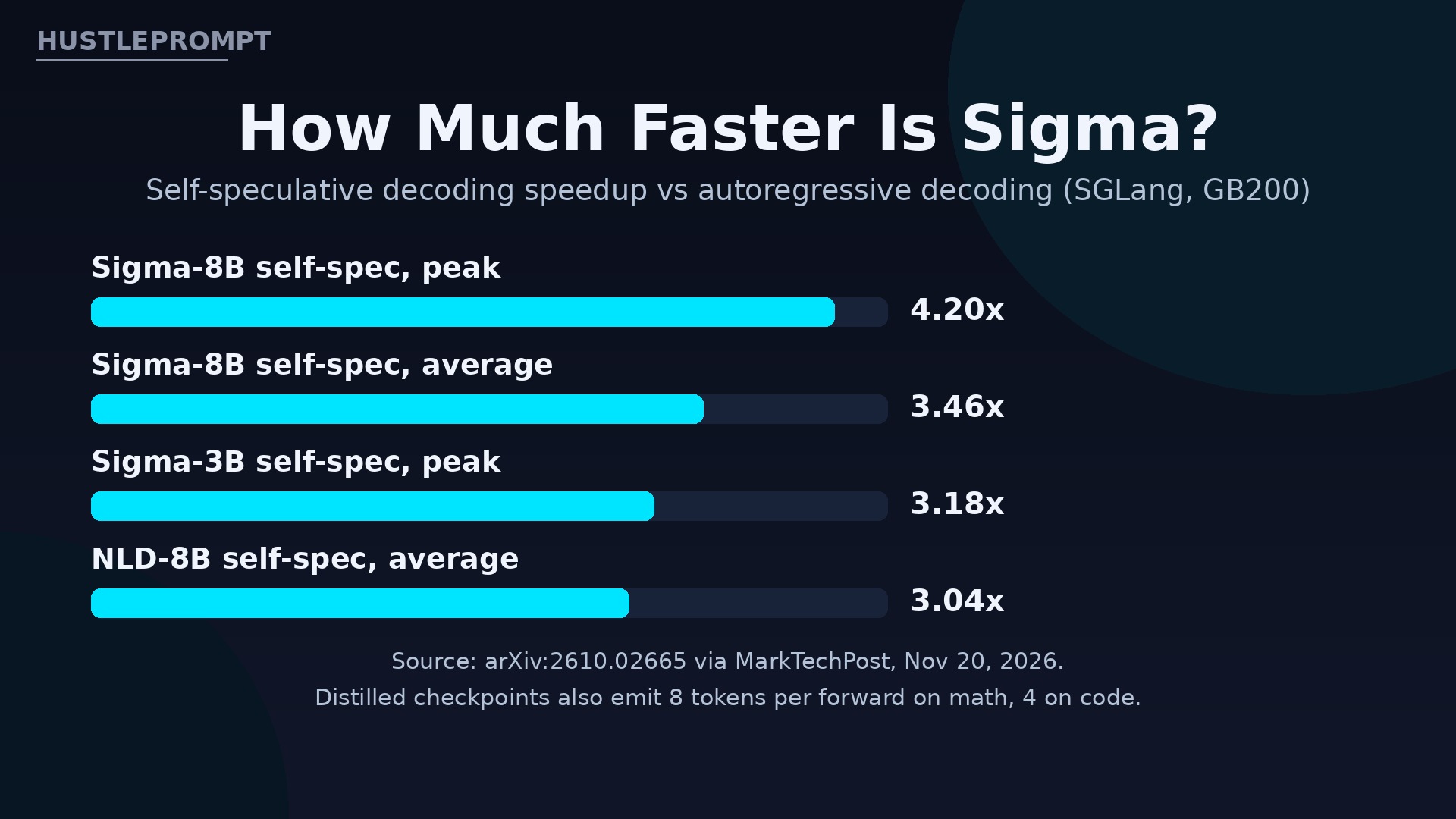
4.20x peak speedup — self-speculative Sigma-8B vs autoregressive decoding on one GB200 with SGLang; 3.46x on average.
120–140 tokens/s — measured throughput of the base model on a single Hopper H100 in bfloat16.
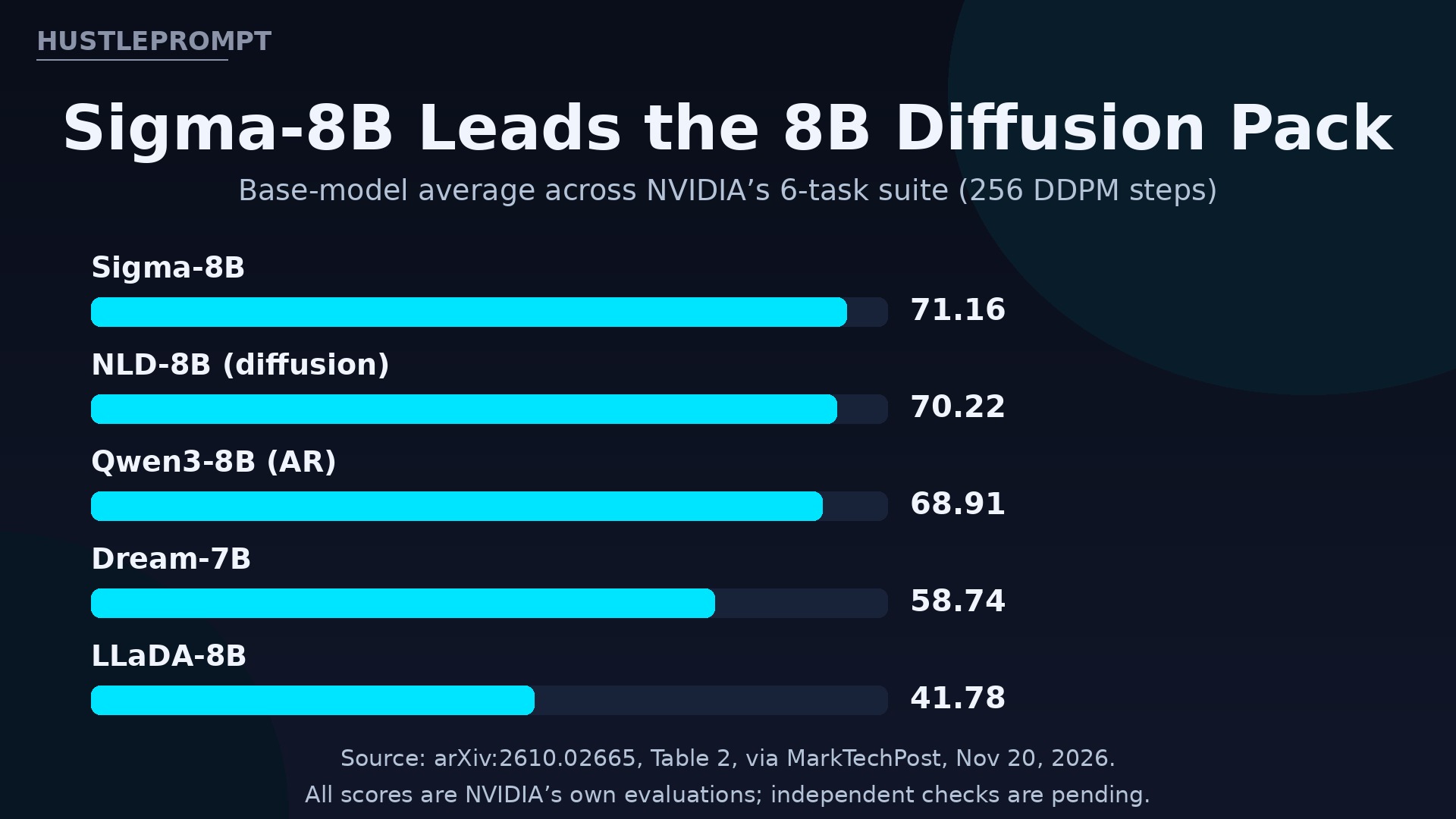
71.16 average — Sigma-8B base on NVIDIA’s 6-task suite, ahead of NLD-8B at 70.22.
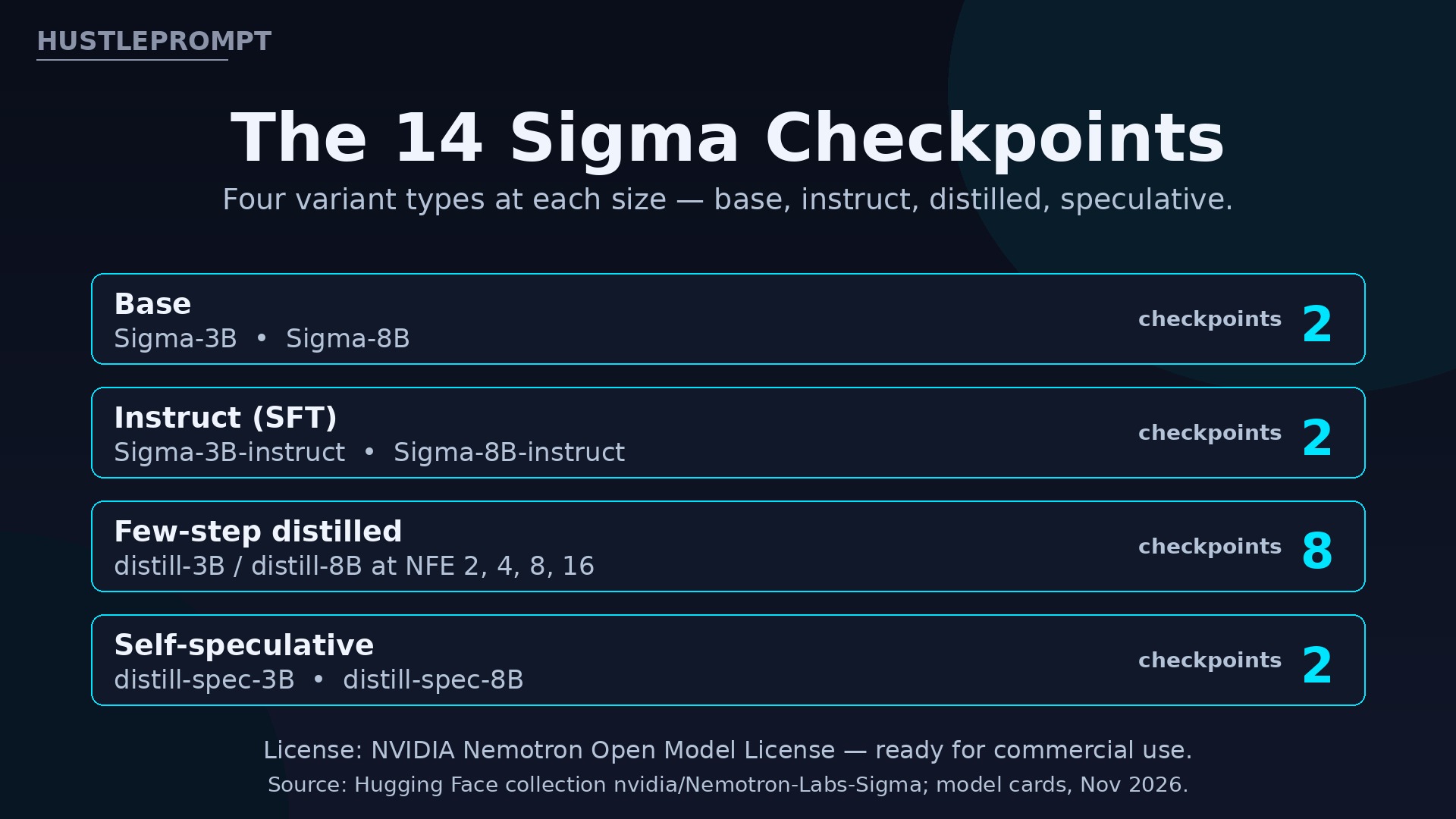
14 checkpoints — base, instruct, few-step distilled, and self-speculative variants at 3B and 8B.
“Instead of generating text one token at a time, it denoises Gaussian noise in a low-dimensional (16-D) continuous token-embedding space.” — NVIDIA, Nemotron-Labs-Sigma-8B model card
All scores are NVIDIA’s own evaluations. Independent verification of the speed claims is still pending.
How fast is it, really?
The headline number needs its context. The 4.2x figure is the peak speedup of the self-speculative 8B checkpoint against autoregressive decoding, measured on one GB200 with SGLang. The average on the same setup is 3.46x, and the 3B peak is 3.18x.
That is still a large gain. The distilled checkpoints push it further in a different way: distribution-matching distillation gives roughly 8x acceleration on math and 4x on coding, emitting 8 tokens per forward pass on math and 4 on code, with negligible accuracy loss according to the paper.
Raw throughput is strong too. NVIDIA measured roughly 120 to 140 tokens per second for 256 generated tokens with the DDPM sampler at 32 denoising steps per 64-token block, on a single Hopper H100 in bfloat16. At that rate, a 1,000-token draft takes about 7 to 8 seconds.
The benchmarks: strong, with honest weak spots
On NVIDIA’s 6-task base suite, Sigma-8B with 256 DDPM steps averages 71.16. That beats its discrete-diffusion predecessor NLD-8B at 70.22, Dream-7B at 58.74, and LLaDA-8B at 41.78. It also edges the autoregressive Qwen3-8B at 68.91.
Coding is the standout. Sigma-8B scores 65.12 on HumanEval against 62.80 for NLD-8B. Math holds up as well: 88.57 on GSM8K. MBPP is the soft spot, at 65.74 against 67.00 for NLD-8B.
| Model | Generation | 6-task avg | GSM8K | HumanEval | MBPP | License |
|---|---|---|---|---|---|---|
| Sigma-8B | Continuous diffusion (16-D) | 71.16 | 88.57 | 65.12 | 65.74 | NVIDIA Nemotron Open Model |
| NLD-8B | Discrete diffusion | 70.22 | 87.26 | 62.80 | 67.00 | NVIDIA Nemotron Open Model |
| Dream-7B | Discrete diffusion | 58.74 | 77.18 | 54.88 | 56.80 | Apache 2.0 |
| LLaDA-8B | Discrete diffusion | 41.78 | 70.96 | 32.32 | 40.80 | MIT |
| Qwen3-8B | Autoregressive | 68.91 | 86.73 | 64.63 | 69.40 | Apache 2.0 |
Source: NVIDIA evaluations from the Sigma paper (Table 2 base), via MarkTechPost, Nov 20, 2026. Context: 4,096 tokens for Sigma-8B base, 8,192 for Sigma-8B-instruct.
The instruct version is a mixed picture. Sigma-8B-instruct scores 91.96 on GSM8K, 78.40 on MATH-500, and 82.50 on HumanEval. But hard reasoning stays limited: 23.33 on AIME24 and 17.00 on AIME25. Its 10-task average of 59.14 sits just below NLD-8B at 59.92.
The distilled checkpoints barely lose anything. The 8-step distilled 8B keeps a 70.34 average, with 88.44 on GSM8K and 65.18 on HumanEval, close to the 256-step teacher. Even a cheaper 32-step DDIM sampler still gives Sigma-8B a 70.18 average.
The 14 checkpoints, decoded
All 14 checkpoints live on Hugging Face under the NVIDIA account. Four variant types exist at each size:
- Base: Sigma-3B and Sigma-8B, pretrained models for research, fine-tuning, and distillation.
- Instruct: Sigma-3B-instruct and Sigma-8B-instruct, supervised fine-tuned for chat, Q&A, reasoning, and code.
- Few-step distilled: distill-3B and distill-8B at NFE 2, 4, 8, and 16 — eight checkpoints built for fast generation with no guidance tuning.
- Self-speculative: distill-spec-3B and distill-spec-8B, which add a diffusion draft head verified by the model’s own autoregressive head.
Diffusion vs autoregressive: how the text gets written
Autoregressive (standard)
One token per forward pass. Token 1, then token 2, then token 3 — each step waits for the last. A 256-token answer needs 256 passes.
Sigma diffusion
A whole 64-token block starts as noise and is denoised together over a few steps. Fewer steps, same block — speed up by cutting steps, not tokens.
Distilled + speculative
Distilled checkpoints need as few as 8 denoiser calls per block. Self-speculative ones draft a block with diffusion and verify it with the model’s own AR head — output matches greedy AR decoding exactly.
The smooth 16-D space is what makes this work: trajectories degrade gracefully at low step counts, so few-step distillation stays accurate.
How to profit from Sigma
Sigma is not a product you subscribe to. It is infrastructure you can own. Here is how builders and founders can turn it into money.
- Try it free on Hugging Face first. Open the Nemotron-Labs-Sigma-8B-instruct model page and test it on your own prompts before spending a dollar on hardware.
- Self-host with vLLM or SGLang. The distilled model card lists vLLM, SGLang, and Docker Model Runner for serving. You need PyTorch 2.4 or newer, Transformers 4.55 or newer, and
trust_remote_codeto load the model. - Run it on one GPU. The base model generates about 120 to 140 tokens per second on a single H100 in bfloat16. One GPU, not a cluster, keeps your fixed costs low and your margins wide.
- Pick the distilled checkpoint for production. The 8-step distilled 8B keeps a 70.34 average, nearly matching the 256-step teacher, while emitting 8 tokens per forward on math and 4 on code.
- Sell speed, not tokens. Offer a writing, coding, or drafting tool where the selling point is near-instant output. With no per-token API bill, every subscription dollar stays with you after the GPU is paid for.
- Build on the open license. The NVIDIA Nemotron Open Model License covers commercial use, so you can ship products built on Sigma without negotiating a commercial agreement.
The catches before you build
Sigma is a research release, and the limits are printed on the model card. The base context is 4,096 tokens, rising to 8,192 for the instruct version — far shorter than the 32,768 tokens of Qwen3-8B. Long-document work will need chunking.
It is GPU-only. CPU inference is not supported: the model card states the diffusion sampler is numerically degraded on CPU and produces unusable output. You need a CUDA GPU in bfloat16, on Ampere, Lovelace, Hopper, or Blackwell hardware.
Hard reasoning is the weak spot. AIME25 at 17.00 means this is not the model for competition math. And below roughly 16 denoising steps, the pretrained models lose quality noticeably — use the distilled variants for few-step generation instead.
Finally, treat the speed numbers as NVIDIA’s until independent tests land. The benchmarks and throughput figures all come from NVIDIA’s own evaluations, and no independent verification has been published yet.
Frequently asked questions
What is NVIDIA Nemotron-Labs-Sigma?
It is NVIDIA’s family of continuous diffusion language models at 3B and 8B scale. Instead of generating text one token at a time, Sigma denoises Gaussian noise in a learned 16-dimensional embedding space, writing whole blocks of tokens in parallel. The family has 14 open checkpoints on Hugging Face.
How much faster is Sigma than a normal language model?
NVIDIA reports a peak speedup of 4.20x over autoregressive decoding for the self-speculative 8B checkpoint on one GB200 with SGLang, and 3.46x on average. The distilled checkpoints emit about 8 tokens per forward pass on math and 4 on code. Raw throughput is roughly 120 to 140 tokens per second on a single H100. These are NVIDIA’s own figures; independent verification is still pending.
Can I use Sigma commercially?
Yes. The models are released under the NVIDIA Nemotron Open Model License, and the model cards state they are ready for commercial or non-commercial use. NVIDIA hosts no API, so you run the model on your own hardware.
What hardware do I need to run Sigma?
A CUDA-capable NVIDIA GPU running bfloat16, on Ampere, Lovelace, Hopper, or Blackwell architecture. CPU inference is not supported. You also need PyTorch 2.4 or newer and Transformers 4.55 or newer, loading with trust_remote_code.
Which Sigma checkpoint should I use?
Use Sigma-8B-instruct for chat and instruction following. Use the distilled checkpoints, such as distill-8B at NFE 8, for fast production generation — they keep most of the quality with far fewer steps. Use the base models for research, fine-tuning, and distillation work.
What are Sigma’s weaknesses?
Three stand out: a 4,096-token base context (8,192 for instruct), GPU-only inference with no CPU support, and weak hard reasoning — 17.00 on AIME25. Its 10-task instruct average of 59.14 also trails NLD-8B at 59.92.
Keep Reading
- NVIDIA Q3 Earnings: $115.8B Revenue Crushes Estimates
- NVIDIA Rubin HPC: 50,000 Cores Aim at Science Agents
- NVIDIA Cosmos 3 Gives Robots Free World Models