
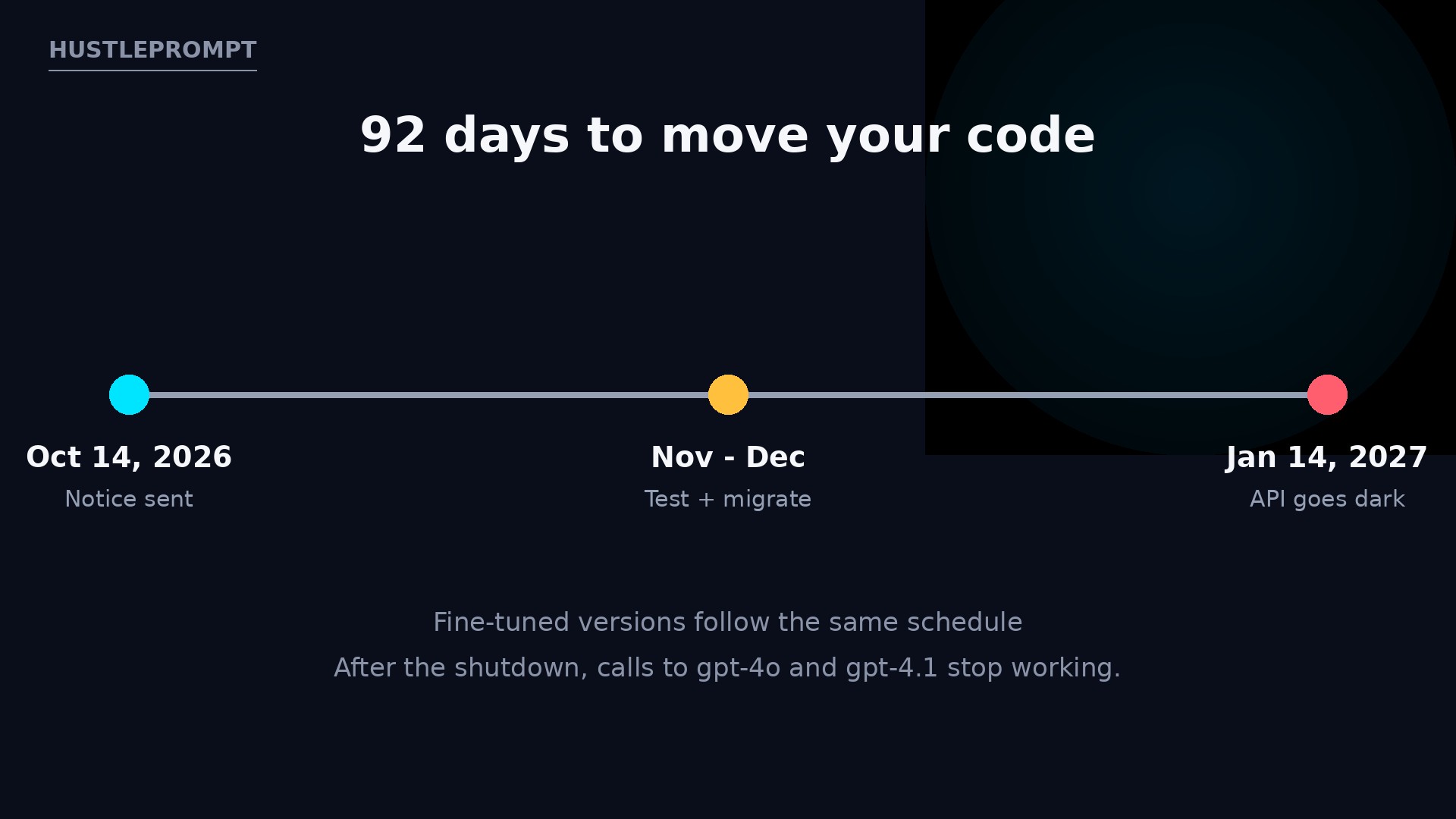
If the model string in your code starts with gpt-4o or gpt-4.1, it has an expiry date now. On October 14, 2026, OpenAI added a new entry to its official deprecations page: those GPT-4 series models leave the API on January 14, 2027. That is 92 days from notice to shutdown — and after that date, every call simply stops working.
This is the biggest GPT-4o retirement wave yet, and it lands right on the models that thousands of small businesses, freelancers, and agencies built real products on. The good news: OpenAI’s named replacement, GPT-6 Luna, is dramatically cheaper. The bad news: the migration will not do itself — and “cheaper per token” is not automatically “cheaper for you.”
What exactly is being retired
OpenAI’s official API deprecations page lists the new October 14 entry at the top. Four model families are going away, each with its recommended replacement:
| Shuts down | Model / system | Replacement |
|---|---|---|
| Jan 14, 2027 | GPT-4o (gpt-4o-2024-08-06, gpt-4o-2024-11-20) |
gpt-6-luna |
| Jan 14, 2027 | GPT-4o mini (gpt-4o-mini-2024-07-18) |
gpt-6-luna |
| Jan 14, 2027 | GPT-4.1 (gpt-4.1-2025-04-14) |
gpt-6-luna |
| Jan 14, 2027 | GPT-4.1 mini (gpt-4.1-mini-2025-04-14) |
gpt-6-luna |
Two details that matter for anyone running a business on these models:
- Fine-tuned versions follow the same schedule. If you fine-tuned GPT-4o for your support bot or your extraction pipeline, your custom model dies on the same day as the base model.
- This is the API only. ChatGPT subscriptions have a separate schedule — but if your app calls the API with these model strings, January 14 is the hard stop.
The money part: Luna costs roughly half
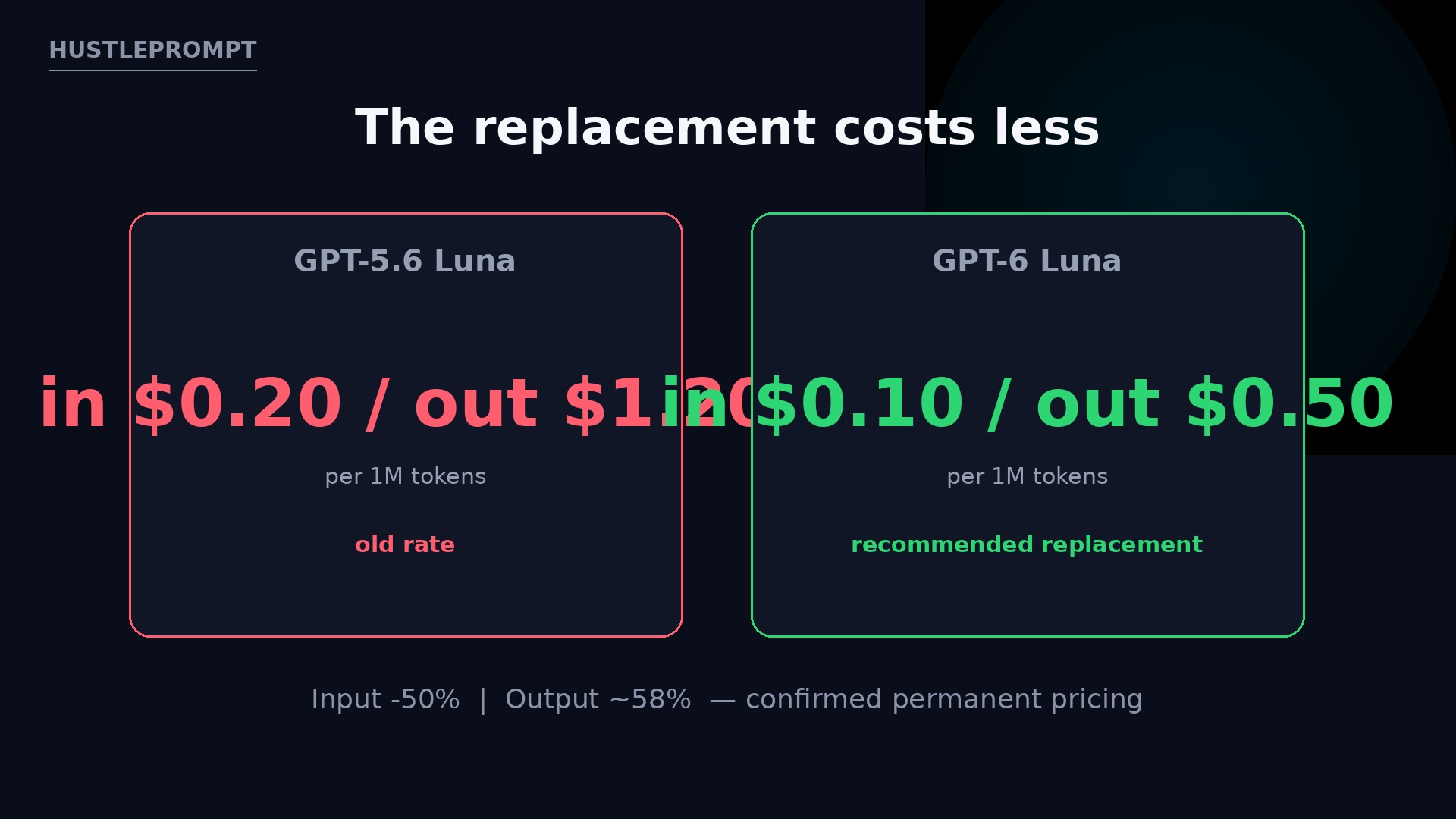
Here is where it gets interesting for your wallet. OpenAI points every retiring model at GPT-6 Luna, its high-volume efficiency tier — and Luna’s pricing is a steep drop from the model it replaces.
| Model | Input / 1M tokens | Output / 1M tokens | Change |
|---|---|---|---|
| GPT-5.6 Luna (old) | $0.20 | $1.20 | — |
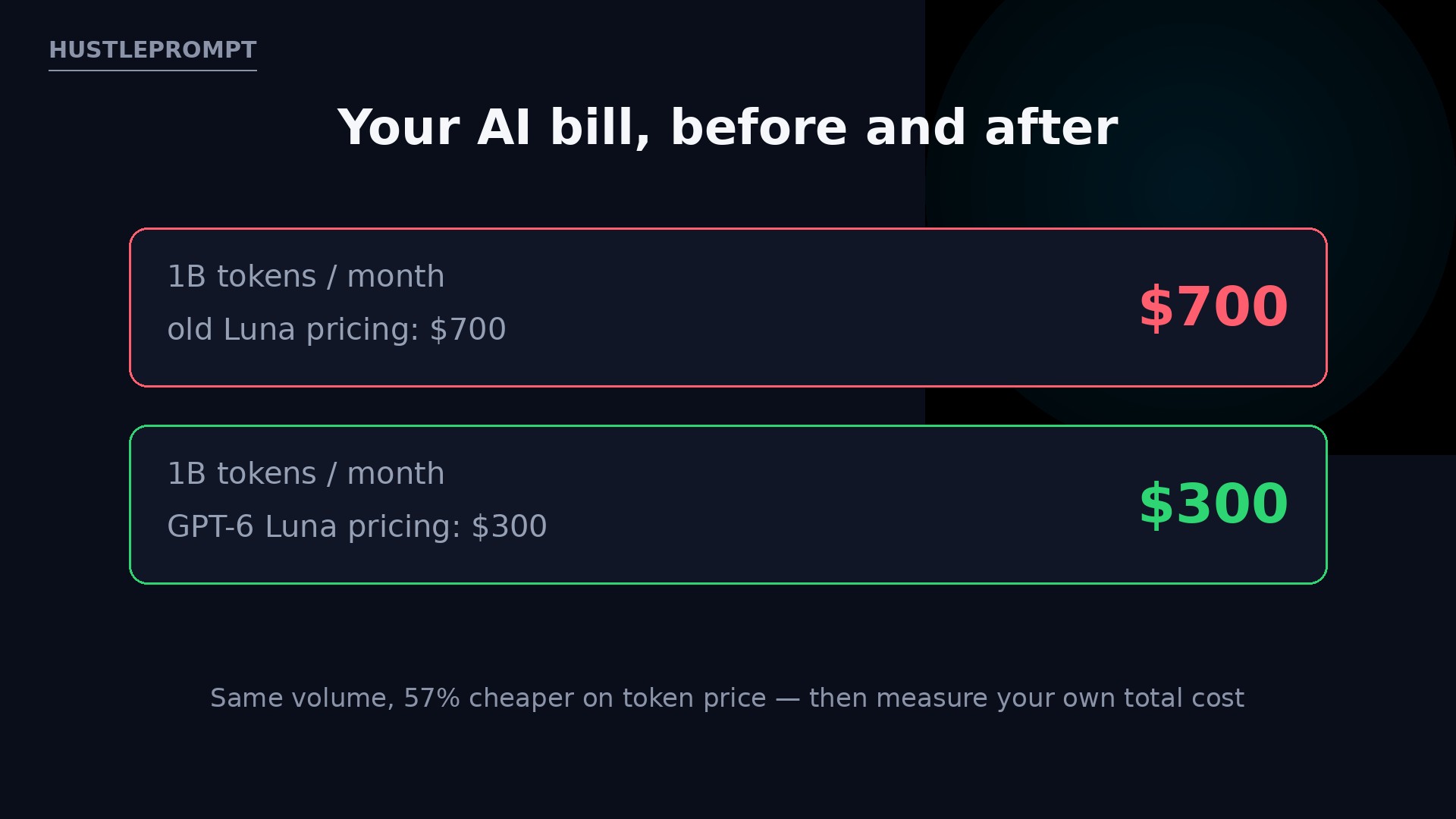
| GPT-6 Luna (replacement) | $0.10 | $0.50 | −50% input, −58% output |
An OpenAI spokesperson confirmed to VentureBeat that these are permanent rates, not promotional pricing. The same cut happened one tier up: GPT-6 Sol is $2/$10 per million tokens, half of GPT-5.6 Sol’s $4/$20.
But do not celebrate yet. OpenAI’s own migration guidance says to measure total cost on your own workloads, because token consumption and reasoning settings change the real bill. Luna is built for high-volume, tightly scoped jobs — summarization, extraction, routine Q&A — not the hardest reasoning. Swap blindly, and extra retries can eat the savings.
Who gets hit hardest
Three groups should treat this as urgent, not routine:
- Agencies and freelancers with client apps. Shipped a classifier, extractor, or support-ticket router on a small OpenAI model in the last two years? The quiet API call behind a feature nobody touched since launch works until January 14. Then it stops — and the client calls you.
- Anyone with fine-tunes. Your custom model inherits the base model’s shutdown date. No grace period.
- Teams on pinned snapshots. Pinned
gpt-4o-2024-08-06for reproducibility? You are pinned to a model with a death date.
The 5-step migration playbook
OpenAI’s guidance is simple: test representative workloads, check output formats and tool use, and introduce production traffic gradually. Here is the same advice as a concrete plan:
GPT-4o → GPT-6 Luna migration flow
gpt-4o and gpt-4.1 strings + fine-tunesHow to profit from a forced migration
Every forced migration is a paid consulting opportunity wearing a deadline costume. Here is how to turn this one into money:
- Sell “migration sprints.” Small businesses will pay a flat fee for someone to audit their model strings, benchmark Luna, and switch them over before the deadline. Deadlines sell. January 14 is a hard one.
- Productize the audit. A simple script that scans a codebase for deprecated model IDs and estimates the new bill is a sellable one-time report — or a lead magnet for your agency.
- Go model-agnostic, permanently. As consultant Shelly Palmer put it, models are “Lego bricks” that should be easily changed out inside a system you control — your data, business rules, and architecture stay proprietary. Build the model name as an environment variable once, and the next shutdown becomes a one-line change.
- Pocket the price difference. If your clients pay per-query and you cut your token cost 50%+, that margin is yours — while delivering the same or better output.
This is a pattern, not an event
The GPT-4 retirement is just the headline item on OpenAI’s 2027 shutdown calendar. From the same official deprecations page:
| Shuts down | What dies | Recommended replacement |
|---|---|---|
| Jan 6, 2027 | tts-1, tts-1-hd, GPT-4o-mini TTS snapshots |
gpt-realtime-2.1-mini |
| Jan 20, 2027 | Legacy audio, realtime, and transcription model families | gpt-realtime-2.1 / gpt-audio-1.5 |
| Apr 1, 2027 | gpt-5.1, gpt-5.3-codex, gpt-5.4-nano |
gpt-6-sol / gpt-6-luna |
The lesson for anyone building a business on AI: assume every model string in your code has a countdown. OpenAI gives 3–6 months of notice for GA models, which is generous — but only if you are watching. Subscribe to the deprecations page, and check the shutdown_date field on the models endpoint programmatically. Ninety-two days feels long until it is January.
OpenAI’s official “Introducing GPT-6 in ChatGPT” video — GPT-6 Luna powers the free tier, which is why the replacement is built for scale.
Frequently asked questions
When exactly does GPT-4o stop working?
January 14, 2027, in the OpenAI API. OpenAI announced the deprecation on October 14, 2026, giving 92 days of notice. After the shutdown date, calls to the retired model IDs stop working entirely.
Which model should replace GPT-4o?
OpenAI’s official recommended replacement for all four retiring models (GPT-4o, GPT-4o mini, GPT-4.1, GPT-4.1 mini) is GPT-6 Luna (gpt-6-luna) — its high-volume efficiency model priced at $0.10 input / $0.50 output per million tokens.
Do fine-tuned GPT-4o models get extra time?
No. OpenAI states that fine-tuned versions of these models follow the same shutdown schedule as their underlying base models. Plan to retrain or migrate your fine-tunes before January 14, 2027.
Is GPT-6 Luna actually cheaper than GPT-4o-era pricing?
Compared with GPT-5.6 Luna, GPT-6 Luna is 50% cheaper on input and about 58% cheaper on output — and OpenAI confirmed the rates are permanent, not promotional. But OpenAI itself advises measuring total cost on your own workloads, since token consumption and reasoning settings affect the real bill.
Does this affect ChatGPT or just the API?
This deprecation covers the OpenAI API. ChatGPT subscriptions follow a separate schedule — check your plan’s model availability rather than assuming the API dates apply.
What about my other OpenAI models?
Check the official deprecations page and the shutdown_date field on the models endpoint. More shutdowns land in 2027: TTS models on January 6, legacy audio/realtime on January 20, and GPT-5.1 / GPT-5.3-Codex / GPT-5.4-Nano on April 1.
Where can I read OpenAI’s migration guidance?
The guidance is embedded in the deprecations documentation: test representative workloads, verify output formats and tool use, and roll production traffic over gradually. Third-party analysis from Shelly Palmer’s breakdown of the GPT-4 sunset adds the model-agnostic architecture argument.
Sources
- OpenAI API deprecations page — official shutdown dates, model IDs, and recommended replacements
- Shelly Palmer: OpenAI will sunset selected GPT-4 models in January — migration guidance and the model-agnostic argument
- Dev.to: GPT-4o and GPT-4.1 leave OpenAI’s API on January 14, 2027 — developer-focused 92-day breakdown