
A 501-billion-parameter AI model just became free to download. Today, Reflection AI released the open weights of Beam — its first open-weight model — on Hugging Face under the Apache 2.0 license, which means anyone can download it, self-host it, fine-tune it, and build commercial services on top of it. It arrives one day after Meta’s Muse Spark Open and sharpens the biggest money question in AI right now: when frontier-class models go free, the value moves to whoever deploys them best.
Reflection calls Beam a “workhorse model” for coding, reasoning, and long-horizon agentic workloads. But the real story isn’t the model alone — it’s the 40-plus partner ecosystem the company launched with it, which it describes as an “open operating system for agents.” Here’s what actually dropped today, what the numbers say, and five concrete ways to profit from it.
What dropped today
According to Reflection’s official availability announcement, today’s release includes far more than weights:
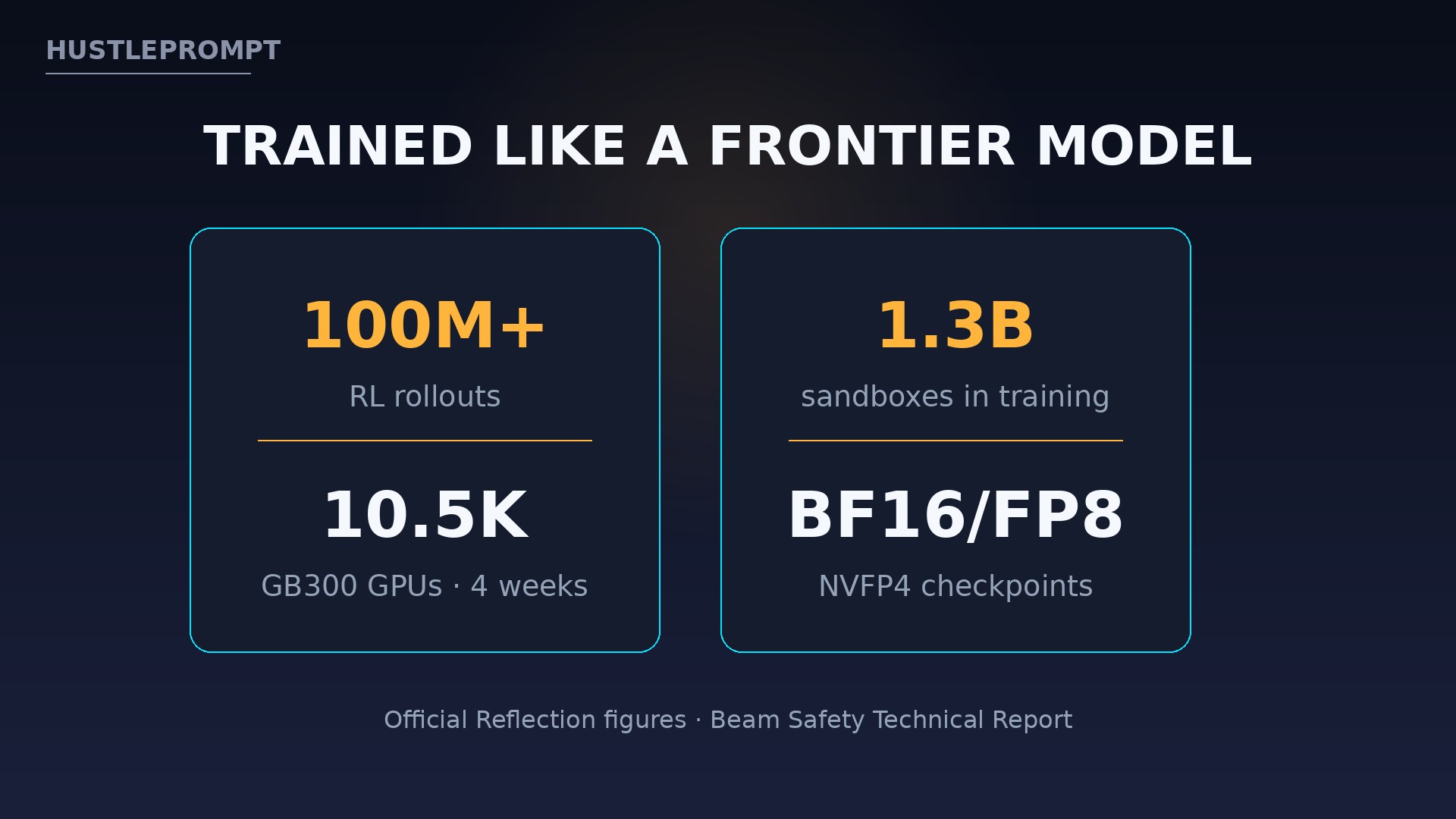
- Open weights on Hugging Face under Apache 2.0 — full commercial use allowed. Checkpoints ship in BF16, FP8, and NVFP4 precision, plus a speculative-decoding drafter model for faster serving.
- Final benchmarks in the official model card, and a Beam Safety Technical Report covering the model’s complete safety methodology.
- Mirror CLI, an open-source-friendly agentic coding harness co-trained with Beam. It pairs a Python frontend with a minimal Rust agent core, supports resumable conversations and parallel agents in separate worktrees, and plugs into skills, MCP connections, Slack, Linear, and GitHub. Reflection built it for its own engineers first — then open-sourced it.
- Reflection’s first-party API at platform.reflection.ai, now in public beta and free to start.
- Day-zero support across the serving stack: Transformers (Hugging Face), vLLM, SGLang, Unsloth, Axolotl, TokenSpeed, and NVIDIA Dynamo — “from weights to a production-scale endpoint without writing custom plumbing.”
Beam at a glance
| Spec | Value | Source |
|---|---|---|
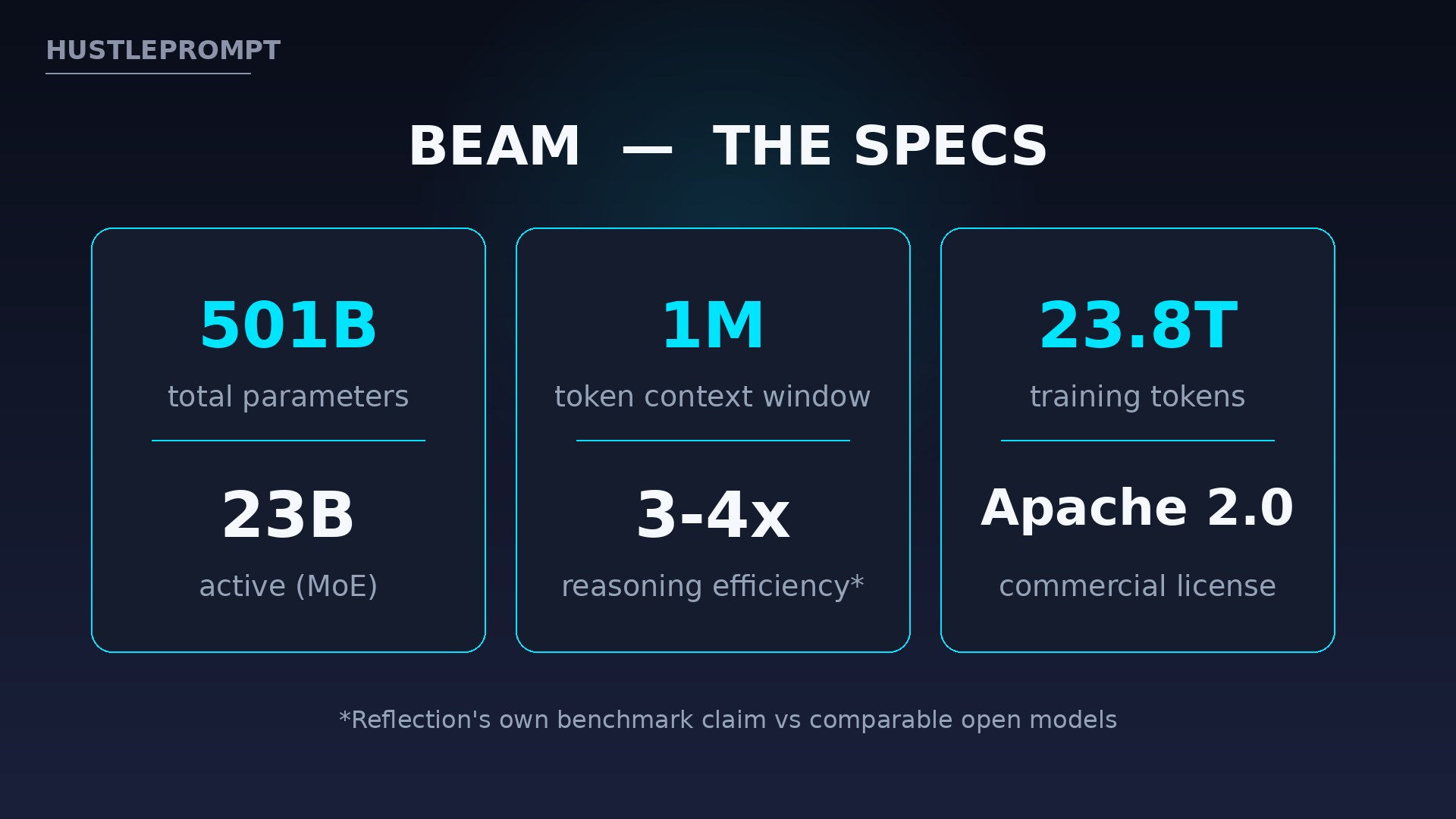
| Architecture | Sparse mixture-of-experts, 501B total / 23B active parameters | Reflection |
| Context window | 1 million tokens | Reflection |
| Pretraining | 23.8 trillion tokens | Reflection |
| Reinforcement learning | 100M+ rollouts on 10,500 NVIDIA GB300 GPUs over 4 weeks; ~1.3B sandboxes across training and evals | Reflection |
| License | Apache 2.0 — commercial use permitted | Reflection |
| Tested harnesses | Mirror CLI, Pi, OpenCode, Hermes | Reflection |
The efficiency bet: fewer tokens, not cheaper tokens
Reflection isn’t trying to win the raw-capability crown. Its pitch is token efficiency: Beam is trained to finish tasks in far fewer tokens than models its size, which lowers the cost of each completed task. On its own benchmarks, the company claims 3–4x higher reasoning compute efficiency than comparable open models — and on advanced reasoning tests, performance on par with Z.ai’s GLM-5.2, one of China’s leading open models.
The trick, per an exclusive VentureBeat interview with Reflection CTO Ioannis Antonoglou, was penalizing the model during reinforcement learning whenever it used unnecessary tokens. Asked what Beam gave up to produce shorter answers, Antonoglou said: “You don’t give up anything. You just penalize it in terms of how many tokens it can use.”
Treat efficiency claims the way you’d treat any vendor benchmark: as a directional signal, not gospel. But the economic logic is sound — for businesses running agents at scale, tokens per finished task is the number that shows up on the invoice.
An “open operating system for agents”
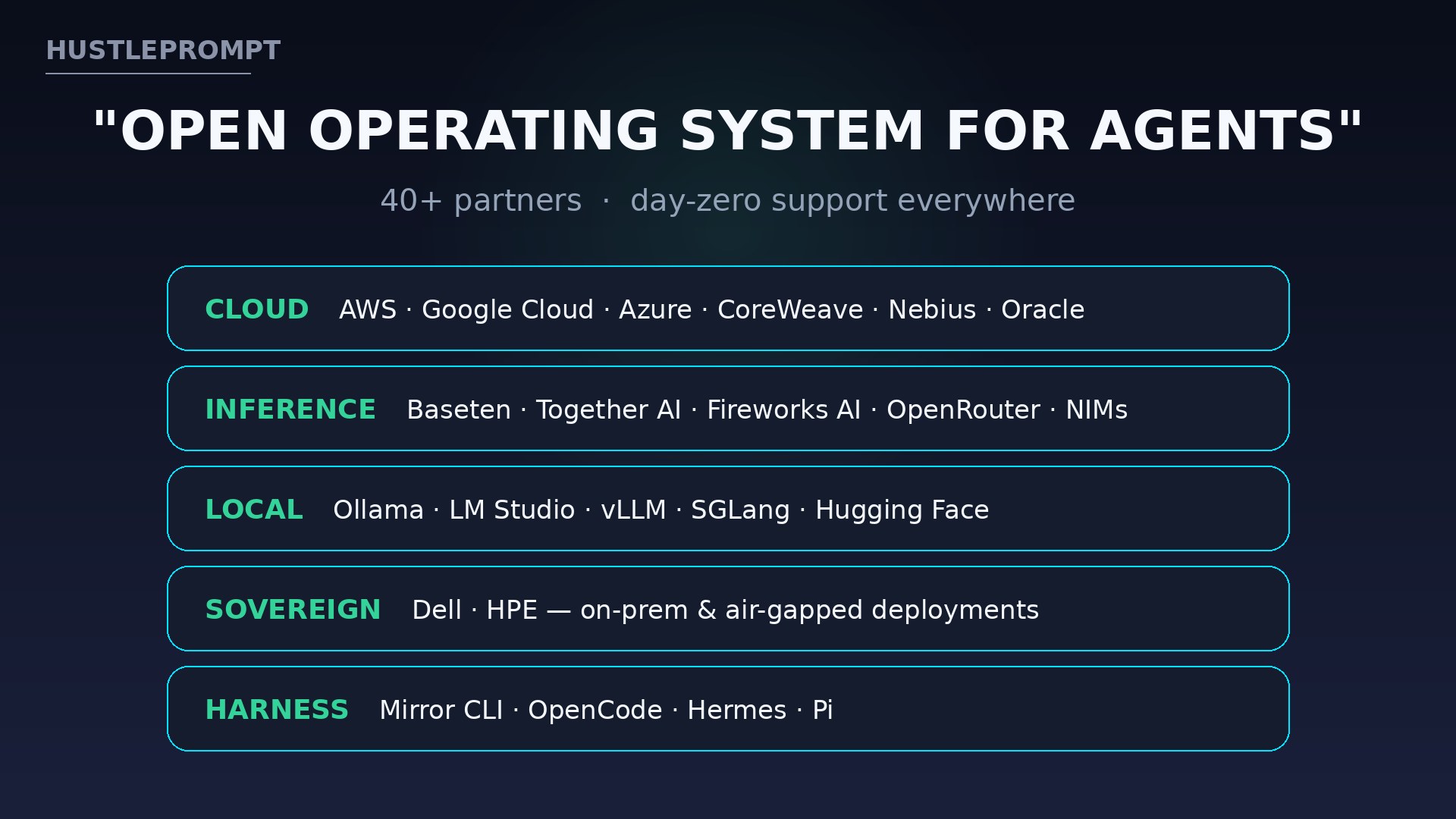
Reflection’s framing is deliberate: “The model is the kernel, and everything above the infrastructure layer is open — reference agentic integrations, deployment containers, inference integrations, and customization pipelines.” More than 40 partners are live at launch:
- Cloud: AWS, Google Cloud, Microsoft Azure, CoreWeave, Nebius, Oracle, Nscale, Databricks
- Inference APIs: Baseten (day-zero Model APIs and dedicated inference), Together AI, Fireworks AI, OpenRouter, NVIDIA NIMs, Modal, Vercel
- Local & open source: Ollama (free for a limited time), LM Studio, vLLM, SGLang, Hugging Face
- Sovereign & on-prem: Dell and HPE deliver Beam behind the firewall for air-gapped environments
- Fine-tuning & RL: NVIDIA (NeMo RL, AutoModel, Megatron), RadixArk, Hugging Face (TRL), Anyscale (SkyRL), Axolotl — plus self-distillation recipes Reflection says arrive “in the coming days”
Google is going hard on day zero: per the official Google Cloud announcement, Beam gets ready-to-run deployment recipes on Google Cloud AI Hypercomputer with up to 5x higher throughput and 8x lower latency on optimized instances. Reflection’s VP of Product Joe Spisak put it this way: “By deploying our Beam model on Google Cloud, we achieved up to 5x higher performance and 8x lower latency to optimize serving of agentic workloads.”
How it scores — with the caveats
Reflection’s own numbers put Beam roughly level with Z.ai’s GLM-5.2 on advanced reasoning while beating Western open models on efficiency. Independent evaluation adds texture. The table below mixes both — read the source column:
| Benchmark | Beam | Context | Source |
|---|---|---|---|
| AA Intelligence Index | 30 — #2 US open-weights model | Behind Meta’s Muse Spark Open (39); ahead of NVIDIA’s Nemotron 3.5 Super VL (26) | Artificial Analysis (independent) |
| AutomationBench-AA | 48.5% | ~11 points ahead of K2 Horizon (37.2%) | Artificial Analysis (independent) |
| Terminal-Bench 4.0 | 3.0% (weak point) | Muse Spark Open scores 8.1% here | Artificial Analysis (independent) |
| AA-Omniscience | 33% correct / 47% hallucination rate | Knows more but guesses more than peers | Artificial Analysis (independent) |
| Advanced reasoning | On par with GLM-5.2 | Vendor claim, not independently verified | Reflection |
The honest read: Beam is a strong #2 in the US open-weight race — clearly behind Meta’s 816B Muse Spark Open on raw scores, clearly ahead on the efficiency story. For agentic coding and business workloads (where Beam scores 48.5% on AutomationBench), that efficiency-first positioning is exactly what keeps inference bills down.
How to profit from Beam’s release
Every open-weight release creates the same window: the model is free, but deploying it well is not. Five plays, ordered by how fast you can start:
- Managed Beam hosting for businesses. Day-zero integrations on Baseten, Together AI, Fireworks AI, and OpenRouter mean you can stand up a hosted Beam endpoint for a client this week and charge a margin over token costs. The pitch writes itself: private inference, predictable pricing, no Big Tech API lock-in.
- Fine-tuning and domain customization. Apache 2.0 permits commercial use, and Reflection is shipping RL and fine-tuning recipes with NVIDIA, Hugging Face, Anyscale, and Axolotl. Agencies can productize “Beam, trained on your company’s data” as project-based engagements.
- Private AI agent builds for SMBs. Pair self-hosted Beam with Mirror CLI and sell the privacy story: “your data never leaves your building.” Local law firms, clinics, and financial advisors will pay setup fees plus monthly retainers for agents that run entirely on-prem.
- Sovereign and regulated deployments. With Dell and HPE offering Beam behind the firewall, there’s a consulting lane in compliance-heavy industries — scoping, deploying, and documenting air-gapped AI for organizations that can’t touch public APIs.
- The content wave. Every model release creates a tutorial vacuum. Beam is free to start via the public beta API and free for a limited time on Ollama — which means zero cost to produce the first wave of setup guides, benchmark comparisons, and Mirror CLI walkthroughs while search interest peaks.
The Beam Profit Pipeline
Sign up for the public beta API at platform.reflection.ai — free to start — and benchmark Beam on your actual use case.
Hosting, fine-tuning, private agent builds, or regulated deployments — one lane, done well, beats four done thin.
vLLM, SGLang, Ollama, or a partner endpoint — the plumbing already exists, so skip straight to the client.
Retainers, per-task pricing, or hosting margins — sell the result (working agents), not the model.
FAQ
Is Beam really free for commercial use?
Yes. The weights are released under the Apache 2.0 license, which permits commercial use, modification, and redistribution. You can download the weights from Hugging Face, self-host them, fine-tune them, and sell services built on them — no royalties to Reflection.
What hardware do I need to run Beam?
All 501 billion parameters must fit in memory even though only 23B are active per token, so full-precision self-hosting means a multi-GPU server. The FP8 and NVFP4 checkpoints cut that substantially, and community quantization will shrink it further. If that sounds like too much hardware, the hosted route is simpler: Reflection’s public beta API is free to start, and Ollama is offering Beam free for a limited time.
How does Beam compare to DeepSeek, Qwen, and GLM?
Reflection claims Beam matches Z.ai’s GLM-5.2 on advanced reasoning benchmarks while using 3–4x less inference compute — but those are the vendor’s own numbers. Independent testing from Artificial Analysis ranks Beam at 30 on its Intelligence Index, a solid #2 among US open-weight models. The honest framing from Reflection itself: Beam “advances the Western open-weight frontier” on efficiency, not raw capability.
How does Beam compare to Meta’s Muse Spark Open?
Muse Spark Open is the bigger model — 816B total parameters with 42B active — and it scores higher on independent benchmarks (39 vs 30 on the Artificial Analysis index). Beam’s counter is efficiency: fewer tokens per task, lower inference cost, and a 1M-token context. Think of Spark Open as the capability play and Beam as the cost-per-task play.
What is Mirror CLI?
Mirror is the open-source-friendly agentic coding harness Reflection co-trained with Beam. It runs in your terminal, supports resumable conversations and parallel agents in separate worktrees, and connects to skills, MCP servers, Slack, Linear, and GitHub. Reflection built it for internal use — its engineers reported major productivity gains on code review — then open-sourced it. It works with Beam today through Reflection’s API, partner endpoints, or self-hosted models.
Where can I access Beam right now?
Three paths: pull the weights from Hugging Face and self-host; sign up for the free public beta at platform.reflection.ai; or hit a hosted endpoint from one of the 40+ launch partners (Baseten, Together AI, Fireworks AI, OpenRouter, Google Cloud, AWS, Azure, Ollama, LM Studio, and more).
The bottom line
Beam’s weights release is the second major open-weight event in 48 hours — and it confirms the pattern: the models are becoming free infrastructure, and the money is moving to deployment, customization, and agents. Reflection handed the ecosystem a 501B-parameter model, an Apache 2.0 license, day-zero tooling, and a 40-partner distribution network on day one. The window for first movers — hosting, fine-tuning, private agent builds, and content — is open right now, and it will not stay this uncrowded for long.
Keep Reading
- Meta Muse Spark Open: 816B Free AI Model for Mac
The 816B open-weight giant Beam is chasing — free to run, 1M context, Apple’s new AI battleground. - Microsoft’s 2.8T MAI-Base-2 Beats OpenAI on 1/4 Compute
The efficiency race is the whole game now — Microsoft’s 2.8T model vs the open-weight wave. - NVIDIA Drops a 74B AI Model That Runs on Your Laptop
Local AI is having a moment — NVIDIA’s 74B model you can actually run yourself.
Sources
- Beam is now available — Reflection AI official announcement (Oct 16, 2026)
- Day-0 support with 5x perf for Reflection Beam on Google Cloud — Google Cloud official blog
- Beam: Efficient reasoning for coding and agentic workloads — Baseten official launch post
- Reflection’s Beam aims to undercut Chinese open models with fewer tokens, not cheaper tokens — VentureBeat exclusive with Reflection’s CTO