
Every small business owner makes expensive decisions with almost no data: open a second location or not, match a competitor’s price or hold, launch the new service line now or wait. The professional way to answer those questions — a commissioned market study — is priced for corporations: sector price guides put custom studies at $15,000–$65,000. Meanwhile the United States has 36,207,130 small businesses, 99.9% of all US firms, according to the SBA’s 2025 profile. That gap is the business in this tutorial: sell AI market reports to small businesses — decision-grade research, produced with Perplexity and ChatGPT, verified figure by figure, and delivered as a clean report for a fraction of the agency price.
Transparency note: this article uses the standard HustlePrompt block that embeds a third-party video tutorial. Where the tutorial text cites earnings examples or ranges, they are always presented as illustrative references — never as promises of income.
Why this market exists: the price gap is real and documented
Market research is a big, expensive industry: ESOMAR’s global figures put its revenue at roughly $153 billion in 2024. That money mostly serves large companies. At the small end, the documented price guides (LegalClarity’s 2026 cost breakdown of market research, used here as a sector reference) describe the two traditional options: a custom study between $15,000 and $65,000, run over 4–12 weeks, or a syndicated report — pre-published, generic — at $1,500–$8,000 that answers a national question, not the owner’s local one.
AI research tools collapse the production cost of the middle option: a local, specific, sourced report. Perplexity Pro and ChatGPT cost about $20/month each at standard US pricing. Your margin does not come from the tools — anyone can subscribe — it comes from the verification discipline and the write-up: every figure traced to its source, every competitor claim checked against their actual website, every conclusion separated from the data that supports it. That is what owners pay for, and it is also what keeps the service honest.
What the service is, exactly
You deliver a finished report (PDF, 10–20 pages) answering one business question, built from three standard blocks:
- Competitor analysis: who the 5–10 real competitors are, their offer, their published prices, their review standing — each fact with its source.
- Local pricing scan: what the market actually charges for the client’s product or service in their area, with the listings or pages captured.
- Customer sentiment: what buyers praise and complain about in public reviews and forums — the unmet needs the client can exploit.
Perplexity does the sourced searching (it returns citations by design); ChatGPT or Claude helps structure and draft. Your work: define the question tightly with the client, verify every load-bearing figure against the original source, and write the “so what” — the recommendation section that turns data into a decision. A report whose numbers cannot be traced is worth less than no report, because the owner will act on it.
One decision, one question, in writing.
Perplexity gathers sourced data.
Every figure checked at its source.
Report with tables, charts, recommendations.
Walkthrough call + one revision round.

The cost comparison your clients understand instantly
| Option | Typical price | Wait | Fit for a local question |
|---|---|---|---|
| Custom agency study | $15,000–$65,000 | 4–12 weeks | Excellent, unaffordable |
| Syndicated report | $1,500–$8,000 | Immediate | Generic, national-level |
| Your AI-assisted report | Illustrative package: a few hundred dollars | About a week | Built around the client’s exact decision |
Present the third row as what it is: your package price, set by you, compared against documented market prices for the alternatives (LegalClarity’s 2026 guide ranges). Never present it as a market average — it is your offer. The comparison works because the alternatives’ prices are real and checkable.
Step 1: pick a niche with recurring decisions
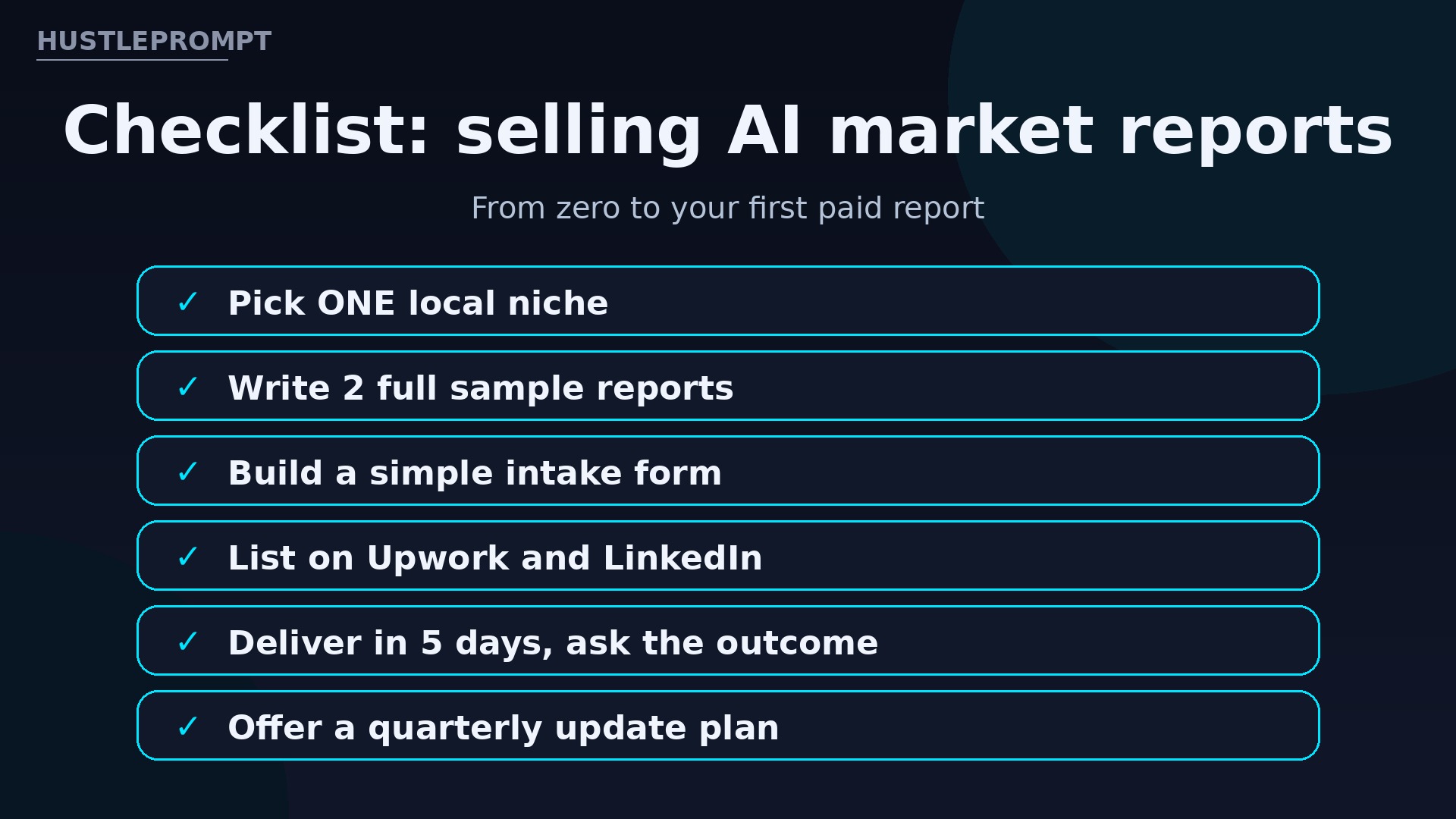
Choose businesses that face market questions repeatedly: restaurants and food concepts (new locations, menu pricing), beauty and wellness (service pricing, new treatments), local e-commerce and retail (assortment, competitor pricing), trades (which services to add), and clinics. One niche means your source lists, prompts and report template get faster with every job — and your sample reports speak the client’s language.
Step 2: write two sample reports before selling anything
Produce two complete sample reports for fictional-but-realistic businesses in your niche, using real public data: “Should a third specialty coffee shop open on this corridor?” style questions. These samples prove the method: sources cited, figures verifiable, recommendations concrete. They are also your quality bar — if a paid report would embarrass you next to the samples, it is not ready.

Step 3: the brief — one decision per report
Reports fail when the question is “tell me about my market.” Force one decision: “Should I open in neighborhood X at rent Y?” or “Can I raise prices 10% without losing my base?” Write the brief with the client, list the exact data the decision needs, and agree the delivery format and date. The brief protects you from scope creep and the client from a vague deliverable.
Step 4: research with verification, not copy-paste
Run the research in Perplexity with source-returning prompts, competitor by competitor and question by question. Then do the step that makes the service real: open every source behind every figure you plan to use. AI tools misread pages and occasionally fabricate plausible numbers; if a stat cannot be found at its claimed source, it does not go in the report — no exceptions. Keep a verification log (figure, source, date checked): clients rarely ask for it, but it is your insurance and your differentiator when they do.
Step 5: deliver, walk through, and sell the update
Deliver the PDF with a 30-minute walkthrough call: findings first, recommendation second, data appendix last. Include one revision round for factual corrections or added competitors. Then offer the natural continuation: a quarterly update, because prices, competitors and sentiment move. Owners who made one decision with your data come back when the next decision arrives — that is the annuity in this model, earned, not promised.
What to charge: an illustrative framework (not a promise)
No official rate exists for AI-assisted local research, so validate locally and treat the following as structure, not expectation. Operators typically price a single-question report as a one-time package calibrated against the documented alternatives — far below the $15,000 floor of a custom study, above the “free” of doing it badly — with the quarterly update as a smaller recurring fee. Anchor on the decision’s stakes: a report informing a lease or a price change is worth more than a curiosity report, and should be priced that way. Your costs are roughly $20/month per AI tool plus your hours; price the verification time honestly, because it is the product.
The mistakes that kill this business
- Unverified AI output. One fabricated competitor price in a delivered report ends the business. Verify every load-bearing figure at its source.
- Vague briefs. “Research my market” produces unread reports. One decision, one question, agreed in writing.
- Data dumps without a recommendation. Owners buy decisions, not spreadsheets. Lead with what the data says to do, then show the data.
- Copying agency language. Padding a report with generic market-size filler destroys the one advantage you have: local specificity.
- Promising accuracy you cannot check. State sources and dates, flag estimates as estimates, and never present your package pricing as an industry average.
Frequently Asked Questions
Why would a small business pay for this?
Because the traditional alternatives are priced out of reach: sector guides put custom studies at $15,000–$65,000 and syndicated reports at $1,500–$8,000. A local, sourced report built around their exact decision — delivered in about a week — fills a gap that the $153 billion research industry (ESOMAR, 2024) largely ignores.
What tools do I need?
Perplexity Pro for sourced research and ChatGPT or Claude for structuring and drafting — about $20/month each at standard US pricing — plus a document tool for the PDF. The tools are cheap; the verification process is the skill you are selling.
How do I know the AI’s data is right?
You don’t — until you check it. Open the original source behind every figure, confirm the number and its date, and keep a verification log. Anything that cannot be traced gets removed or explicitly flagged as an estimate. This discipline is non-negotiable: the client will make real decisions with your report.
How big is the potential client base?
The SBA’s 2025 profile counts 36,207,130 small businesses in the US — 99.9% of all firms. You do not need the country; you need one niche in one metro area with recurring decisions, and a reputation for sourced, honest work inside it.
How long does a report take?
A focused single-question report typically takes about a week part-time: a day for the brief and research plan, two to three days of research and verification, and a day of writing and delivery. Quote the date in the brief and keep it — reliability is part of the product.
Can I guarantee the report’s conclusions?
No. You guarantee method: sources cited, figures verified, estimates flagged, and a clear line between data and recommendation. The decision — and its outcome — belongs to the owner. Clients who understand that distinction are exactly the ones who reorder quarterly updates.
Keep Reading
- Sell AI Business Plan Writing Services — the report’s findings become the plan the owner acts on.
- Sell AI Pitch Decks to Startups — turn verified market data into the deck that raises money.