
Only 41.98% of Kickstarter projects ever reach their funding goal. That is the gap you sell. This tutorial shows you how to sell AI product launch campaigns to direct-to-consumer (DTC) brands: the teaser sequence, the waitlist, the launch-day email and SMS push, and the post-launch follow-up, built with AI tools and delivered as a done-for-you service. This is a launch campaign for a NEW product — not the discount-driven holiday sale push in post 11471, not the post-purchase upsell emails in post 11362, and not the nonprofit fundraising campaigns in post 11047.
Disclaimer: general business information, not legal advice. Use written agreements and the client’s own tools. Prices are illustrative, never promises of income.
What the service is, exactly
You build and run a brand’s new-product launch for one fixed fee: the coordinated set of messages that turns a product nobody has heard of into a first week of sales. DTC means direct-to-consumer — brands that sell through their own store instead of through retailers. AI drafts the copy and designs; you check every price and date before anything goes live.
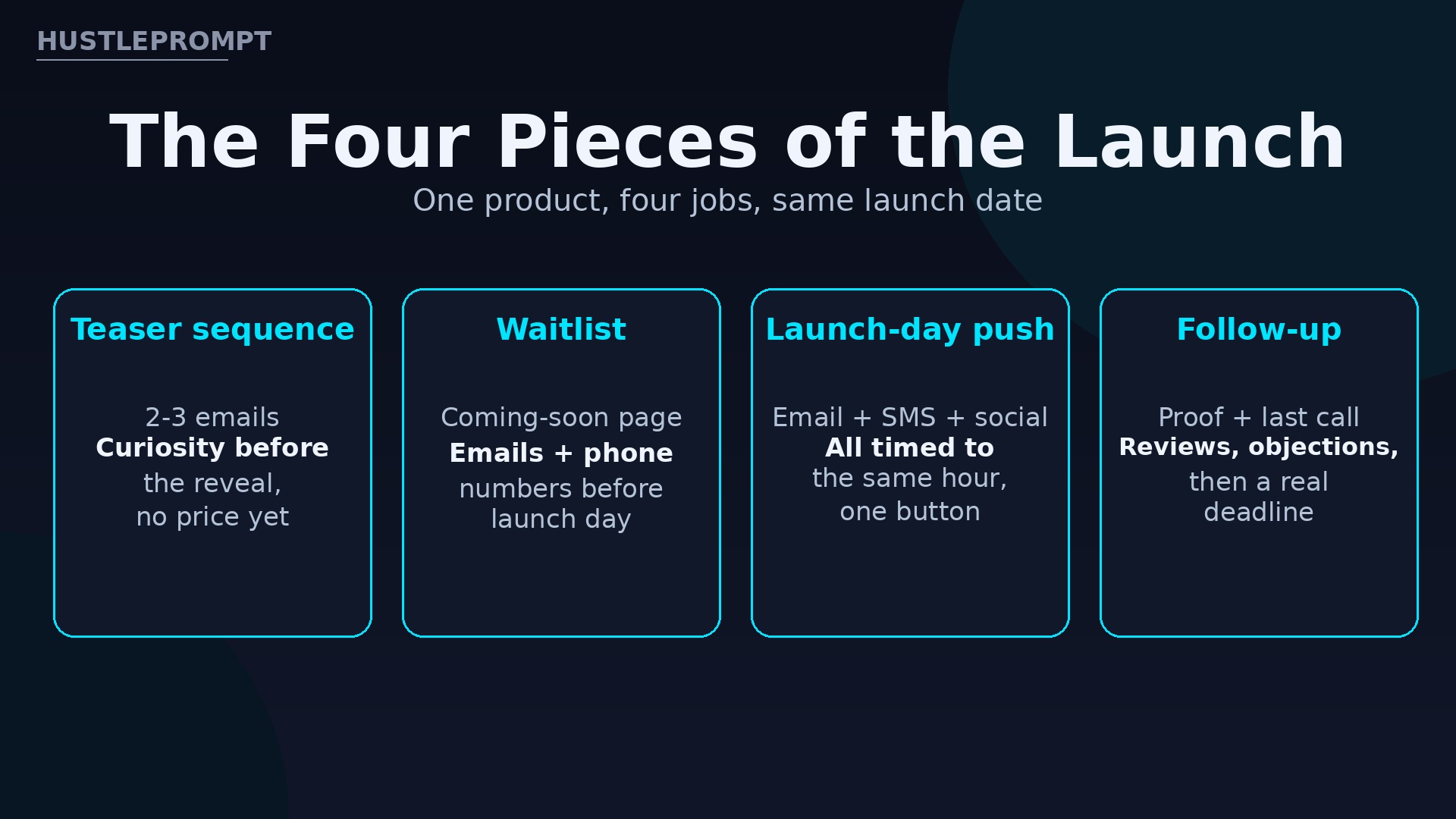
- The teaser sequence: two to three emails that build curiosity before the product exists for sale.
- The waitlist: a coming-soon page that captures emails and phone numbers before launch day.
- The launch-day push: email, SMS, and social posts, all timed to the same hour.
- The follow-up sequence: social proof, objection handling, and a last call for non-buyers.
- The launch report: waitlist growth, opens, clicks, orders, and what to repeat next time.
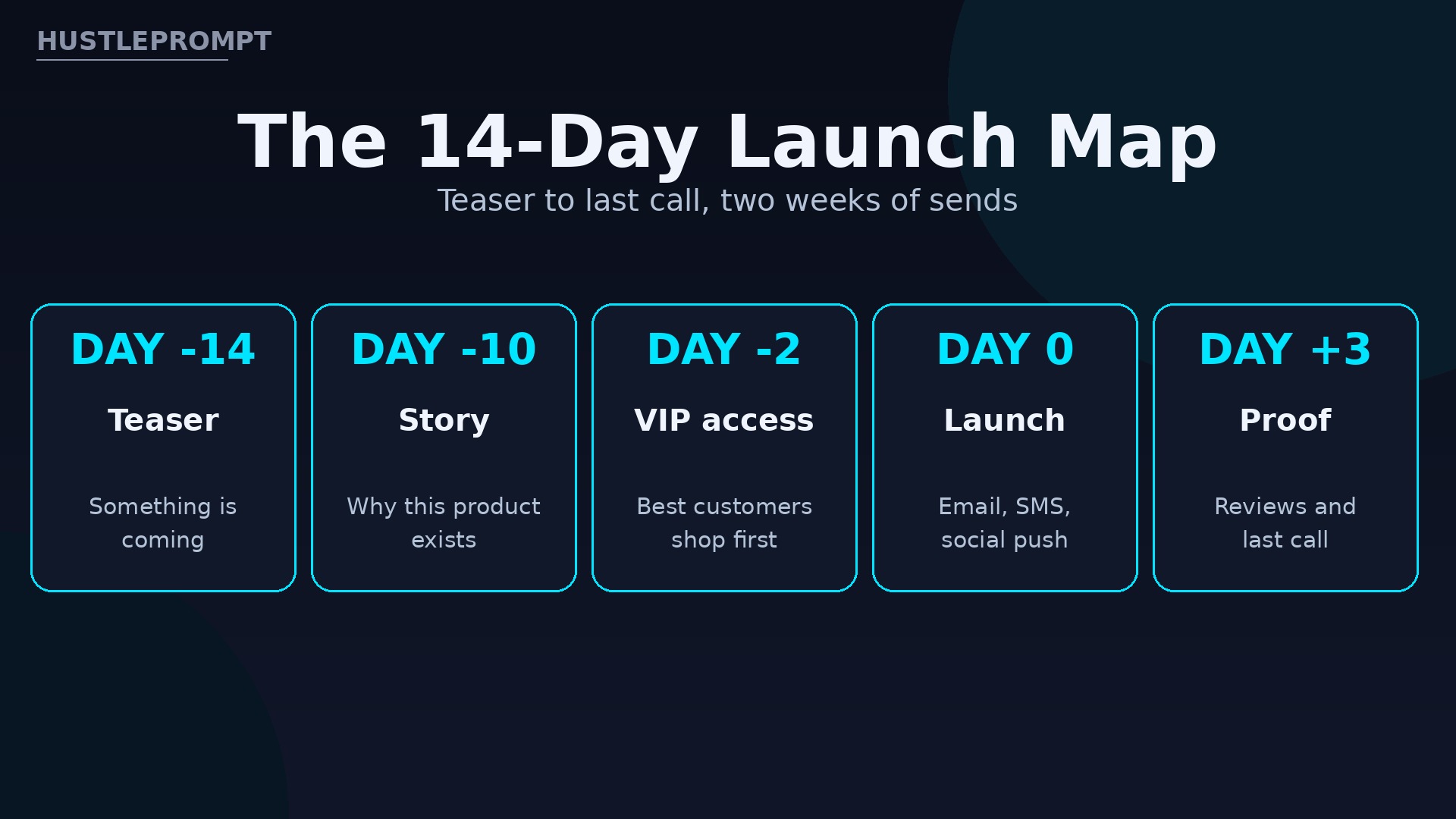
Teaser 1: something is coming.
Story: why this product exists.
VIP early access opens.
Launch: email, SMS, social.
Proof: reviews, last call.
The evidence: launches are won before launch day
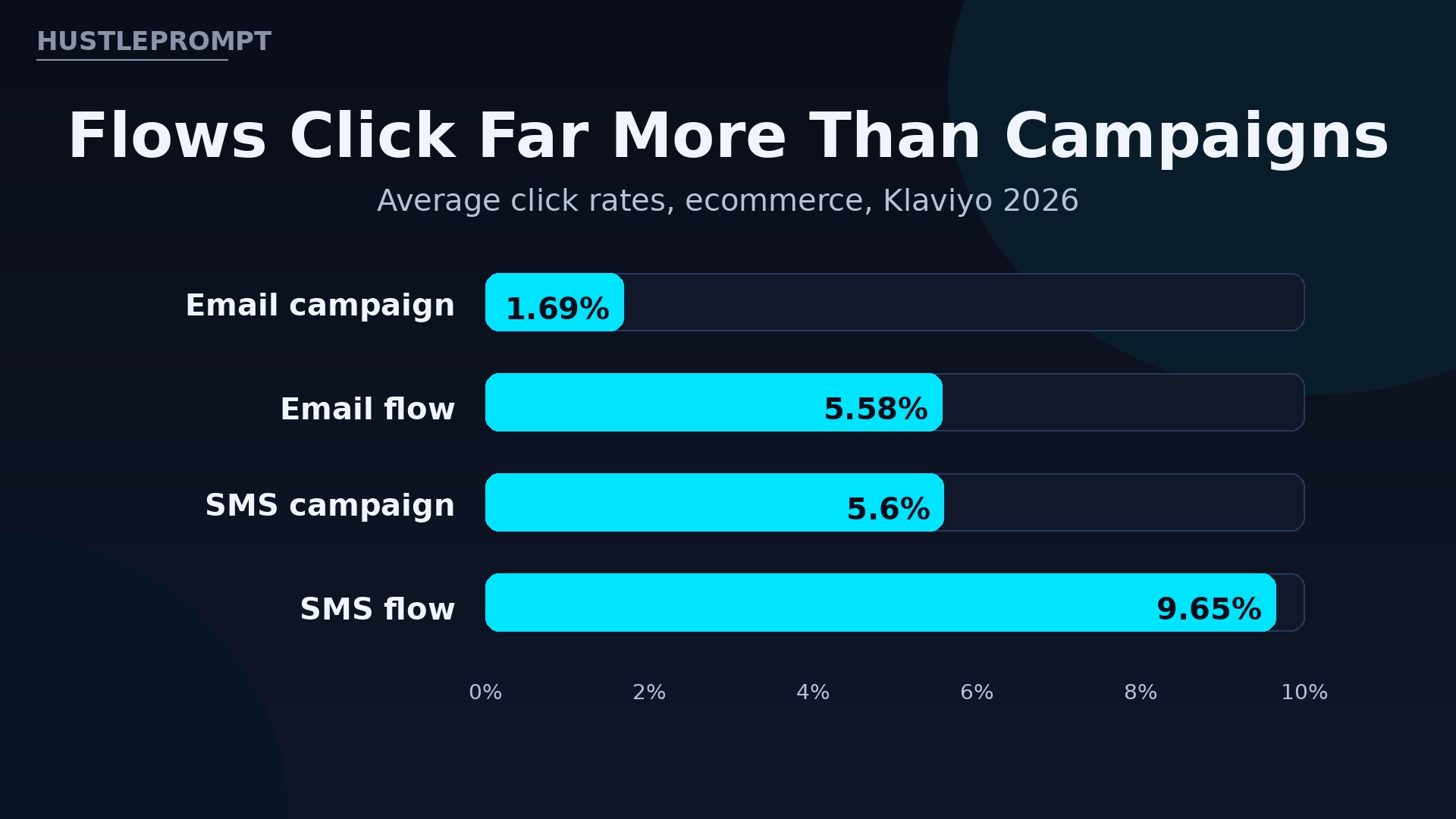
Klaviyo’s 2026 benchmarks, built on more than 183,000 brands, show why the sequence beats the single announcement. Email campaigns average a 31% open rate and a 1.69% click rate, while automated flows average 32.2% opens and a 5.58% click rate. Flows are only 5.3% of email sends, yet they generate nearly 41% of total email revenue, with revenue per recipient nearly 18 times higher than campaigns.
| Channel | Campaign click rate | Flow click rate | Flow share of revenue |
|---|---|---|---|
| 1.69% | 5.58% | ~41% of email revenue | |
| SMS | 5.6% | 9.65% | 45.2% of SMS revenue |
Klaviyo’s 2026 SMS benchmarks put campaign click rates at 5.6% and flow click rates at 9.65%, with top performers above 16.6%. SMS order rates run 0.27% for campaigns and 1.9% for flows. And 64.4% of SMS flow revenue comes from new buyers.
Kickstarter data from January 2025 shows 41.98% of more than 651,000 launched projects reached their funding goal, with over $8.5 billion pledged in total — and 79% of projects that raised more than 20% of their goal were funded. A launch with no warm audience is a coin flip.
Your costs: what the tools charge
| Tool | Price (Nov 26, 2026) | What you get |
|---|---|---|
| Klaviyo Free | $0/mo | 250 profiles, 500 emails/mo |
| Klaviyo Email | $20/mo | 500 profiles, 5,000 emails/mo |
| Mailchimp Standard | $20/mo | 500 contacts, automations, 5 users |
| Canva Pro | $18/mo ($144/yr) | Brand Kit, Magic Resize, premium templates |
| ChatGPT Plus | $20/mo | Copy drafts, subject lines, image creation |
| Claude Pro | $20/mo ($17 annual) | Long-form copy, research, launch planning |
Start free: Klaviyo’s free plan covers a small brand’s pilot launch. The client pays for their own email plan — Klaviyo Email or Mailchimp Standard, both $20 a month. Your costs are Canva Pro at $18 a month and one AI writer at $20 a month, reused across every client.
How it works: the campaign you sell
Here is how you sell it, step by step.
Step 1: pick one niche and twenty brands
Pick one pair: skincare brands on Shopify, or beverage brands with a new flavor coming. Audit 20 targets: do they have a coming-soon page? Did their last launch get more than one email? A brand with 5,000 subscribers and one “it’s live” email for its last product is a warm lead.
Step 2: build the offer and the launch kit
Agree on one launch date, one hero product, and one reason it exists. Then build the kit with AI: draft the teaser, story, and launch emails in Claude or ChatGPT, and make the social teasers in Canva. Check every claim, price, and date by hand — a wrong launch date burns the whole sequence.
Step 3: sell it with a one-page sample
Skip the slide deck. Build one free sample: a teaser email and a mock waitlist page with the brand’s real product and launch date. Send it with the numbers — Klaviyo’s 5.58% flow click rate against 1.69% for campaigns, and the 41.98% Kickstarter success rate. Your best line: “Your last launch was one email. Your competitors run fourteen days.”
Step 4: run the launch week and watch the numbers
Load everything into the client’s own Klaviyo or Mailchimp account and schedule it before the teaser goes out. VIP early access opens two days before launch, the full push lands on launch morning, social proof follows on day three, and the last call closes the window. Exclude buyers from every follow-up.
Step 5: report results and sell the next launch
One week after launch day, send a one-page report: waitlist growth, opens, clicks, orders, best email, best channel. Then pitch the follow-up: a win-back for everyone who clicked but did not buy. The launch is a one-time fee; the next product is how it becomes a retainer.
What to charge
No official price list exists — these are illustrative ranges.
| Package | Illustrative price | What it includes |
|---|---|---|
| One-page sample | Free | Teaser email + mock waitlist page |
| Launch campaign | $1,000 to $1,800 one-time | Waitlist page, 5–7 emails, SMS, social pack |
| Campaign + live management | $1,800 to $3,000 one-time | Everything above + daily monitoring, launch week |
| Monthly retainer | $900 to $1,600 a month | Next launch, then monthly campaigns |
Scale it: 5 brands at $1,400 is $7,000 per launch cycle, and 2 of them on a $1,200-a-month retainer add $28,800 a year.
The mistakes that kill this business
- Starting the week of launch. Start two weeks out, minimum.
- Sending one email on launch day. One blast cannot carry a fourteen-day story.
- Teasing without a waitlist. Curiosity with nowhere to sign up is wasted traffic.
- Mailing buyers the follow-ups. Exclude buyers, or deliverability and trust both collapse.
- Promising a sell-out. Sell the campaign, not the outcome.
- Working in your own account. The client must own the email, SMS, and landing page accounts.
Frequently Asked Questions
What are AI product launch campaigns?
A done-for-you service that builds and runs a DTC brand’s new-product launch — teaser sequence, waitlist, launch-day email and SMS push, and post-launch follow-up — using AI tools, with a human checking every price, date, and claim.
How is a launch campaign different from a holiday sale campaign?
A launch campaign introduces a product that did not exist before, building demand from zero with teasers and a waitlist. A holiday sale campaign (post 11471) discounts products the store already sells.
How long before launch day should the campaign start?
At least fourteen days: one week to build the kit, one week to tease and grow the waitlist, then launch day and three days of follow-up. VIP early access opens two days before the public launch.
Which tools do I need to build a product launch campaign?
Klaviyo or Mailchimp for email and SMS, Canva Pro for graphics, and ChatGPT Plus or Claude Pro for copy. Klaviyo’s free plan covers 250 profiles and 500 emails a month; Email starts at $20 a month. The client pays for their own email plan.
How much can I charge for AI product launch campaigns?
Illustrative: $1,000 to $1,800 for a one-time launch campaign, $1,800 to $3,000 with live launch-week management, and $900 to $1,600 a month on retainer for the next launch and monthly campaigns.
Do I need design skills to sell launch campaigns?
No. Canva Pro’s templates and Magic Resize turn one launch design into every size you need, and ChatGPT or Claude drafts the copy. Your skill is the launch plan — timing, segments, waitlist — and the quality check.
Keep Reading
- Sell AI Holiday Sale Campaigns to E-Commerce Stores.
- Sell AI Post-Purchase Upsell Emails to E-commerce Stores.
- Sell AI SMS Marketing to Local Businesses.
Sources: Klaviyo 2026 email benchmarks — klaviyo.com; Klaviyo 2026 SMS benchmarks — klaviyo.com; Kickstarter/Statista Jan 2025 — statista.com; Klaviyo pricing — klaviyo.com; Mailchimp pricing — mailchimp.com; Canva pricing — canva.com; ChatGPT Plus — help.openai.com; Claude Pro — claude.com. Checked Nov 26, 2026.