
Most freelancers lose work before anyone reads their portfolio. Their proposal arrives late, reads like a template, and buries the price on page four. That gap is exactly what AI proposal writing services sell: fast, tailored scopes, quotes, and client proposals for freelancers and consultants who would rather do the work than write about it.
This is not a pitch-deck service for investors. It is a practical service for working independents who need a sharp proposal for a real client, this week.
What AI Proposal Writing Services Actually Sell
Clients are not buying words. They are buying a decision-ready document that a busy buyer can approve in one sitting.
A strong proposal answers four questions in order:
- What problem are we solving?
- What exactly will you deliver?
- What does it cost, and what are the options?
- What happens next if I say yes?
Who Buys Them (and Who Does Not)
Your best buyers are independents who win work through proposals but hate writing them. Think of these groups:
- Freelance designers, writers, developers, and marketers
- Consultants selling audits, strategy, or implementation packages
- Small agencies that need consistent, on-brand proposals for every lead
- Coaches and specialists moving from hourly billing to fixed packages

The Proposal Structure Clients Pay For
Every proposal you deliver should follow the same spine. Consistency makes the service fast, and clients learn to trust it.
Use these six blocks, in this order:
- Summary: the client’s goal, restated in their own words.
- Scope: deliverables, with what is included and excluded.
- Process: phases, timeline, and what you need from the client.
- Investment: two or three priced options, not a single take-it-or-leave-it figure.
- Proof: two relevant results, with permission to share them.
- Next step: one action, one deadline, and a simple way to accept.
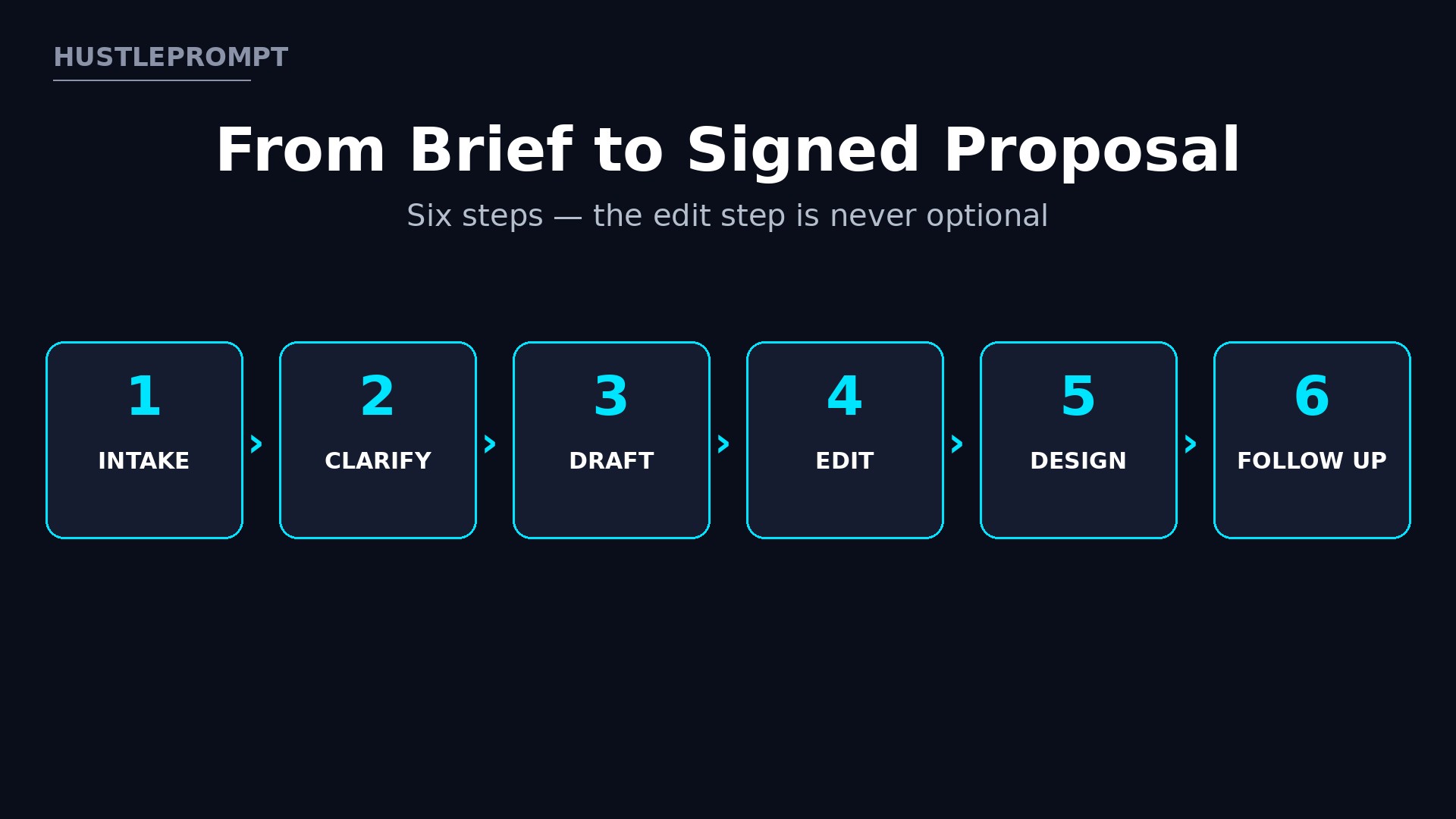
From Brief to Signed Proposal: The 6-Step Flow
1. Intake
Client answers a short brief form.
2. Clarify
You confirm scope, price range, and deadline.
3. Draft
AI produces a first draft from your templates.
4. Edit
You rewrite claims, check numbers, cut hype.
5. Design
Format, price table, and e-signature link.
6. Follow up
One reminder, then one closing note.
If any step is skipped, the proposal gets weaker. The edit step is never optional.
Build Your Service Step by Step
Step 1: Pick one niche to start
Choose one buyer type, such as freelance designers or marketing consultants. A narrow niche lets you reuse examples, price ranges, and objections.
Step 2: Build a 10-question intake form
Ask for the client’s goal, audience, deliverables, timeline, budget range, and two past results. Add one question about what a win looks like in 90 days.
Step 3: Write three master templates
Create one template for a single project, one for a monthly retainer, and one for a short audit or sprint. Each template holds the six blocks from the section above.
Step 4: Build your prompt library
Write prompts that do one job each. One prompt turns intake answers into a scope list. Another turns a scope list into three priced options. A third tightens the draft to plain language.
Feed the AI only facts the client provided. Never let it invent results, clients, or guarantees.
Step 5: Add a human edit checklist
Step 6: Choose a delivery format
Step 7: Package, price, and launch
List the service on your site with samples (anonymized), turnaround time, and revision limits. Launch with one offer, not five.
Tools and Real Costs
You need two kinds of tools: an AI writing tool and a proposal delivery tool. Keep the stack small.
Start with a paid AI plan so client work never stalls on free-tier limits. OpenAI lists ChatGPT Plus at $20 per month, billed monthly, on its official help page.
For delivery, compare proposal tools on list price before you commit. The table below uses figures from a comparison of the vendors’ pricing pages, checked on October 25, 2026. Prices change, so confirm them on each vendor’s site before you buy.
| Tool | Entry plan (billed annually) | Monthly billing | Why it matters |
|---|---|---|---|
| ChatGPT Plus (OpenAI) | No annual option listed | $20 per month | Drafting, tightening, and reformatting |
| PandaDoc Starter | $19 per seat per month | $35 per seat per month | Documents, e-signatures, and tracking |
| PandaDoc Business | $49 per seat per month | $65 per seat per month | Price tables, CRM links, approvals |
| Proposify Build | $39 per user per month | $49 per user per month | Branded proposals with AI writing |
| Proposify Grow | $65 per user per month | Billed annually | Roles, approvals, and API access |
Sources: OpenAI Help Center, “What is ChatGPT Plus?” (Plus at $20 per month, billed monthly, with no annual billing option) and Signaturely’s Proposify vs PandaDoc comparison (prices described as USD list prices from each vendor’s pricing page, checked October 25, 2026).

How to Profit
Price the service by outcome and turnaround, not by hour. Clients pay for a proposal they can send with confidence, not for the minutes you spent drafting it.
The packages below are ILLUSTRATIVE only. All figures are gross, before tool costs and taxes, and they are not income promises. Adjust them to your niche, speed, and local market.
| Package (ILLUSTRATIVE) | What is included | Illustrative price |
|---|---|---|
| Single Proposal | One proposal, one revision round, 3-day turnaround | $150 |
| Proposal Sprint | Three proposals, shared template, 7-day turnaround | $375 |
| Monthly Retainer | Up to four proposals per month, priority turnaround | $600 per month |
Here is the illustrative math, gross before tool costs and taxes. Four single proposals at $150 each equal $600 in gross revenue. Two sprints at $375 each equal $750. One monthly retainer at $600 equals $600 per month while it lasts.
Your real margin depends on turnaround time. If a single proposal takes three hours, that $150 package equals $50 per hour gross before costs. If it takes six hours, it equals $25.
How to Find Your First Clients
- Offer one free proposal teardown in freelance communities, with the owner’s permission.
- Publish one anonymized before-and-after example per week.
- Partner with a bookkeeper, coach, or community leader who serves your niche.
- Ask every happy client for one referral and one short testimonial.
Mistakes That Kill Proposal Services
- Copy-paste drafts: clients can smell a generic proposal in seconds.
- Invented proof: never let AI add results, logos, or testimonials you cannot verify.
- Vague scope: “marketing support” is not a deliverable; name the thing.
- Hidden prices: if the price is hard to find, the answer is usually no.
- No follow-up: a proposal without a follow-up plan is a wish, not a sale.
Watch: Writing a Proposal With AI
The short tutorial below shows the core move: turning a weak freelance proposal into a clear one-page pitch with need, plan, timeline, and a single next step.
Frequently Asked Questions
Do clients care that AI helped write their proposal?
Most care about accuracy, not authorship. Say plainly that you draft with AI tools and edit every line yourself, and never present AI output as unchecked work.
How long should a client proposal be?
Short enough to decide on. Aim for one to three pages for most freelance services, with detail in an appendix or linked scope document if the project needs it.
What should I charge for my first proposal?
Charge a real price, even if it is modest. Free work attracts vague briefs, while a paid first project filters for clients who value the outcome.
Can I use the client’s proposal as a sample?
Only with written permission, and anonymize names, prices, and identifying details. When in doubt, rewrite the example from scratch.
What if the client’s proposal does not win the work?
A proposal cannot guarantee a win, and your contract should say so. Offer a debrief instead: review the feedback, fix the weak section, and improve the next one.
Do I need proposal software to start?
No. Start with your AI tool and a clean document, then add tracking and e-signature software once clients ask for it or volume justifies the cost.
Keep Reading
You may also like: more step-by-step tutorials on AI workflows, pricing your freelance services, and winning clients without cold pitching.
AI proposal writing services reward one skill above all: turning a messy brief into a clear, priced, sendable document. Build the templates, protect the edit step, and price the outcome. Your first client is probably a freelancer who is staring at a blank proposal right now.