
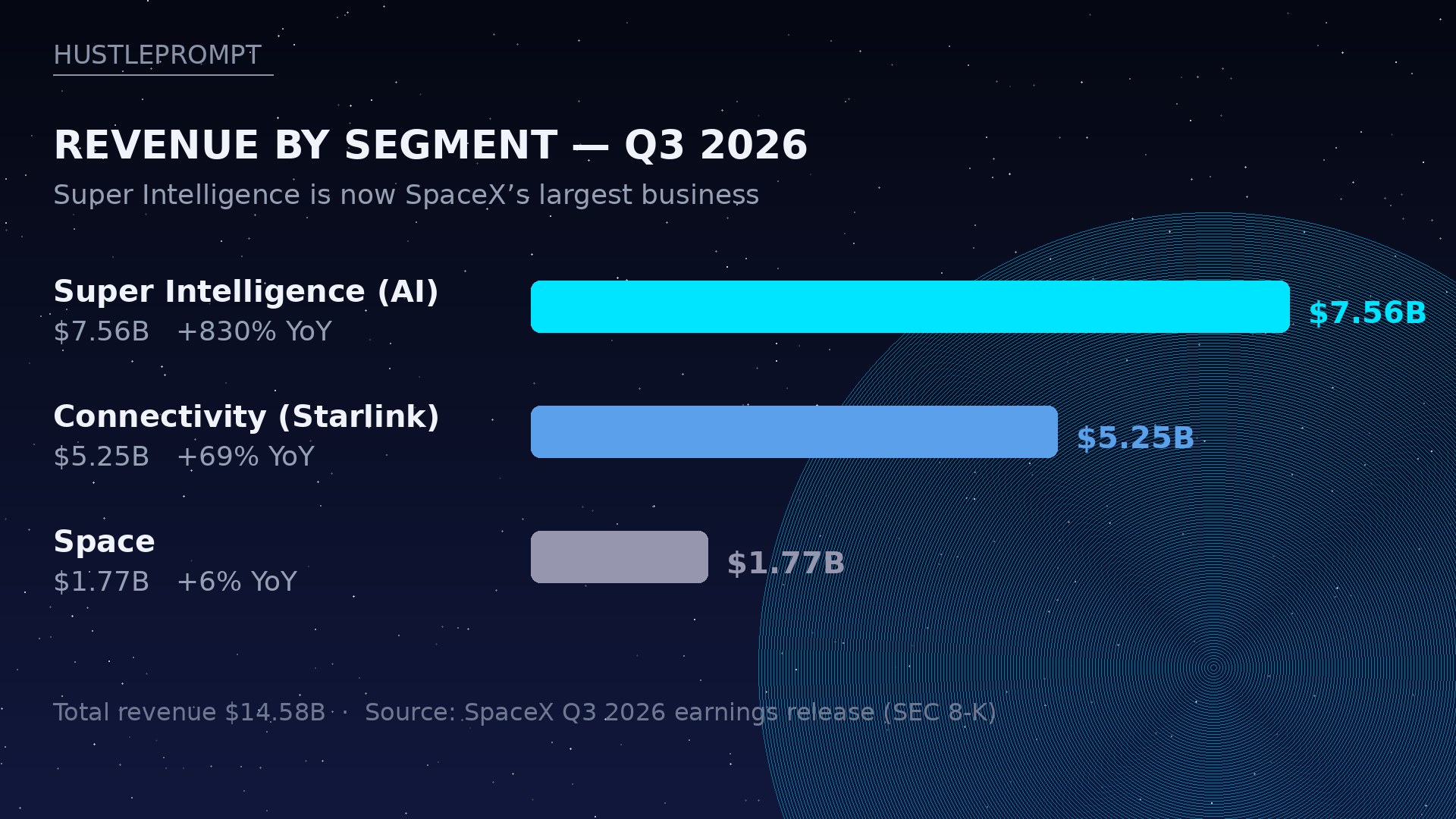
For the first time, SpaceX makes more money from artificial intelligence than from anything else it has ever built. In its SpaceX Q3 earnings report on October 20, the company revealed its Super Intelligence segment — Grok, Grok Bot, Cursor, and rented data-center compute — pulled in $7.56 billion, leaving Starlink’s $5.25 billion in second place.
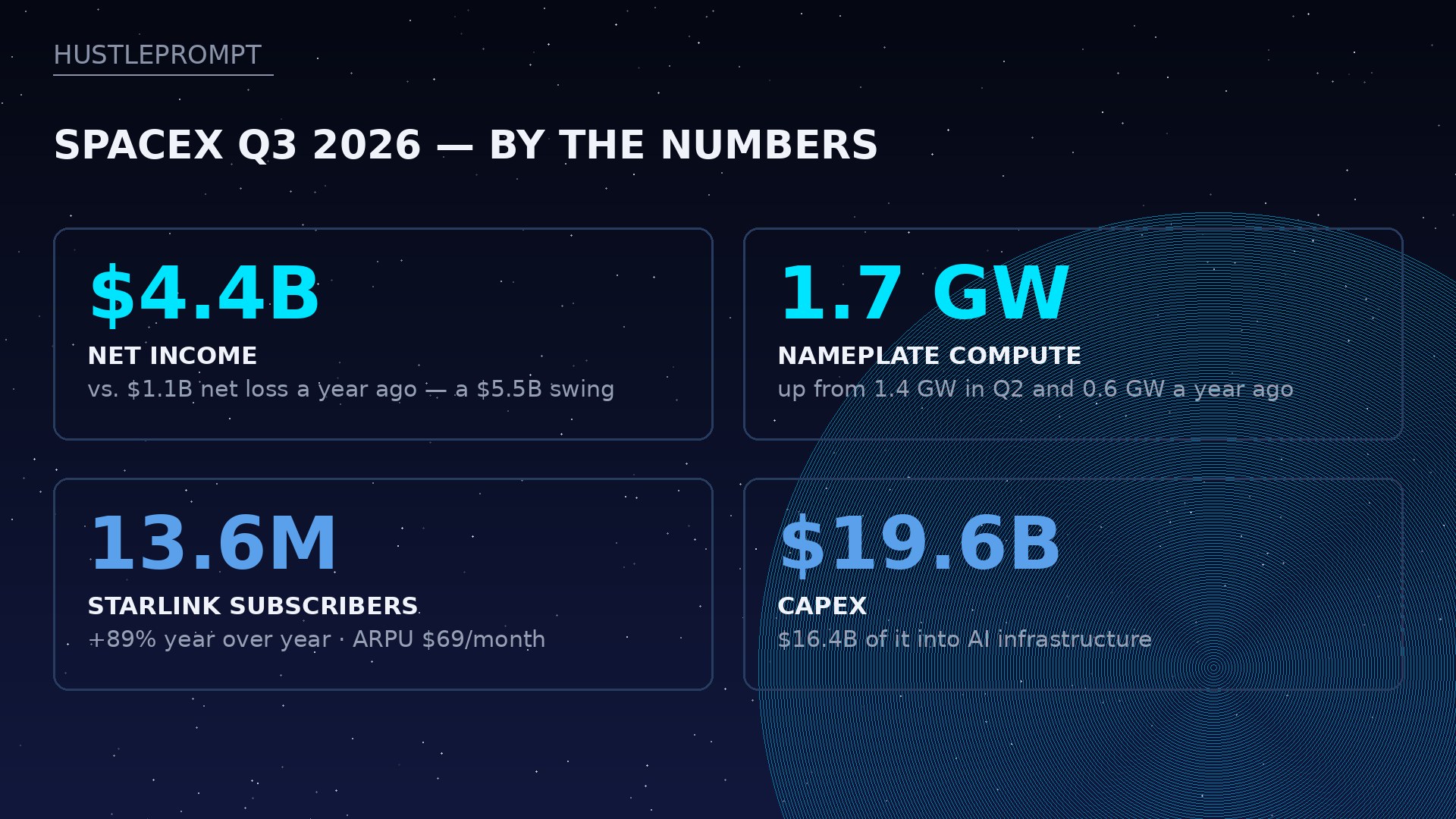
Total revenue hit $14.6 billion (+161% YoY), well ahead of the ~$12.9 billion consensus. Net income: $4.4 billion — a $5.5 billion swing from last year’s $1.1 billion loss. Adjusted EBITDA tripled to $8.8 billion, and diluted EPS of $0.35 more than doubled estimates.
Only SpaceX’s second report since the June IPO (ticker SPCX). Three months ago: a $541 million loss. Now it prints cash.
The headline numbers
Every major line beat expectations, per SpaceX’s official Q3 2026 earnings release, furnished to the SEC on Form 8-K and signed by CFO Bret Johnsen.
- Revenue: $14.575 billion, up 161% from $5.576 billion a year ago
- Net income: $4.404 billion, versus a $1.054 billion net loss
- Income from operations: $2.791 billion, versus a $273 million loss
- Adjusted EBITDA: $8.809 billion, up 306% from $2.169 billion
- Diluted EPS: $0.35, versus a $0.36 loss per share (basic EPS $0.37)
Adjusted EBITDA — earnings before interest, taxes, depreciation, and amortization — is a non-GAAP measure of core operating profitability.
Johnsen’s verdict: “Revenue grew an impressive 161% year-over-year, fueled by continued momentum in Connectivity and a clear inflection in our Super Intelligence business.”
Segment breakdown: AI dethrones Starlink
The segment table tells the story. Super Intelligence is now SpaceX’s largest business — with the best growth on the page.
| Segment | Revenue | YoY | Op. income | Adj. EBITDA | Capex |
|---|---|---|---|---|---|
| Super Intelligence | $7.560B | +830% | $431M | $4.953B | $16.444B |
| Connectivity (Starlink) | $5.248B | +69% | $2.367B | $3.499B | $1.543B |
| Space | $1.767B | +6% | -$7M | $357M | $1.606B |
| Total | $14.575B | +161% | $2.791B | $8.809B | $19.593B |
Source: SpaceX Q3 2026 earnings release (SEC Form 8-K), millions rounded.
Super Intelligence: the clear inflection
SI revenue jumped 830% year over year (195% from Q2) on new cloud agreements, the Cursor acquisition, and rising Grok adoption. The segment posted its first operating profit — $431 million — with adjusted EBITDA of $5.0 billion.
Cursor, acquired August 14 at an implied $60 billion equity value, contributed $608 million of revenue. The quarter also introduced Grok Bot, an always-on agentic SI system.
Starlink keeps compounding
Connectivity revenue rose 69% to $5.248 billion, with 13.6 million subscribers and ARPU of $69 a month. Operating income nearly doubled to $2.367 billion.
Space: Starship’s first paying mission
The Space segment grew 6% to $1.77 billion on 35 launches. The highlight: Starship Flight 14, the first orbital and first revenue-generating Starship flight, delivering 26 Starlink V3 satellites. SpaceX also signed new NASA and national security missions.
The two virtuous cycles
SpaceX now runs on two self-reinforcing loops — and the money flows where they intersect.
Starlink profits: $2.4B →
Funds Starship & constellation ↻
AI capex: $16.4B →
Compute: 1.7 GW nameplate ↻
Nameplate compute = maximum built-and-energized data-center capacity — the ceiling of AI horsepower SpaceX can rent out. Source: SpaceX Q3 2026 earnings release.
What this means if you build with AI
Demand for GPU and data-center capacity is the trade of the decade. Four moves to make now.
1. Sell compute-adjacent services
Anchor compute customers reportedly pay ~$1.25B/month (Anthropic) and ~$920M/month (Google), per TheStreet’s reporting. The scarcest resource is managed capacity — sell workload optimization, GPU brokerage, or inference-cost auditing.
2. Master the Grok and Cursor toolchains
Cursor did $608 million of revenue in six weeks inside SpaceX, and Grok Bot just launched. Early specialists in a fast-growing platform command premium rates — learn both toolchains now.
3. Sell recurring AI retainers, not projects
SI solutions revenue grew $6.7 billion year over year on multi-year cloud agreements. Enterprise AI budgets are recurring — package your services the same way.
4. Watch the capex cycle for entry points
Capex of $19.6 billion still exceeds revenue, and Q4 is guided at $35–40 billion. Heavy spend phases create volatility — buy when the market flinches at the bill.
The other side of the ledger
The risks are real: total costs ran about $11.8 billion, above forecasts, and Q1 2027 revenue guidance of $33–37 billion implies more than doubling this quarter in two quarters. Execution is the story from here.
Still, the market approved: shares rose about 6.5% after hours to $157.47. Track future updates on the SpaceX investor relations site.
Watch: Starship — the holy grail of rocketry
From SpaceX’s official channel: the Starship program, whose Flight 14 was the quarter’s first revenue-generating mission.
Frequently asked questions
What were SpaceX’s Q3 2026 results?
Revenue $14.575B (+161% YoY), net income $4.404B, adjusted EBITDA $8.809B (+306%), diluted EPS $0.35 — all beating consensus.
What is the Super Intelligence segment?
SpaceX’s AI business — the former xAI merged in February: Grok models, Grok Bot, the Cursor coding platform, and rented data-center compute.
How did Starlink perform?
Connectivity revenue +69% to $5.248B; 13.6M subscribers; ARPU of $69/month; operating income nearly doubled to $2.367B.
Is SpaceX profitable now?
Yes — first profitable quarter since the June IPO: $4.4B net income vs. a $1.1B loss a year ago.
What is nameplate compute?
The maximum data-center capacity SpaceX has built and energized — the ceiling of AI horsepower it can rent out. It reached 1.7 GW, up from 0.6 GW a year ago.
What guidance did SpaceX give?
On the webcast, the CFO guided Q4 capex of $35–40 billion and Q1 2027 revenue of $33–37 billion, per webcast coverage. The written release gave no numeric guidance.