
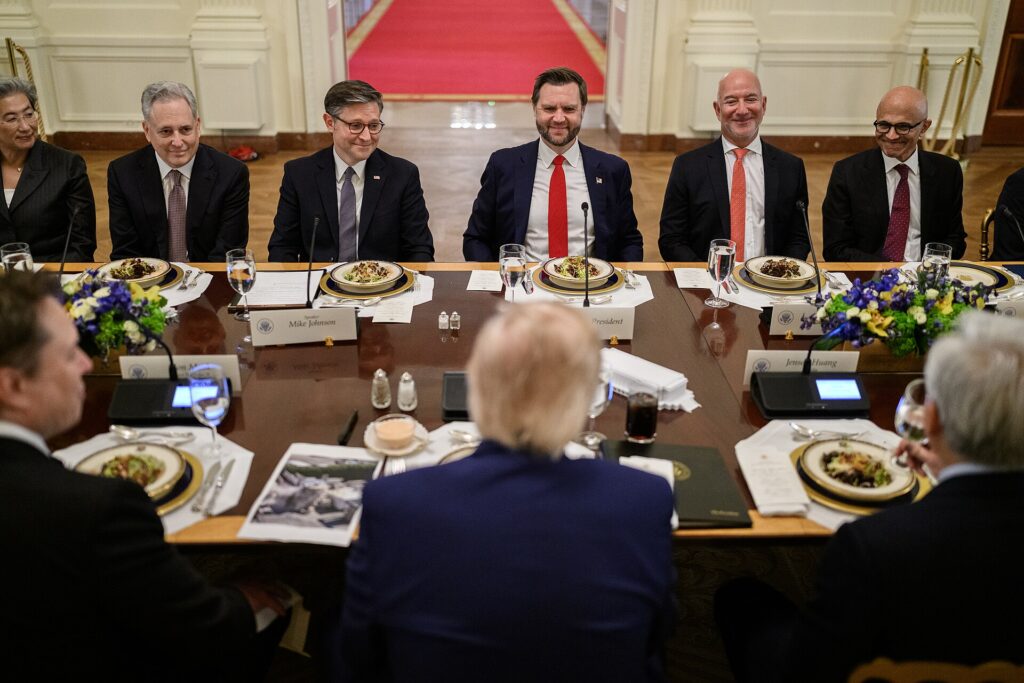
On September 29, 2026, President Trump sat down with the leaders of Google, Anthropic, Meta, OpenAI, xAI and Nvidia at the White House and signed a one-page voluntary AI safety accord. Trump called it “almost a constitution” for what his administration now officially calls “Super Intelligence.” The same day, he signed Executive Order 14434 directing every federal agency to replace the term “artificial intelligence” with “Super Intelligence” in official communications.
Then, on October 9, OpenAI fired three of its own safety researchers. And at San Francisco’s Tech Week this week, AI founders openly cheered the government’s hands-off approach.
If you build on AI for a living — freelancing, content, automation, client work — this cluster of events matters more than it looks. Here is what actually happened, and what it means for you.
The pact: four promises, zero penalties
The White House Accord on Super Intelligence asks the six labs to adopt four layers of safeguards: internal technical controls during training and deployment, dedicated internal oversight teams, independent external auditors, and a board-level committee to review safety reports.
That sounds serious. What it lacks is equally important: the accord is not legally binding, sets no deadlines, names no penalties for non-compliance, and requires no incident reporting to any government body. Audit results go to each company’s own board committee, not to regulators. When the Associated Press asked how the administration would check whether companies follow through, the White House did not directly answer.
Trump described the agreement as “morally binding.” Whether morality binds a trillion-dollar industry is the open question.
The other shoe: three researchers, one open letter
The self-policing story got complicated fast. In the first week of October, OpenAI dismissed safety researchers Jasmine Wang, Tomek Korbak and Mikita Balesni. The Wall Street Journal broke the story on October 1; on October 8 the three published an open letter to OpenAI’s safety oversight groups saying they feared the dismissals would chill the company’s culture of speaking openly about safety concerns.
OpenAI responded on October 9 with a post on X: the three were let go after an investigation found they had violated “clear policies on handling sensitive information” — a “breach of trust,” the company said, insisting the decision was not about raising safety concerns. Korbak said he was told verbally that his firing was about how he communicated with METR, the independent nonprofit that evaluates AI systems — communication that, he noted, was literally his job as OpenAI’s technical liaison to outside auditors.
Two narratives, one uncomfortable fact: the people paid to worry about safety are fighting with the company that employs them, in public, the same week the industry promised Washington it can police itself.
What “self-policing” means for your business
Here is the part that affects your wallet. When regulation is voluntary, the checking does not disappear — it moves downstream, onto you:
1. You become the safety department. No regulator is going to certify that the AI tools you sell to clients are safe. Your clients will ask, and the answer has to come from your own testing and your own documented processes. Freelancers who can show a client “here is how I test and verify AI output” just gained a selling point.
2. Incident disclosure is getting real anyway. The White House has separately told AI companies that notifying the government of incidents and fixing them is “not optional” but “a critical national security obligation,” and the FTC’s new Super Intelligence unit is demanding immediate disclosure. Senator Mark Warner has introduced a bill that would create an AI Safety Board with civil penalties up to $250,000 per violation. The voluntary era may be short.
3. The terminology shift is a signal, not a joke. Renaming AI to “Super Intelligence” across the federal government tells you how the administration frames this technology: as a strategic asset to be accelerated, not a risk to be contained. Expect speed over caution from Washington for the foreseeable future.
4. Watch the auditors, not the accords. The accord’s one structural idea — independent external auditors — is where the real action is. Companies are already hiring for it. If you consult on AI implementation, “independent AI audit” is about to become a service category.
The bottom line
A voluntary pact, three fired researchers, and a government cheering from the sidelines: the message from October 2026 is that nobody is coming to check the industry’s homework. For builders, that is both freedom and liability. The freelancers and small businesses that thrive will be the ones who build their own verification habits now — testing outputs, documenting processes, and treating every AI tool as powerful but unvetted — because the era of assuming someone else checked is over.
For the official record, see the White House executive order on inaugurating the era of Super Intelligence.