
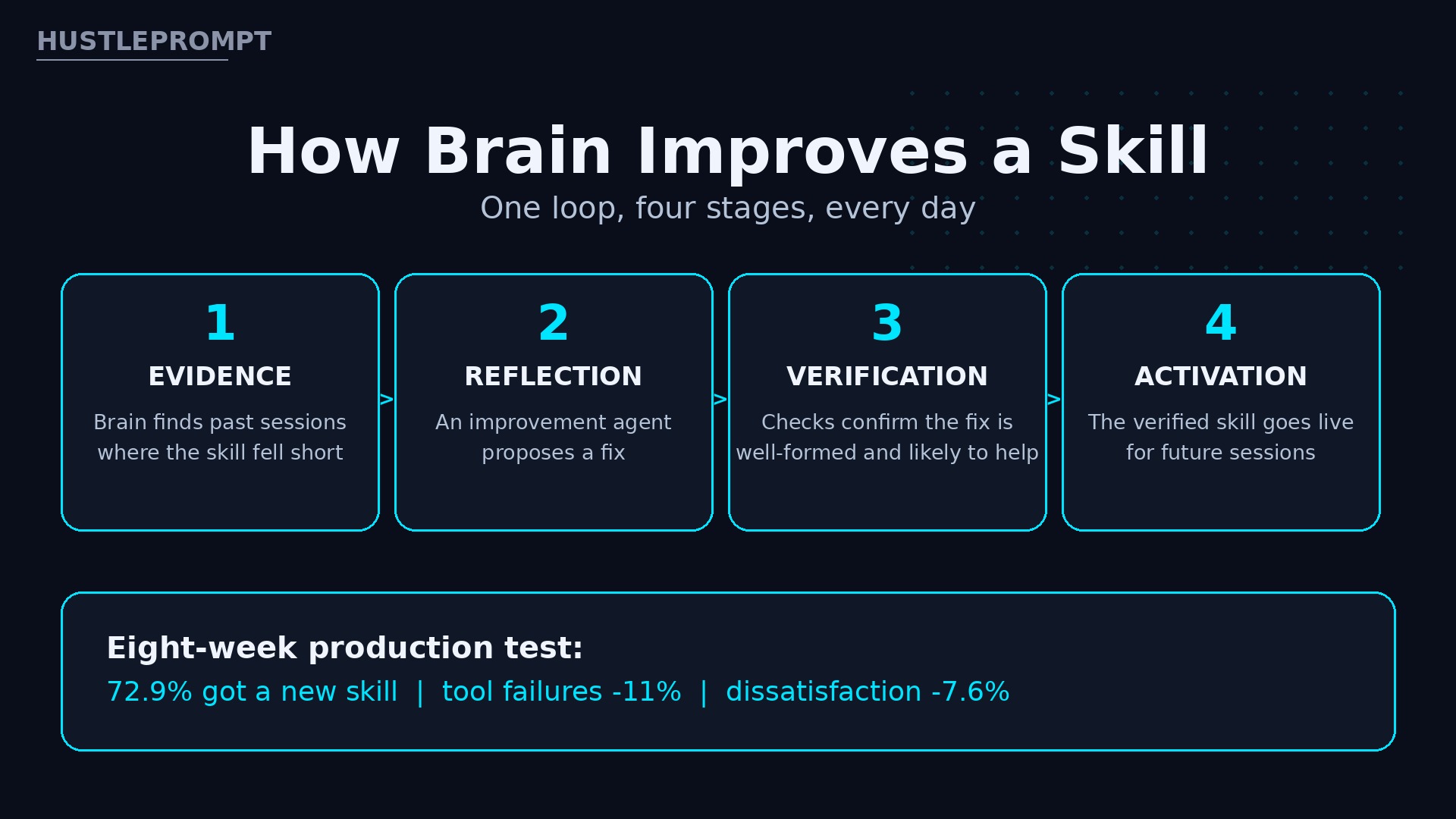
Your AI assistant just stopped forgetting how you like things done. On November 18, 2026, Perplexity Computer Brain gained the ability to write and update its own skills, reusable instructions that capture exactly how you do recurring work. In an eight-week production test, 72.9% of users with the feature on received at least one new personal skill, against 6.5% who had to add one by hand. Tool calls failed 11% less often.
That is the number that matters if you bill by the hour. A computer agent that learns your procedures is not a smarter chatbot. It is a coworker that needs less supervision every week, which is the closest thing to hiring help without hiring anyone.
What Perplexity just shipped
Brain is the self-improvement system inside Perplexity Computer, the agent that plans and runs multi-step work in your browser and files. Until now, Brain kept a knowledge wiki of what you did and what you corrected. The November update extends it to skills: step-by-step instructions for recurring tasks, including scripts for procedures that can be expressed in code.
There are two kinds, and the distinction matters. Personal skills are built from your memory and session history, and they belong to you alone. Built-in skills ship to every Perplexity user, so their updates face a much stricter bar. Do not confuse this with the Monitor and Context APIs announced the same week. Those are developer tools for watching the web. This is the Computer agent learning your workflows.

Personal skill improvement is now available to all US Max subscribers. It is on by default for eligible users, and you can turn it off. The Plugins tab shows your skills, marks the ones Brain wrote, and lets you choose which stay enabled.
The four-stage loop that rewrites the instructions
Every improvement runs through the same four-stage loop. First, Brain gathers evidence, finding past sessions where a skill was used, especially ones where it fell short. Then an improvement agent studies that evidence and proposes an update. Checks confirm the proposal is well-formed and likely to help. Finally, the verified change goes live for future sessions.
The loop is deliberately conservative. Creating a skill needs two independent occurrences of the same reusable behavior. Updating one needs a single grounded occurrence. The improvement agent cannot edit a skill directly. It writes a proposal, and if the evidence does not support a change, it abstains. A skill that changes on weak evidence would make the agent worse.
Built-in skills get even more protection. Updates use sanitized evidence from sessions eligible for training, with credentials, secrets, and attached files stripped out. A weekly revision job looks only for failures that recur across many sessions. Candidates must pass paired replay tests, then an engineer must approve the change.
Personal skills vs. built-in skills
YOUR PERSONAL SKILLS
- Built from your memory and sessions
- New skill: 2 independent occurrences
- Update: 1 grounded occurrence
- Cap: 10 auto-created skills per user
- Activates automatically once verified
- US Max subscribers, on by default
BUILT-IN SKILLS (EVERYONE)
- Built from aggregate patterns
- Sanitized evidence, secrets stripped
- Weekly revision job, recurring failures only
- Must pass paired replay tests
- Human engineer must approve the change
- One bad session cannot rewrite a skill
The numbers: what the eight-week test actually proved
The headline numbers come from an eight-week randomized test on production traffic, not a demo. Perplexity compared users with automatic skill improvement enabled against a control group with it disabled. The gap is hard to argue with: 72.9% of the enabled group got at least one new personal skill, while only 6.5% of the control group added one manually.
Adoption turned into use. More than half of the enabled group, 53%, had a personal skill loaded in a conversation they started, against 13% of controls. Their turns loaded a personal skill about 3.6 times as often. Among customers who received a Brain-written skill, 63% used one again in a later conversation within four weeks. People did not just collect skills. They kept using them.
| Result (eight-week production test) | Skill improvement on | Control group |
|---|---|---|
| Users who got at least one new personal skill | 72.9% | 6.5% |
| Users with a personal skill loaded in a conversation | 53% | 13% |
| How often turns loaded a personal skill | About 3.6x | Baseline |
| Tool call failure rate | 11% lower | Baseline |
| User dissatisfaction (medium/high threads per user) | 7.6% lower | Baseline |
| Repeat use within four weeks | 63% of skill recipients | Not reported |
Source: Perplexity, Self-improving skills.
Brain already had the receipts
Self-improving skills are the second act of a system Perplexity has tested since June 18, 2026, when Brain launched as a research preview. In an internal evaluation of 640 questions across 44 synthetic personas, Brain lifted answer correctness from 0.600 to 0.661, a gain of 6.1 percentage points, and evidence recall by 5.2 points. Over a 30-day paired evaluation, Brain-enabled sessions beat the control on every run and every judged dimension, while using about 15% fewer tokens, costing 10% less, and finishing 10% faster. In SkillLearnBench, task success rose from 43.8% without generated skills to 62.5% with them.

| Evaluation | Result | Source |
|---|---|---|
| Brain offline test, 640 questions, 44 personas | Correctness 0.600 to 0.661 (+6.1 points); recall +5.2 points | Perplexity Brain blog |
| 30-day paired production evaluation | Correctness +9.3, currentness +8.0, recall +8.9 points | Perplexity Brain blog |
| Same 30-day evaluation, efficiency | About 15% fewer tokens, 10% lower cost, 10% faster | Perplexity Brain blog |
| SkillLearnBench offline test | Task success 43.8% to 62.5% with generated skills | Perplexity skills blog |
| Built-in ecommerce skill case study | 6% quality increase at 32% lower cost | Perplexity skills blog |
| Skills written, Aug 1 to Nov 14, 2026 | 80,000+ skills for 20,000+ users | Perplexity skills blog |
| Automatic skill updates, Sep 4 to Nov 14, 2026 | 100,000+ updates to 30,000+ skills | Perplexity skills blog |
Sources: Perplexity, Self-improving skills and Brain: Agentic Memory as a Knowledge Wiki.
How to profit from a coworker that trains itself
Here is how to turn this into billable hours. Pick three workflows you repeat every week: a client report, an invoice reconciliation, a research brief. Run each one through Computer twice, correcting it the same way both times. That repetition is what Brain needs. Two independent occurrences trigger a new personal skill.
- Pick three repeatable workflows. Client reports, invoice reconciliation, research briefs, social captions, meeting follow-ups. If you do it weekly, it qualifies.
- Run each one twice, correcting it the same way. Two independent occurrences are what Brain needs to write a new personal skill.
- Audit the Plugins tab. Keep the skills that match how you work. Disable the ones that do not. A tidy library of ten good skills beats fifty noisy ones.
- Feed it your templates once. House style, file formats, naming rules. Stop re-explaining them in every session.
- Sell the saved time. A shorter session is a slot for another client. Price the output, not the hours you used to spend on it.
Then check the Plugins tab. Keep the skills that match how you work and disable the rest. Feed the agent your templates and house style once, and stop re-explaining them in every session. The payoff compounds: each corrected session makes the next one shorter, and shorter sessions mean more client work fits in the same day. Small teams can go further by standardizing a workflow first, then letting Brain encode it for everyone.
Computer Brain vs. hiring a virtual assistant
The obvious comparison is hiring a virtual assistant. Upwork’s own rate guide puts freelance virtual assistants at a typical $10 to $20 an hour, with a $13 median and an average of $18 to $35 an hour depending on skills and experience. Do the math on ten hours a week at $15 an hour, and a human VA costs about $650 a month. Perplexity Max, the plan that includes this feature, costs $200 a month. The agent is not a replacement for a person. It cannot join a client call, negotiate, or exercise judgment. But for repeatable digital work, it now trains itself for a third of the price of the cheapest human help, and it never quits or forgets.
| Perplexity Computer Brain (Max) | Freelance virtual assistant | |
|---|---|---|
| Monthly cost | $200 (Max plan) | About $650 for 10 hrs/week at $15/hr |
| Typical hourly rate | Flat subscription, 10,000 Computer credits included | $10 to $20 typical; $13 median (Upwork) |
| Training | Learns from your sessions automatically | You train, brief, and manage them |
| Availability | 24/7, no sick days | Set hours, needs time off |
| Judgment calls | None: follows skills and instructions | Yes: negotiates, decides, pushes back |
| Best for | Repeatable digital workflows | Client calls, judgment, relationships |
Sources: Perplexity Help Center (Perplexity Max costs $200/monthly or $2,000/annually); Upwork, Virtual Assistant Hourly Rates. VA monthly figure is our math: 10 hours a week at $15 an hour.
The catches to know before you pay
- Ten-skill cap. Brain keeps at most ten automatically created skills per user. To add one at capacity, it must retire another and justify the swap.
- US Max only, for now. Personal skill improvement is available to US Max subscribers. Expansion to user-authored, project-shared, and organization skills is planned.
- On by default. The feature is enabled automatically for eligible users. If you do not want Brain writing skills from your sessions, turn it off in settings.
- No speed gain measured. Perplexity found no measurable change in cost or response time. This is a reliability upgrade, not a faster one.
- Built-in changes stay human-gated. Skills that ship to everyone need paired replay tests and an engineer’s approval. Your personal skills do not.
There are limits worth knowing before you pay. Brain caps automatically created skills at ten per user, and at capacity it must retire one and justify the swap. Personal skill improvement is limited to US Max subscribers for now. Perplexity also measured no change in cost or response time, so this is a reliability upgrade, not a speed upgrade. And the 11% drop in tool failures covers all Computer activity, including background runs. Excluding those, the drop is about 7%.
Perplexity’s official video introduces Brain, the self-improvement system behind this update. It covers Brain’s memory layer rather than the November 18 skills announcement specifically.
Frequently asked questions
What are Perplexity Computer Brain self-improving skills?
They are reusable instructions that Brain writes and updates from your session history, so Computer follows your procedures for recurring tasks without being told again. Brain creates them from your past work and refines them when a skill falls short.
When did Perplexity launch self-improving skills?
Perplexity announced the feature on November 18, 2026. It extends Brain, the self-improvement system that launched as a research preview on June 18, 2026, from memory alone to memory plus skills.
How much does it cost to use self-improving skills?
The feature is included for US Max subscribers. Perplexity Max costs $200 a month or $2,000 a year, according to Perplexity’s Help Center, and includes 10,000 monthly Computer credits.
How does Brain decide to write a new skill?
A new personal skill needs two independent occurrences of the same reusable behavior. An update to an existing skill needs one grounded occurrence. The improvement agent proposes changes, checks verify them, and only then does the skill go live.
Is there a limit on how many skills Brain can create?
Yes. Brain keeps at most ten automatically created skills per user. At capacity it must retire an existing skill and justify why the replacement is more useful.
Can I turn off automatic skill improvement?
Yes. The feature is on by default for eligible US Max subscribers, but you can turn it off. The Plugins tab shows your skills, marks the ones Brain authored, and lets you enable or disable each one.
Is this the same as the Monitor and Context APIs?
No. Monitor and Context are developer APIs Perplexity announced the same week for watching the web and feeding content to agents. Self-improving skills are a Computer agent feature that learns your personal workflows.
Keep Reading
- Perplexity Monitor and Context APIs Watch the Web
- Perplexity Orchestrator Puts 45+ AI Models on One Key
- Perplexity Teammates Hit Mac: AI Coworkers for $200 a Month