
Perplexity Orchestrator is the closest thing the AI industry has to a universal remote. Launched on November 17, 2026, it puts more than 45 frontier and open-weight models — GPT, Claude, Gemini, Grok, GLM, Kimi and DeepSeek — behind one API key, one base URL and one bill.
The pitch is simple. Until now, a developer who wanted the best model for each job needed an account with OpenAI, another with Anthropic, another with Google, another with xAI, plus contracts, keys, invoices and rate limits for each one. Orchestrator collapses all of that into a single Perplexity API key. You pick the model, Perplexity picks the deployment, and if that deployment fails, the request retries on another deployment of the same model.
For freelancers and small dev shops, that is a cost and reliability story, not a convenience feature. One bill means one budget line to show a client. Failover means a provider outage stops being your outage. And the perplexity/auto preview can send cheap jobs to cheap models and hard jobs to flagship models without you writing the logic. Here is what launched, what it costs, and how to use it to make money.

What Perplexity Orchestrator actually is
Orchestrator is a model gateway: the same layer Perplexity runs in production every day — the company says it routes hundreds of millions of requests across more than 85 models and more than a dozen providers — now opened to outside developers.
It is not a search API and it is not an agent. Orchestrator is for direct model access with your own prompts and tools. Web-grounded answers with built-in citations are the Agent API; ranked web results to feed a model you already run are the Search API. Orchestrator does one job: give you the model, reliably, and bill you for it.
“Today we’re launching the Perplexity Orchestrator API, making our model-agnostic technology available to developers and teams building AI applications. Through one API, teams can run simple, high-volume tasks on lower-cost models and reserve more powerful models for more demanding work.”
— Perplexity, “Orchestrator: One API for frontier and open-weight models,” November 17, 2026
One report dates the private preview to November 9, 2026; the public launch landed eight days later, on November 17.
One key, 45 models: what is in the catalog
The launch catalog lists 45 models across seven provider families — counted from the official models page, matching the company’s “45+” wording. Every model works in all three request formats and carries the same prefixed ID style, such as openai/gpt-6-luna or perplexity/glm-5.3.
| Provider family | Models in catalog | Example model | Minimum tier |
|---|---|---|---|
| Anthropic | 15 | Claude Opus 5.5, Claude Sonnet 5.5, Claude Fable 5.2 | Tier 1 (Opus 5/5.5 and Fable: Tier 2) |
| OpenAI | 18 | GPT-6.1 Sol, GPT-6 Luna, GPT-5.6 Sol | Tier 1 |
| 5 | Gemini 3.8 Flash, Gemini 3.5 Flash-Lite | Tier 0 (every tier) | |
| xAI | 3 | Grok 4.7, Grok 4.6, Grok 4.5 | Tier 0 (every tier) |
| Z.AI | 2 | GLM-5.3, GLM-5.3 Flash | Tier 0 (every tier) |
| DeepSeek | 1 | DeepSeek V4 Pro | Tier 0 (every tier) |
| Moonshot AI | 1 | Kimi K3 | Tier 0 (every tier) |
| Total | 45 | — | — |
Check the tier rules before you promise a client a model. Google, xAI and open-weight models work at every tier, including Tier 0. OpenAI and Anthropic models need Tier 1 or higher; Claude Opus 5, Opus 5.5 and the Fable models need Tier 2. Ask for a model above your tier and the API answers HTTP 402; zero-data-retention organizations calling Fable get HTTP 403. Context windows reach 1,000,000 tokens on Claude and GLM models and 1,050,000 on the GPT-6 family.
Same-model failover: the reliability pitch
The feature that separates Orchestrator from a plain model list is failover — and the key word is same-model. After you pick a model, Perplexity distributes traffic across deployments using observed error rates, capacity and latency. If a request fails, it retries on another deployment of the same model: a Claude request can move from Anthropic to AWS Bedrock and still be a Claude request, at the same rate.
That distinction is the whole product: switching models mid-task changes the answer, switching deployments does not. Perplexity’s blog notes that for teams running millions of requests a day, even the gap between 99.0% and 99.99% success can affect thousands of responses.
| What happens | Orchestrator’s response | What you pay |
|---|---|---|
| Provider error, rate limit or timeout | Retry on another deployment of the same model | Billed at the requested model’s rate |
| Request fails before producing output | Retried across deployments | Not billed |
| Stream fails after output begins | Partial response delivered | Billed for tokens already delivered |
| Invalid request or context-window overrun | HTTP 400, no retry | Not billed (no output produced) |
| Every deployment exhausted | HTTP 429, Retry-After header | Not billed |
Perplexity reports — this is the company’s own measurement, not an independent benchmark — that Claude and GPT requests sent through Orchestrator between October 4 and November 2, 2026 succeeded more often than requests to any individual provider it measured, with smaller daily swings during provider incidents. One detail matters for speed-sensitive work: over the same 30 days, Azure’s median GPT-5.6 Sol output speed was 27% higher than OpenAI’s. Speed-aware provider selection is still in development.
Watch: Perplexity Academy explains Computer, the multi-model agent built on the orchestration layer that Orchestrator now opens to developers.
SEND → ROUTE → SERVE → BILL
1. SEND
One Perplexity API key, one base URL, any model ID. Your existing OpenAI or Anthropic SDK works unchanged.
2. ROUTE
Pin a model, or set perplexity/auto and let a decision model pick one per request.
3. SERVE
Perplexity picks the healthiest deployment; a failure retries on another of the same model.
4. BILL
One consolidated bill at the published rate of the model that answered — never a platform fee on top.
perplexity/auto: the preview that picks your model
Failover chooses the deployment; the optional perplexity/auto preview chooses the model. Set the model to perplexity/auto and pass a routing object: a decision model reads the conversation and your plain-language route descriptions — not the route names or model IDs — and picks the route that fits. A default model serves when no route fits.
The quickstart shows it working: a debugging request matched a hard_debugging route and was served by openai/gpt-6.1-sol, with headers reporting a confidence of 0.889. Unmatched requests fall back to the default — in the docs example, perplexity/glm-5.3-flash. Start from a built-in Lower cost, Balanced or Higher quality profile, or build a custom one with one to five task routes.
Three warnings belong here. First, routing happens independently for each request, so turns within one conversation can use different models — and each model keeps a separate prompt cache, so costs can shift between turns. Second, the default model serves when the decision model fails or times out, or when the conversation includes images, audio, video or files. Third, the tier rule still applies: the default policy needs Tier 1 or higher, and naming a model your tier cannot use returns HTTP 400. A second preview, Auto effort, adjusts how much reasoning a supported model uses on its next turn according to a policy you define.
What it costs: real prices from the catalog
Orchestrator is pay-as-you-go at the published per-token rates, with no additional platform fee on top of credits. Usage draws from the same prepaid credits as the rest of a Perplexity API project, and the console breaks spend down by model, project, API key and date, with spend caps and model allowlists.
| Model | Input ($ / 1M tokens) | Output ($ / 1M tokens) | Minimum tier |
|---|---|---|---|
| GLM-5.3 Flash | $0.15 | $0.50 | Tier 0 |
| GPT-6 Luna (up to 272k input) | $0.10 | $0.50 | Tier 1 |
| Claude Haiku 5.5 (up to 100k input) | $0.10 | $0.50 | Tier 1 |
| Gemini 3.8 Flash | $0.75 | $3.75 | Tier 0 |
| DeepSeek V4 Pro | $1.32 | $3.96 | Tier 0 |
| Claude Sonnet 5.5 | $2.00 | $10.00 | Tier 1 |
| GPT-6.1 Sol (up to 272k input) | $2.00 | $10.00 | Tier 1 |
| Claude Opus 5.5 | $4.00 | $20.00 | Tier 2 |
| Claude Fable 5.2 | $8.00 | $40.00 | Tier 2 |
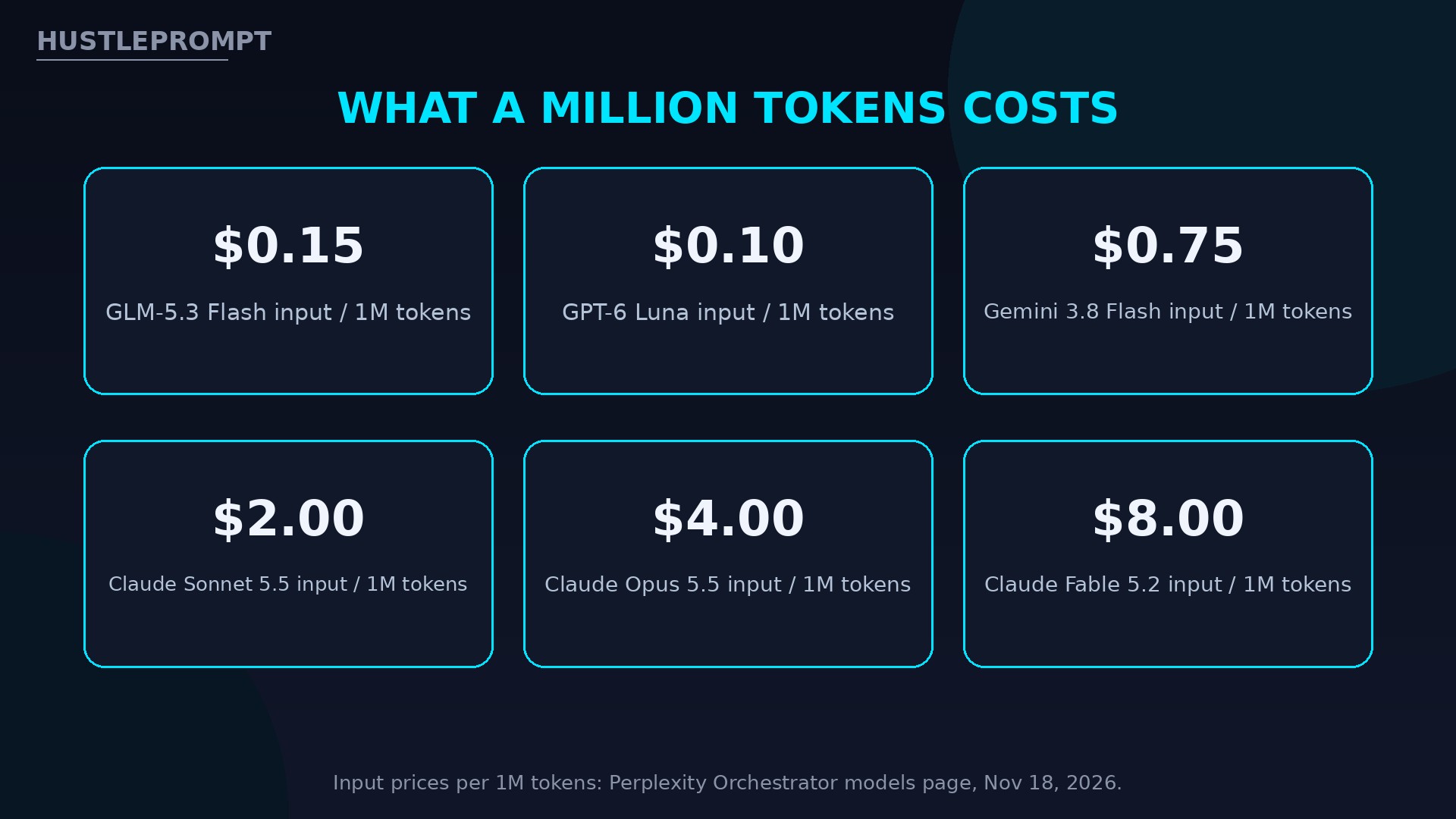
The spread is the business case. GPT-6 Luna or Claude Haiku 5.5 at $0.10 per million input tokens costs one-eightieth of Claude Fable 5.2’s $8.00. A shop that routes classification, extraction and summarization to a $0.10 model and reserves the $8.00 model for the one step that needs it can cut a client’s token bill by an order of magnitude. Cache reads are cheaper still — $0.03 per million on GLM-5.3 Flash. Watch the stepped rates: several models get more expensive above a context threshold.
How to switch in an afternoon
Migration is deliberately boring: change the base URL and the API key, and use the model’s full ID from the catalog.
- Create an API key in the Perplexity API Console. Your existing Perplexity API key works — there is no new credential to manage. Use separate keys per project so spend breaks down by key.
- Point your SDK at the Orchestrator base URL. Set it to https://api.perplexity.ai/orchestrator/v1 in your existing OpenAI or Anthropic SDK. No new library is required.
- Swap the model ID. Use the full catalog ID, such as openai/gpt-6-luna or perplexity/glm-5.3. Switching models later is a one-line change.
- Check your tier before you promise a model. List the models your organization can call with a GET request to the models endpoint. Tier 0 covers Google, xAI and open-weight models only.
- Send the full conversation every time. The API is stateless, so fields that depend on server-side state return an error. Include the full conversation in each request — each model keeps a separate prompt cache.
How freelancers and small shops can profit
The gateway is a commodity. The money is in what you build on top of it:
- Sell the migration. Every small business with a chatbot wired to a single provider is one outage away from a bad day. Offer a fixed-price switch to Orchestrator: same model, same prompts, one bill, failover included. The work is an afternoon; the pitch is uptime.
- Sell the routing audit. Most teams run every request on the flagship model they started with. Audit a client’s last month of traffic, move the routine 80% to a $0.10–$0.15 input model, and keep the flagship for the hard 20%. Charge a share of the savings — the before-and-after bill is the proof.
- Productize one workflow. Build a single-purpose tool — contract summarizer, support-triage inbox, lead-enrichment pipeline — where each step calls the cheapest model that can do it well. Your margin is the gap between the flagship rate the client expects and the blended rate you pay.
- Sell fallback as a feature. Client-facing apps that die when one provider dies lose trust. Ship with same-model failover and put it on the sales page: your app stays up when a provider goes down.
- Resell reliability, not tokens. Price client work per completed job or per month, not per token. Your costs fall every time Perplexity adds a cheaper model to the catalog; your price does not have to.
What Orchestrator does not do
Four honest limits:
- It is stateless. Every request must carry the full conversation. There is no server-side memory and no thread to resume. Your app owns the history.
- Routing is a preview. perplexity/auto can change the model — and the cost — between turns of one conversation.
- Failover has edges. Bad requests and context-window overruns return HTTP 400 with no retry. If every deployment is exhausted you get HTTP 429. And if a stream fails after output begins, you pay for the tokens already delivered.
- Tiers gate the good stuff. The cheapest tier cannot call OpenAI or Anthropic models at all, and the top Claude models need Tier 2. A demo that works on Tier 0 breaks the moment a client asks for Opus or Fable.
What to watch
- Whether routing graduates from preview. If perplexity/auto becomes stable, small teams can sell “right model, right price” without building routing themselves. If it stays a preview, the gateway is mostly a failover and billing story.
- How fast the catalog grows. The production layer already covers 85+ models; the public catalog lists 45. Each new model that lands without a new contract is a reason to stay.
- What the reliability numbers look like in six months. The October–November comparison is Perplexity’s own measurement. One real provider outage routed through Orchestrator will be the test that matters.
Models are becoming a commodity, and commodities need a distributor. Perplexity spent years building the routing layer that lets its own products use the best model for each job. Now it is renting that layer out, one API key at a time, with no platform fee. Your client gets GPT, Claude, Gemini and Grok, and you get one bill and one less 3 a.m. page.
Frequently asked questions
What is Perplexity Orchestrator?
It is an API launched on November 17, 2026 that gives developers access to more than 45 frontier and open-weight models — from OpenAI, Anthropic, Google, xAI, Z.AI, DeepSeek and Moonshot AI — through one API key, one base URL and consolidated billing, with automatic same-model failover.
How much does Perplexity Orchestrator cost?
There is no additional platform fee on top of credits. You pay the published per-token rate of the model that answered, from $0.10 per million input tokens up to $8.00 per million for Claude Fable 5.2.
Which models can I use at Tier 0?
Google, xAI and open-weight models work at every tier, including Tier 0 — for example Gemini 3.8 Flash, Grok 4.7, GLM-5.3 Flash, DeepSeek V4 Pro and Kimi K3. OpenAI and Anthropic models need Tier 1 or higher, and Claude Opus 5, Opus 5.5 and the Fable models need Tier 2 or higher.
What is perplexity/auto routing?
It is a preview feature that lets a decision model pick the model for each request. You define up to five plain-language routes plus a default model, or start from a built-in Lower cost, Balanced or Higher quality profile. You are billed at the rate of the model that answered.
What happens if a provider goes down?
Orchestrator retries on another deployment of the same model — a Claude request can move from Anthropic to AWS Bedrock — without changing the model or its rate. Requests that fail before producing output are not billed.
Do I need a new API key or SDK?
No. Use your existing Perplexity API key and your existing OpenAI or Anthropic SDK, pointed at https://api.perplexity.ai/orchestrator/v1, with the model’s full catalog ID such as openai/gpt-6-luna. The API is stateless, so each request must include the full conversation.
Keep Reading
Sources: Perplexity, “Orchestrator: One API for frontier and open-weight models” (Nov 17, 2026); Perplexity Docs, Orchestrator API quickstart; Perplexity Docs, Orchestrator models and pricing; Perplexity community announcement (Nov 17, 2026).