
OpenAI Private Inference is now being tested with a small group of business customers, CEO Sam Altman announced on November 25, 2026. The feature runs your prompts on sealed-off hardware that even OpenAI cannot read — a first for the company’s frontier models.
Privacy, not capability, is the wall keeping frontier AI out of the most valuable work. Hospitals, law firms, and banks all share one objection: they cannot send confidential data to a cloud provider that can read it.
What Private Inference actually does
Today, a prompt sent to OpenAI’s API is processed on its own servers. Business terms already say it does not train on business data, and Zero Data Retention means it keeps no prompts or replies afterward. But while the model is working, the data is visible to OpenAI’s systems.
Private Inference closes that gap with confidential computing: data stays encrypted even while the processor works on it, inside isolated chips whose security can be independently verified. OpenAI’s page puts it plainly: Private Inference “combines confidential computing with strict controls designed to protect your prompts and responses while the model processes them.”
Listed as Alpha on OpenAI’s Private Intelligence page, it is the second leg of Private Intelligence, the bundle OpenAI revealed at DevDay on September 29, 2026, with a preview promised for fall 2026. Altman’s post is the first confirmation that real customers are testing it.

What Altman said
“Stronger privacy protections will make frontier AI useful for a lot more work, and business privacy is important for a healthy ecosystem.”
— Sam Altman, OpenAI CEO, announcing the Private Inference pilot on X, November 25, 2026
The three layers of Private Intelligence
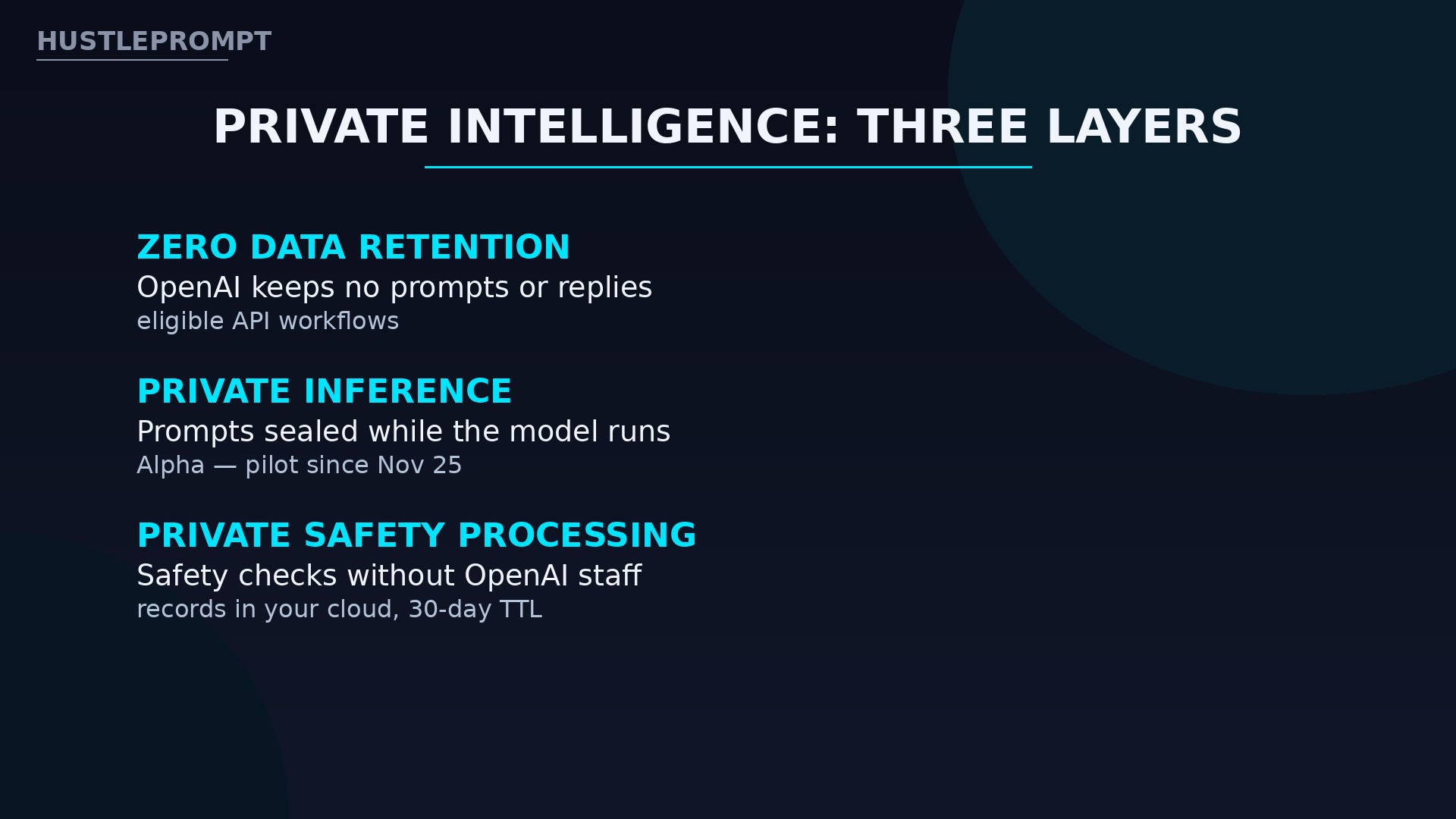
Private Inference does not stand alone. It is one of three protections covering a prompt at three moments: while it is processed, after it is processed, and when it is checked for abuse.
| Protection | What it does | Status |
|---|---|---|
| Private Inference | Seals prompts and replies with confidential computing while the model runs | Alpha — pilot since Nov 25, 2026 |
| Zero Data Retention | OpenAI keeps no prompts or model replies after processing | Available for eligible API workflows |
| Private Safety Processing | Safety reviews without OpenAI staff seeing content; flagged records encrypted into customer-controlled storage, 30-day TTL | Available for relevant API customers |
The safety layer is the detail most people miss. Flagged content is encrypted into customer-controlled cloud storage — S3, Azure Blob, Google Cloud, or Oracle Cloud. The review runs inside a hardware-attested Safety Review Runtime with human access disabled, and OpenAI keeps only an index of operational metadata.
How a sealed prompt travels
Nothing about the developer experience changes except who can see the data.
The money angle: the work AI could not touch
Every regulated industry has data it legally cannot hand to a vendor that reads it: patient records, client files, deal documents, trade secrets. Until now, those companies kept frontier AI out or built expensive local infrastructure.
Private Inference lets OpenAI sell its best models into that work — and the first vendor that credibly promises “we cannot see your data” has a real edge.
Anthropic opened zero-retention Claude safeguards in beta on November 24, one day before Altman’s announcement, and Google is pursuing a similar approach with Private AI Compute. OpenAI is scaling up too: Shekar, the employee leading the effort, called the pilot “the first step towards private intelligence for everyone.”
How to profit from it
You cannot buy Private Inference yet, but you can position for it:
- Register interest now. OpenAI’s page links to a form where organizations describe their privacy needs and use cases. Early pilots go to companies that raise their hand first.
- Audit what you already send to AI. Every workflow where your team pastes client, patient, or deal data into an AI tool is a first candidate — and a current risk.
- Use Zero Data Retention today. For eligible API workflows it is already available: it does not seal processing, but it stops retention.
- Do not budget on it yet. OpenAI has published no price, no model list, and no date for general availability. Treat it as a 2027 revenue line, not a 2026 one.
The honest caveats
Three things keep this from being a finished product. First, it is an alpha pilot with a small group of customers — not a launch. Second, OpenAI has not said which models it supports, what it will cost, or when it will be generally available. Third, the protections carry eligibility limits: Zero Data Retention applies to “eligible API workflows,” and the compliance claims — SOC 2 Type 2, ISO, HIPAA via Business Associate Agreements, FedRAMP — apply to eligible services, not everything. It also targets business customers only; consumer ChatGPT conversations are used for training by default unless users opt out.
Frequently asked questions
What is OpenAI Private Inference?
An alpha feature that processes business prompts inside confidential computing, so data stays sealed while the model runs — even from OpenAI.
When will Private Inference be available?
No date announced. Testing with a small group of customers since November 25, 2026.
Which models does Private Inference support?
No model list published. The product page lists it for eligible workflows, with an API preview.
How much will Private Inference cost?
No pricing published, and OpenAI has not said whether it will be a separate charge or bundled into business plans.
How is Private Inference different from Zero Data Retention?
Zero Data Retention covers after processing: OpenAI keeps nothing. Private Inference covers during processing: the data stays sealed while the model runs.