
Regulated companies can finally use Claude’s most powerful models without handing Anthropic their data. On Monday, November 23, Anthropic opened Enterprise Frontier Safeguards in public beta — a system that watches for misuse across requests while keeping every prompt and response in storage the customer owns. It fixes the 30-day rule that kept banks, hospitals and law firms away from Claude’s best models since June.
The trade-off it ends was real. Since Claude Fable 5 arrived on June 9, 2026, Anthropic has required 30 days of retention on its most capable models, to monitor misuse over time. Healthcare, finance and law firms could not accept that. EFS keeps the monitoring and moves the data.
What changed on November 23
Anthropic first announced EFS in September, then developed it with more than 100 customers — including a quarter of the Fortune 100. Bridgewater, Salesforce and Stripe evaluated it in private beta.
The beta covers the models the retention rule blocked: Claude Fable 5, 5.1 and 5.2, and Claude Mythos 5, 5.1 and 5.2. Fable 5.2, the current flagship, costs $8 per million input tokens and $40 per million output tokens — down from $10 and $50 for Fable 5.1.
| Legacy zero data retention | Enterprise Frontier Safeguards | |
|---|---|---|
| Who keeps your data | Nobody — and no cross-request view | You do, in your own bucket |
| Per-request screening | Real-time classifiers | Same, plus monitoring |
| Cross-request monitoring | None — split attacks slip through | Automated monitoring looks back |
| Human review | Anthropic staff could review flagged traffic | None — your team reviews Safety Cases |
| Training on your data | Never without permission | Never — safety monitoring only |
| Covered models | Excludes Fable and Mythos | Includes Fable and Mythos 5, 5.1, 5.2 |
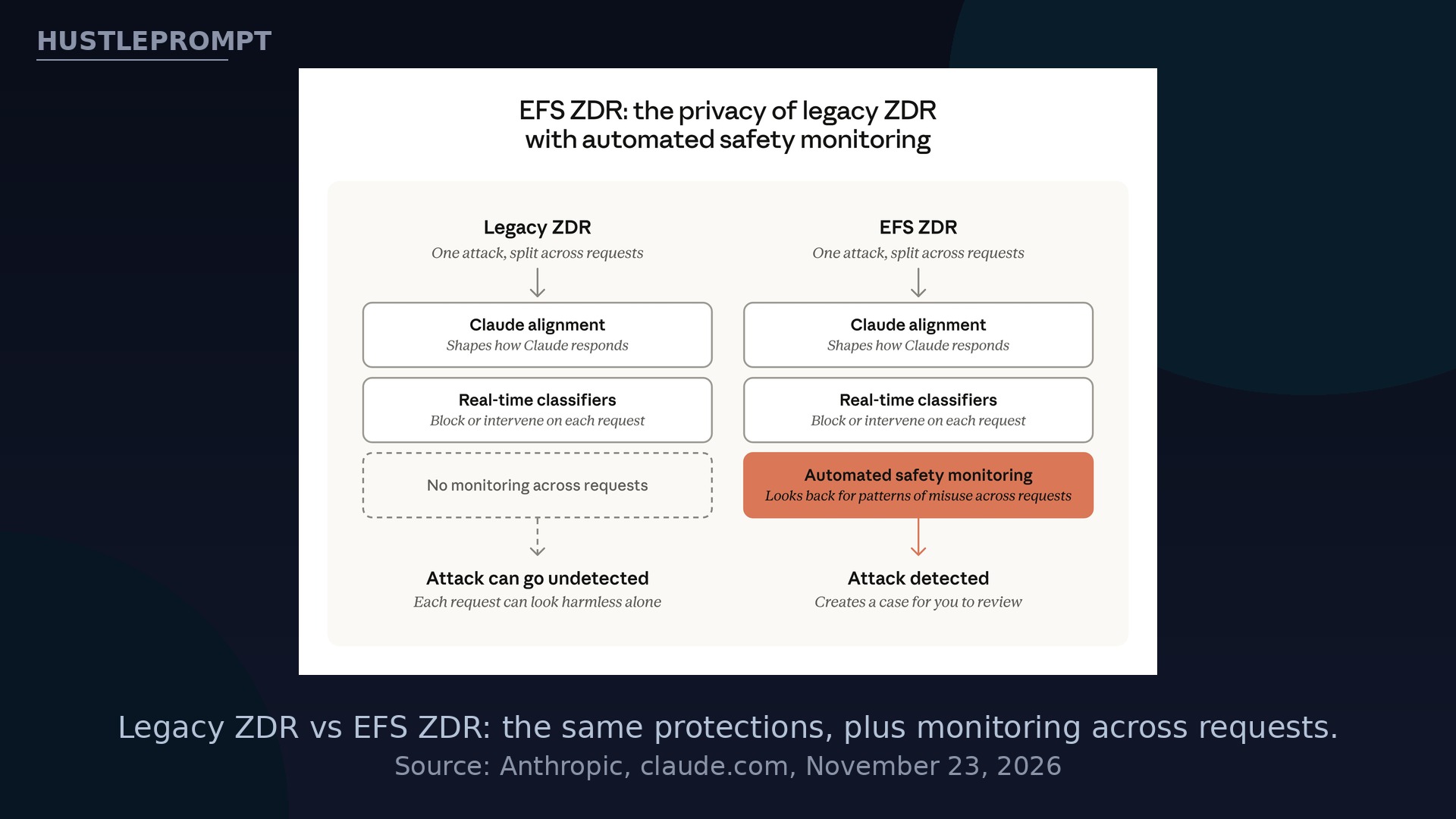
How it works
The design is simple: separate detection from storage. Anthropic’s systems still watch, but they read data that lives on infrastructure the customer controls.
Anthropic’s three guarantees are absolute: zero data retention, no operator human review, no training on your data. “Neither Anthropic nor any cloud providers retain enterprises’ data.” One catch: a workspace on Anthropic-managed storage is not on EFS.
What the companies testing it said
At Stripe, protecting customer data is foundational to how we operate. Anthropic’s Enterprise Frontier Safeguards will enable us to use frontier models with added protection against misuse. It will also let us retain conversation logs in Stripe’s AWS environment, with access and review governed by Stripe’s security controls.
— Stripe, quoted in Anthropic’s announcement, 2026
EFS provides state-of-the-art detection of sophisticated misuse, while remaining compatible with zero data retention (ZDR): neither Anthropic nor any cloud providers retain enterprises’ data.
— Anthropic, “Zero data retention with Enterprise Frontier Safeguards is now in beta,” 2026

Where it runs — and what it costs
EFS is available on four routes today, with a fifth on the way:
| Platform | EFS status |
|---|---|
| Claude Platform | Public beta |
| Claude Platform on AWS | Public beta |
| Amazon Bedrock | Public beta (operated by AWS) |
| Claude on Google Cloud | Public beta (Google Managed) |
| Microsoft Foundry | Coming soon |
Anthropic does not charge for EFS, and it changes neither API pricing nor rate limits. Your cloud provider bills for storage and operations. On Claude Platform, EFS applies to every request in a workspace once enabled — Messages API requests only, not code execution containers, Files API uploads, Batch API results or Claude Managed Agents sessions.
The same November 23 release notes set another date: Claude Opus 4.5 retires on the Claude API on January 22, 2027. Anthropic recommends migrating to Claude Opus 5.5.
Why it took so long
The retention rule was a response to a real attack. Anthropic’s September threat report describes an operation against roughly fifty organizations: an AI agent split an attack across many agents running in parallel, saving harvested credentials between sessions. One request at a time, it looked benign.
EFS is the engineering answer: keep the cross-request view, lose the Anthropic-held copy. The sealed data includes prompts, responses and model reasoning, encrypted — your own team cannot read it either. Only the automated monitor can access it.
What it means for your money
If you work in a regulated industry: the door just opened. Healthcare, finance and legal teams blocked by the 30-day rule can now run Claude’s best models — Fable 5.2 at $8 per million input tokens — on client data.
If you sell AI to regulated clients: your pitch changed overnight. “Zero data retention with misuse monitoring” removes the objection that killed most enterprise Claude deals since June.
If you run security: budget for the new duty, not just the new tool. EFS is free, but your team must answer every Safety Case within 7 days.
The caution: EFS is a beta, and beta behavior can change. Eligibility is decided by Anthropic, and the interim zero-retention exception is available only for a limited time. Do not build a compliance plan on it without written confirmation.
Frequently asked questions
What is Enterprise Frontier Safeguards?
Anthropic’s system for enterprise Claude customers: zero data retention plus automated misuse monitoring. Your prompts and responses go to storage you own.
Which models does EFS unlock?
Claude Fable 5, 5.1 and 5.2, and Claude Mythos 5, 5.1 and 5.2 — the covered models.
Does Anthropic charge for EFS?
No. Anthropic does not charge for EFS or change API pricing or rate limits. Your cloud provider bills for storage and operations as usual.
Who reviews a flagged Safety Case?
Your team — not Anthropic. Safety Cases carry a harm category, status and flagged transcript IDs, but no inputs or outputs. Your team must respond within 7 calendar days.
Where is EFS available?
Claude Platform, Claude Platform on AWS, Amazon Bedrock and Claude on Google Cloud. Microsoft Foundry support is coming soon.
What does EFS not cover?
Messages API requests in a workspace — not code execution containers, Files API uploads, Batch API results or Managed Agents sessions. A workspace on Anthropic-managed storage is not on EFS.