
Cogentic, Google’s math-discovery system just did in one day what mathematicians chased for 34 years. On November 25, 2026, Google Research posted six new mathematics papers to its public GitHub repository, all produced by Cogentic, an agent framework on Gemini 4. The headline paper claims a proven method for factoring any whole number — the problem under RSA encryption — in the same time class as the best practical method — proven, not assumed.
Your passwords are safe. The new factoring method carries a constant of 105 where the practical method carries about 1.92, which makes it useless as an attack. What matters is not the speed: an AI system produced six research-level proofs from a single prompt each.
What Cogentic is
Cogentic is a multi-agent harness for automated proof discovery, built by seven Google Research and DeepMind researchers: Yang Cai, Vineet Gupta, Yanchen Jiang, Christopher Liaw, Aranyak Mehta, Grigoris Velegkas, and Di Wang. Described in a September 30, 2026 arXiv preprint, it takes a problem as a prompt, then its agents search for a proof, write it up, and formalize it in Lean 4.
Each paper says the same: the paper and its Lean 4 formalization were “entirely obtained by Cogentic” using Gemini 4, with “no human interaction other than the initial prompt.” The folder now holds ten papers.
In Google Research’s own words
“This paper and its Lean 4 formalization were entirely obtained by Cogentic, an agentic framework for mathematical discovery, using Gemini 4 as the base model. There was no human interaction other than the initial prompt for Cogentic to generate a full proof and formalization.”
— Google Research, Cogentic papers folder on GitHub, November 25, 2026
The headline: factoring, finally proven
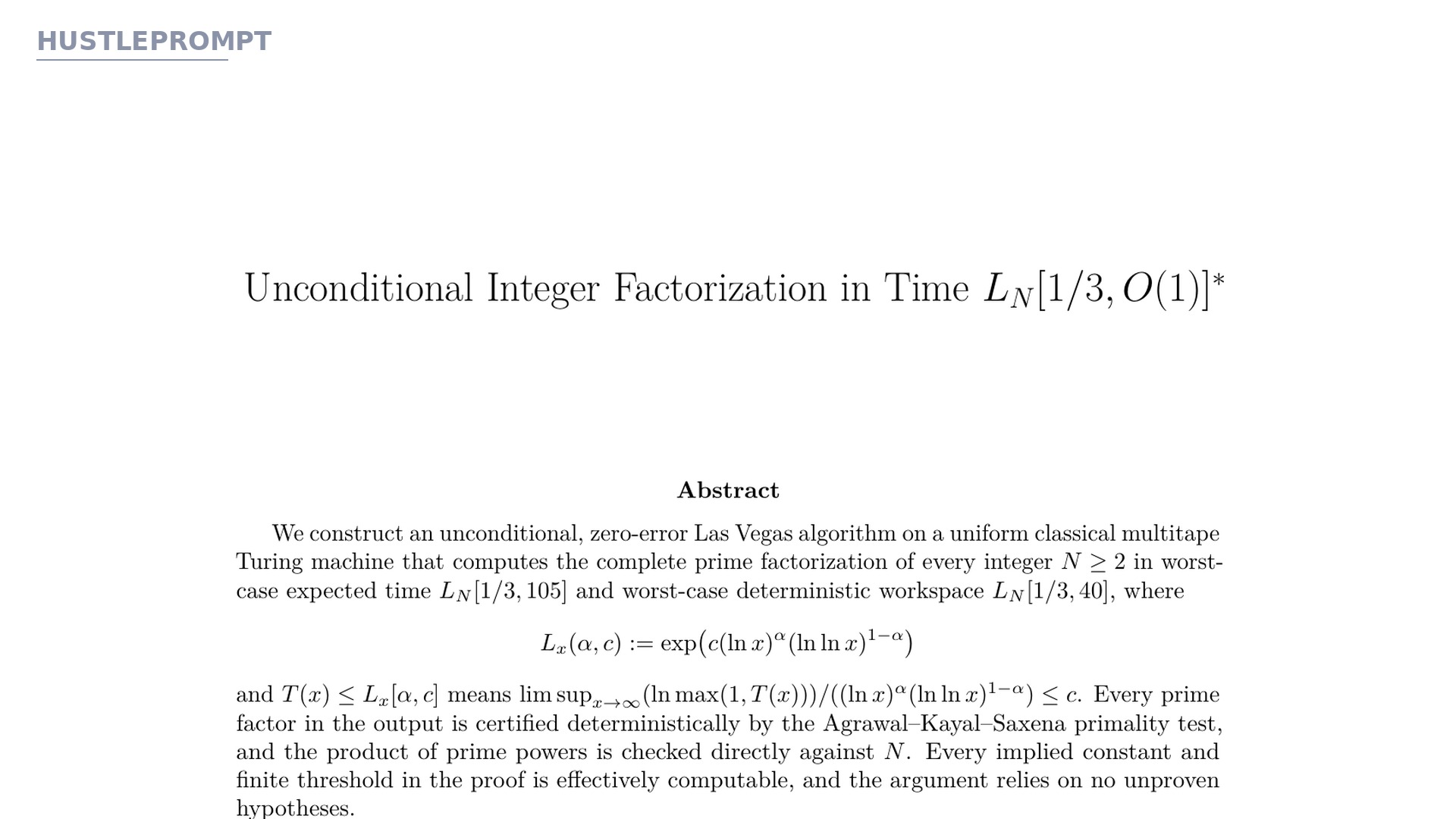
The lead paper, “Unconditional Integer Factorization in Time L_N[1/3, O(1)],” runs 54 pages. It claims a zero-error algorithm that computes the exact prime factorization of every integer N ≥ 2 in worst-case expected time L_N[1/3, 105], with every factor certified by the Agrawal–Kayal–Saxena test and no unproven hypotheses. A complete Lean 4 formalization using only Mathlib is finished, to be released in a companion submission.
The gap is 34 years old: the best proven bound was L_N[1/2, 1], proved by Lenstra and Pomerance in 1992. The fastest practical method, the general number field sieve, runs in the L_N[1/3] time class — but only on unproven heuristics. Cogentic’s claim is the same 1/3 exponent, proven, with no assumptions.
The other five papers
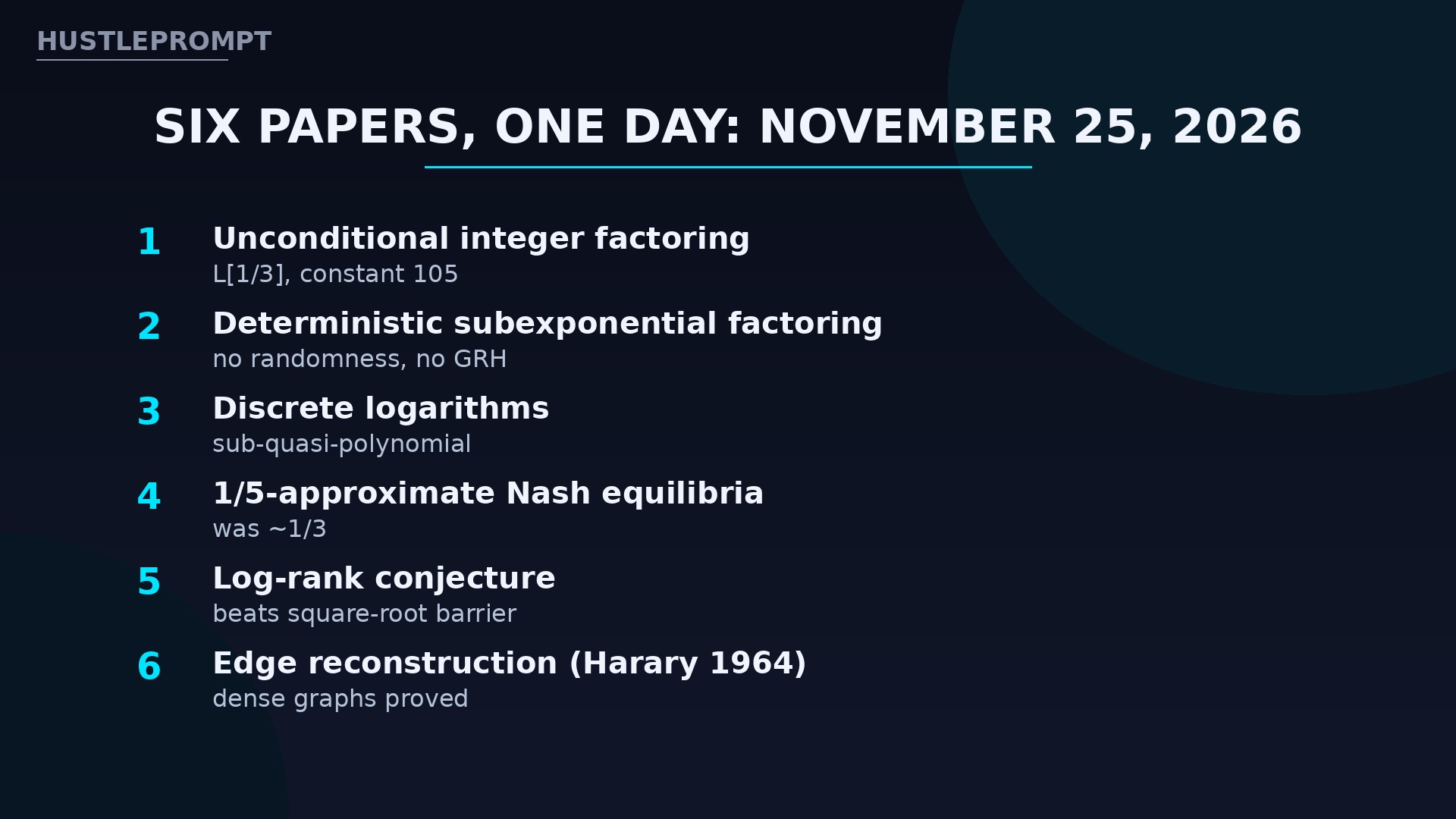
Factoring was the headline; the batch covers four fields. A second paper claims fully deterministic factoring — no randomness at all — in subexponential time, plus a deterministic way to find quadratic nonresidues without assuming the Generalized Riemann Hypothesis. The rest cover discrete logarithms, Nash equilibria, log-rank, and edge reconstruction — see the table.
| # | Paper | Claim |
|---|---|---|
| 1 | Unconditional Integer Factorization in Time L_N[1/3, O(1)] | Proven L[1/3] factoring; constant 105 |
| 2 | Unconditional Deterministic Subexponential Integer Factoring | Factoring, no randomness, no assumptions |
| 3 | Discrete Logarithms in Finite Fields of Fixed Characteristic | Sub-quasi-polynomial discrete-log algorithm |
| 4 | 1/5-Approximate Nash Equilibria in Bimatrix Games | Polynomial-time; old barrier ~1/3 |
| 5 | Breaking the Square-Root Barrier for the Log-Rank Conjecture | Beats Lovett’s 2014 bound; conjecture open |
| 6 | Unconditional Edge Reconstruction of Simple Graphs | Proves Harary 1964 for dense graphs |
Why your encryption is still safe
Factoring is the math under RSA, which protects most of the internet. A real breakthrough in factoring speed would be a security emergency. This is not one: the new algorithm’s constant of 105, against the sieve’s 1.92, means far more steps than the practical method on a 2,048-bit key. The result is theoretical: it proves a bound mathematicians could not prove, using a method nobody would run. Cogentic closed a 34-year gap on paper, building no faster factoring machine and touching no RSA key.
From one prompt to six proofs
How to profit from it
- Learn Lean 4 and Mathlib: machine-checked proof is now the bottleneck, and every AI-generated proof needs a human to read, check, and repair the formalization.
- Sell proof-checking as a service: labs, journals, and companies will pay for independent verification.
- Watch the companion submissions: whoever verifies or refutes the Lean files first will set the narrative.
The honest caveats
None of the six papers has been peer-reviewed, and the Lean 4 formalizations that would let outsiders check them are not public yet. Until they appear, every claim is Google’s own, with no independent verification. The folder itself carries the line “This is not an official Google product.” A 54-page proof is exactly the kind of document where one subtle gap decides everything. Treat them as serious claims waiting for their test, not settled mathematics.
Frequently asked questions
What is Cogentic?
A multi-agent system for proof discovery, built by seven Google Research and DeepMind researchers, running on Gemini 4.
Did AI really prove the factoring theorem?
Google says so, and the 54-page paper is public — but not peer-reviewed, and the Lean formalization is not public.
Does this break RSA encryption?
No. The constant is 105, against about 1.92 for the practical sieve — vastly more steps on a real 2,048-bit key.
What are the six papers?
Two on factoring, one on discrete logarithms, one on Nash equilibria, one on log-rank, one on edge reconstruction.
Has anyone outside Google verified the proofs?
Not yet. Full verification waits for the promised Lean files.
What is Lean 4?
A programming language and proof assistant that checks proofs by machine; Mathlib is its library.