
Your free DeepSeek chats were never really free — somebody paid for every token. Starting this week, DeepSeek is showing you the receipt: a gray-tested per-turn cost display in its web and mobile apps that breaks down each round into tokens used and an estimated price. The DeepSeek chat cost it reveals is the clearest sign yet that a paid plan is on the way.
The feature surfaced on November 26, when users started seeing a detail panel pop up after each conversation round. It lists the tokens consumed — cache-hit input, cache-miss input, and output — plus an estimated cost in yuan at DeepSeek’s API rates. Personal chats stay free during the test; the numbers are estimates, not charges.
The rollout is limited: the panel appears in the Android app from version 2.10.0, and not on iOS yet, according to reports. DeepSeek has not announced it — a grayscale test reaches only a slice of users.
What the new display actually shows
After each round, the panel shows three token buckets, each priced at off-peak API rates:
- Cache-hit input — tokens served from the context cache. The cheapest kind.
- Cache-miss input — fresh tokens read for the first time. Fifty times the price of a cache hit.
- Output — the tokens in DeepSeek’s reply. The most expensive kind.
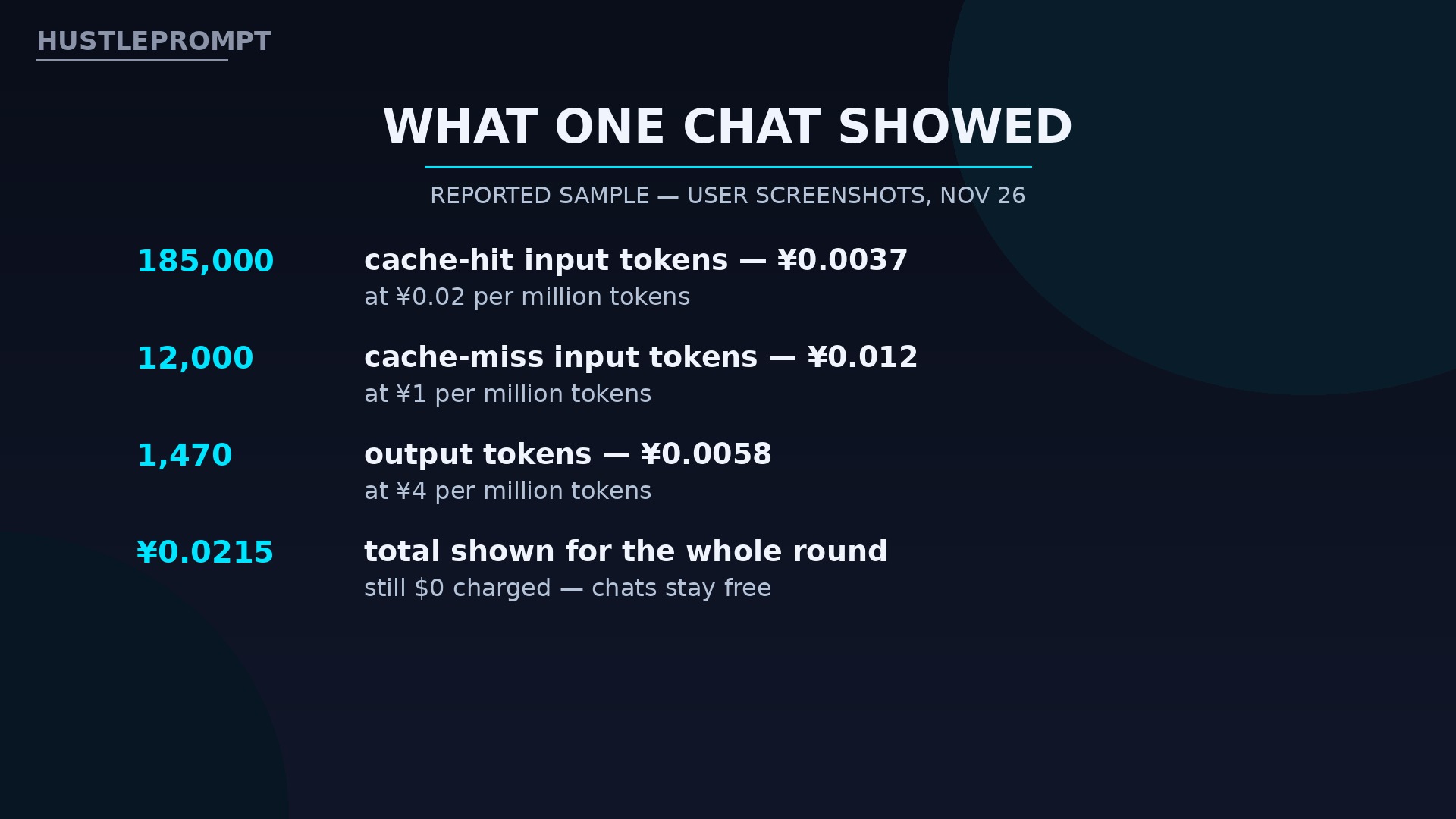
One reported example makes the math concrete: a single round used 185,000 cache-hit input tokens, 12,000 cache-miss input tokens, and 1,470 output tokens, priced at ¥0.0037, ¥0.012, and ¥0.0058 — ¥0.0215 in total, about a third of a US cent. A one-word “nihao” exchange came to ¥0.000528.
| Token type | Tokens | Rate | Shown cost |
|---|---|---|---|
| Cache-hit input | 185,000 | ¥0.02 / 1M | ¥0.0037 |
| Cache-miss input | 12,000 | ¥1 / 1M | ¥0.012 |
| Output | 1,470 | ¥4 / 1M | ¥0.0058 |
| Total | 198,470 | — | ¥0.0215 |
The numbers check out against DeepSeek’s own price list
The evidence: the panel reads the real price list.
“While individual user conversations remain free, the feature reveals the underlying computing costs using ‘idle period’ rates.”
— Phemex’s report on the gray test, November 27, 2026
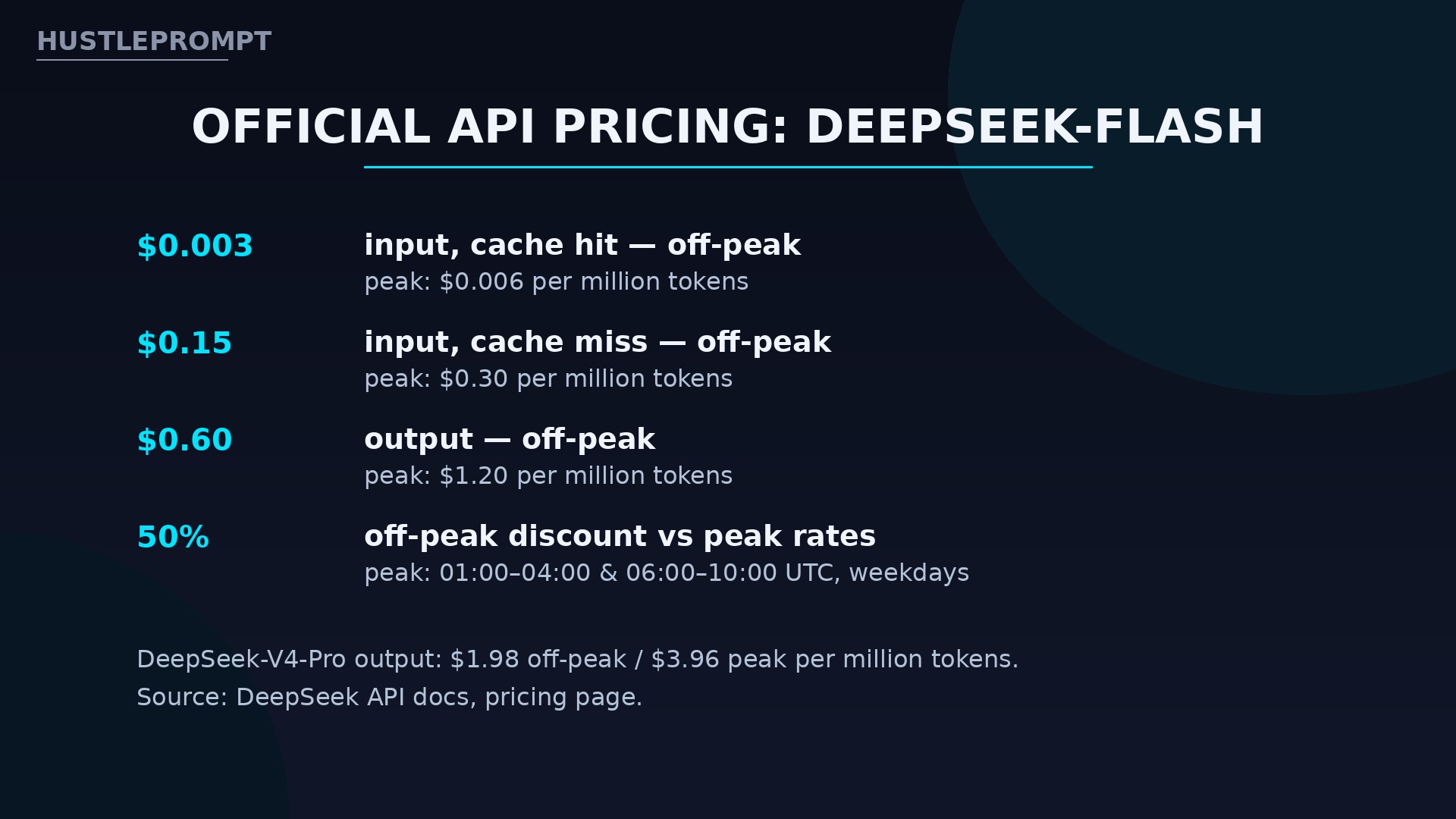
The yuan figures are not random. They match DeepSeek’s official API pricing page for its current Flash model, DeepSeek-V4.1-Flash-1017, at off-peak rates: cache-hit input $0.003 per million tokens, cache-miss input $0.15, and output $0.60. At roughly ¥6.7 to the dollar, those convert to exactly the ¥0.02, ¥1, and ¥4 per million the panel shows. The display is reading the same price list developers pay against.
| DeepSeek-Flash rate | Off-peak | Peak |
|---|---|---|
| Input, cache hit | $0.003 / 1M | $0.006 / 1M |
| Input, cache miss | $0.15 / 1M | $0.30 / 1M |
| Output | $0.60 / 1M | $1.20 / 1M |
| DeepSeek-V4-Pro output | $1.98 / 1M | $3.96 / 1M |
Peak hours are 01:00–04:00 and 06:00–10:00 UTC on weekdays, per DeepSeek’s pricing page; everything else is off-peak, at half the peak price.
Why DeepSeek is showing you the bill now
A free chatbot that shows you its costs is a chatbot getting ready to charge for something. The display teaches users the token economics of every chat, and it arrives alongside reports that app code references an upcoming “Coding Plan,” a paid tier for heavy coding use, according to today’s AI briefing. DeepSeek has not confirmed the plan — but the pattern is familiar: show the cost first, then offer the plan that covers it.
HOW A FREE CHAT BECOMES A PAID PLAN
1. Free chats show their cost. Every round ends with a price tag.
2. Users learn what heavy use is worth. Coders see what long sessions cost.
3. A paid Coding Plan covers the heavy users. App code already references the tier.
How to profit from the new transparency
Use the panel the moment it reaches you. Treat it as a price tag on your workflow:
- Price client work by the token, not by the hour. When a session shows ¥0.40 of compute behind a $50 deliverable, you know your margin.
- Run heavy work off-peak. Off-peak rates are half the peak rates, so long research sessions and big refactors cost 50% less outside 01:00–04:00 and 06:00–10:00 UTC on weekdays.
- Keep context in one thread. Cache-hit tokens cost about 2% of cache-miss tokens. Long conversations reuse context; starting fresh pays full price for the same words.
- Compare Flash against Pro before you pay. Pro output costs $1.98 per million off-peak against Flash’s $0.60 — a 3.3x markup when Flash does the job.
Frequently asked questions
Is DeepSeek still free?
Yes — the display shows estimates, not charges, and personal chats remain free during the test.
What is a token?
A chunk of text the model reads or writes, roughly four characters in English. The panel counts input and output separately.
Why does the display use off-peak rates?
The screenshots price at off-peak API rates — half the peak price, covering most hours of the week.
What is the Coding Plan?
A paid tier for coding use that app code reportedly references. DeepSeek has not confirmed it.
Does the display work on iOS?
Not yet. It appears in the Android app from version 2.10.0 and on the web, for a slice of users.
How much does one chat actually cost?
Reported examples run from ¥0.000528 for a greeting to ¥0.0215 for a 198,470-token round — a fraction of a US cent.
Keep Reading