
The Nvidia halts AI server shipments story is the sharpest sign yet that the AI chip war has moved from press releases to loading docks. Nvidia has told its manufacturing partners to stop shipping AI servers to four Southeast Asian countries, and buyers who already placed orders are being told their servers will not leave.
The halt, first reported by the Financial Times on Thursday, November 26, lands one week after new US export rules took effect.
What Nvidia just did
Nvidia told its manufacturing partners to stop shipping servers built with its AI chips to Malaysia, Singapore, Thailand, and Indonesia, the Financial Times reported, citing three people with knowledge of the matter.
Dell and Supermicro, the partners named in the report, have told buyers there that their orders cannot ship. Nvidia makes the chips; the two firms package them into servers.
Reuters, which covered the report, said it could not immediately verify it, and Nvidia, Dell, and Supermicro did not immediately respond. It is unclear whether the halt is temporary.
The evidence
Nvidia has told its manufacturing partners to stop shipping servers to four Southeast Asian countries, the Financial Times reported on Thursday, citing three people with knowledge of the matter.
Source: Reuters, November 26, 2026.

The rule behind the halt
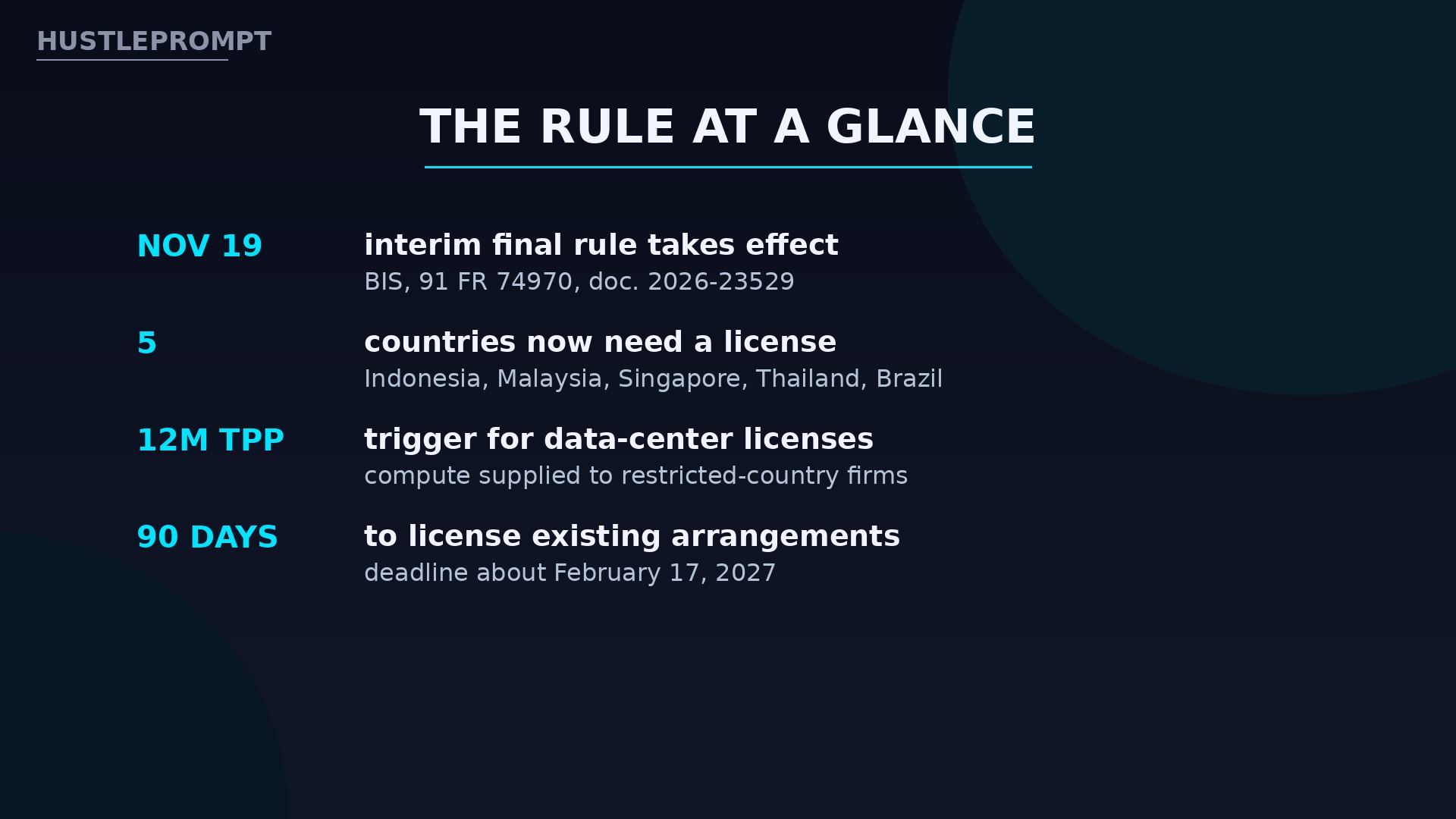
The halt follows a US Commerce Department rule effective November 19, 2026: the Bureau of Industry and Security’s interim final rule, “Addressing Remote Access to Advanced Semiconductors” (91 FR 74970).
The rule does two things: exports of advanced semiconductors to Indonesia, Malaysia, Singapore, Thailand, or Brazil now need a US license, and data centers anywhere need one if they supply over 12,000,000 aggregate total processing performance (TPP) of compute to firms in China, Macau, or other restricted countries. It also rescinds the never-enforced Biden-era AI Diffusion Rule.
| Rule change | Detail |
|---|---|
| Effective date | November 19, 2026 |
| License countries | Indonesia, Malaysia, Singapore, Thailand, Brazil |
| Exemption | US-headquartered firms (with reporting) |
| Data-center trigger | Over 12M TPP to restricted-country firms |
| Existing arrangements | 90 days from Nov 19 (about Feb 17, 2027) |
| Public comments due | January 19, 2027 |
Why these four countries
The four countries became the workaround: Washington restricts direct chip exports to China, so Chinese developers rented compute from cloud providers that bought Nvidia-powered servers there. The rule closes the gap from both sides — no shipments without a license, and no large-scale rentals to restricted-country firms without one either.
How the loophole worked — and how it closes
US blocks direct chip sales to China.
Top Nvidia chips cannot go directly to China.
Servers land in Southeast Asia instead.
Providers there buy Nvidia servers legally.
Chinese firms rent the compute.
Developers use the chips over the internet.
The new rule cuts both routes.
Shipments and data centers over 12M TPP need licenses.
The rule arrived days after Jensen Huang returned as Nvidia CEO on November 23, and the same week the Commerce Department added Megaspeed — the firm at the center of the chip-diversion scandal — to the Entity List.
The money at stake
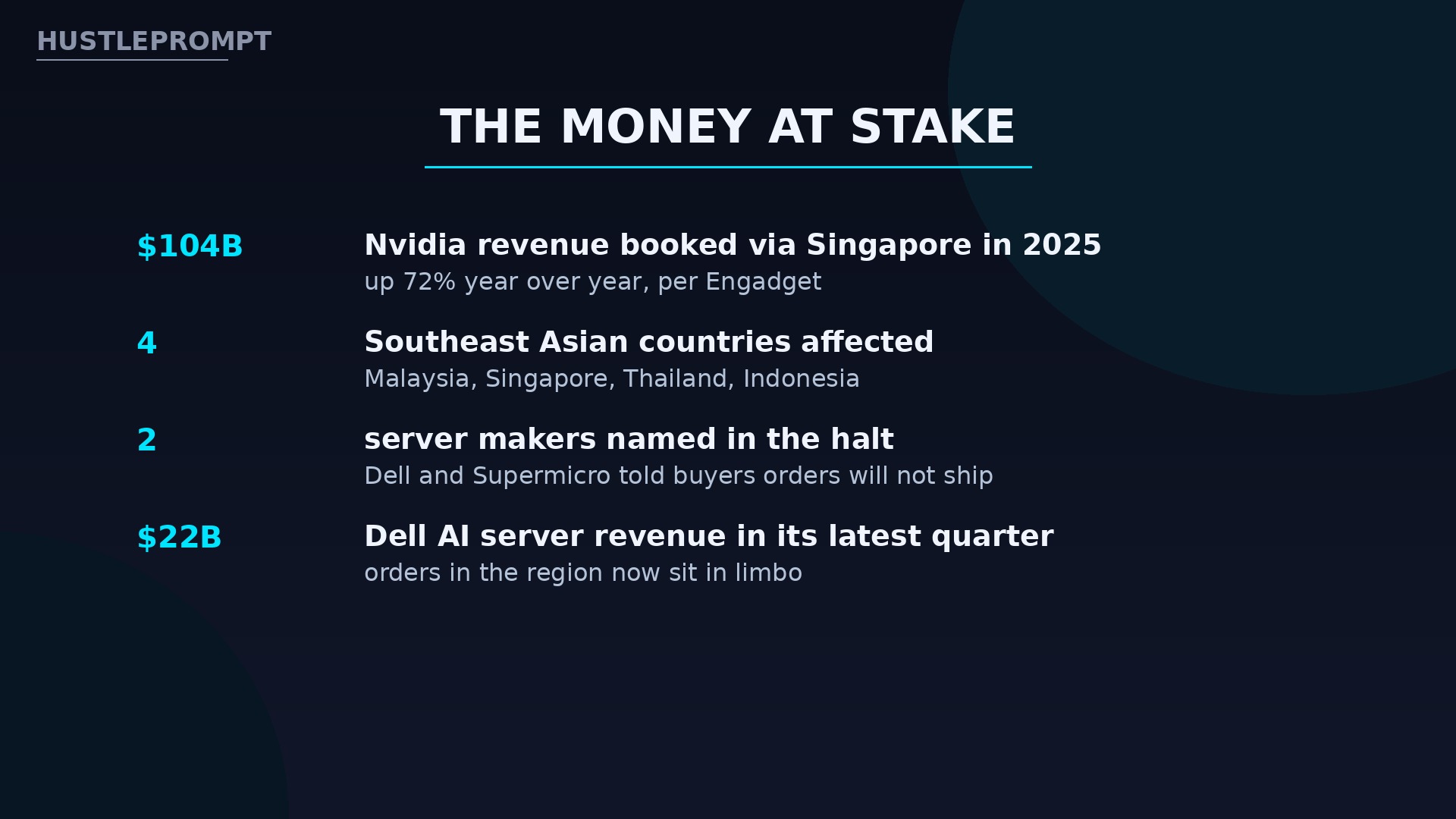
Singapore is not a side market for Nvidia. The company booked $104 billion in revenue through its Singapore subsidiary in 2025, up 72% year over year, according to Engadget — billing through the subsidiary, not only chips delivered there.
Dell shipped $22 billion of AI servers in a single quarter, and its orders in the region now sit in limbo while compliance is worked out. Supermicro faces the same freeze.
How to profit — or protect yourself
If you buy, sell, or invest around AI infrastructure, this is a supply shock with a 90-day clock.
- If you hold Nvidia, Dell, or Supermicro stock: watch license decisions, not headlines — the first approvals or denials will move these stocks most. Dell’s $132.3 billion AI backlog is a cushion; Supermicro has less room.
- If you buy AI servers in the region: ask your vendor, in writing, whether your order needs a license and who is applying. US-headquartered buyers are exempt if reporting rules are met.
- If you build AI products: diversify your compute. US-based capacity and US-headquartered providers sit outside the new rule.
What happens next
Three dates matter: shipments may resume first for exempt US-headquartered buyers; comments on the rule are due January 19, 2027; and the 90-day window closes about February 17, 2027, when covered data centers must hold a license or stop.
Watch: Official NVIDIA video on how the Blackwell systems at the center of this halt are built.
Frequently asked questions
Did Nvidia really stop shipping AI servers to Southeast Asia?
The Financial Times reported it on November 26. Reuters covered the story but could not verify it, and Nvidia has not confirmed it publicly.
Which countries are affected by the halt?
Malaysia, Singapore, Thailand, and Indonesia. The rule also adds Brazil to the license list, but the reported halt covers the four Southeast Asian countries.
Why did the US impose the new export rule?
To stop Chinese firms from reaching advanced US chips through third countries — developers rented compute from Southeast Asian data centers that bought Nvidia servers legally.
Can the servers still be shipped with a license?
Yes — a license, not a ban. Shipments to the five countries need US approval, and so do data centers over 12 million TPP. How fast licenses come is still unknown.
What should buyers in the four countries do now?
Ask your vendor in writing whether your order needs a license and who is applying. US-headquartered buyers are exempt if reporting rules are met.