
DeepSeek free limits are here. On November 16, 2026, users of DeepSeek’s free app and web chat began reporting the first usage caps in the service’s history: a daily conversation quota, a single-input cap of about 40,000 characters, and long chats that can no longer be resumed after sitting idle. The reason shown in the app is blunt — not enough computing power.
One thing to be clear about up front: DeepSeek has not published a unified announcement of these rules. Everything in this article comes from what users are seeing in the app and from the Chinese financial press that reported it first — Kechuangban Daily, via 21st Century Business Herald — corroborated by several independent outlets. Where the reports disagree, this article says so. Nothing here is presented as officially confirmed by DeepSeek.
That caveat matters less than it sounds. The limits are already live for free users, the topic trended on Weibo, and the numbers behind them explain why: DeepSeek’s V4.1 Flash model just became the most-called model in the world. The free ride is narrowing, and if your side hustle runs on free DeepSeek, your workflow needs a plan B.
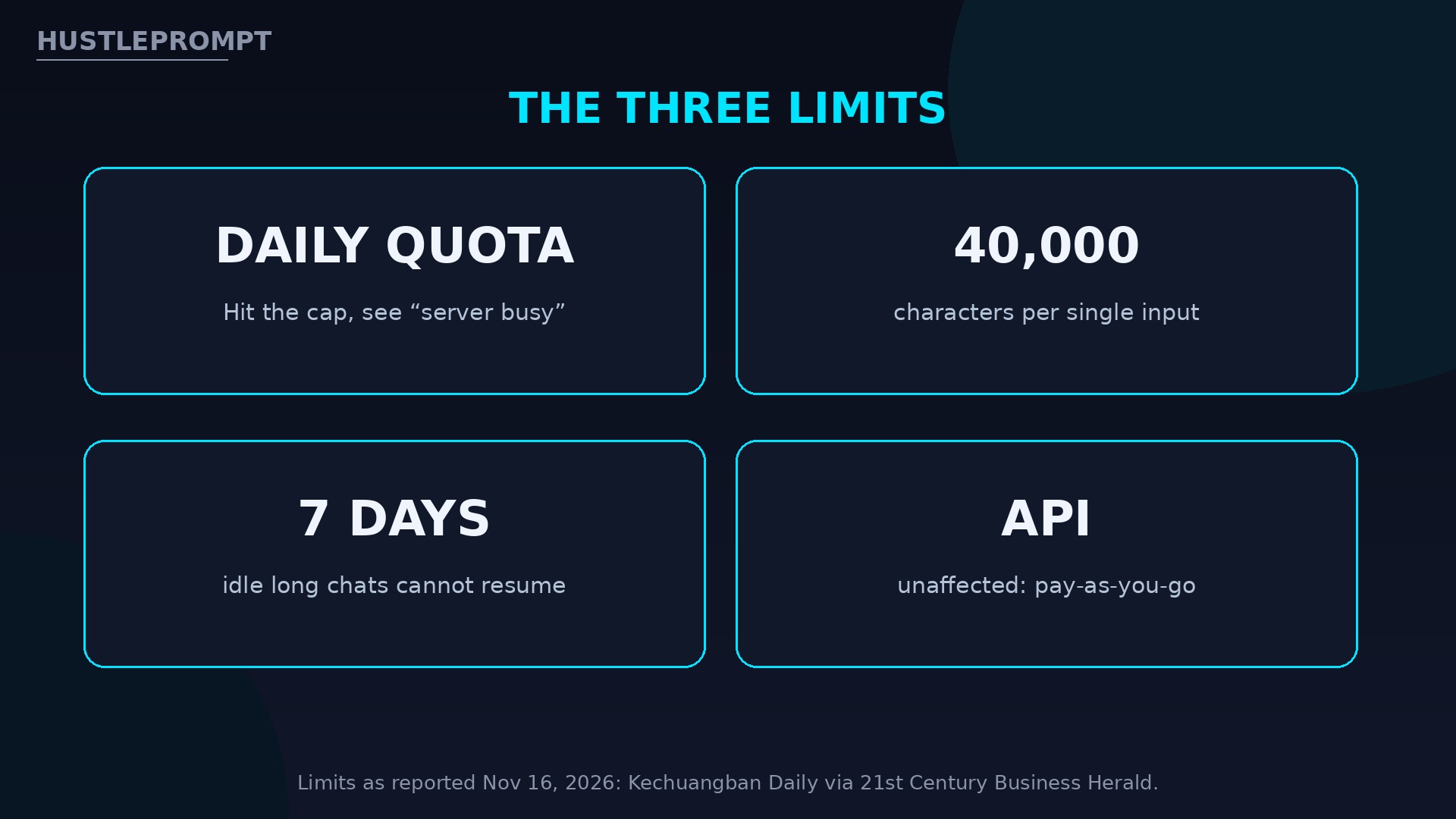
The three limits, as reported
Three separate restrictions showed up for free users on November 16. They hit different parts of the workflow, and they hit at different moments — which is why some users noticed one before the others.
| Limit | What free users see | Reported by | Status |
|---|---|---|---|
| Daily conversation quota | Once the daily cap is hit, the app shows a “server busy, usage quota reached” message and stops answering | Kechuangban Daily; Inside AI News | Live, per user reports |
| ~40,000-character input cap | Single inputs shortened to about 40,000 characters, down from the previous limit | Kechuangban Daily; InvestingLive | Live, per user reports |
| Long chats expire | Conversations inactive for more than 7 days can no longer be resumed | Kechuangban Daily; Aju Press | Live, per user reports |
| API | Unaffected: separate call limits and pay-as-you-go billing | All outlets reporting the story | Confirmed by every source |
The daily quota is the one that bites first. Some users report hitting it after less than two hours of continuous use, and the message that appears is the same one DeepSeek has used during overloads: the service is busy and the usage quota has been reached. The quota resets the next day — users report resets around 01:00 — so the cap is cyclical, not permanent. But a cap that stops you mid-day is a cap that changes how you plan work.
The 40,000-character input cap matters most for heavy users: long documents, full reports, long code files and batch materials no longer fit in one message. Routine questions are unaffected. The long-chat expiry matters for anyone who treats a DeepSeek conversation as a project file — a thread you return to over weeks is now a thread that can die.
“Due to insufficient computing power, long conversations inactive for more than seven days are no longer supported.”
— Notice shown to DeepSeek users, as reported by Kechuangban Daily, November 16, 2026 (translated from Chinese)
What is confirmed, and what is not
Because DeepSeek has not published unified rules, it is worth separating what multiple sources agree on from what is still unclear.
- Confirmed by several outlets: the three limits exist and are live for free App and web users; the in-app reason given is insufficient computing power; the API is unaffected.
- Confirmed by usage data: DeepSeek’s V4.1 Flash 1017 model completed 59.2 trillion tokens of calls in the week of November 9–15, ranking first globally among models tracked by OpenRouter. Demand is real and record-breaking.
- Confirmed by the status page: DeepSeek’s official status page has logged eight incidents since October affecting the chat service and the V4 Pro and V4.1 Flash APIs.
- Disputed: the inactivity threshold. Most reports say 7 days; some users report being unable to resume chats after just 72 hours. Until DeepSeek publishes rules, treat 72 hours as the safe assumption.
- Not announced: whether the limits are temporary, whether a paid consumer plan is coming, and what the exact daily quota is. DeepSeek has said nothing on any of those points.
CHAT → TYPE → CAP
1. CHAT
Long conversations die if they sit idle — 7 days by most reports, 72 hours by some.
2. TYPE
One message now holds about 40,000 characters. Big documents must be split.
3. CAP
A daily quota stops you mid-day with a “server busy” message until the next reset.
Free app vs. API: the gap is the business model
The most important line in this story is the one every source agrees on: the API is unaffected. The limits apply only to the free consumer app and web version. Developers using the API keep separate call limits and pay-as-you-go billing.
| Free app / web | DeepSeek API | |
|---|---|---|
| Daily quota | Yes — stops you mid-day | No daily message quota; pay-as-you-go |
| Input length | Capped at ~40,000 characters | Separate API limits |
| Long chats | Expire after 7 idle days | Not applicable — API calls are stateless |
| Price | Free, now capped | Paid per token |
| Full app features | Web search, deep thinking, files, voice | Same capabilities, opened Nov 13, 2026 |
That split is the whole story in miniature. DeepSeek opened a full API on November 13 — three days before the free limits appeared — with web search, deep thinking, file and link handling, and voice input. The free tier narrows, and the paid door stands open next to it. It is the classic freemium squeeze, and it is also the rational response to a compute shortage: charge the heaviest users, protect the free tier for light use.
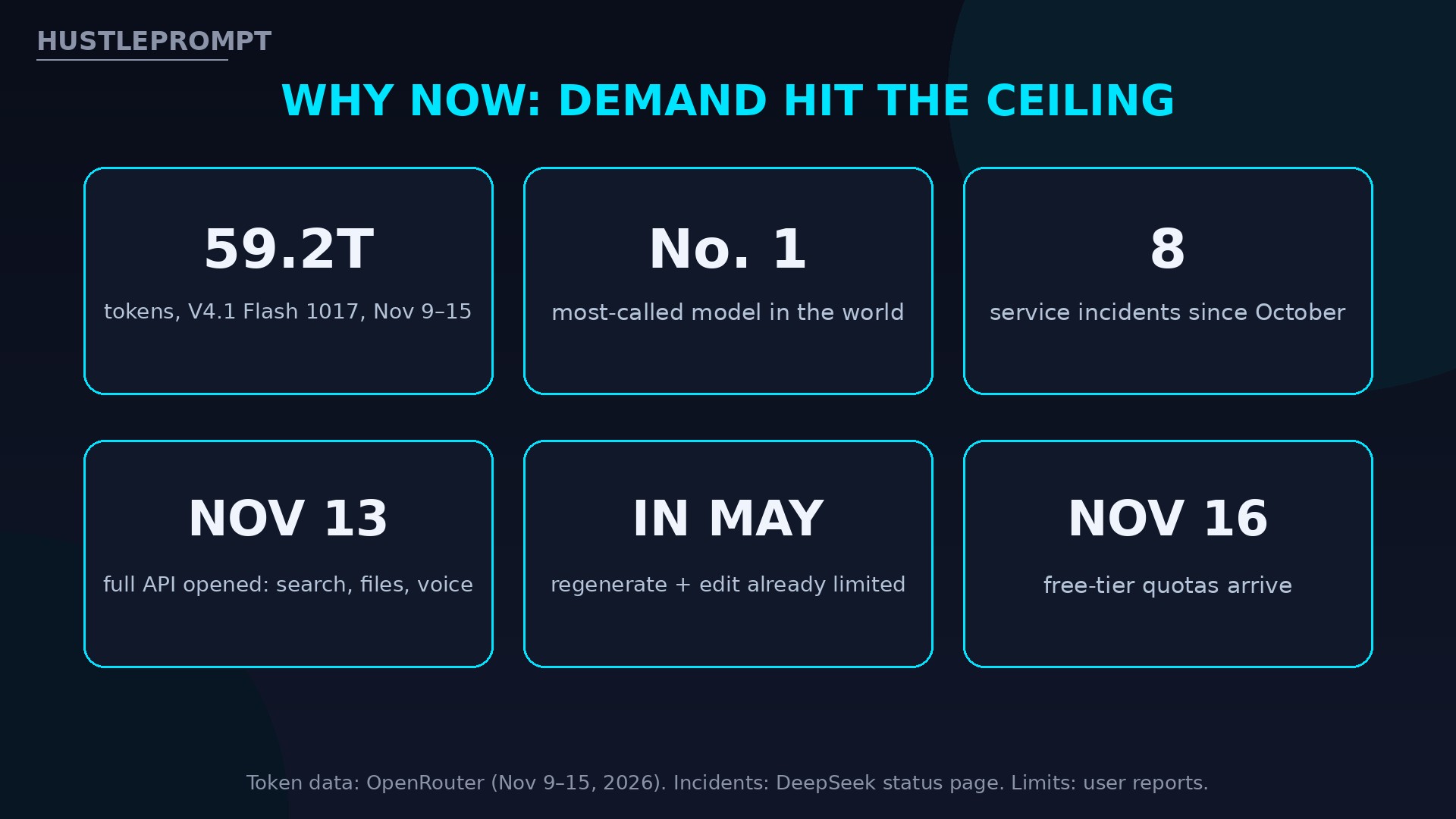
Why now: the demand behind the caps
The timing is not a coincidence. In the week of November 9–15, DeepSeek’s V4.1 Flash 1017 model completed 59.2 trillion tokens of calls, ranking first globally among models tracked by OpenRouter — ahead of every model from OpenAI, Google and Anthropic on that measure. A free service carrying the world’s heaviest model traffic is a service running out of hardware.
The strain was visible before the quotas. DeepSeek’s status page has logged eight incidents since October affecting the chat service and the V4 Pro and V4.1 Flash APIs. And this is not the first quiet tightening: back in May, DeepSeek limited the regenerate and edit functions for free users without a big announcement either. The pattern is the same — limits arrive silently, in the product, before they arrive in any statement.
The wider context is the chip crunch. The United States has been tightening AI chip export controls, including rules aimed at Chinese firms reaching restricted chips through overseas data centers. DeepSeek cites “insufficient computing power” in its own in-app notice, and the demand numbers make that explanation credible: record traffic, eight outages in six weeks, and now quotas.
What this costs you if you work on free DeepSeek
For casual users, almost nothing changes. A few questions a day, short inputs, fresh chats — none of that hits any of the three limits. The people who pay the price are the ones who built real workflows on the free tier.
- Content and research workflows break first. A long research thread that you revisit over two weeks can now die at day seven — or day three, if the 72-hour reports are right. Copy important conclusions out of the chat instead of trusting the thread to survive.
- Batch work gets slower. Feeding a full report, a long contract or a big code file in one message no longer works at ~40,000 characters. Splitting inputs means more messages, which means hitting the daily quota sooner.
- The daily quota is the hidden tax. Heavy days now end early. If you run client work through free DeepSeek, a quota stop at 3 p.m. is a missed deadline, not an inconvenience.
- The API is the obvious escape hatch — and it costs money. Pay-as-you-go pricing means your heaviest days are your most expensive days. Budget it like any other business input, and compare it against what ChatGPT, Claude and Gemini charge for the same work.
How to keep working for free: 5 moves
You do not have to pay yet. Five concrete moves keep the free tier usable while the limits stand:
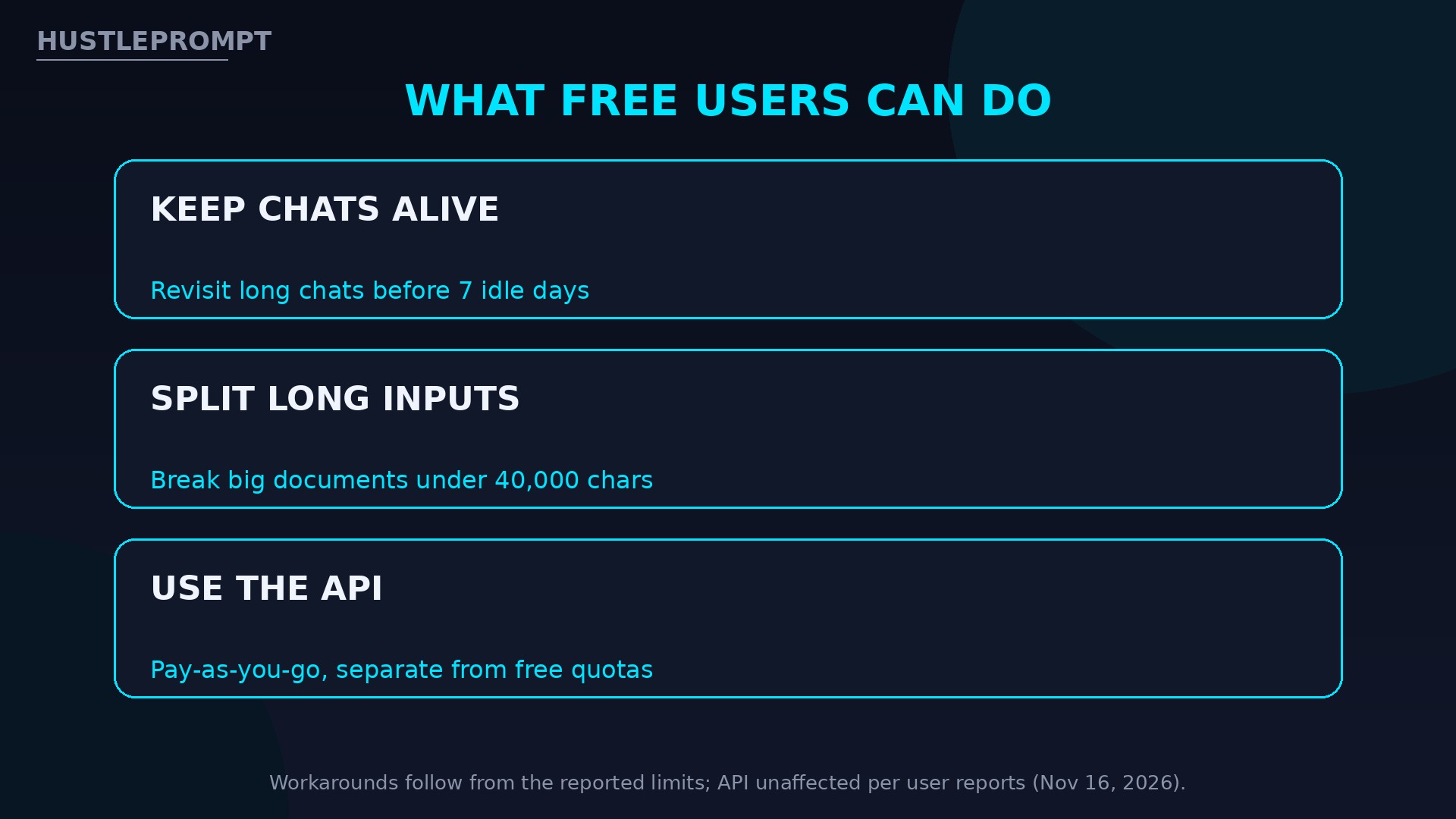
- Keep long chats alive. Revisit important threads at least every two or three days — well inside even the disputed 72-hour threshold — so they never go idle long enough to expire.
- Save conclusions outside the chat. Copy key outputs into a document after each session. If a thread dies, you lose the conversation, not the work.
- Split long inputs before you send them. Break documents into chunks under 40,000 characters and send them as a sequence, with a short instruction at the start of each chunk so the model keeps the context.
- Move heavy, deadline work to the API. Use the free tier for exploration and the pay-as-you-go API — opened in full on November 13 — for batch jobs and client deadlines, where a mid-day quota stop would cost you real money.
- Watch for a paid plan. DeepSeek has said nothing about one, but the pattern — free limits first, paid API already open — is how a consumer subscription usually starts. When it arrives, compare its price against the API cost of your actual usage before subscribing.
What to watch
Three things will tell you whether this is a temporary squeeze or the new normal.
- Whether DeepSeek publishes rules. A unified quota announcement would settle the 7-day versus 72-hour dispute and the exact daily cap. Silence suggests the limits are being tuned live, and could tighten further.
- Whether a consumer paid plan appears. The API is already paid; a subscription for heavy free-tier users is the obvious next step. Its price will show what DeepSeek thinks its free users are worth.
- Whether the outages stop. Eight incidents since October is the backdrop to all of this. If the quotas stabilize the service, they stay. If outages continue, expect more limits — or higher prices.
The broader lesson is one this site has made before: a free frontier model is a gift, not a contract. DeepSeek gave millions of users world-class AI for nothing, and the bill for that generosity arrived as record traffic. The users who adapt — saving work outside the chat, splitting inputs, budgeting a little API spend — keep the advantage. The ones who assume “free and unlimited” was permanent will find out mid-deadline that it was not.
A note on video: DeepSeek announced nothing officially and there is no DeepSeek-channel YouTube video for these limits, so this article embeds none rather than a third-party clip.
Frequently asked questions
What limits did DeepSeek add for free users?
Three, reported on November 16, 2026: a daily conversation quota, a single-input cap of about 40,000 characters, and long conversations that can no longer be resumed after sitting idle. The limits apply to the free app and web version only; the API is unaffected.
What is the 40,000-character input cap?
Free users can now send about 40,000 characters in a single message, down from the previous limit. Routine questions are unaffected, but long documents, full reports and big code files must be split into smaller chunks.
What happens to long chats after 7 days?
According to user reports, a long conversation with no activity for more than 7 days can no longer be resumed. Some users report a 72-hour threshold instead. Until DeepSeek publishes official rules, treat 72 hours as the safe assumption.
What does the daily quota message say?
When daily usage hits the cap, users see a message saying the service is busy and the usage quota has been reached. The quota resets the next day, so the limit is cyclical rather than permanent.
Are DeepSeek API users affected?
No. The API has separate call limits and pay-as-you-go billing, and every outlet reporting the story agrees it is unaffected. DeepSeek opened a full API on November 13, 2026, with web search, deep thinking, files, links and voice input.
Why is DeepSeek limiting free users now?
DeepSeek’s own in-app notice cites insufficient computing power. The demand data supports that: its V4.1 Flash 1017 model completed 59.2 trillion tokens of calls in the week of November 9–15, ranking first globally, and the status page has logged eight incidents since October.
Has DeepSeek officially announced the limits?
No. As of November 17, 2026, DeepSeek has published no unified announcement of the quota rules and no timeline for lifting them. The details in this article come from user reports and the Chinese financial press, and are labeled as reported throughout.
Keep Reading
Sources: Kechuangban Daily via 21st Century Business Herald (Nov 16, 2026); Inside AI News on the DeepSeek chat limits (Nov 16, 2026); Aroged on the limits and OpenRouter token data (Nov 16, 2026).