
One hundred million downloads in nine months. Seven million daily users. A ByteDance app that did not exist when the year began is one of the fastest-scaling apps in history.
That is PineDrama’s scorecard. The microdrama gold rush — 90-second vertical episodes ending on cliffhangers, unlocked with coins — is projected to be a $14 billion market in 2026. And AI just rewrote the cost structure underneath it.
The $14B number is real — here is the math
The numbers look like the early streaming wars on fast-forward.
| Metric | Figure | Source |
|---|---|---|
| Downloads, Q1 2026 | 850M (+140% YoY) | ASO World |
| In-app purchases, 2025 | $2.98B (+115% YoY) | ASO World |
| IAP revenue, Q1 2026 | ~$750M | ASO World |
| Total market, 2026 | ~$14B incl. ads/platforms | Fast Company |
| Overseas market | $4B (2025) → $6B (2026), +50% | inorain |
| Daily viewing, Apr 2026 | 25 min (+85% vs Jan 2025) | Sensor Tower |
$1.05B — ReelShort’s projected 2026 revenue, up from $97M in 2023. First net profit (~$40M) expected in 2026 after a $12M loss in 2025. (inorain)
168M daily users — ByteDance’s China app Hongguo hit 168M DAU in July 2026 (+107% YoY), beating iQiyi, Tencent Video, Youku, and Mango TV combined. (QuestMobile)
6.5B views — microdramas on YouTube in H1 2026, watch time up 50%+ year over year. (YouTube Blog)
That red-to-black swing proves the unit economics work — not just the growth story.
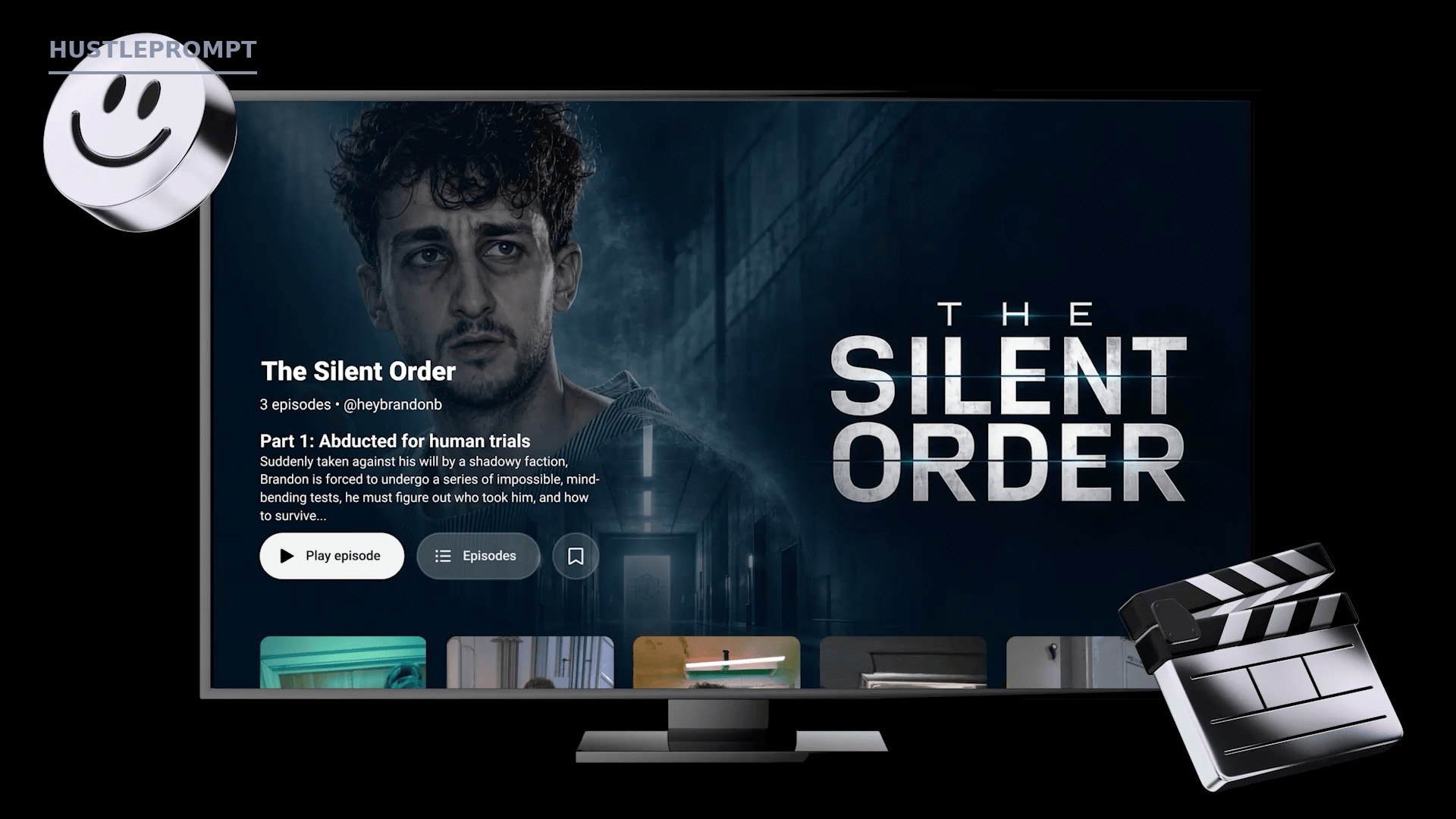
Source: YouTube Blog — official promo image for the Shorts Series feature (Made on YouTube, Sep 2026).
Why it exploded: three forces at once
Force 1: ByteDance brought a firehose
PineDrama launched in December 2025 and hit 100M downloads in nine months — the only one of seven 100M-download apps launched less than a year ago. It topped charts in Brazil and Indonesia, holds ~7M daily users, and added 17M+ new users per month as of September 2026 (ASO World, Aju Press).
ByteDance is flooding distribution until the format becomes a habit.
Force 2: AI collapsed production cost
Traditional 80–100 episode series: $40K–$275K. AI pipelines claim 50%+ cost cuts, some 80–90% (Skrew AI News). In January 2026, ~470 AI short dramas launched per day in China; by March, tens of thousands of AI-native titles shipped in a single month.
The format suits generative video: 60–90 second episodes, limited sets, formulaic beats, vertical screens where minor artifacts go unnoticed.
Force 3: the coin economy
ReelShort inverts streaming economics. No monthly fee. Opening episodes are free, then viewers pay $0.30–$0.50 per episode in coins — about $10–$15 per full series (inorain). The two-currency system breaks the mental link between dollars and episodes, so spend never announces itself. North America drives ~59% of revenue; LatAm and APAC hold 60% of users but only 19% of revenue (inorain). Closing that ARPU gap is the industry’s biggest bet.
Old studio pipeline vs AI studio pipeline
🎬 Old pipeline
- $40K–$275K per 80–100 episodes
- Timeline: months
- Actors, locations, full crew
- One season at a time
🤖 AI pipeline
- 50–90% cheaper, ~$1,000/episode documented
- Days — 10 episodes, 3-person crew
- Locked character sheets
- Multiple seasons per quarter
Cost data: Skrew AI News · Season example: invideo.io

Source: reelshort.com — official key art for “The Great and Powerful Genie.”
The brutal catch nobody posts about
Only 1.3% of 430,000 new AI drama titles broke even in H1 2026 — 50 million views is the break-even benchmark, per DataEye (Finance Biggo).
AI cut costs — and a supply tidal wave followed. Hits are scarcer than ever, which is precisely why they are valuable.
ReelShort’s profit mechanics matter more than its revenue. Two underreported ones:
- The web-checkout arbitrage. ReelShort moved purchases to its own web checkout, dodging app-store commissions up to 30%. On a $0.40 unlock that is twelve cents — across hundreds of millions of transactions, the entire distance between loss and profit (inorain).
- Marketing is half the business. User acquisition ran at an estimated 55% of revenue in 2025 (inorain) — a paid-media business with a content layer attached, not the reverse.
Production is the cheapest part of the equation. Winners ship the most seasons fastest and convert viewers into coin-spenders — not the people who generate video cheapest.
6 ways to cash in right now
Money flows through four paths: platform payouts, ad revenue, per-episode unlocks, and brand integrations (invideo.io).
1. Solo AI production. 10 episodes at ~$1,000/episode, 3-person crew, 3 days. At $0.25 net per unlock, a $10,000 season breaks even at ~40,000 unlocks (~5,000 paying viewers). The play is portfolio math: five seasons per quarter, and one hit pays for the rest.
2. Branded micro-dramas for companies. The proven B2B lane. Crocs × ReelShort (“Charmed to Meet You”): 7.8M views in three weeks (Archyde). Issa Rae’s “Screen Time” (Hoorae × TikTok/PineDrama): nearly 75M views in its first week, with Gushers sponsoring the finale (TheWrap). JCPenney × TelevisaUnivision: 16M+ impressions with QR codes in the story (Marketing Dive). Pitch brands a 5–10 episode series — AI-produced, unskippable attention for them.
3. AI dubbing and localization. Every AI title chasing global reach needs multilingual voices — studios already dub into English, Spanish, and Portuguese for ReelShort and DramaBox. Price per-episode dubbing against the $1,000/episode baseline.
4. Sell finished pilots to platforms. Apps constantly acquire content as viewers churn through series. Deals: upfront license, revenue share on unlock spend, or hybrid with a minimum guarantee. Finish the season first, prove traction with free social episodes, then negotiate the revenue-share tier — that is where long-tail money sits.
5. The YouTube early-mover window. Shorts Series gives creators seasons, episodes, custom thumbnails, and sequential playback on web, mobile, and TV. Microdramas already did 6.5B views on YouTube in H1 2026; TV views up 90% YoY. YouTube VP Aparna Pappu: “We’re really excited to see the growth of episodic content and shows on YouTube, including categories like microdramas” (Fast Company). Quibi spent $100K per minute and died in six months; microdrama seasons cost ~$100K total.
6. AI showrunner pipelines as a service. The scarce skill is consistency: locked character sheets, a show bible, context across episodes. Sell it as a monthly-retainer service — in China, “AI director” roles are rising as background-actor roles shrink.

Source: reelshort.com — official key art for “Sold to the Warlord, Born for the Sky.”
What to do this month
- Pick one proven genre. Romance, revenge, billionaire tropes. Do not fight the formula — it converts.
- Ship one finished 10-episode season. Unfinished series do not get licensed.
- Post free episodes natively on TikTok, Reels, and Shorts — each ends on an unresolved beat, order pinned in playlists.
- Place the paywall at your strongest cliffhanger — then pitch one brand a mid-season integration priced against your production cost.
- Track two numbers: unlock rate per episode and drop-off points. The rest is vanity.
Where this is heading
Consolidation. With 1.3% of titles breaking even, the 430,000-title flood compresses into studios with pipelines and distribution deals. Survive by becoming a pipeline yourself — seasons per quarter, not per year.
The ARPU gap closes through localization. SE Asia, Latin America, and India drive over 75% of downloads (inorain), and daily viewing hit 25 minutes — closing in on OTT at 35 minutes. Whoever monetizes cheap-reach markets wins next.
YouTube becomes the default free tier. Shorts Series, Gemini-powered AI tools in the mobile app, TV viewing up 90% YoY. The stack: YouTube for discovery, dedicated apps for unlocks, brands for budget.
FAQ
What is a microdrama? 60–90 second vertical episodes, 55–100+ parts per season, built for mobile binge viewing. Born in China’s duǎnjù market; now spans ReelShort, DramaBox, and PineDrama.
How big is the market? About $14B in 2026 incl. ads and platforms. Apps did $2.98B in-app in 2025 (+115% YoY) and ~$750M in Q1 2026 on 850M downloads (+140% YoY) — Sensor Tower.
How much does AI production cost? Traditional: $40K–$275K. AI pipelines claim 50%+ cuts, some 80–90%. Documented: 10 episodes at ~$1,000/episode, 3-person crew, ~3 days.
Can a solo creator make money? At $0.25 net per unlock, a $10,000 season breaks even at ~40,000 unlocks (~5,000 paying viewers). Only 1.3% broke even in H1 2026 — so ship multiple seasons and let one hit pay for the rest.
How does YouTube Shorts Series work? Made on YouTube (Sep 2026): creators organize Shorts into seasons/episodes with custom thumbnails and sequential playback on web, mobile, and TV.
Why did Quibi fail but microdramas win? Quibi spent up to $100K per minute and died in six months. Microdrama seasons cost ~$100K total, use unknown actors, and monetize per episode. Economics inverted.
What is the biggest risk for creators now? Supply: ~470 AI short dramas launched per day in China (Jan 2026). Production is commoditizing; distribution is not. Winners own audiences, platform deals, or brand relationships — not tools.