
Meta just rewrote the fine print governing every business on Facebook, Instagram, WhatsApp, and Messenger — and legal experts told Nieman Lab the new language could let Meta scrape news sites and use “any content” for Meta AI training. The Meta AI training terms take effect October 30, 2026. Consent is passive: keep using Meta’s business products, and you agree. The only refusal is leaving Meta’s business tools.
What the new clause actually says
Section 1 of the Meta’s updated Commercial Terms (preview edition) authorizes Meta — or any entity acting on its behalf — to use automated software, including scrapers, bots, crawlers, and user agents, and to create test credentials to crawl the domains, pages, and URLs tied to your products or services. The final sentence does the heavy lifting: Meta may use that content to train Meta Company Products.
“You authorise us (or any entity acting on our behalf) to use automated software (such as web scrapers, bots, robots, spiders, crawlers and user agents) and create test credentials to access, index, cache, analyse, collect, retrieve or crawl the domains, web pages or URLs (and any content available through them) that are associated with your products or services, or that are made available through your or users’ use of Meta Company Products and services, and to periodically pull updates from such domains, web pages or URLs. Meta may use any content from such domains, web pages or URLs to provide, develop, improve, research, train and maintain the integrity of, the Meta Company Products, services and features provided under these Commercial Terms and any other applicable supplemental terms.”
— Meta Commercial Terms, preview edition (UK English), quoted by PPC Land and corroborated by Nieman Lab
Meta Company Products include Meta’s AI offerings, so the training application is written directly into the contract. The clause also covers “any content available through” those domains — far wider than product catalogs.
Who is in the blast radius
The terms cover commercial use across Facebook, Instagram, WhatsApp, and Messenger: running ads, managing a business Page, selling or listing products, using Business Suite, or running the Meta Pixel. Almost every news publisher runs at least one Meta business account — which is why newsrooms are first in the blast radius.
Why publishers specifically
Nieman Lab’s October 15 report focused on publishers because their sites are among the most valuable training corpora on the web. Under the emerging reading, a publisher’s ordinary Facebook marketing presence could become legal cover for Meta to ingest its entire archive.
The licensing-market question
Meta already pays for content elsewhere, with licensing deals with CNN, Fox News, USA Today, and People Inc. Meanwhile Meta launched a paid “Meta One” subscription charging creators for links in posts. The new terms sit awkwardly against both facts: paying some publishers for their archives while reserving the right to crawl others for free.
What the experts say
Nieman Lab asked three legal experts to review the new language. Their verdicts — and the responses — follow:
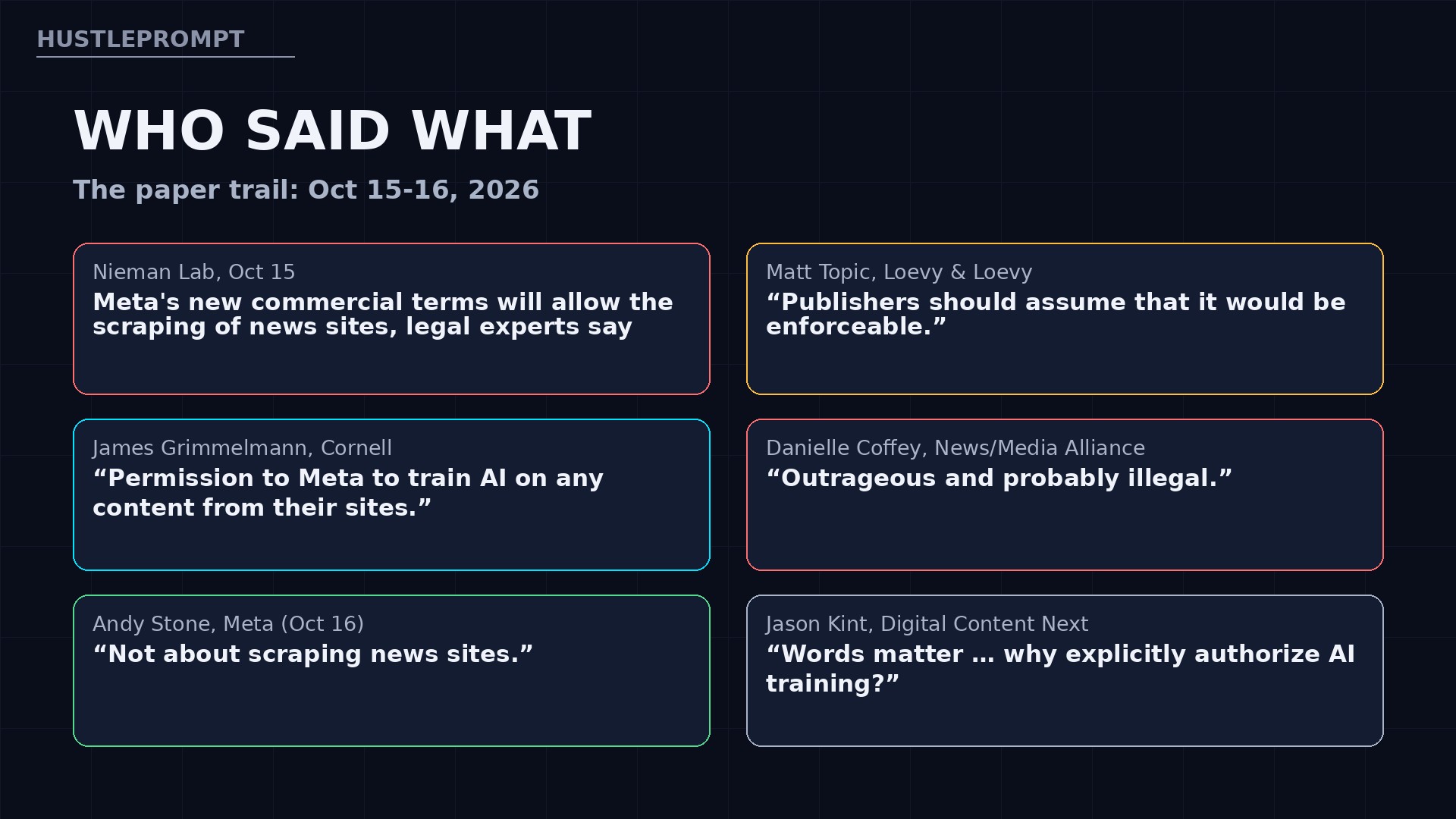
| Date | Who | What they said |
|---|---|---|
| Oct 15, 2026 | Nieman Lab (Andrew Deck, Hanaa’ Tameez) | Reported the terms could allow the scraping of news sites for AI training. |
| Oct 15, 2026 | Matt Topic, Loevy & Loevy | “Publishers should assume that it would be enforceable.” The material “would likely cost many millions of dollars in a licensing market.” |
| Oct 15, 2026 | James Grimmelmann, Cornell | “For news publishers, this clearly represents permission to Meta to train AI on any content from their sites.” |
| Oct 15, 2026 | Benjamin Sobel, U. Wisconsin | Framed the move in tying / tying-like antitrust terms: accept the crawl clause or lose access to Meta’s business audience. |
| Oct 15, 2026 | Danielle Coffey, News/Media Alliance CEO | Called the terms “outrageous and probably illegal.” |
| Oct 16, 2026 | Andy Stone, Meta communications | “This is false. There’s no change to how Meta uses web crawlers… not about scraping news sites.” |
| Oct 16, 2026 | Jason Kint, Digital Content Next CEO | X thread (45,500 views): “Words matter… why explicitly authorize AI training?” |
Three lawyers read the same paragraph and saw a scraping license; Meta’s spokesperson saw routine ad-crawling language. Which reading a court would accept is untested — but Topic’s advice to publishers stands: assume enforceability.
Meta pushes back
On October 16, Meta communications executive Andy Stone responded on X: “This is false. There’s no change to how Meta uses web crawlers… not about scraping news sites.” That day, Digital Content Next CEO Jason Kint’s thread questioning the clause passed 45,500 views: “Words matter… why explicitly authorize AI training?” The sharpest detail: robots.txt is not mentioned in the terms, and there is no opt-out short of leaving Meta’s business products.
What to do before October 30
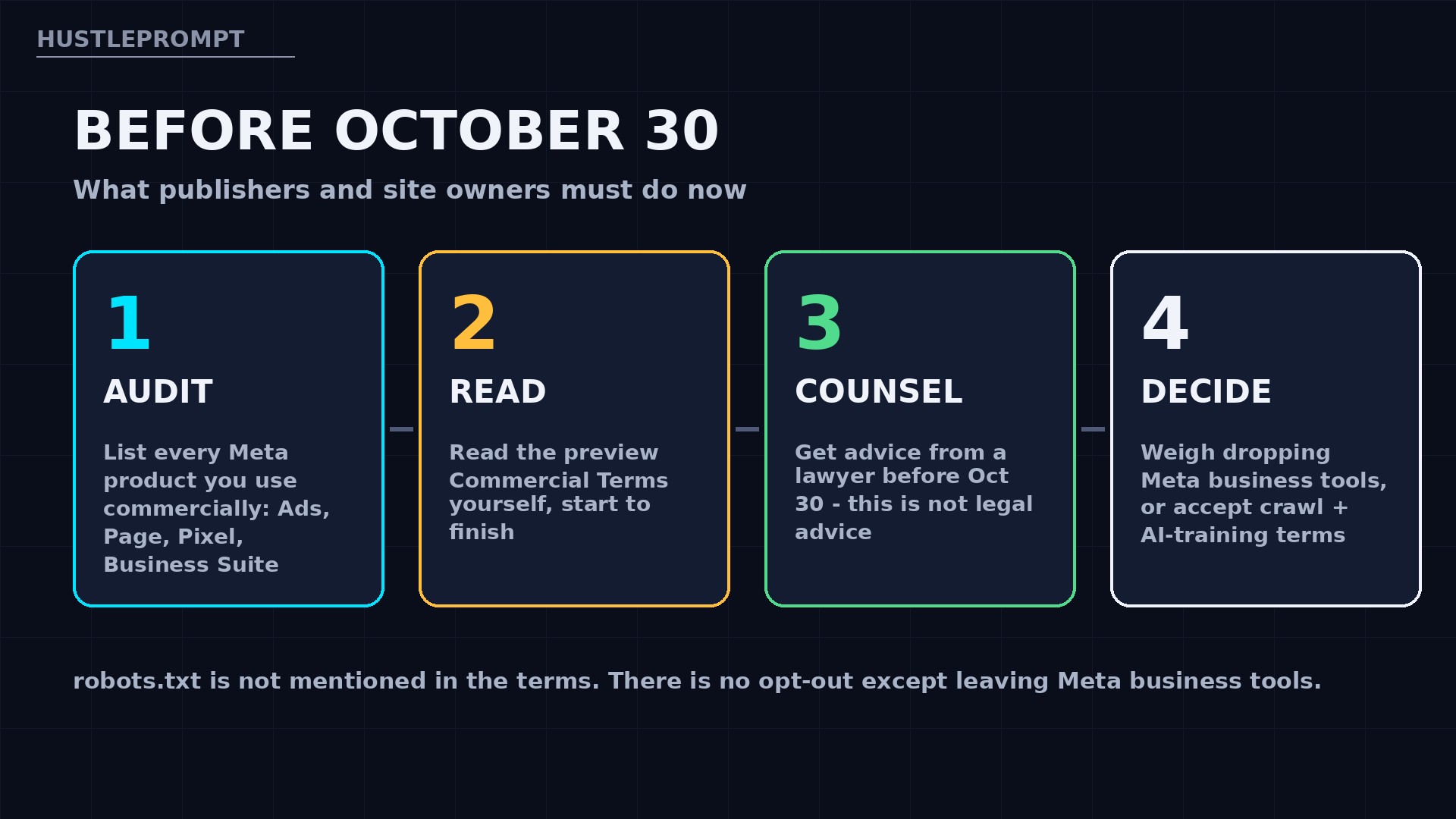
This is not legal advice — but every publisher, blogger, and site owner should run this checklist first:
Your October 30 action plan
How to turn this into an opportunity
Stories like this create paid work for people who understand them. Three grounded responses:
- Offer a Meta-terms exposure audit. Small businesses and bloggers don’t read terms of service. A fixed-price audit — inventorying their Meta Pixel, Ads Manager, Business Suite, and WhatsApp Business usage and flagging what the new clause covers — is a service you can sell this month, before October 30.
- Document your content and licensing position. Inventory your archive now: what you own, your licensing terms, timestamps. Meta already pays CNN, Fox News, USA Today, and People Inc. — a documented archive is the prerequisite for any future licensing conversation.
- Cover the licensing fight as a beat. The AI-content licensing war is a growing news beat, and publishers need plain-English analysis. Each development is an entry point to an engaged audience.
Note: this article is not legal advice — the steps above are practical precautions.
Frequently asked questions
When do Meta’s new Commercial Terms take effect?
October 30, 2026. They replace the version effective March 6, 2024.
Does this affect personal Facebook or Instagram users?
No. The terms cover business or commercial use — ads, Pages, selling, catalogs, Business Suite.
Can I opt out of the crawling and AI-training clause?
There is no partial opt-out. Businesses that don’t agree must stop all access to or use of Meta’s products for business purposes.
Will my robots.txt file block Meta’s crawlers under these terms?
robots.txt is not mentioned in the terms. Experts told Nieman Lab the contract could be argued to supersede such instructions — though Meta has not confirmed it.
Is Meta already paying publishers for AI content?
Yes — Meta licenses content from CNN, Fox News, USA Today, and People Inc. The new terms would let it take content from many more publishers without a separate license.
What should site owners do before October 30?
Audit your commercial Meta-product use, read the preview terms, get a lawyer’s advice, weigh dropping Meta business tools, and document your content and licensing position. None of this is legal advice.
Keep Reading
- Google Is Now Paying 400+ Publishers for AI Content — the other licensing market.
- x401: Websites Can Now Ask AI Agents for ID — how sites can control machine visitors.
- The GEO Gold Rush: Getting Cited in ChatGPT Beats SEO — why your content’s AI visibility is now an asset.
Sources: Meta’s updated Commercial Terms (preview edition); Nieman Lab (Andrew Deck & Hanaa’ Tameez, Oct 15, 2026); Andy Stone on X (Oct 16, 2026); PPC Land (Oct 16, 2026).