
Anthropic just published the most uncomfortable numbers in AI this year — about itself. Its report on Anthropic junior hiring shows entry-level technical hires collapsed from 27% to 9% in about a year, while AI agents logged six working hours per human hour. No frontier lab has released a self-study like this before.
The Headline Numbers: The Entry Rung Got Cut
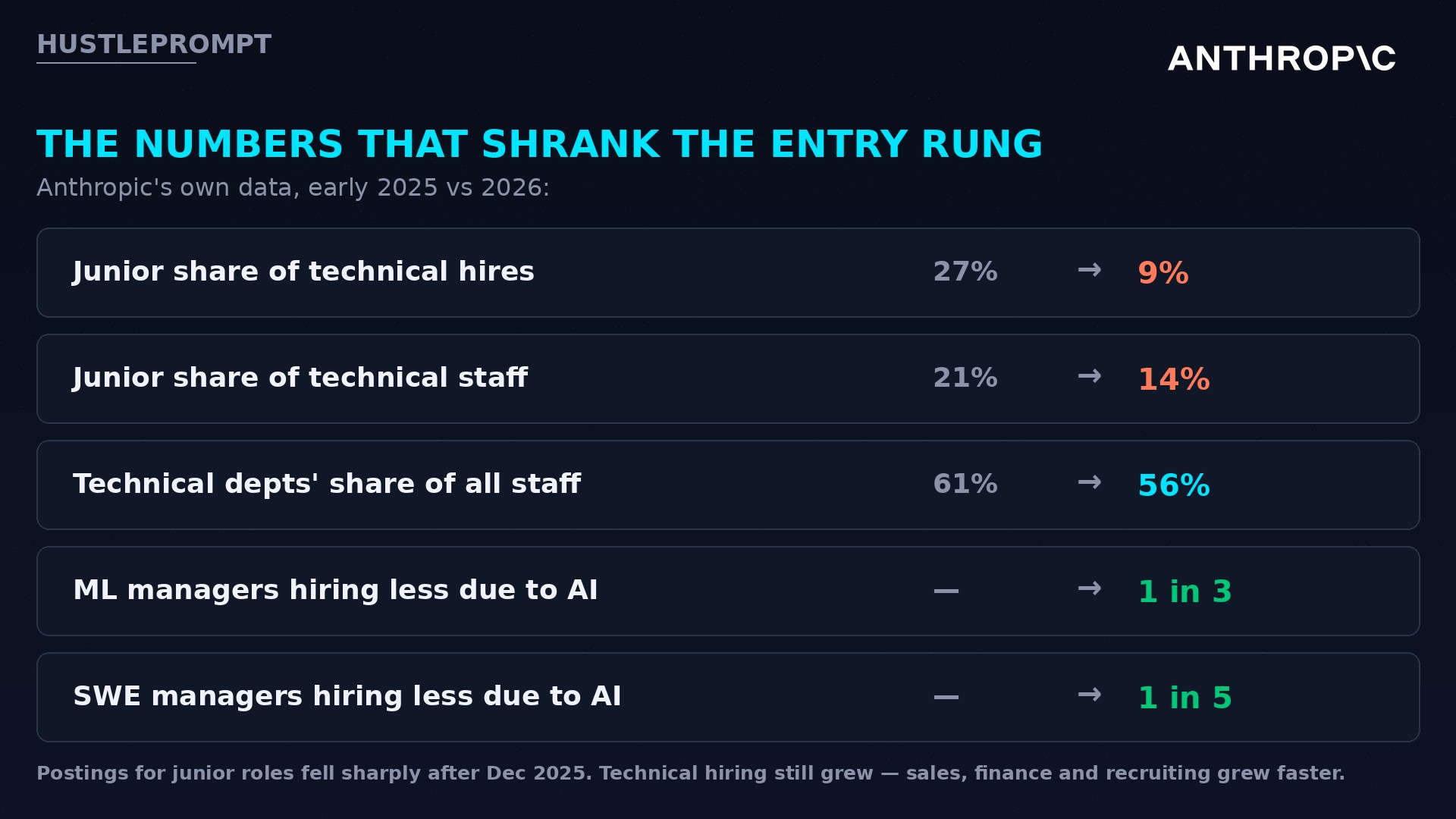
The report, “How employment is changing at Anthropic” by Anthropic Institute researchers Nathan Wilmers, Regina Catipon, Maxim Massenkoff and Peter McCrory, draws on internal employment, hiring and productivity data plus 17 employee interviews. Comparing early 2025 with 2026:
| Metric | Early 2025 | 2026 |
|---|---|---|
| Junior share of technical hires | 27% | 9% |
| Junior share of technical staff | 21% | 14% |
| Technical depts’ share of staff | 61% | 56% |
| ML managers “hiring less due to AI” | — | ~1 in 3 |
| SWE managers “hiring less due to AI” | — | ~1 in 5 |
Two notes: technical hiring still grew in absolute terms, but sales, finance and recruiting grew faster; and the junior drought is recent — postings fell hardest after December 2025.
Agents Now Outwork Humans 6 to 1
The hiring shift happened because the work moved. In March 2026, combined agent hours passed human hours for the first time; by August, employee-directed agents worked six times as many hours as their handlers.
Output followed. Commits per engineer hit roughly 5x their level of six months earlier, and non-engineers joined in: non-technical staff went from 2 coding-agent sessions a month in August 2025 to 90 by May 2026. The constraint moved from the model to the person watching it — interactive Claude sessions sit idle about 80% of the time, waiting on a human.
| Metric | Then | Now |
|---|---|---|
| Agent vs human hours | Below parity | Agents ahead Mar 2026 |
| Agent : human hours | — | 6:1 |
| Commits per engineer | Baseline | 5x |
| Non-technical agent sessions/mo | 2 | 90 |
| “Meta-work” share | 10% (fall 2025) | 22% |
| Median meeting time | Baseline | +20% YoY |
What Hiring Managers Screen for Now
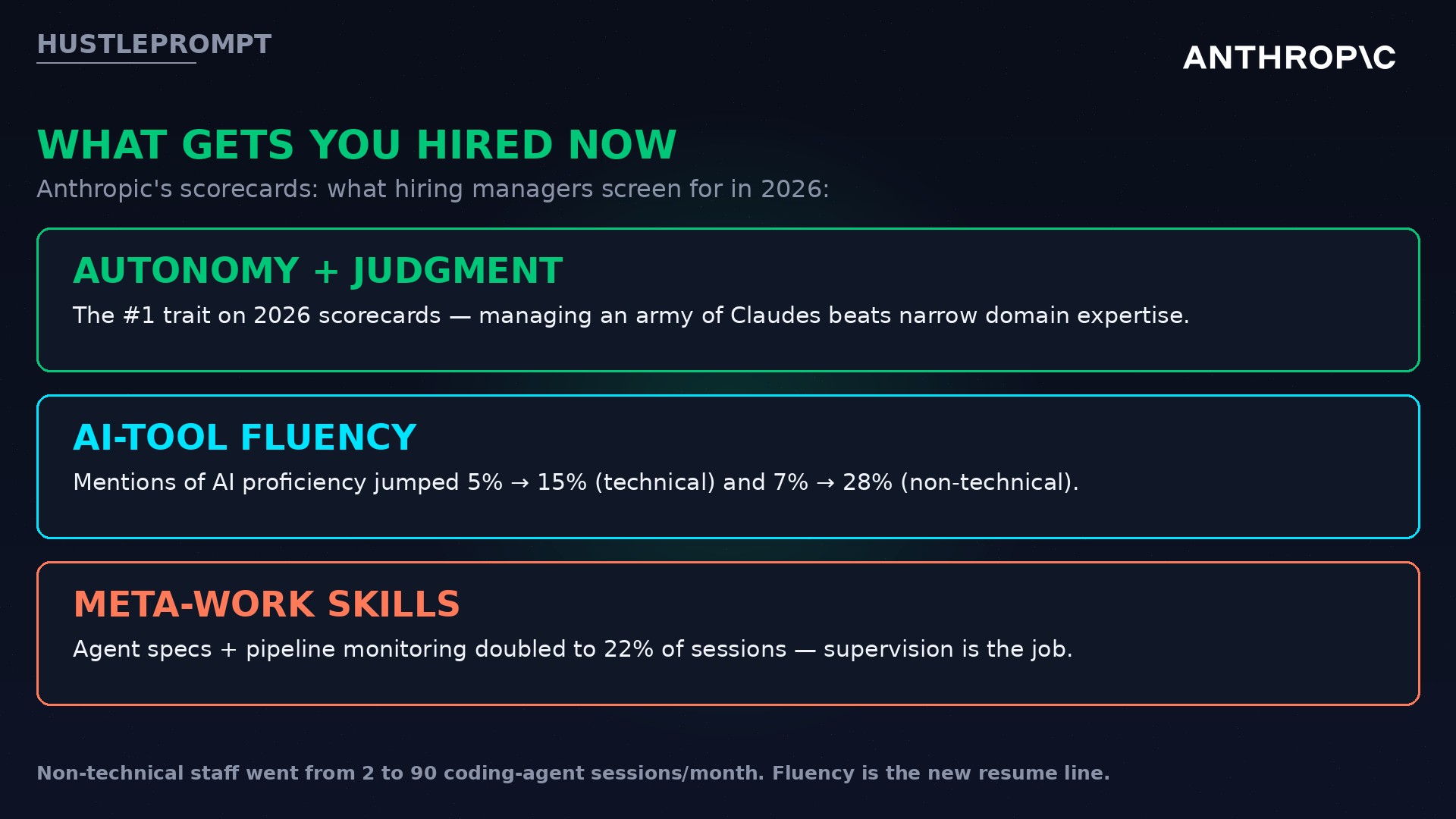
The report coded hiring-manager scorecards. The 2026 bar looks nothing like the 2025 one:
- Autonomy and judgment top the scorecards, ahead of narrow domain expertise. One manager’s new default: hire people who stay “fungible across domains.”
- Provable AI-tool fluency. Mentions of AI proficiency in assessments jumped from ~5% to 15% for technical roles and 7% to 28% for non-technical ones.
- Supervision skills. “Meta-work” — writing agent specs, monitoring pipelines — doubled to 22% of sessions. One in five staff say their role shifted to managing Claudes.
- Attention management. One engineer described facing “an army of Claudes, with every one asking for my attention.”
The Caveats: Read These Before Panicking
Anthropic calls this a self-portrait, not a census. Three warnings: adoption was not random — the 192 engineers who adopted agents were already ramping output faster than the 74 who did not; the company tripled headcount over the same stretch; and “more code does not necessarily mean better code.”
The strongest quality signal: agent-written and human-written commits showed no difference in revert rates. Staff expect AI to handle 75% of their work by 2030 — versus 28% for other Americans.
How to Profit From This Shift: 5 Concrete Moves
Do not read this as doom — read it as a price list. The market now pays a premium for five things:
- Become the supervisor. Write agent specs, monitor pipelines, review output. That “meta-work” doubled — and bills by the hour.
- Prove AI fluency with receipts. Hiring mentions of AI proficiency tripled. Show shipped agent workflows, not certificates.
- Sell the transition. Offer agent-setup services to small businesses, and resume rewrites to displaced juniors.
- Build in public with agents. A portfolio of agent-built projects now beats a degree line.
- Own what agents cannot: judgment. The top hiring trait is autonomy and judgment — client-facing, accountable work.
Frequently Asked Questions
Did Anthropic really cut junior hiring because of AI?
The junior share of technical hires fell from 27% to 9% since early 2025, and about one-third of ML managers said they hire less due to AI. Anthropic frames itself as a leading indicator, not proof every company looks like this.
What does “6 to 1 agent hours” mean?
Interactive sessions where an employee directs Claude: by August 2026 those agents ran six working hours per human hour, excluding waits over 30 minutes, against assumed 40-hour human weeks.
Is the code AI agents write any good?
Yes, with limits: comparing the same employees’ agent-written and human-written commits, researchers found no difference in revert rates — but adoption was not random.
Are junior tech jobs gone everywhere now?
No. One AI lab studying itself during explosive growth. The signal is the direction of travel — agents absorb entry-level execution first — not the exact percentages.
What skills should I learn right now?
Autonomy and judgment, demonstrable AI-tool fluency, and agent supervision: writing specs, monitoring pipelines, reviewing output. Non-technical staff multiplying agent sessions 45x shows the bar is reachable without a CS degree.
Where can I read the full report?
In the Anthropic Institute’s full employment report (October 16, 2026). All figures here come from that official source.
Watch: Anthropic’s official demo of coordinated agent threads in Claude Code.
- Anthropic Wants AI Agents to Haggle Prices for You — the lab is writing fair-play rules before agents cut deals for you.
- The AI Coding Trap: 30% More Code, Zero More Software — why output metrics lie, and what actually ships.
- Sell AI Resume Rewrites: Earn $75+ Per Resume — turn the hiring shakeup into a side hustle.
Sources: Anthropic’s official employment study (Anthropic Institute, Oct 16, 2026); coverage via TechCrunch, The Inference and AI Weekly, Oct 17–18.