
DeepSeek just did to web search APIs what it did to model pricing. On October 17, the Chinese lab opened its in-house search engine to every developer as two API endpoints — priced at $0.75 per 1,000 calls each. Every established competitor charges at least $5. That’s a 6.7x cut on the retrieval layer every AI agent depends on.
Announced in a four-post thread on X alongside the V4.1-Flash-1017 refresh (we covered the model here and here). The DeepSeek Search API is the part that rewrites the cost of building agents — and it ships with a free testing window that closes November 1.
What DeepSeek actually launched
Two raw JSON endpoints, per DeepSeek’s official API documentation:
- Search API — finds web pages for a query and returns structured results, powered by DeepSeek’s in-house search engine.
- Fetch API — retrieves a single web page and returns its content as Markdown.
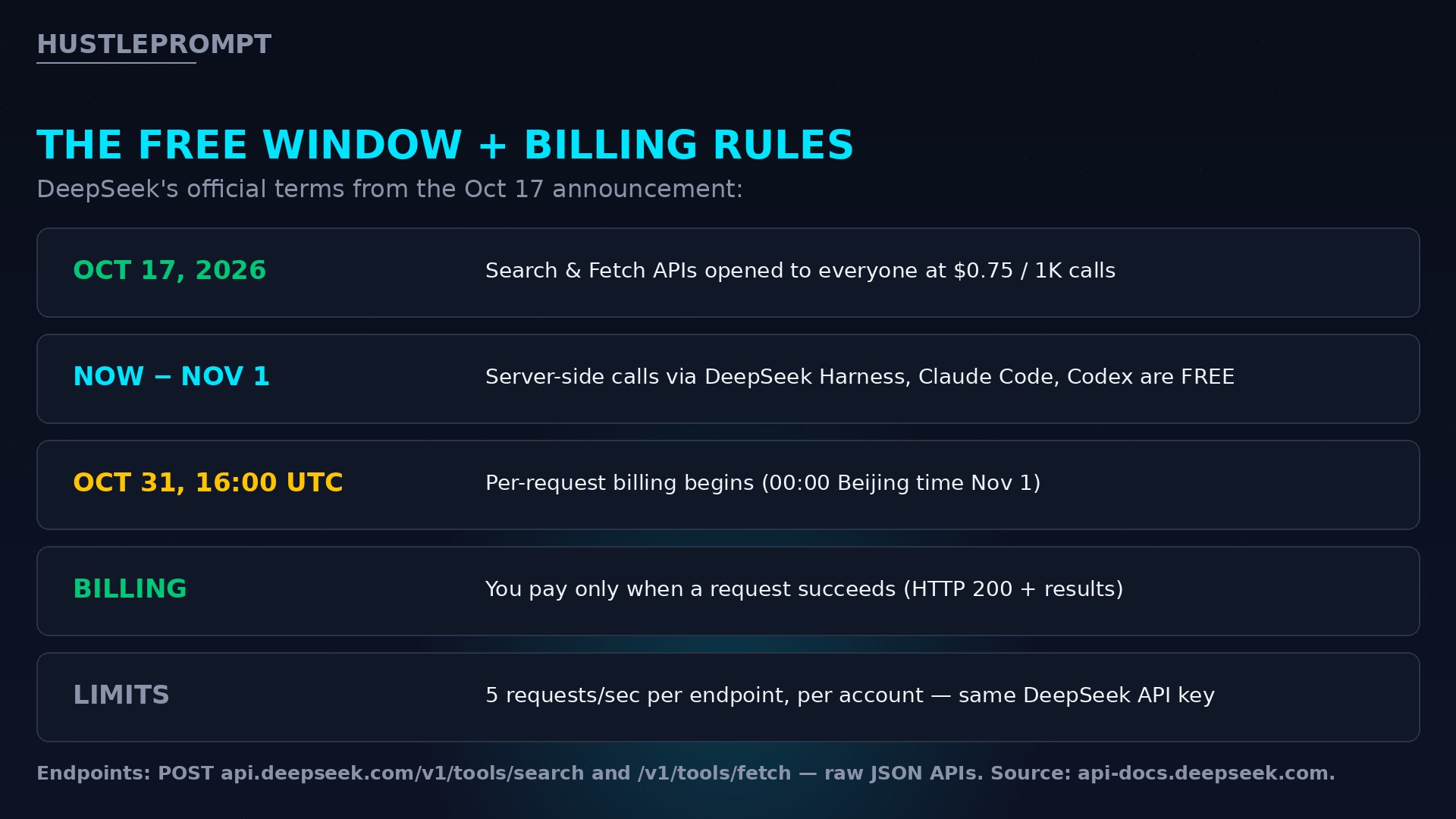
Both use the same bearer token as the chat API — no second account, no new key. The endpoints are POST /v1/tools/search and POST /v1/tools/fetch on api.deepseek.com.
The company says its engine “reliably handles hundreds of millions of search requests from around the world every day” and indexes hundreds of billions of pages. Those are DeepSeek’s own claims — not independently measured.
Search takes 1–128 character queries, returns 10 results by default (up to 50), and supports site:, lang:, and date operators. Each result carries a title, URL, snippet, model-oriented summary, and relevance/authority scores.
The price math: $0.75 vs. everyone else
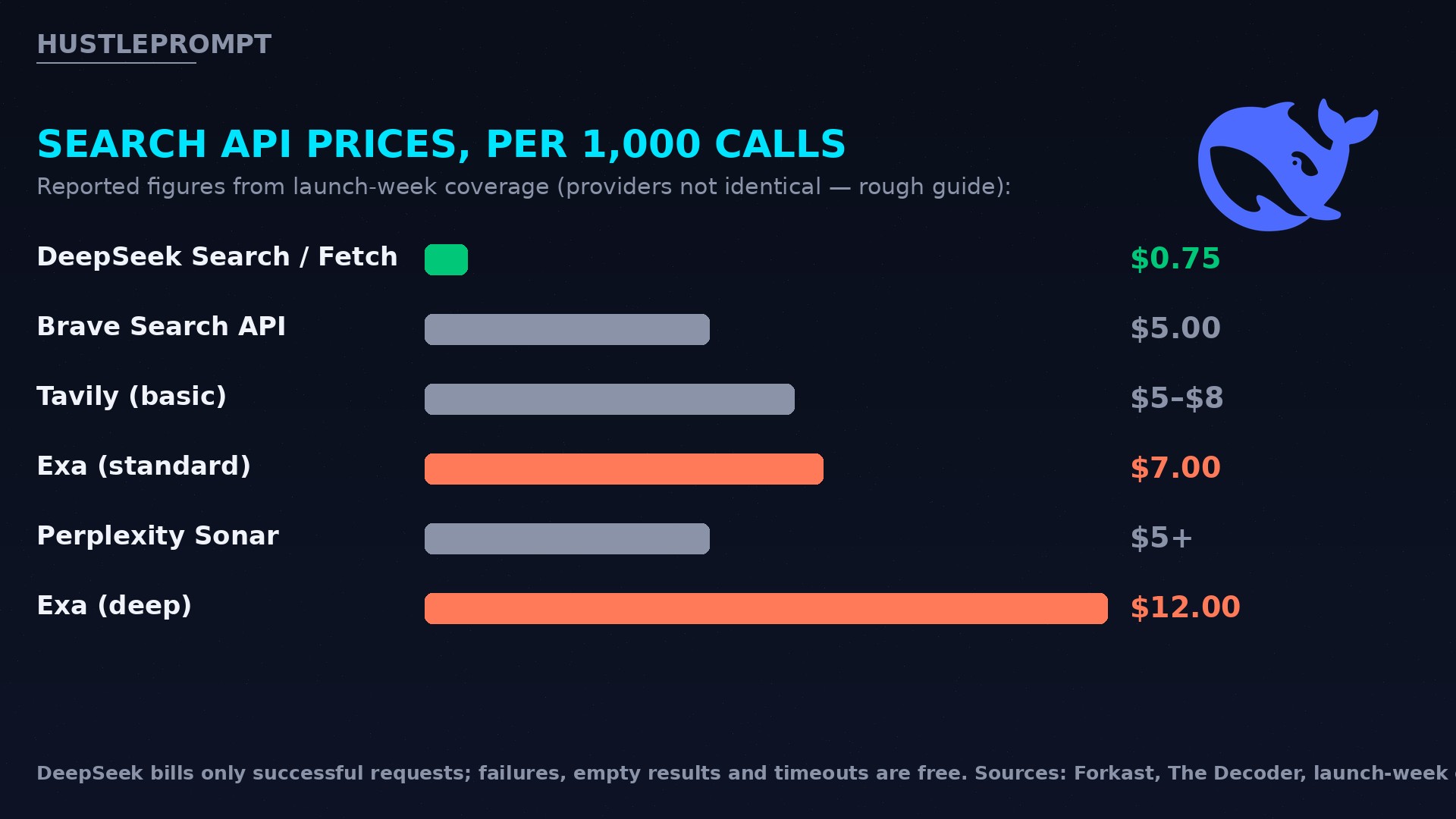
Launch-week pricing per 1,000 calls (services aren’t identical — rough guide; figures: Forkast):
| Provider | Price per 1,000 calls | Notes |
|---|---|---|
| DeepSeek Search / Fetch | $0.75 | Flat rate, 50 results/query |
| Brave Search API | $5.00 | Next cheapest provider |
| Perplexity Sonar | $5–$12 | By depth; + token costs on Pro |
| Tavily (basic) | $5–$8 | Plan-dependent |
| Exa (standard) | $7.00 | $12 for deep search |
| Google Custom Search | $5.00 | 100 free/day; web mode ends Jan 2027 |
Two billing rules make it friendlier than it looks: you pay only for successful requests (failures, empty results, and timeouts cost nothing), and one result or fifty costs the same.
Free until November 1 — then the meter starts
Calls routed through DeepSeek Harness, Claude Code, or Codex are currently free for DeepSeek API users. Per-request billing begins at 00:00 Beijing time on November 1, 2026 (16:00 UTC, October 31). Each endpoint is capped at 5 requests per second per account.
Caveats: no index-size or spam-filtering detail in the docs — and launch prices can change.
How a $0.001 grounded query works
What a full search-augmented answer costs on the new rate card:
1. SEARCH
POST /v1/tools/search
50 ranked results
$0.00075
2. FETCH
POST /v1/tools/fetch
Pages → Markdown
$0.00075
3. GENERATE
V4.1 Flash
Grounded answer
~$0.0003
TOTAL
One grounded query
all three steps
≈ $0.001
At 1M grounded queries a month: $1,500 in retrieval — versus $5,000+ on Brave, $7,000+ on Exa.
Why builders are paying attention
The announcement thread crossed 543 points on Hacker News by October 19. The top comment: “These services only exist because Google refuses to provide a paid search API.”
The deeper shift is strategic. DeepSeek is pricing the tool the agent calls, not just the model it runs. Search is the toll booth every browsing agent must pass through — and the lab that built its reputation on subsidized inference is now selling the retrieval layer at a price that undercuts the entire market by 6–9x.
It pairs with the model: V4.1-Flash-1017 hits 77.0% on DeepSWE v1.1 (ahead of Claude Opus 5 and GPT-5.6 Sol, per DeepSeek) at $0.15/$0.60 per million tokens, with MIT open weights released the same day. Cheap model, cheap search, one API key.
How to profit: 3 concrete plays
- Ship search-augmented agents at 10x margin. Selling research agents, SEO monitors, or price trackers? Swap your search backend before November 1. At $0.75/1K vs. $5+/1K, cut your sticker price in half and still widen margin — or keep prices and bank the difference.
- Sell the migration as a service. Teams on Perplexity Sonar, Brave, or Tavily pay 6–9x too much. Offer a one-week “search-stack audit”: benchmark their volume, swap the endpoint, show the savings. The free window is your demo period — the client tests at zero cost.
- Build now, bill later. Use the free window through October 31 to prototype RAG pipelines, news monitors, and grounded chatbots at zero retrieval cost. Ship when you’re ready; the meter starts when you do.
FAQ
What is the DeepSeek Search API?
Live web search for agents and RAG apps: query in, structured results out (title, URL, snippet, summary, scores), powered by DeepSeek’s in-house engine. A companion Fetch API returns one page as Markdown.
How much does it cost?
$0.75 per 1,000 successful requests per endpoint. Only successful requests are billed — failures, empty results, and timeouts are free. Asking for 50 results costs the same as asking for one.
Is it really free right now?
Yes — server-side calls through DeepSeek Harness, Claude Code, or Codex are currently free for DeepSeek API users. Billing starts 00:00 Beijing time on November 1, 2026 (16:00 UTC, October 31).
How does $0.75 compare to rivals?
Brave charges $5 per 1,000, Exa $7 (standard) to $12 (deep), Tavily $5–$8, Perplexity Sonar $5–$12 plus token costs. DeepSeek is ~6.7x cheaper than the next cheapest provider — though the services aren’t identical, so treat it as a rough guide.
What are the rate limits?
5 requests per second per account on Search and 5 on Fetch, counted separately. Both endpoints use the same bearer token as the DeepSeek chat API.
Can I use it without the DeepSeek model?
Yes — both are standalone raw JSON APIs any agent framework can call directly.
What’s the catch?
The free window ends November 1; launch prices can change; and quality claims (index size, spam filtering) are DeepSeek’s alone, untested independently.
Keep reading
- → DeepSeek V4.1 Flash Takes #1 Open Spot in Code Arena
77.0 on DeepSWE — the model behind the API. - → OpenCode Makes DeepSeek V4.1 Flash Free (Full Guide)
Run the model free; pair it with the free search window. - → Google Puts More Links Inside AI Search
Google’s search play — while DeepSeek undercuts the plumbing.
Sources: DeepSeek’s official Search & Fetch API documentation; DeepSeek’s announcement thread on X (Oct 17, 2026); DeepSeek’s API changelog. Quotes from DeepSeek are verbatim. Competitor pricing and HN figures: Forkast, The Decoder, launch-week coverage.