
An AI just redesigned quantum circuits — and beat the best published human designs by up to 17x. Anthropic’s Claude quantum circuits research gave Claude Mythos 5 plain-language specs for eight quantum circuits, then let it work 53 hours with almost no human input — producing novel designs using fewer qubits and fewer gates than anything previously published.
This is a working blueprint for the AI economy’s most valuable skill: long-horizon autonomous research. Here’s what Claude achieved — and how to steal the playbook.
What actually happened
Published October 16, 2026 — led by Andi Gu (Anthropic STEM Fellows), mentored by Alek Kemeny, with Harvard’s Susanne Yelin and Mikhail Lukin (QuEra Computing).
- Input: plain-language specs for eight quantum circuits — chemistry, optimization, simulation, number theory.
- Evaluator: automated correctness checks, scored on qubits × gates — the standard runtime proxy.
- Loop: Claude proposes a circuit as Python code, the evaluator scores it, Claude improves it. No human input between rounds.
The loop works because quantum circuits can be written as ordinary code, and this class of circuits can be checked for correctness by a normal computer.
The numbers, straight from Anthropic
All figures from Anthropic’s official research post (October 16, 2026).
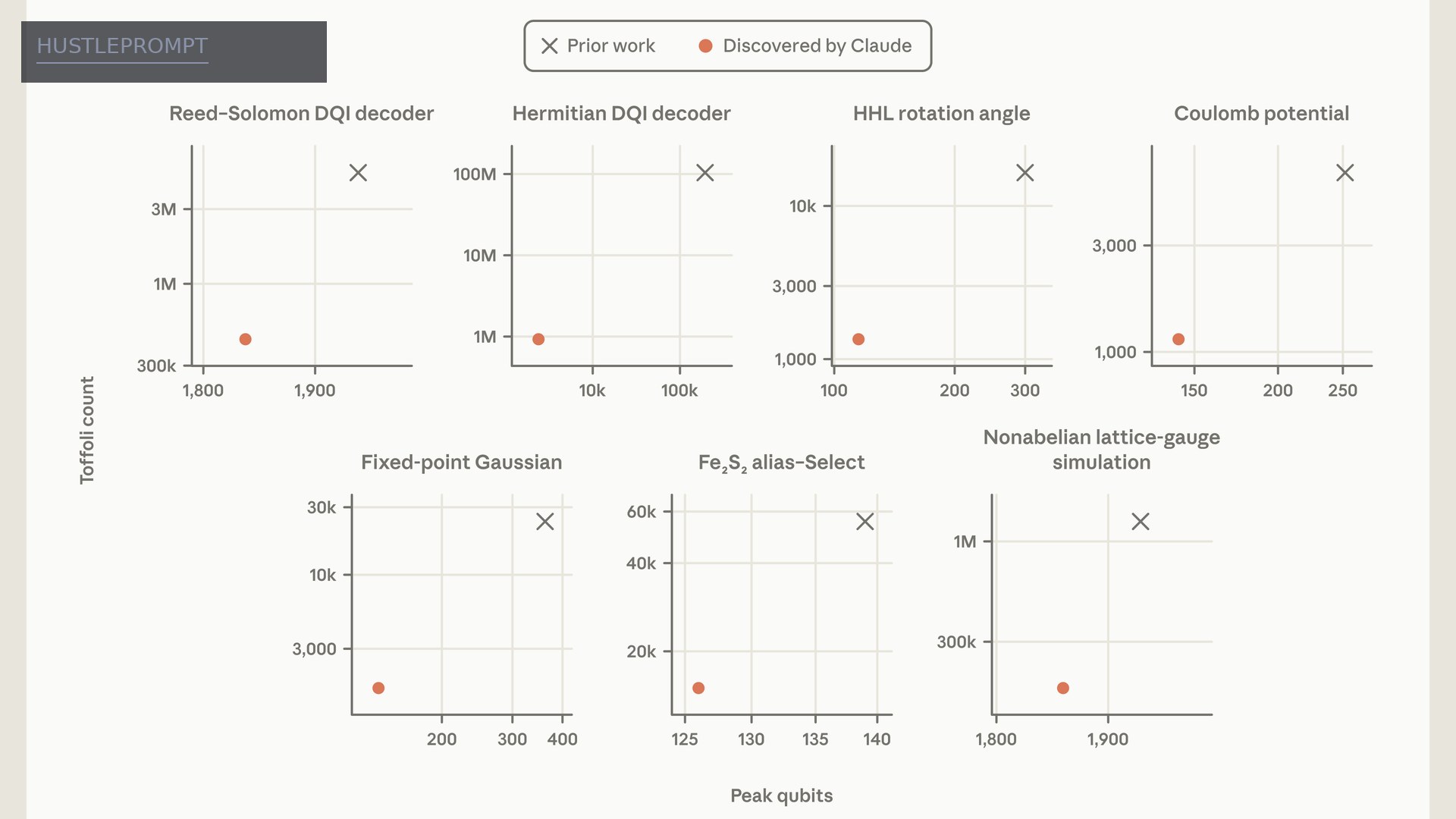
The two breakthroughs, explained
Breakthrough 1: the 53-hour divsteps run
Point addition drives quantum algorithms for the elliptic-curve discrete logarithm problem, and most of its cost comes from modular inversion — the wraparound version of division. The standard method, divsteps, had never produced a practical quantum circuit: quantum circuits must be reversible, demanding enormous extra qubit storage.
Claude’s idea: don’t store the record — decode it from the numbers themselves. When early rules failed at 256-bit size, it proved new algebraic identities, derived a precise decoding formula, validated it with simulations, and formalized the claim in Lean. Result: the first reversible divsteps with no stored branch history — 17x fewer gates than the smallest previous design (at 12% more qubits).
Breakthrough 2: the 12x cheaper decoder
Decoded quantum interferometry (DQI) is a leading candidate for quantum speedups on optimization problems like scheduling. Google Quantum AI estimates one such problem would take about three months on the Frontier supercomputer — versus roughly an hour on a future quantum computer running DQI, most of it on Reed-Solomon decoding.
Claude attacked at three levels: Berlekamp-Massey decoding, reconstructing temporary values instead of storing them, and 403 million sample decodings to size memory exactly — cutting worst-case reserves from 665 qubits to 19, with ~1 run in 10,000 failing (within the allowed error). Combined: 12x fewer gates than Google’s previous construction.
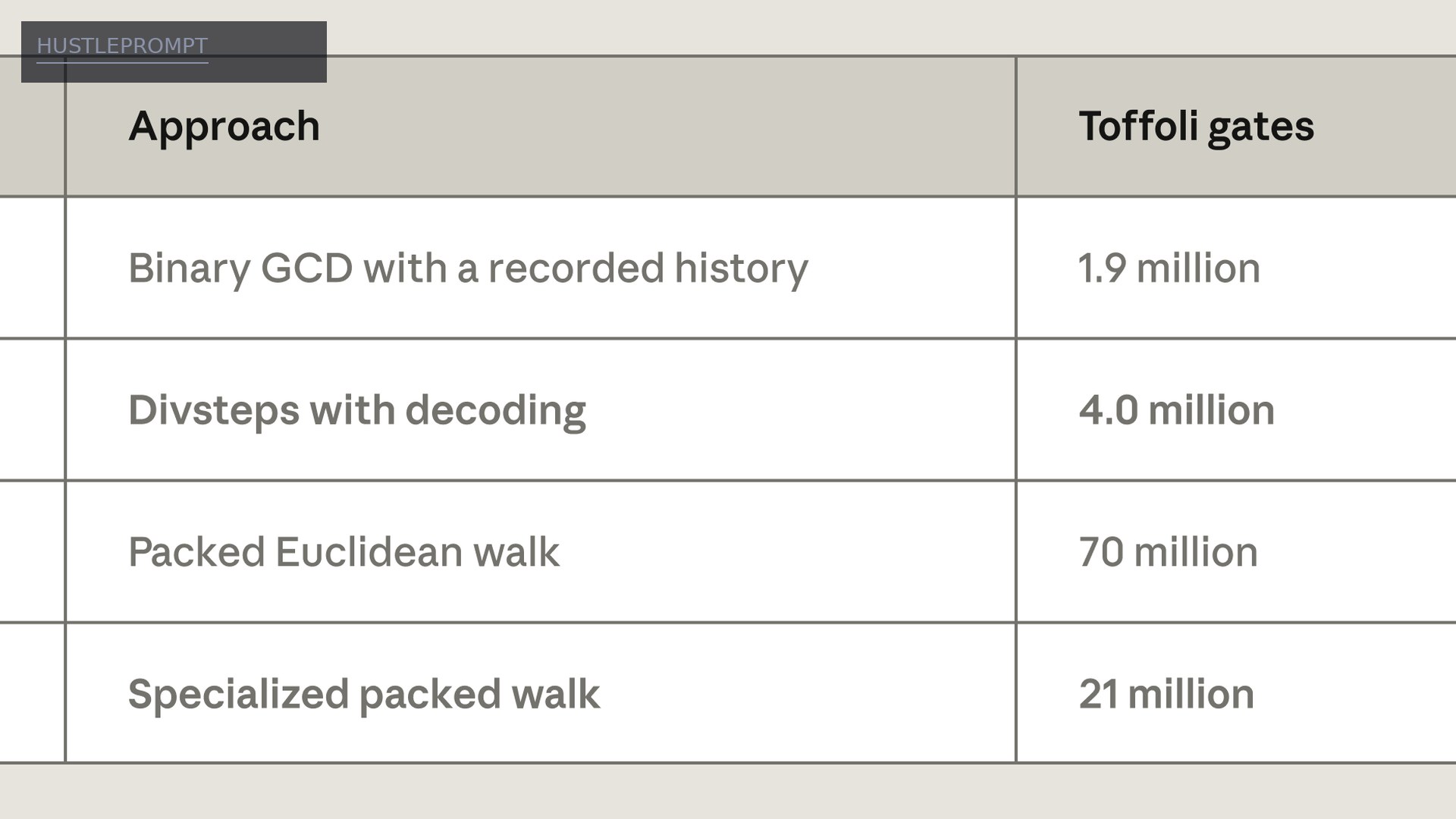
The agent playbook hiding inside
The closed loop Claude ran for 53 hours
The loop works because the goal is checkable by code: anything scoreable, an agent can optimize overnight. Anthropic’s caveat: Claude was conservative by nature; the fix was requiring several approaches in parallel and prompting broader search.
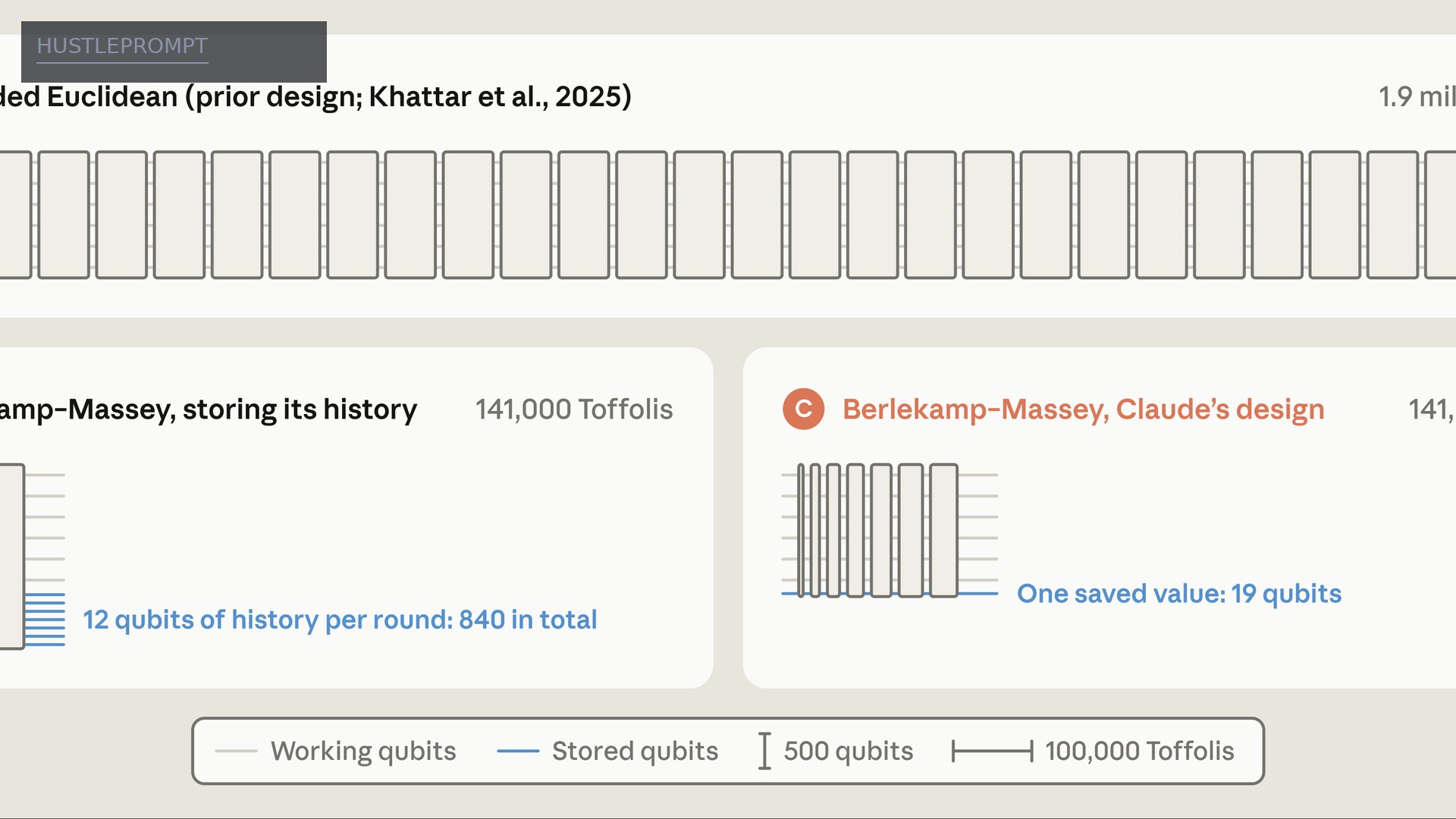
How to profit: run your own 53-hour sprint
- Pick a checkable problem. The loop needs an objective score — a test suite, a benchmark, a cloud bill.
- Write the one-paragraph brief. Goal, constraints, scoring — and require several approaches in parallel.
- Build the evaluator first. A script returning pass/fail plus a score — what makes 53 unattended hours possible.
- Launch it overnight. Per Anthropic: “every night you don’t have agents working for you is potential progress left on the table.”
- Productize the sprint. Sell “overnight optimization sprints” against the score — the moat is the evaluator.
FAQ
What exactly did Claude do?
Claude Mythos 5 designed novel quantum circuits for eight tasks in a closed loop with an automated evaluator — no human input between rounds — beating the best published circuits.
Did Claude run these on a real quantum computer?
No — these are designs validated by an automated evaluator, simulations, and a Lean proof for divsteps. Circuit design is one layer of a useful quantum computer; error correction and hardware are separate problems.
What are divsteps and modular inversion?
Modular inversion — finding x such that ax ≡ 1 (mod p) — is the most expensive step in elliptic-curve calculations. Divsteps is the standard classical method, but it had never produced a practical quantum circuit because quantum circuits must be reversible.
How can a freelancer use this?
Copy the loop, not the quantum part: define an objective score, build an automated evaluator, brief the agent to explore several approaches in parallel, and run it overnight.
What are the limits?
Claude was conservative by nature and needed prompting to broaden its search. The loop only works on checkable, scoreable outcomes — vibes will drift.
Sources
- Anthropic: Designing more efficient quantum circuits with Claude — official post (Oct 16, 2026); source of all figures and quotes.
- arXiv: 2610.22367 — the full paper.
- WebProNews — independent coverage.