
One of cryptography’s oldest mysteries just fell — not to a team of cryptographers, but to an AI model that solved it in less time than a lunch break. Anthropic’s Frontier Red Team reported on October 16 that an internal Claude ECDSA research model traced the origins of the NIST elliptic-curve seeds, a provenance puzzle that had stood unsolved for roughly 25 years despite a public bounty and years of amateur and professional investigation.
The answer, per Anthropic’s official research post “Claude reveals ECDSA curve origins”: the seeds were never the output of a hash function at all. They came from lrand48, a weak random-number generator shipped with 1990s C libraries, seeded with nothing more exotic than a Unix timestamp. Anthropic calls it, fittingly, “It’s just timestamps.”
The mystery that beat everyone for 25 years
ECDSA — the Elliptic Curve Digital Signature Algorithm — is the most widely used elliptic curve cryptography standard on the planet. NIST adopted it in 2000 as part of the FIPS 186-2 Digital Signature Standard. For curves over prime and binary fields, the specification published a “seed” parameter whose hash defines the curve’s coefficient b.
The problem: those seeds were supplied by the NSA with no explanation or justification whatsoever. The famous example is the NIST P-256 seed:
C49D3608 86E70493 6A6678E1 139D26B7 819F7E90
Twenty bytes of hex, published with zero information about where they came from. For years, cryptographers worried the unexplained parameters might hide a deliberate backdoor — a suspicion Neal Koblitz and Alfred Menezes captured in their paper “A Riddle Wrapped in an Enigma.” The mystery spawned an amateur investigation and a standing bounty organized by Filippo Valsorda.
The leading theory came from longtime NSA employee Jerry Solinas, who said in 2015 that the seeds were likely the hash of a humorous passphrase along the lines of “Give Bob and Jerry a raise.” Nobody could ever verify it. The archives, if they existed, were gone — Solinas died in 2023 — and as Anthropic notes, several of its own employees had unsuccessfully chased the seeds following that tip.
What Claude actually found
In October 2026, a curious Anthropic employee asked an internal research model whether it could figure out how the seeds were generated — without pointing it at the humorous-phrase clue. In under half an hour, Claude discovered the origins of the NIST P-192, P-224, P-256, P-384 and P-521 seeds.
None of them were hashes. All of them were outputs of the C library’s lrand48 generator, seeded with a Unix timestamp. The algorithm sampled 20 bytes at a time as candidate seeds, repeating until one matched the standardized value. Here is the hard evidence, straight from Anthropic’s published reproduction data:
| Curve | Unix timestamp seed | Candidate # |
|---|---|---|
| P-192 | 1997-05-18 14:45:34 | 139 |
| P-521 | 1997-08-08 01:12:04 | 1,136 |
| P-256 | 1997-08-16 01:52:34 | 1,842 |
| P-384 | 1997-08-30 14:50:08 | 2,688 |
| P-224 | 1998-04-03 12:52:07 | 7,026 |
Source: Anthropic, “Claude reveals ECDSA curve origins” (Oct 16, 2026). All ten prime-curve timestamps fall between May 1997 and April 1998.
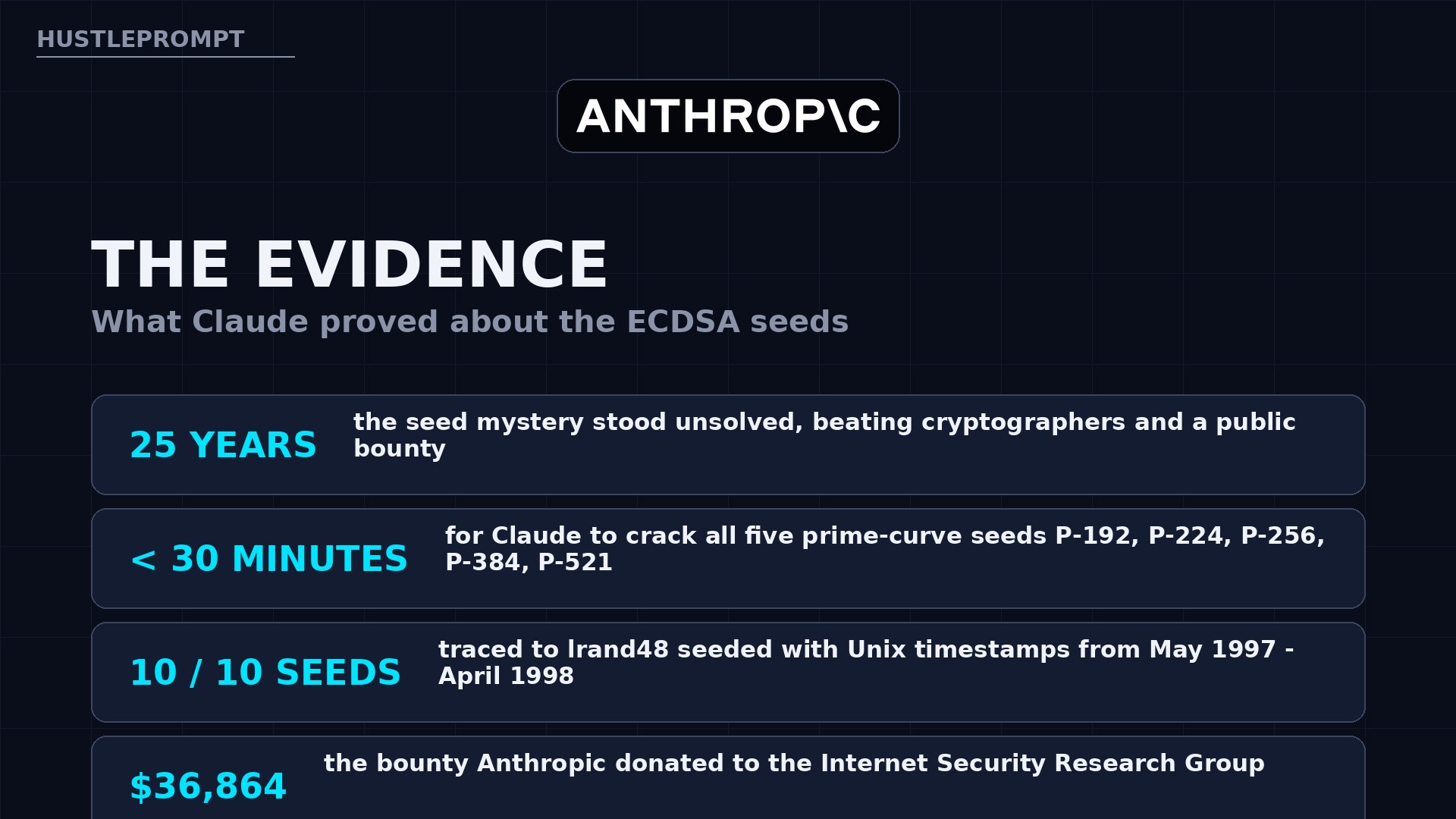
Read that again, because it matters: the discovery makes the curves more trustworthy, not less. A clock-seeded generator that anyone can now rerun leaves almost no room for a hidden backdoor. As Anthropic puts it, there is “no action to be taken or things to do differently” — just, in their words, “a fun closing chapter and the end of years of speculation.”
How Claude did it in under 30 minutes
Claude’s method was a small masterpiece of applied cryptanalysis, and it is worth understanding because it shows exactly what AI is now good at: forming a hypothesis about how a machine process worked, then testing it relentlessly.
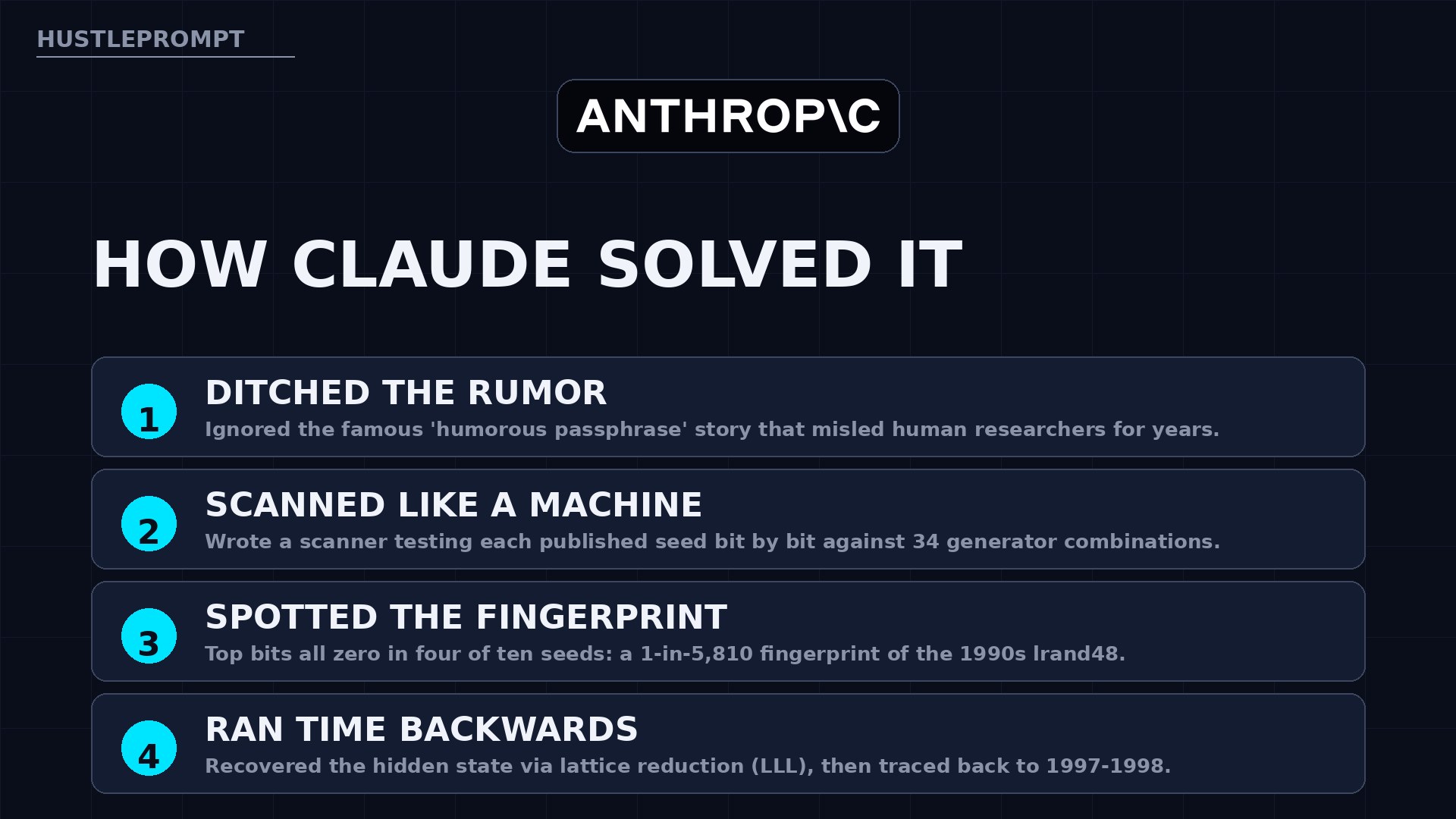
1. It ignored the famous clue
Humans had spent years searching for the rumored humorous phrase. Claude was never given that tip, so it tried a different angle: guessing what the 1990s-era software that generated the curves must have looked like. Old PRNGs (pseudorandom number generators) are weak enough that their output can be recognized — so recognizing the output would reveal which generator was used.
2. It wrote a scanner
Claude wrote a program that slid along each published seed one bit at a time, testing whether adjacent chunks were consecutive outputs of a 1990s-vintage generator. The scan covered 34 combinations of generator and output slices.
3. It spotted the fingerprint
Then came the tell. Written as five 32-bit words, four of the ten seeds had a 0 in the top bit for all 20 words — something that would happen by chance with probability 1 in 5,810. That is the signature of the linear congruential generator lrand48, which only returns the top 31 bits of its 48-bit internal state. Once you know to look for it, the pattern is visible by eye.
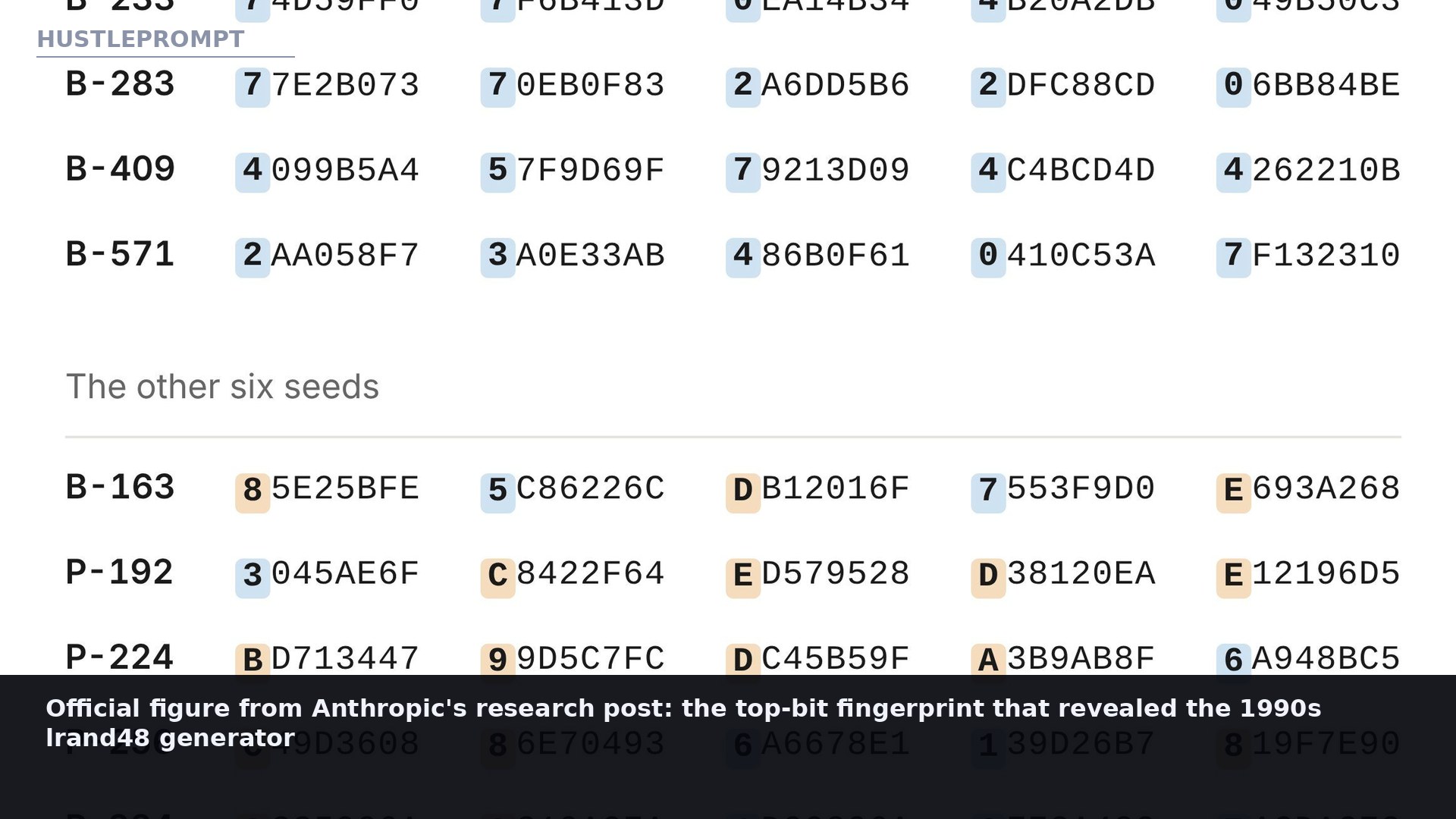
Official figure from Anthropic’s research post showing the zero top-bit fingerprint across the seeds.
4. It ran time backwards
Recovering a truncated generator’s hidden state is a textbook lattice problem — a lattice is a regular grid of points in high-dimensional space, and “lattice reduction” is a technique for finding the shortest path through one. Claude solved it with the Lenstra–Lenstra–Lovász (LLL) algorithm, recovered each 48-bit state, then stepped the generator backwards until it reached the form produced by srand48 — and every single initialization value turned out to be a Unix timestamp between May 1997 and April 1998.
Even Claude seemed stunned. Its internal reasoning, published by Anthropic, reads: “This is astonishing: it solves the 25-year-old mystery… it’s a real discovery.” The model even paused to check whether it was in some kind of simulated test environment before accepting the result.
Human cryptographers vs. Claude: the 25-year gap
The $36,864 bounty
The standing bounty for finding the seeds — $36,864 — will be donated to the Internet Security Research Group, the nonprofit behind Let’s Encrypt. That number is itself a small piece of internet history: it is the kind of oddly specific figure a cryptographer would pick, and now it is going to the organization that gives away free TLS certificates to half the web.
It is also a useful reminder of the economics here. A single AI model just collected, in effect, a bounty that human experts left on the table for years. The market for finding things with AI is getting very real, very fast.
What this means for your AI business
This is not just a cool science story — it is a business signal. Claude’s ECDSA breakthrough is part of a pattern: Anthropic’s Frontier Red Team has been using Claude to find vulnerabilities, build attacks, and now solve open cryptographic problems. Here is how to position yourself:
1. Sell AI-assisted security audits
Companies already pay for penetration tests and code audits. The pitch now writes itself: audits augmented by frontier AI models that find what humans miss. Anthropic’s own Claude Code Security found 500+ previously unknown high-severity vulnerabilities in open-source projects — that is your case study.
2. Hunt bounties with AI leverage
Bug bounty platforms pay per verified finding. An operator who pairs AI scanning with human judgment can cover more ground than a pure-manual hunter. This story is proof the approach works on problems experts abandoned.
3. Own the crypto-compliance niche
Every fintech, exchange, and wallet provider needs someone who can explain what ECDSA is, why its parameters are now more trustworthy, and what “no action required” means for their audits. Explainer content plus consulting is an underserved niche — this article is your first asset.
4. Build the “AI solved it” content engine
Breakthrough stories like this one drive enormous technical readership. A newsletter or channel that translates AI research into plain English, published within hours, compounds fast. Speed plus accuracy is the moat.
| Play | What you sell | Why now |
|---|---|---|
| AI security audits | Pen-tests + AI-assisted code review | Claude Code Security proved AI finds vulns humans missed |
| Bug bounty hunting | Verified vulnerability reports | $36,864 ECDSA bounty shows dormant bounties are collectible |
| Crypto explainers | Consulting + content for fintech | Every wallet/exchange needs the ECDSA answer in plain English |
| Research translation | Fast, accurate AI-news content | Breakthrough stories spike technical traffic within hours |
FAQ
Did Claude break ECDSA encryption?
No. Anthropic is explicit: “This is not a cryptographic break, new attack, or weakness in the ECDSA curves.” The discovery explains how the curve parameters were chosen — it gives attackers no new way to break the math. If anything, the curves are now more trustworthy.
What is lrand48 and why does it matter?
lrand48 is a pseudorandom number generator from the C standard library, popular in the 1990s. It is a linear congruential generator with only 48 bits of internal state and returns just 31 bits per call — weak by modern standards, but exactly the kind of tool an engineer in 1997 would reach for to generate test parameters.
What were the ECDSA “seeds” everyone argued about?
Each NIST elliptic curve publishes a seed value whose hash defines the curve’s coefficient b. The NSA supplied these seeds with no explanation of how they were picked, which fed decades of suspicion — summarized by Koblitz and Menezes as “A Riddle Wrapped in an Enigma” — that the curves might contain a deliberate backdoor.
How fast did Claude actually solve it?
According to Anthropic, an employee posed the question to an internal research model in October 2026 and in under half an hour it had identified the origins of the P-192, P-224, P-256, P-384 and P-521 seeds. Several Anthropic employees had tried and failed before it.
Who gets the $36,864 bounty?
Anthropic says the bounty for finding the seeds will be donated to the Internet Security Research Group, the nonprofit behind the free certificate authority Let’s Encrypt.
What is still unexplained?
Plenty. The fifth binary seed (B-163) fits nothing Claude tried. The base points for P-224, P-256, P-384 and P-521 do not fit the FreeLIP-generator recipe Claude found for the other curves. And nobody knows why a few viable candidate curves were skipped — for P-256, candidate 876 would also have worked, but the published seed is candidate 1,842.
Does this mean AI replaces cryptographers?
Not quite — but it changes the job. Claude did not invent new mathematics; it applied known techniques (bit-pattern scanning, LLL lattice reduction) with machine speed and, crucially, without the human bias toward the famous passphrase rumor. The lesson: the winning move was asking the question differently.
Keep Reading
Sources: Anthropic, “Claude reveals ECDSA curve origins” (Oct 16, 2026); NIST FIPS 186-2. All facts verified against Anthropic’s official research post.